
Most DO students have no idea how brutally simple audition rotation grading really is.
You think it’s about your osteopathic skills, your didactic knowledge, your SOAP notes. That’s the story schools sell you. On the program side, we’re using a completely different scorecard.
Let me tell you what actually happens behind those closed resident workroom doors when they decide if you’re “rank 1–5” material or “do not rank.”
What Programs Really Use Auditions For
Programs do not bring you in to see how well you can answer “what’s the mechanism of action of amiodarone.” They can get that from your COMLEX, USMLE, and transcript.
Audition rotations—especially for DO applicants—are primarily three things:
- A personality and work-ethic stress test
- A month-long interview
- A quiet filter for “absolutely not” and “surprisingly excellent”
In almost every osteopathic-heavy program I’ve worked with (think community IM/FM, smaller EM programs, ACGME programs with a lot of DO faculty), the sub-I evaluation feeds into one main question:
“Would I want this person suffering with me at 2 a.m. on a Saturday when everything is on fire?”
If the answer is yes, they’ll find a way to rank you. If the answer is no, your COMLEX 650 does not save you.
The formal grading form is mostly for show and documentation. The real “grade” is a short, brutally honest conversation that happens between residents and attendings, usually without you ever knowing it happened.
How Your Sub-I Actually Gets Scored Behind the Scenes
Let me walk you through what a real evaluation process looks like. This is not theoretical. This is the actual flow I’ve seen at DO-heavy programs and mixed MD/DO institutions that still take a lot of osteopathic students.

| Step | Description |
|---|---|
| Step 1 | Student finishes 4-week audition |
| Step 2 | Residents talk in workroom |
| Step 3 | Chief/PD hears specific positives |
| Step 4 | Red flags listed by name |
| Step 5 | Attendings fill eval form positively |
| Step 6 | Attendings mention concerns on eval or in email |
| Step 7 | Applicant tagged as rank strongly |
| Step 8 | Applicant tagged as low rank or do not rank |
| Step 9 | Overall vibe? |
Here’s what really feeds that process.
1. Residents’ Unfiltered Gut Score (Your Real Grade)
This is the part no one tells you: your true grade is determined by the residents, usually in about 4–7 days. The rest of the month either reinforces or slowly tanks that first impression.
I’ve heard it said out loud more times than I can count:
“Rotation eval doesn’t matter. What matters is whether the residents liked them.”
Residents are grading you constantly on a silent, three-part scale:
- “I’d absolutely work with them again — please rank”
- “Fine, neutral — whatever”
- “No. Please do not bring this person back”
If you’re DO, you’re already under extra scrutiny at many academic places, and under different scrutiny at DO-heavy places. At MD-heavy university programs, they may be looking to see if you “fit the culture” and can hang academically. At DO-heavy programs, they’re checking if you’re going to work like a dog and not complain.
Residents care about four things far more than your medical knowledge:
- Do you make their day easier, or harder?
- Do you need babysitting?
- Are you normal to be around at 2 a.m. or are you weird/abrasive?
- Do you show up consistently, or only when attendings are around?
Your grade lives or dies there. The formal evaluation form is the paperwork version of whatever residents have already decided.
2. The Official Evaluation Form (Translation Device)
Every program has some bland evaluation form: “Medical Knowledge, Work Ethic, Communication, Professionalism, Initiative.” Usually a 1–5 or “Below/At/Above expectations” scale.
For DO students on audition rotations, here’s how that really functions:
- “Above expectations” = we liked you and can see you as an intern
- “At expectations” = you were fine, but we’re not going to fight for you
- “Below expectations” = you’re on the “do not rank” radar
There’s often a comment box. You care way too much about that box. The faculty using it are not writing poetic narratives. They’re doing this between notes and discharge summaries.
Common real comments I’ve seen:
- “Hard worker, pleasant, teachable. Would be a good fit here.”
- “Quiet but reliable. Needs to read more but improved.”
- “Struggles with multitasking, needed prompting, seemed disengaged.”
What the PD reads between the lines is far more important than the star rating.
| Written Comment | What PD Actually Hears |
|---|---|
| "Would be a good fit here" | Rank this person fairly high |
| "Hard worker, pleasant" | Safe to rank, residents liked them |
| "Improved over the month" | Rough start but salvaged it |
| "Needs to continue to work on..." | Mild concerns, rank only if needed |
| "At level for stage of training" | Neutral; no one is excited about you |
The form is just a translated, watered-down reflection of the hallway discussions.
What DO Programs Really Look At On Your Audition
Let’s break down the actual categories that get you “rank strongly” versus “meh” versus “nope.”
1. Work Ethic and Reliability (Non-Negotiable)
This is the single biggest category, and DO applicants live or die on this one.
Program directors expect DO students to come in hungry. Fair or not, there’s a stereotype: “DOs grind, MDs expect privilege.” When a DO student looks entitled, it tanks them twice as hard.
What they’re explicitly watching:
- Do you show up before sign-out consistently, not just when it’s convenient?
- Do you volunteer for the annoying stuff: scut, extra admits, late discharges?
- Do you disappear when things get busy? Residents always notice this.
- Do you ask, “Is there anything else I can help with before I go?” every single day?
I’ve sat in resident rooms where someone says:
“The DO from LECOM? Dude was always there early, took ownership of his patients. I’d take him over half the MD rotators we had.”
That one line does more for your rank list position than any COMLEX score.
2. How You Present Cases and Think
No one expects a sub-I—especially a DO student who’s bounced between sites—to be brilliant. They do expect you to:
- Recognize sick vs. not sick
- Present in a structured, concise format
- Admit what you don’t know without collapsing
- Show that you’re reading and improving
The grading here is quiet and fast: after you present, as you walk away, residents sometimes say to each other:
“They’re green, but I can work with that.”
“They’re dangerous. They look confident but miss basic stuff.”
Dangerous + overconfident is an automatic “no.” Green + humble + improving becomes “teach this one, might be worth ranking.”
3. Professionalism: The Hidden Tripwire
On DO auditions, professionalism is where people most often blow themselves up without realizing it.
What gets silently recorded:
- Complaining about osteopathic vs allopathic bias out loud on day 1–2
- Bad-mouthing your home school (“My COM faculty are useless…”)
- Being weirdly transactional: only talking when attendings are present, vanishing when they leave
- Acting like the rotation is a formality because “I already have strong scores”
You might think it’s harmless, but residents absolutely talk about it:
“She kept talking about how COMLEX isn’t respected and how she wanted big-name places. Why is she even here?”
That line alone can drop you from “maybe” to “no rank.”
If you’re DO at a mixed MD/DO place, you’re being silently assessed on whether you carry a chip on your shoulder or whether you’re just here to work and learn. Programs are tired of applicants who radiate resentment about the system.
4. Fit With the Resident Culture
This one’s hard to fake and impossible to see from your side.
At some DO-heavy IM programs, the culture is: blue-collar, grind, complain together, then get it done. At others: more academic, journal clubs, people applying to fellowships, a few MDs mixed in.
What they’re asking is not, “Are you impressive?” but “Can this person sit in our workroom for 80 hours a week without driving everyone crazy?”
Signs you fit:
- You can laugh at yourself when you mess up
- You don’t dominate conversations or overshare your life story
- You pick up on the group’s tone and mirror it reasonably
- You have some normal interests outside medicine and can talk about them like a human being, not a robot
I watched one DO student at a midwestern community program play one game of pickup basketball with the residents on a Saturday. That did more for his ranking than three “honors” evaluations from other rotations.
Programs are choosing future coworkers, not Step 1 scores.
How DO vs MD Actually Plays Into Audition Grading
Everybody lies publicly and says, “We treat DO and MD the same.” That’s not entirely true, in either direction.
Here’s the unfiltered version.
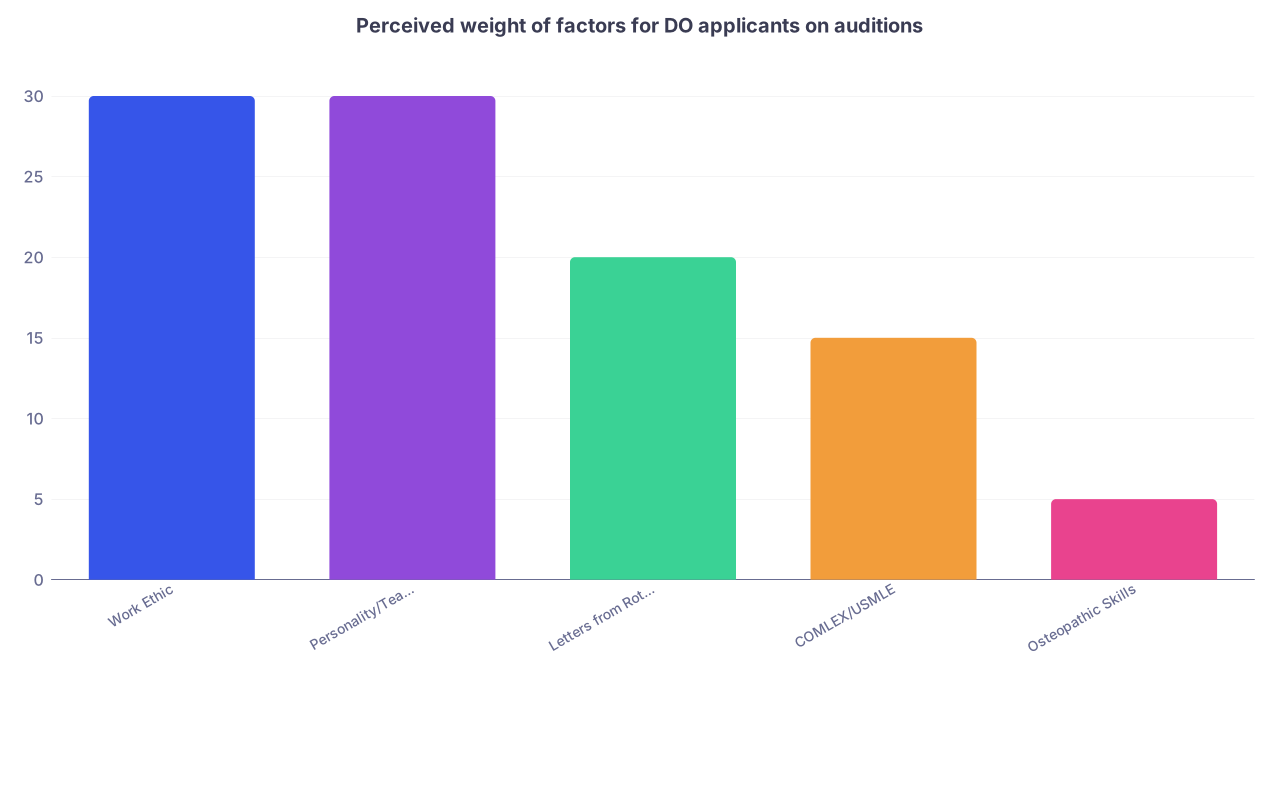
| Category | Value |
|---|---|
| Work Ethic | 30 |
| Personality/Team Fit | 30 |
| Letters from Rotation | 20 |
| COMLEX/USMLE | 15 |
| Osteopathic Skills | 5 |
At DO-Heavy / Historically Osteopathic Programs
Former AOA programs, community hospitals, places with a DO PD or a lot of DO faculty:
- They know DO schools are variable. They do not care nearly as much about your preclinical grades.
- They heavily weight how hard you work and how much residents like you.
- Being DO is not a disadvantage. Sometimes it’s a plus: “They get our world.”
Your OMM skills? Honestly, unless it’s a strongly OMM-focused program, your HVLA is a mild curiosity, not a grading metric. At best, it’s a party trick that helps them remember you.
What matters is whether you fit their DO culture. If you come in acting like you’re “better” than community medicine and really want a university fellowship track, they pick up on that fast.
At MD-Dominant University Programs That Still Take DOs
These places use auditions to decide: “Is this DO applicant actually as good as their paper looks?”
They’re watching:
- Can you handle the academic pace and sick patients?
- Do you hold your own against MD rotators?
- Do you get defensive when you don’t know something?
Your COMLEX alone won’t get you in. A good sub-I where residents say:
“Their fund of knowledge isn’t flashy, but they hustle, they read, and they’re not fragile.”
…can push you into the “okay, we can rank a DO or two” category.
If, instead, the phrase “seems insecure and defensive” shows up, that’s it. You’re done.
How Your Sub-I Evaluation Affects Your Rank List Position
Here’s the part no one explains clearly: how that rotation grade gets turned into a rank decision.
Most programs do some version of this, especially for DO-heavy services.
Internal Tagging: The Real Labels
Behind the scenes, before the formal rank meeting, programs tag audition rotators into buckets. I’ve literally seen spreadsheets labeled like this:
- “Yes — strong”
- “Yes — okay”
- “Maybe — depends on pool”
- “No”
Your sub-I evaluation—resident gossip plus attending forms—decides that tag.
Then, when your full ERAS file is reviewed:
- “Yes — strong” + decent scores/letters → top-third of the rank list
- “Yes — okay” + solid application → mid-list backup
- “Maybe” → used as filler if the pool is weak
- “No” → you can have a 270 / 700+, you’re not going on the list
The critical mistake DO students make is thinking, “If I crush the rest of my application, the rotation won’t matter as much.” Wrong. A mediocre rotation at a place that knows you well is far more damaging than a random lukewarm LOR from someone who barely remembers you.
How to “Grade Well” Without Being Fake
You’re not going to out-memorize everyone. And you don’t need to be. Sub-I grading is less about brilliance and more about pattern recognition: are you acting like the interns they actually want?
Here’s the insider formula I’ve watched work consistently for DO students who punch above their paper stats.
Week 1: Set the Tone, Don’t Perform
You’re not auditioning for Broadway. You’re trying to become part of the crew.
- Show up early, consistently, without announcing it.
- Ask residents: “How do you like presentations? What helps you on this team?” That line alone makes you look like someone who understands hierarchy and reality.
- On day 1–3, under-call your competence. Say “I’m happy to be corrected” and mean it.
Interns and seniors will think: teachable, safe, low-ego. That’s gold.
Week 2: Take Ownership of a Small, Clear Slice
Pick a lane: your 3–4 patients, consult follow-ups, or discharge summaries. Own them.
Every day, make sure the residents never have to chase you for:
- New labs/imaging for your patients
- Consultant notes
- Overnight events (“I checked the chart this morning — no new events, but…”)
You’re showing them the template of a future intern. That’s what gets you flagged as “Yes — strong.”
Week 3: Show Growth, Not Perfection
By week 3, they’ve already decided your floor and ceiling. Now they’re watching your trajectory.
When you get corrected on something you should’ve known, say:
“Got it — I’ll read more on that tonight and adjust my plan.”
Then actually show up the next day clearly having read. That “follow-through” is heavily weighted.
I’ve seen attendings say: “He struggled early, but he improved a lot. I’d take someone like that over someone who coasts.”
Week 4: Leave Them With a Clear Impression
Your last week sticks in people’s minds more than week 1.
You want them saying:
- “That DO student was solid, worked hard, didn’t complain, and I’d be fine with them as an intern.”
Notice something: no one is saying “they were brilliant.” That’s not the bar.
On your last or second-to-last day, you can very directly say to a trusted senior or chief:
“I’ve really liked the culture here. This is the kind of place I’d be happy to train. Is there anything I should work on before internship?”
That does three things:
- It signals genuine interest in the program.
- It invites candid feedback (which many residents appreciate).
- It reminds them, right near evaluation time, that you want to be here.
Red Flags That Tank DO Audition Grades Fast
I’ve watched DO students with perfectly decent paper stats completely destroy their chances in 2–3 days. Here are the fastest ways to get labeled “no rank.”
- Acting like the rotation is beneath you because it’s “just a community DO program.” They hear that in every tone and facial expression.
- Constantly talking about how you really want something “more competitive,” like EM or ortho, while rotating on IM/FM.
- Pushing OMM on patients inappropriately because you think that’s how to “show your DO side” when no one asked for it.
- Arguing with residents about guidelines instead of asking questions and then checking the data later.
- Being weirdly absent: taking long breaks, constantly on your phone, disappearing whenever things get busy or procedures happen.
Once someone says, “I don’t trust this person,” the rest is ceremony. Your “grade” is effectively set.
FAQs
1. Does an “Honors” on my DO sub-I evaluation actually matter?
Yes and no. Programs don’t care about the word “Honors” nearly as much as who wrote it and what they say in the comment box. A generic Honors from an attending who barely knows you is weaker than a “High Pass” with a strong narrative comment and residents backing you as a great fit. The internal tag (“strong yes / maybe / no”) is what really affects your rank position.
2. If I screw up the first week, is my audition rotation doomed?
Not automatically. I’ve seen DO students start shaky and still end up strongly ranked because they improved obviously and quickly. The key is owning mistakes, not making excuses, and showing a very clear upward trajectory by weeks 3–4. What kills you is repeating the same issues, disappearing when corrected, or getting defensive.
3. How much do they really care that I’m DO versus MD on an audition?
At DO-heavy or previously AOA programs, being DO is normal; it’s not a handicap. At MD-dominant academic centers, it matters in this sense: they use the audition to decide if your training and fund of knowledge match up with their usual MD rotators. If you work hard, learn quickly, and don’t carry a chip on your shoulder, the DO vs MD label fades fast. If you’re defensive or underprepared, it becomes the explanation they reach for.
4. Can a great audition rotation overcome weak COMLEX/USMLE scores?
To a point. A stellar rotation can absolutely move you from “borderline” to “we should rank them, they fit here.” It rarely turns a 430 COMLEX into a top-of-the-list candidate at a competitive program, but it can save you from a do-not-rank outcome. At smaller community or DO-heavy programs, a stellar month can matter more than your exact score, especially if the residents go to bat for you.
5. Is it better to do more auditions or fewer, stronger ones?
For DO students, fewer, stronger, well-targeted auditions usually win. Two to three auditions where you show up as a workhorse, fit the culture, and get solid letters is far more powerful than five mediocre rotations where you’re spread thin and forgettable. Each audition is a full-month interview; you only get so many chances to impress the right people.
If you remember nothing else, remember this:
Your DO audition grade is not about how smart you look; it’s about whether residents trust you as a future intern. Work ethic and fit decide your real score. The official evaluation form just cleans it up for the record.