
Most DO applicants are not killed by their scores. They’re killed by their letters of recommendation. Quietly. Behind the scenes.
You’ll never see the email that says, “Looks generic, must be weak.” You’ll just see “no interview” or a surprisingly low position on a rank list. Then you’ll blame “competitiveness” or “Step scores” when the real problem was your letters.
Let me be direct: a single poorly chosen or poorly executed DO letter of recommendation can absolutely drag down your ACGME match chances. Especially in competitive specialties. Especially as a DO.
This isn’t about perfection. It’s about avoiding the landmines that make programs doubt you before you ever walk into an interview room.
The Silent Killers: Letters from the Wrong People
The fastest way to undercut your ACGME chances as a DO is to collect letters from the wrong writers.
1. The “Nice But Useless” DO Letter
You know this one. You worked with a kind DO preceptor in a low-acuity clinic. They liked you. You like them. They agree to write a letter.
And then:
“Student X is a pleasure to work with. They are punctual, compassionate, and have a strong desire to learn.”
That’s not a residency letter. That’s a volunteer reference.
Programs skim that and instantly categorize you as:
- Not seriously evaluated in an inpatient or high-responsibility setting
- Possibly weak clinically
- Possibly avoiding stronger evaluators
You need:
- DO letters from core clinical rotations (IM, FM, surgery, EM, peds, etc.)
- Preferably from attendings who grade residents, not just preceptors who see you once a week in an outpatient office
- Someone who can comment on how you function on a team and under pressure
Avoid:
- Letters from shadowing-only experiences
- Letters from physicians who barely saw you examine patients
- Letters from “nice” attendings who cannot speak to your clinical judgment, reliability, and growth
If you’re thinking “But they offered and they like me!”—that’s not enough. If they can’t compare you to other students and interns they’ve supervised, their letter will sound thin. And thin in this context reads as weak.
2. The “Wrong Specialty, Wrong Signal” Letter
You’re applying to ACGME internal medicine. You have:
- One letter from DO IM
- One from a DO psychiatrist
- One from a DO pediatrician you “really loved”
You’re proud you have three DOs. The PD isn’t. They read it as:
- “This applicant didn’t make strong enough connections in IM to get more than one solid medicine letter.”
- “Are they actually committed to IM?”
Programs, fairly or not, read patterns. You want your strongest DO letters aligned with your target specialty or at least clearly relevant (IM, subspecialties, transitional year, prelim medicine for IM; surgery subspecialties for surgery; etc.).
Do NOT:
- Stack letters from unrelated specialties unless your specialty explicitly allows/encourages that mix
- Use a DO letter from a random elective simply because “they’re a DO” if you have a stronger MD specialty-aligned letter you could use instead
You’re DO; yes, DO letters matter. But it’s not DO-at-all-costs if the relevance is bad.
The Fatal Error: Generic DO Letters in an MD-Dominated Pool
ACGME PDs are used to seeing hundreds of letters every year. They can smell generic from the first sentence.
3. The “Template Letter” That Screams Minimal Effort
I’ve seen this pattern over and over:
“To Whom It May Concern,
I am writing this letter in support of [Student Name] for a residency position. I had the pleasure of working with [him/her/them] during their clerkship at our institution…”
Then it’s two paragraphs of:
- “hard-working”
- “punctual”
- “professional”
- “good with patients”
And absolutely nothing concrete.
Programs think:
- “This attending doesn’t know this student well.”
- “The student probably picked this letter because it’s the best they could get.”
- “Risky. Pass.”
You can’t make an attending a better writer, but you can avoid the worst of this by:
- Giving them a short CV and a focused “brag sheet” with specific cases you handled, feedback they gave you, and concrete examples they might include
- Politely asking: “Would you feel comfortable writing me a strong letter of recommendation for [specialty] residency?”
- Watching their reaction. If there’s any hesitation, you don’t want that letter.
If you’re afraid to ask if it will be strong, you’re doing this wrong.
4. The “Too Short to Be Strong” Letter
A meaningful DO letter for ACGME programs is rarely:
- One half-page
- Three bland paragraphs
- Purely generic attributes with zero narrative
A short letter can be strong if it’s dense with detail, but most short letters are short because the writer has nothing to say.
Programs notice:
- Brevity with no specifics = “lukewarm”
- Lukewarm letters kill borderline applicants
You can’t force length, but you can:
- Choose attendings who have seen you handle responsibility (notes, presentations, cross-coverage, procedures)
- Avoid attendings who only know you from passive observation or a 2-week low-contact elective
- Pick people who actually worked with you directly, not “signed off” on your evaluation from someone else
DO-Specific Mistakes That Hurt in ACGME Programs
You’re playing in an MD-majority environment. Some biases are unspoken. Don’t feed them.
5. Letters That Over-Emphasize “Osteopathic Identity” and Ignore Clinical Rigor
Good:
- A brief, specific note that you integrate OMT thoughtfully when appropriate and understand its limits.
Bad:
- Half the letter describing your passion for osteopathic principles, holistic care clichés, and a final line about your “solid” clinical skills.
Here’s what some (not all, but enough) ACGME PDs hear:
- “Great, another philosophy speech. But can they manage DKA? Can they run a list? Can they not freak out on night float?”
If you’re DO applying to ACGME:
- Osteopathic identity is a bonus, not the main argument
- Clinical competence, reliability, and teachability must be front and center
- OMT mention is fine, but if it becomes the core of the letter, you’ve sent the wrong message unless you’re applying to an OMM-heavy program
Do not coach your letter writers to talk “a lot” about how osteopathic you are. Coach them to talk about how effective you are.
6. DO Letters That Imply You Need “Hand-Holding”
Certain phrases are poison in ACGME eyes, especially for DOs who already face skepticism from some old-school programs.
Red-flag wording:
- “With continued support and guidance, I believe [Student] will become a capable resident.”
- “They would do well in a nurturing program.”
- “They flourish in structured, supportive environments.”
This translates to:
- “Needs micromanagement”
- “Struggles with independent function”
If you’ve ever had remediation, professionalism issues, or academic struggles, you need to be extra careful with letter writers. Some well-meaning attendings will “explain” your growth in ways that absolutely tank your application.
You must:
- Select writers who know your current level, not just your weakest phase
- Avoid asking for letters from attendings who first met you while you were still clearly struggling
- Talk to them before they write: “I’m applying to [specialty]. I’m looking for letters that emphasize how I function now—my reliability, my improvement, and my ability to handle intern-level tasks.”
If their instinct is to underscore your “journey” more than your current competence, don’t use that letter.
Process Mistakes: When Good Letters Get Wasted
Sometimes the content is fine. The process is what kills you.
7. Late, Missing, or Mis-Targeted Letters
Here’s a brutal truth: some programs will never even read your glowing DO letter if:
- It arrives long after they start reviewing applications
- It’s addressed to the wrong specialty or wrong program type
- It doesn’t meet their minimum letter requirements
| Item | Typical Expectation |
|---|---|
| Total LORs | 3–4 |
| Specialty-specific letters | 1–2 in target specialty |
| DO vs MD letters | At least 1 DO preferred by some |
| Submission timing | Within 2–3 weeks of ERAS open |
| Program-specific letter names | Avoided unless absolutely sure |
Common self-inflicted wounds:
- Asking for letters in late August or September for programs that start reviewing in September
- Having a letter that says “To the Family Medicine Selection Committee” while you’re applying to Internal Medicine (I’ve seen that exact mismatch read aloud, followed by eye rolls)
- Submitting only 2 letters when the program expects 3 (and you had 3—you just assigned them incorrectly in ERAS)
Avoid this:
- Ask for letters 6–8 weeks before ERAS deadlines
- Ask writers to keep the salutation general: “To the Residency Selection Committee”
- Triple-check ERAS assignments with a printed or saved list of:
- Program name
- Specialty
- Which letters are assigned
8. Reusing Specialty-Specific Letters Across Applications Sloppily
You’re DO applying to both FM and IM. You reuse everything.
Disaster scenario:
- Your IM letter writer mentions your “strong interest in pursuing a career in internal medicine.”
- You send that letter to FM programs as well.
What does FM see?
- “Backup applicant.”
- “Won’t stay.”
Same thing if a letter talks about how perfect you are for “a career as a hospitalist” and you send it to mostly outpatient FM programs.
You don’t always control what the letter says, but you do control where it gets sent.
If a letter:
- Names the specialty clearly, or
- Frames your interests very narrowly in one direction
You:
- Use that letter only for that specialty
- Get a more general letter from another attending for cross-specialty apps
Red Flag Content: What PDs Quietly Hate Seeing
There are letter phrases that will absolutely sink you, especially as a DO applicant trying to prove parity in ACGME.
9. The “Personality-Only” Letter
If 80% of the letter is:
- “Kind”
- “Caring”
- “Easy to get along with”
- “Patients love them”
And almost nothing on:
- Diagnostic reasoning
- Work ethic under pressure
- Handling cross-cover, admissions, or procedures
- Teachability, growth, and intern-level readiness
Programs assume:
- Your clinical performance was mediocre or inconsistent
- The writer is intentionally avoiding discussing performance details
Your job:
- Choose patients’ favorite + clinically strong, not just “everyone loves them” status
- Remind attendings of specific things you did: “the code I participated in,” “the complex patient I followed,” “the weekend I covered extra admissions”
If all an attending can honestly say is that you’re nice, you should not be using their letter.
10. The “Damning with Faint Praise” DO Letter
Watch for these soft knives:
- “Shows potential” with no description of actual performance
- “Will do well in the right environment”
- “Improved significantly by the end of the rotation” without context
For DO applicants in ACGME—already under more scrutiny by some committees—this is poison.
If you suspect a letter may be like this because:
- The attending gave you mixed feedback
- You barely improved to passing
- You got the sense they didn’t fully trust you independently
You do not ask them for a letter. It’s not “better than nothing.” It’s worse than no letter.
Strategy: How to Set Up Strong DO Letters That Actually Help
Let’s get practical. You avoid most of these errors by being intentional early.
11. Plan Your DO Letter Portfolio Before Your Core Rotations
Stop winging it.
You need a clear idea of:
- Which rotations you’ll target for letters (e.g., IM, surgery, EM, your specialty)
- Which attending(s) you’ll actively engage with during those rotations
- What you want each letter to emphasize
For ACGME-bound DOs, a typical strong portfolio:
- 1–2 letters from attendings in your chosen specialty (DO or MD, at least one strong DO if possible)
- 1 letter from a core rotation showing broad clinical competence (IM/FM/surgery)
- Optional: 1 from research or a key longitudinal mentor—only if they can speak to work ethic and performance, not just “nice in lab”
Don’t make the mistake of waiting until the end of fourth year to realize you have:
- One generic DO FM letter
- One outpatient preceptor letter
- One “I barely remember them” subspecialty letter
Then you wonder why interviews are thin.
12. Manage the Ask Like a Professional, Not a Desperate Student
Attending physicians are busy. Vague asks produce vague letters.
You should:
- Ask in person or via a professional email:
- “Dr. X, I really valued working with you on [rotation]. I’m applying to [specialty] and was hoping you might feel comfortable writing me a strong letter of recommendation based on my performance.”
- Attach:
- Your CV
- A short paragraph on why you’re pursuing that specialty
- 3–5 bullet points reminding them of specific cases/feedback
And yes, use the word strong. It gives them an out. If they hesitate, they’ll often say something like, “I could write you a letter, but I don’t know if it would be as strong as you might want.” That’s a no. Thank them and move on.
Hidden Technical Errors that Make You Look Unprofessional
You can sabotage even a good letter with sloppy execution.
13. LoR Portal & ERAS Sloppiness
Common amateur moves:
- Misspelling the attending’s name or email in the portal
- Using an institutional email that aggressively filters automated messages (and you never follow up)
- Failing to send the right letter request for each program type (e.g., same writer but wrong “specialty” selected)
What this looks like externally:
- Letter never arrives
- Application looks incomplete or thrown together
- Program staff has to chase missing documents (they won’t, they’ll just screen you out)
Treat each letter like a clinical order:
- Verify the attending’s preferred email
- Confirm they received the ERAS/LoR request
- Politely follow up once if it’s been 2–3 weeks with no upload
- Have at least one backup potential writer in case someone flakes
Visualizing Where Your Letters Should Come From
Here’s a rough, high-level way to think about balancing your DO vs MD and specialty scope:
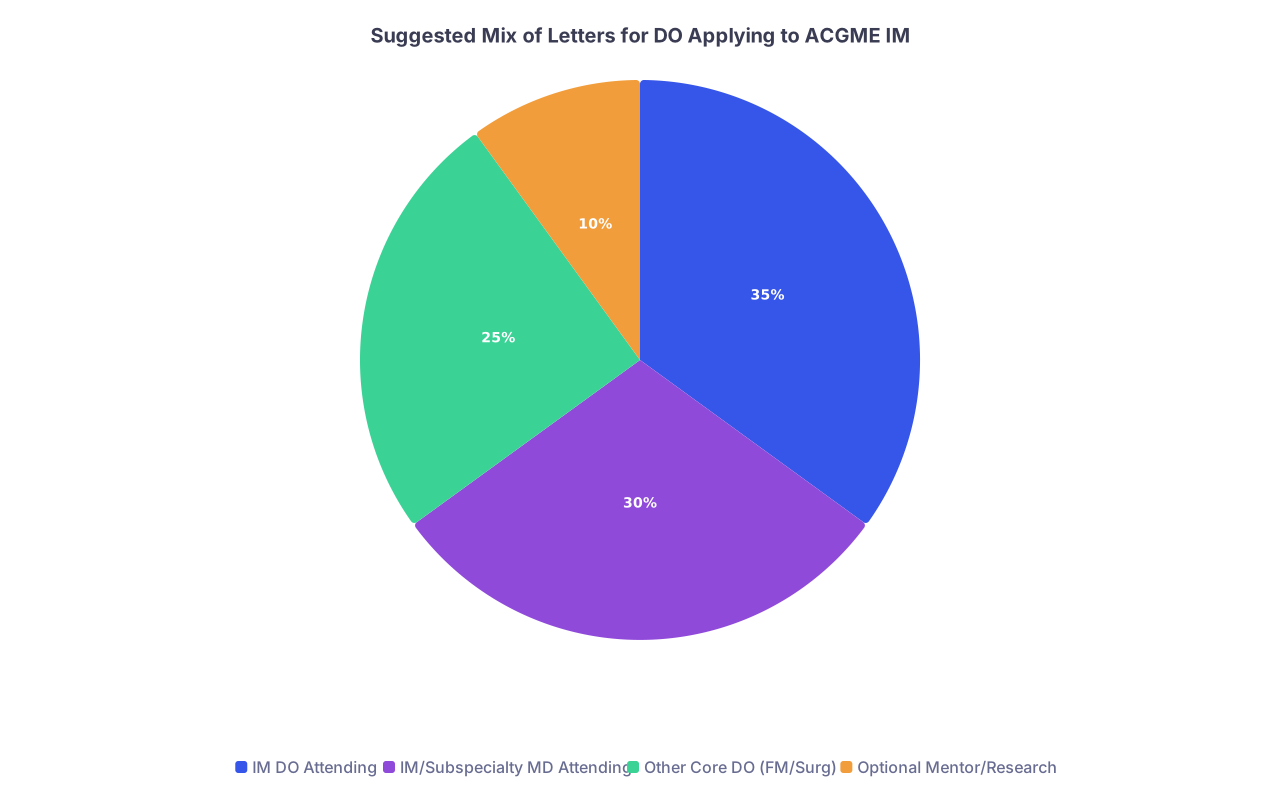
| Category | Value |
|---|---|
| IM DO Attending | 35 |
| IM/Subspecialty MD Attending | 30 |
| Other Core DO (FM/Surg) | 25 |
| Optional Mentor/Research | 10 |
You’re not bound to exact percentages, but if your letters are:
- 0 DOs
- 3 outpatient MDs from marginally related specialties
Or:
- 3 DOs, none in your target specialty, all from low-acuity clinic weeks
You’ve made your life harder than it needs to be.
Final Check: A Quick Internal Audit Before You Submit
Before you hit submit on ERAS, you should be able to answer yes to most of these without lying to yourself:
- At least one DO letter is from an attending in or close to my target specialty who directly observed my clinical work.
- No letter is from an attending who saw me at my worst and never really saw the improvement.
- None of my letters lean heavily on “nice, caring, punctual” with no real detail on clinical reasoning or reliability.
- I have not reused specialty-specific letters across mismatched specialties.
- My writers were explicitly asked for strong letters and given concrete examples to write about.
- All letters were requested early enough and are assigned correctly to each program.
If any of those are a no, fix that now. Not next cycle. Now.
Key Takeaways
- The wrong DO letter—too generic, too soft, or from the wrong person—can quietly sabotage your ACGME match, even with solid scores.
- You must be ruthless about writer selection: prioritize attendings who observed your clinical work directly, in relevant settings, and who can confidently write a strong, detailed letter.
- Treat letters like a high-stakes procedure: plan early, manage the process carefully, and never assume “any letter is better than no letter.” It isn’t.