The wrong electives will quietly sabotage your DO application long before any program director ever reads your personal statement.
You are not just “picking interesting rotations.” You are signaling where you belong, how well you understand the system, and whether you respect the reality of osteopathic residency selection. Many DO students get this profoundly wrong—and they do not realize it until interview season is dead.
Let me walk you through the landmines.
1. The Single Biggest Elective Mistake DO Students Make
The most dangerous rotation choice for DO applicants is not some obscure subspecialty. It is this:
Spending your limited away rotation spots at programs that do not seriously consider DOs.
I have watched this play out too many times. A DO student with a 240–245 Step 2, solid clinical evals, decent research, decides to “shoot their shot” with a month-long away at a historically DO-unfriendly university program. The attendings are “nice.” Residents “seem supportive.” End of the month: no interview. No phone call. Just a polite black hole.
You lose:
- A month of your time
- Hundreds (often thousands) of dollars
- A crucial audition spot that could have been spent at a program that actually matches DOs
Then you compound the damage by doing it twice.
The mistake is not ambition. The mistake is ignoring data. Ignoring match history. Ignoring culture. Believing “if I just impress them, I’ll be the exception.”
No. You will usually be the rule.
If a program has not taken DOs in 3–5 years, or only matches DOs from a couple of “favorite” schools, your odds as an outside DO student are extremely low, no matter how “amazing” you are on an away.
2. Red Flag Rotation Types That Quietly Hurt DO Applicants
Let’s break down the most harmful categories of electives for DO students. These are not automatically forbidden, but they are dangerous if chosen in the wrong context or quantity.
A. Prestige-Only, Historically DO-Unfriendly University Rotations
I am talking about the classic “name brand” programs that:
- Have large categorical residency classes
- Are attached to well-known universities or academic medical centers
- Consistently match MDs from T10–T40 schools
- Rarely or never list DOs among current residents
If you scroll through their residents page and see 30+ residents and zero DOs, that is not an accident. That is a culture.
Yet DO students keep applying for aways there because:
- “My advisor said it would ‘look good’ even if I don’t get an interview.”
- “I want to see how I stack up.”
- “It’s my dream program.”
Do not fall for this.
If the program’s track record with DOs is terrible, an away there does not “look good.” It looks naive. And it steals time from programs that might actually rank you.
A single elective like this in a competitive specialty might be defensible as a calculated gamble. But stacking two or three such rotations? You are burning your audition capital.
B. Over-Loading on Ultra-Competitive Subspecialty Rotations
Another quiet destroyer of DO applications: building a schedule that screams, “I’m chasing prestige, not realism.”
Examples:
- Three aways in dermatology with weak DO derm match patterns
- Multiple orthopedic surgery aways at places that never rank DOs
- A month in neurosurgery, another in interventional radiology, and nothing in general medicine or surgery at DO-friendly community programs
Programs see this and think:
- “This student does not understand odds or fit.”
- “If they do not match here, they will scramble into something else they never rotated in.”
- “They may be a flight risk if they do not get their dream niche.”
There is a huge difference between:
- One subspecialty away to explore or confirm interest
vs. - A schedule dominated by “flashy” subspecialty rotations with no strong connection to realistic DO match outcomes
You want your rotation choices to reflect judgment. Not fantasy.
C. Electives at Sites with Weak or Toxic Teaching Cultures
You might think: “Bad teaching is just annoying, not dangerous.” Wrong.
Toxic or disorganized elective sites hurt you in at least three ways:
Weak letters – Attendings who barely know you, never watched you present, and spend half the month complaining about admin will not write strong LORs. You end up with generic letters that do not move the needle.
Bad word-of-mouth – In some specialties (orthopedics, EM, surgery), attendings talk. A lot. One well-connected unhappy attending can sink you.
Misleading feedback – Toxic environments often over-pathologize normal learner mistakes. You may leave thinking you are terrible when, in reality, the environment was dysfunctional.
You can spot these red-flag electives by:
- Prior students quietly warning: “It’s a grind and they don’t teach much.”
- Residents saying: “Honestly, I’d avoid doing your away here if you have options.”
- High service-to-education ratio: you are scut, not a learner.
If the word on the street is: “You’ll work a ton but maybe get a decent letter,” be careful. Those letters often end up being bland.
D. Non-Core, Non-Strategic “Fun” Rotations During Critical Months
Electives like:
- Sports medicine clinics when you are applying to internal medicine
- Obstetric ultrasound when you are applying to EM
- Lifestyle/wellness medicine when you are trying for general surgery
On their own, these are not evil. The mistake is when you schedule them.
Doing low-yield or unrelated “fun” electives during:
- July–October of your application year
- Instead of audition rotations in your target specialty
- Instead of DO-friendly programs where your in-person performance will matter
This is how you quietly torpedo your application.
I have seen DO students apply to surgery with:
- July: “Global health” telemedicine
- August: Sports med
- September: Vacation
- October: Research
Result: No home or away sub-I during the prime evaluation window. Then they wonder why interview invites are thin.
E. Electives at Programs That Publicly Claim DO-Friendliness but Never Match DOs
This one really frustrates me.
You will see websites say, “We welcome DO applicants” while:
- Their current resident list is 100% MDs
- Their last matched DO was 8 years ago
- Their PD gives talks about “holistic review” but uses filters that screen most DOs out
Rotating there as a DO student is like playing poker at a table where everyone knows the deck is stacked but smiles at you politely.
You must look at actions, not language. Check who they actually match.
| Program Type | Current DO Residents | Last 3 Years DO Match | Risk for DO Away Rotation |
|---|---|---|---|
| Univ IM (no DOs) | 0/45 | 0 | Very High |
| Univ EM (1 DO) | 1/36 | 1 | High |
| Community IM (30% DOs) | 9/30 | Consistent | Low |
| Community FM (majority) | 18/24 | Consistent | Very Low |
| University affiliate mix | 6/24 | Steady | Moderate |
If the numbers look like the first two rows and you are basing your decision on their “we consider all applicants” statement, you are setting yourself up for disappointment.
3. Timing Mistakes: When Even a Good Elective Becomes a Bad Move
Some rotations are not inherently bad but become harmful because of timing and sequence.
A. Doing Your Important Away Rotations Too Early
Many DO schools push students to do away rotations as early as possible (May–July) to “get in front of programs.” That can backfire if:
- Your clinical skills are still shaky
- You have not taken Step 2 yet
- You have not learned the culture of that specialty well enough to shine
A mediocre early rotation at a target program is worse than a strong later one. Your first sub-I in your desired field should not be at your absolute top-choice, super-reach program. That is where you want to arrive polished, not practicing.
B. Stacking Back-to-Back Awaits in the Same Specialty Without Recovery
Three consecutive EM aways. Ortho, ortho, ortho. Month after month. Sounds “hardcore.” Looks bad in real life.
Problems:
- Fatigue drags down performance by month two or three.
- Residents spot burnout. They see the short answers, the flat affect.
- Your letters start looking repetitive instead of progressively stronger.
A smarter pattern: one strong home sub-I → one away at a realistic DO-friendly program → maybe a second away if the specialty and your competitiveness justify it.
C. Leaving Core or Required Rotations Weak While Chasing Flashy Electives
DO students sometimes sacrifice strength in core rotations (IM, surgery, peds) or required school clerkships so they can wedge in that fancy university away.
This is backwards.
Program directors still care deeply about:
- Your medicine and surgery evaluations
- Sub-Is where you functioned like an intern
- How you performed in bread-and-butter inpatient care
If your MS3 core evals are “average,” you do not fix that with a big-name away. You fix it by:
- Doing a strong sub-I at a DO-friendly site
- Getting a letter that explicitly validates your readiness for residency
A glamorous elective does not compensate for weak fundamentals. It highlights them.
4. Specialty-Specific Red Flags for DO Electives
Some pitfalls are universal. Some are specialty-specific. Here are a few painful patterns I have seen.
A. Emergency Medicine
Major red flags:
- Doing aways only at former ACGME academic EM programs that have never taken DOs
- Skipping DO-friendly community EM programs with strong reputations in favor of flashy urban centers that quietly screen out DOs
- Not doing any EM away at a site that writes SLOEs regularly and is known to support DOs
If an EM program does not regularly write SLOEs for DO students or has almost no DO residents, rotating there is a very poor use of your time.
B. Orthopedic Surgery / Neurosurgery / ENT
Ultra-competitive specialties are already brutal for DOs.
Red-flag moves:
- Spending multiple aways at programs that have never matched a DO into ortho/neuro/ENT
- Ignoring community-based or previously AOA-affiliated programs that actually take DOs
- Believing that a single month at a “top” MD institution will override years of their selection patterns
Reality: If you do not have top-tier scores, strong research, and a very credible DO-supportive mentor, aways at historically DO-closed university programs are mostly theater. You are there for the experience; they are not truly evaluating you as a future colleague.
C. Internal Medicine
You might think IM is “safe.” Many DOs match IM, yes. But there are still traps.
Bad elective choices in IM:
- Only rotating at high-prestige university IM programs that historically only match MDs from elite schools
- Skipping solid community or university-affiliated programs where DOs make up 20–40% of the resident body
- Choosing outpatient boutique electives (concierge IM, integrative medicine, cash-only clinics) instead of inpatient sub-I experiences
IM PDs want to know: can you carry a census, write orders, present clearly, and handle the grind? A fancy outpatient elective does not prove that.
D. Family Medicine & Pediatrics
Even in more DO-friendly fields, you can shoot yourself in the foot:
- Doing electives at private practices with no residency program connection and expecting strong “residency-weight” letters
- Choosing rotations at programs with poor reputations for education or questionable ACGME standing
- Spending your prime months at distant “cool” locations that have no track record of supporting DOs into good fellowships if that matters to you
FM and peds seem forgiving, but patterns still matter. You want to train where DOs thrive, not just where DOs are tolerated.
5. How to Spot Low-Yield or Dangerous Electives Before You Commit
You can avoid most of these mistakes if you stop believing marketing language and start doing crude but effective reconnaissance.
Step 1: Look at the Resident List
Non-negotiable.
You want to know:
- How many DOs are in the program right now?
- Are DOs spread across all PGY levels or just stuck in a single year from some special circumstance?
- Do the DOs come from a narrow set of schools or broadly?
If you see zero DOs across 3+ classes, that is a blaring alarm.
Step 2: Check Recent Match Data and PD Reputation
Talk to:
- Recent grads from your school
- Residents at your own hospital
- Specialty-specific advisors who actually know your region
Listen for comments like:
- “They say they take DOs, but they never rank them highly.”
- “They only take DOs from their affiliated school.”
- “You can rotate there; just do not expect an interview.”
Believe these people. They have nothing to gain from lying to you.
Step 3: Evaluate the Rotation’s Educational Culture
Before locking in an elective, ask current or recent students:
- Were you allowed to present and write notes?
- Did attendings know your name by week two?
- Did they ever talk about letters of recommendation?
- Did any DO students actually match there after rotating?
If the answers are vague or negative, do not assume you will somehow charm them into caring more.
Step 4: Map Rotations to a Coherent Strategy
This is where most DO students fail: their schedule looks like a bucket list, not a plan.
Your core questions:
- What is my realistic target specialty?
- Which programs have objectively demonstrated DO-friendliness?
- Where can I get strong, specific letters from people who are known within that specialty?
- How many aways does my specialty actually require for a DO applicant?
Then you build a rotation schedule that aligns with those answers, not your FOMO.
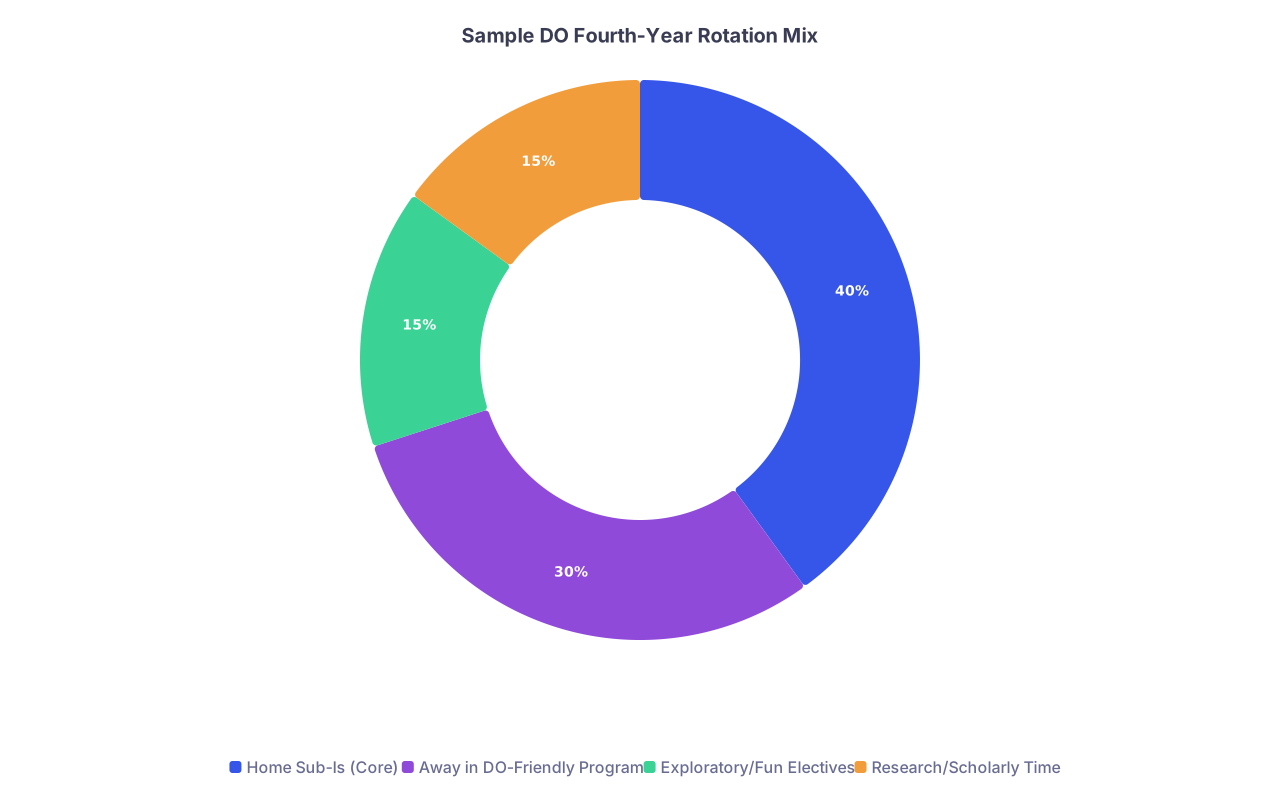
| Category | Value |
|---|---|
| Home Sub-Is (Core) | 40 |
| Away in DO-Friendly Program | 30 |
| Exploratory/Fun Electives | 15 |
| Research/Scholarly Time | 15 |
A rough rule for many DO applicants in moderately competitive specialties:
- Majority: Core sub-Is and home rotations where you can shine
- Some: Strategic aways at proven DO-friendly programs
- Few: Pure “interest” or fun electives, carefully timed outside of peak evaluation months
6. What You Should Do Instead: A Safer Framework for DO Electives
You are not trying to impress fictional PDs on Reddit. You are trying to match.
Here is a cleaner decision framework for DO students:
Anchor your schedule in at least one strong sub-I in your specialty at your home or a DO-heavy affiliate.
You need one place where people truly know you and can vouch for your readiness.Limit high-risk aways to 0–1 unless you are very competitive and have real data they consider DOs.
One reach away may be reasonable. Three is self-sabotage.Prioritize DO-friendly programs for aways.
Look for 20–50% DO residents, especially in your specialty. That is where your chance of a strong letter plus interview is highest.Avoid wasting key months (July–October) on non-core, low-impact electives.
Save those for after interviews or late in the year.Be brutally honest about your competitiveness.
Your board scores, class rank, research, and school reputation matter. Choose electives where a strong month can actually move you from “maybe” to “yes,” not from “never” to “probably still never.”

| Step | Description |
|---|---|
| Step 1 | Consider Rotation |
| Step 2 | Low Priority / Late MS4 Only |
| Step 3 | High Risk - Avoid as Away |
| Step 4 | Moderate Risk - 1 Reach at Most |
| Step 5 | Reasonable Choice for Away |
| Step 6 | Residency Program Attached? |
| Step 7 | Current DO Residents? |
| Step 8 | Recent DO Matches? |
If a rotation does not help you:
- Strengthen core clinical skills
- Generate a meaningful letter from someone with specialty credibility
- Build a relationship with a DO-supportive residency program
Then it is likely not worth a precious away slot during your application year.
FAQ (Exactly 5 Questions)
1. Is it ever worth doing an away rotation at a program that has no current DO residents?
Sometimes, but rarely. It may be defensible if:
- The program just converted from a different structure and has little recent history; or
- A trusted mentor with inside knowledge explicitly tells you they are actively trying to recruit DOs now; and
- You are a highly competitive applicant for that specialty (top scores, research, strong home letters).
Without those conditions, you are mostly doing brand tourism, not improving your match odds.
2. How many away rotations should a typical DO student do in a moderately competitive specialty?
For many DO applicants, 1–2 well-chosen aways are sufficient. One DO-friendly, realistic program where DOs match consistently. Possibly one “reach” if there is evidence they accept DOs and you are on the stronger side statistically. Doing 3–4 aways usually adds fatigue and risk more than it adds interviews.
3. Do program directors see “fun” or unrelated electives as red flags?
They do not care about a couple of off-beat rotations, especially later in the year. The red flag appears when your schedule suggests poor judgment—such as using July–October for loosely related “fun” electives instead of sub-Is or aways in your field. It looks like you did not understand how serious fourth year is for building your application.
4. How can I tell if an elective site has a toxic or low-yield culture before going?
Ask very specific questions to students who rotated there in the last 1–2 years:
- “How often did you present to attendings?”
- “How many written evaluations or direct feedback sessions did you get?”
- “Did any students you know match there after doing that elective?”
If the answers sound vague (“they’re busy,” “you kind of just help out”) or if no one seems to get interviews or letters from that site, treat it as high risk.
5. What is one concrete step I should take this week regarding my elective choices?
Open your current or planned fourth-year schedule and, for every away or elective rotation, write down: (1) percent of DO residents at that program, (2) whether DOs have matched there in the last 3 years, and (3) what specific letter or advantage you expect to gain. If you cannot clearly justify a rotation on that basis, replace it with one at a proven DO-supportive program or a core sub-I where you can earn a strong, detailed letter.