
The sorting happens before anyone reads your story.
That’s the part pre-meds and M3s never really believe. On ERAS review day, most ACGME programs are not “holistically reviewing” every applicant. They are batch-handling you. And yes—at many programs—DO and MD files are quietly handled differently before a single personal statement is opened.
Let me walk you through what actually happens in those first 48–72 hours after apps drop. Not the brochure version. The real one.
The First Hour: Filters, Not Feelings
Program leadership doesn’t log into ERAS and say, “Let’s read everyone carefully and thoughtfully.” They say things like:
- “Okay, we’ve got 1,800 apps. I need this down to 300 by tomorrow.”
- “Turn on the filters. Then we can fix the exceptions.”
The “filters” part is where DO vs MD starts to matter—especially at university-based ACGME programs and competitive specialties.
Here’s the unspoken structure most PDs and coordinators use:
- Hard filters (scores, attempts, graduation year).
- Credential filters (US MD vs US DO vs IMG).
- Preference tiers (home students, affiliates, strong letters, special connections).
- Then, and only then, actual holistic review.
Degree type doesn’t always appear as a literal on-screen toggle (though sometimes it does). But it lives in every sort, every priority list, every “we’ll get to them if we still have space.”
At the faculty computer on review day, the conversation is not:
“Are DOs good doctors?”
It’s:
“Do we have enough MDs on the interview list yet?”
How Programs Technically Sort You
Let me spell out the mechanics, because this is what nobody explains.
Most programs export ERAS applications into a spreadsheet or their own applicant management platform. Once it’s in Excel, Google Sheets, or a vendor system, it’s game over for “blind review.”
They create columns:
- Name
- Degree (MD/DO)
- School
- USMLE Step 1/2
- COMLEX Level 1/2
- Attempts
- Graduation year
- Research count
- “Tag” field (home student, rotator, PD-connection, etc.)
I have literally watched coordinators do this:
- Sort by “Degree”
- Then within each degree, sort by “USMLE Step 2 score” descending
- Then color-code groups: green (definite review), yellow (maybe), red (unlikely)
DOs often end up in one of three buckets:
- DO with USMLE scores → grouped with MDs but usually analyzed as a “parallel track.”
- DO with only COMLEX → often filtered to a separate list for “later review” (which may or may not ever happen).
- DO from known osteopathic schools/programs with existing relationships → tagged as exceptions and pulled up earlier.
Nobody announces, “We are discriminating.” What they say out loud is more coded:
- “Let’s handle the US MDs first.”
- “Put the DOs and IMGs in a separate tab for now.”
- “We’ll see how many interview spots are left after we finish this group.”
That “for now” is where a lot of DO applicants die quietly.
The DO vs MD Triage System They Don’t Talk About
Here’s the rough internal hierarchy at many mid-to-large ACGME programs. They might deny it publicly. They don’t deny it in the workroom.
| Tier | Group |
|---|---|
| 1 | Home MD students, strong rotators |
| 2 | US MD from reputable schools |
| 3 | US DO with USMLE and strong metrics |
| 4 | US DO without USMLE / weaker metrics |
| 5 | US-IMG, then non-US IMG |
Are there programs that don’t do this? Yes. Community-based programs, former AOA residencies, and some genuinely DO-friendly academic programs run a flatter structure.
But if you’re looking at competitive specialties or big-name university-affiliated programs and pretending tiers don’t exist—you’re lying to yourself.
Here’s the key:
Programs don’t think they’re “sorting DOs lower.” They think they’re “protecting their board pass rates” and “prioritizing the applicant pools they know best.” Degree type is just their lazy proxy for risk.
The COMLEX Problem: Why “We Accept COMLEX” Doesn’t Mean What You Think
You know those program websites that proudly state: “We accept COMLEX”?
You want the translation?
“We technically will not block your application if you only have COMLEX. But we’re going to sort you into a second pile and maybe get to you if we have gaps after USMLE-based applicants.”
Here is what actually happens:
The PD asks the faculty: “Do we want to require USMLE this year?”
If they say yes, COMLEX-only DOs are basically done at that program. They’re not going to publicly say “USMLE required” because GME and HR sometimes frown on it, but internally that’s the rule.If they say “COMLEX is fine,” there’s a second layer:
“Okay, but who here is comfortable interpreting COMLEX scores across different schools?”
Answer: usually no one.
So what do they do?
They default to what they recognize: USMLE numbers.When filtering, they’ll:
- First pull MDs and DOs with USMLE.
- Then, time permitting, “sample” some COMLEX-only DOs, usually ones from schools they know or with strong letters.
This is why DOs who only take COMLEX often feel like ghosts. You’re in the system, but you’re not in the early decision set.
To put it bluntly:
“COMLEX accepted” is very different from “COMLEX treated equally to USMLE.”
What Review Day Actually Looks Like (Hour by Hour)
Let me strip away the mystery and give you the inside view. Picture an internal medicine program with ~2,500 applications and 400 interview slots.
Morning: Mass Filtering
The coordinator and PD log in.
First conversation:
- “Filter out graduation year > 5 years.”
- “Remove anyone with failed Step 2 attempts.”
- “Exclude incomplete applications.”
Then they start building their working lists.
A very typical workflow:
- Export all US MD + DO with USMLE into one sheet.
- Export DO with only COMLEX into another sheet.
- Export IMGs into a third.
They will not tell you this at an info session. But I’ve watched this split happen year after year.
Next, they’ll sort:
- US MD only → descending by Step 2.
- DO with USMLE → separate sort, descending by Step 2.
- DO with COMLEX only → by Level 2, if they even look yet.
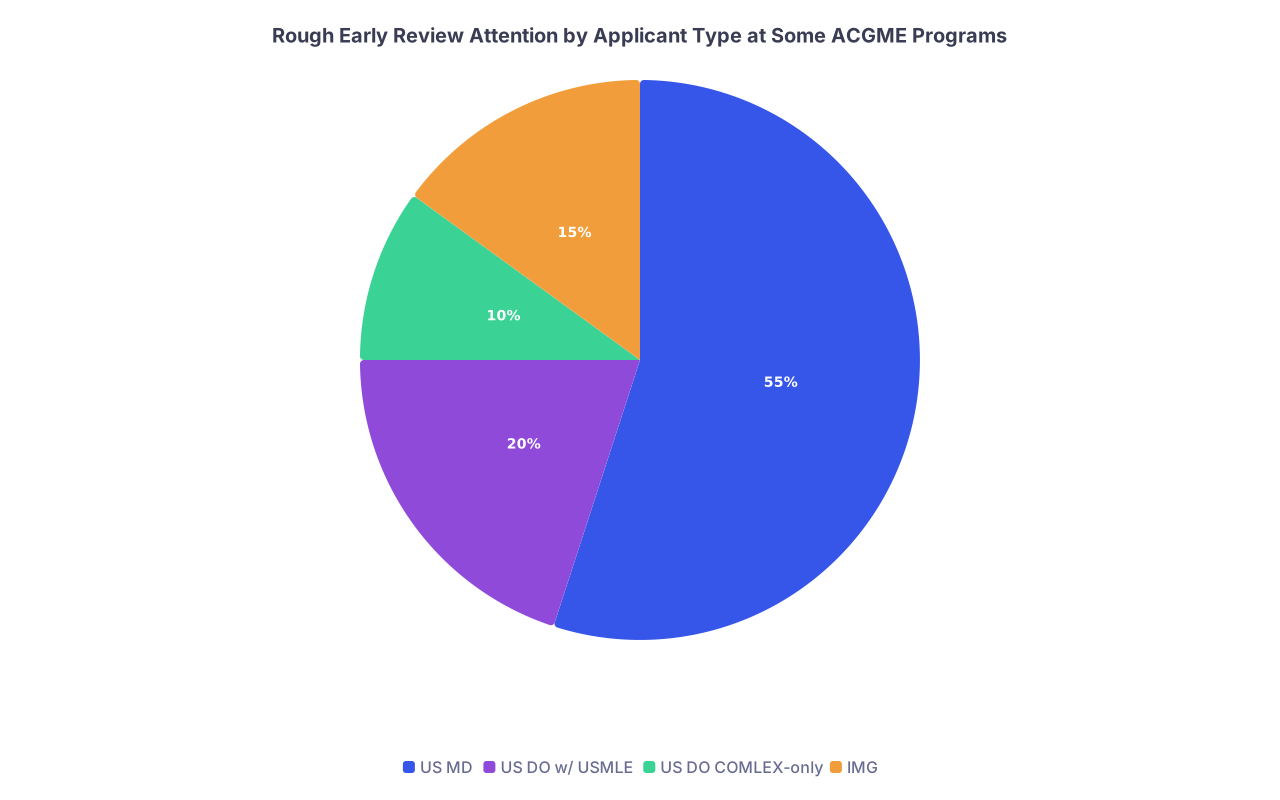
| Category | Value |
|---|---|
| US MD | 55 |
| US DO w/ USMLE | 20 |
| US DO COMLEX-only | 10 |
| IMG | 15 |
These numbers aren’t universal. But they’re representative of how attention is proportioned at many places during the first pass.
Early Afternoon: The Shortlist
Once they skim top US MDs and a handful of strong DOs-with-USMLE, they start building a preliminary “interview likely” set. Maybe 250–300 names.
Who’s in that first wave?
- Home students and rotators.
- MDs from schools they recognize.
- DOs they’ve seen on rotations or know through faculty.
- DOs with USMLE ≥ their median accept threshold.
Who is not in that first pile?
- COMLEX-only DOs, unless someone advocates for you specifically.
- DOs from schools they’ve never had before.
- DOs who look “fine” but not exceptional on paper.
Those may still get interviews. But they’re competing for leftover slots, not front-row seats.
Late Afternoon / Next Day: The “We Should Be Fair” Round
This is when someone at the table usually says:
- “We need some DOs on the list.”
- “Have we looked at the DO-only group yet?”
- “Let’s not ignore COMLEX-only; pull some high scorers.”
Now that they’ve “protected” their perceived safe core (mostly MDs + well-known DOs), they feel comfortable widening the lens. This is where a lot of DOs finally get a look.
This phase is where you can benefit if:
- You rotated there and impressed people.
- Your letters are from people the PD knows.
- Your school already has a history of matching residents there.
- Your numbers are strong enough to jump out at a quick glance.
How Certain Specialties Treat DO vs MD Behind Closed Doors
Let’s drop some specialty-specific truth. Obviously there are exceptions, but this is the pattern at many ACGME programs.
| Specialty | DO-Friendliness (Typical) | Notes |
|---|---|---|
| Family Med | High | Many DO PDs, COMLEX accepted freely |
| Internal Med | Moderate, varies by site | Academics more MD-heavy, community more open |
| Pediatrics | Moderate | Increasing DO presence |
| General Surgery | Low–Moderate | Strong DOs get in, but sorting is real |
| EM | Used to be solid; now mixed | USMLE expectation growing |
In competitive fields (ortho, derm, ENT, plastics, neurosurg), the sorting is brutal. DOs absolutely match these, but programs often:
- Filter MDs first.
- Expect DOs to have USMLE and be top-tier.
- Treat COMLEX-only as a near-non-starter unless it’s a DO-heavy or previously AOA program.
You can rage about fairness. Or you can plan accordingly and decide if you’re willing to play on those terms.
The Hidden Advantage: Relationship Overrides Degree
Here’s the part most DO students underestimate: relationship trumps degree type more often than you think.
Programs will bend their filters for:
- A rotator who was outstanding on service.
- A DO from their “feeder” school with a great track record.
- An applicant with a strong letter from someone the PD personally respects.
- A DO who reminds them of a past resident they loved.
I’ve seen this exact thing happen:
The spreadsheet is sorted: US MDs at top, then DOs. Someone scrolling says, “Wait, stop—this DO rotated with us in August. He was fantastic.” The PD replies: “Add him to the invite list now.”
In that moment, you’re not DO vs MD. You’re “our guy from August who saved the floor when census exploded.”
So yes—the sorting is real. But it’s not absolute. Personal presence can punch you out of the DO pile and into the “we’re taking them” column very quickly.
What DO Applicants Can Actually Do About This
You can’t control the quiet filters. But you can absolutely shift where you land in the mental hierarchy.
Here’s what actually moves the needle from the PD side:
1. USMLE Changes Your Sorting Lane
If you’re a DO and you’re aiming at:
- University-based programs,
- Competitive specialties,
- Or geographic areas packed with strong MD schools,
then not taking USMLE often means: “Place my file in the later, lower-priority pile.”
I’m not telling you to take it lightly. It’s miserable. But I’ve watched the difference in real time:
- DO with solid COMLEX 2 only → “We’ll see.”
- DO with COMLEX 2 and USMLE 2 > 235–240 → “Okay, this is someone we can slot in with our MDs.”
The unfortunate reality: many faculty still use USMLE as the “common currency” when glancing at hundreds of files.
2. Audition Rotations Are Your Degree-Level Cheat Code
If you’re DO and walk in cold through ERAS, they see you first as “degree + numbers.”
If you’ve rotated there? The conversation changes to:
- “He was reliable on nights.”
- “She handled feedback well.”
- “He worked like a PGY-1 by the end.”
That kind of memory easily overrides the DO label during sorting. I’ve seen PDs drag a numerically weaker DO rotator into the invite list over stronger paper MDs because, in their words, “I know what I’m getting with her. I don’t know those other guys at all.”
3. Pick Your Program List With Eyes Wide Open
Many DO applicants make the same mistake: they apply like an MD with identical stats. Then they get back half the number of interviews.
Program choice matters more for you.
Patterns I’ve seen:
- Former AOA / DO-heavy ACGME programs → your degree matters far less; COMLEX-only is often truly accepted.
- Big-name university programs with no history of DO residents → your odds drop drastically unless you’re exceptional on every conventional metric.
- Community or hybrid community–academic programs → usually more DO-friendly, often with faculty who trained in DO environments.
If a program has had exactly one DO in the last five years—and that person had Ivy League research, 260 USMLE, and 15 pubs—do not pretend you’re on equal footing with MD applicants in the 230–240 range.
4. Letters That Cross Degree Lines
Letters from osteopathic physicians are fine. But the letters that cut through bias are often from:
- MD faculty at your rotation site.
- Well-known educators or researchers with existing relationships to the program.
- Subspecialists in the exact field you’re applying to.
When those people write, “This student is in the top 5% of all students I’ve worked with, including those from [big-name MD school],” it attacks the MD/DO hierarchy at its root. And PDs do pay attention to that.
What PDs Will Admit Off the Record
If you catch PDs away from the podium and off the marketing leash, you’ll hear comments like:
- “We sort by degree only because we’re overwhelmed. It’s not that DOs are worse; it’s that we know less about the schools.”
- “COMLEX is a black box for most of my faculty. We’re terrified of tanking our board pass rates.”
- “We had a couple of weak DO residents years ago, and honestly the faculty still overgeneralize from that.”
It’s lazy pattern recognition. Some of it is outdated. Some of it is fear. But it’s real.
The programs that truly treat DO and MD on equal footing tend to be explicit about it and have multiple DO residents across every class. If their current roster is 0/36 DOs, believe the pattern, not the website slogan.
How This Will Actually Feel to You on Match Year
From the applicant side, what you feel is confusion and paranoia:
- “My stats are similar to my MD classmates; why am I getting half the interviews?”
- “This program told us they love DOs, but no one from my school matched there last 3 years.”
- “Why am I getting love from Program X and radio silence from Program Y with the same profile?”
From the inside, I’ll tell you what’s happening: different programs set different internal thresholds for how “risky” they perceive DOs and COMLEX to be. You’re not crazy; you’re experiencing the effect of silent filters you never see.
Your job is not to moralize about whether that’s fair. Your job is to:
- Map the landscape early.
- Stack your application to escape the lower-priority pile.
- Choose targets where your degree is not treated as a handicap to be “overcome.”
FAQ
1. If I’m a DO and only have COMLEX, should I even bother applying to big academic programs?
You can, but be cold-blooded about it. If they have almost no DOs on their current roster and publicly “accept COMLEX,” your realistic odds are low unless you have something extraordinary: major research, strong home connection, or an internal advocate. For most DOs without USMLE, you’ll get a much better yield focusing on DO-friendly and community or hybrid programs.
2. Do any ACGME programs truly review DO and MD together without separation?
Yes, but they’re a minority. You’re more likely to see that at: former AOA programs, DO-heavy residencies, and some mission-driven community programs that have grown up with osteopathic grads. At those places, COMLEX is genuinely standardized in their minds, and many faculty are DOs themselves. Always cross-check: website claims + current resident list + your school’s match history there.
3. Does a strong audition rotation completely erase the DO vs MD bias?
Not completely, but it’s the single most powerful equalizer you control. A stellar rotation can move you from “maybe later in the DO pile” to “automatic interview” even with average numbers. But it doesn’t magically turn you into a competitive candidate at places where they don’t take DOs at all. It elevates you within whatever pool they’re actually willing to consider.
4. How many interviews should a DO aim for to feel reasonably safe for the Match?
For core fields like IM, FM, peds, EM (where still viable), many DO advisors quietly target 12–15 solid interviews as the comfort zone, given the degree-related attrition earlier in the process. For more competitive fields, DOs often need even more interviews than MD counterparts with similar stats to have comparable odds, simply because some programs will rank DOs more conservatively. The earlier you strategize your program list with this reality in mind, the less Match Week will blindside you.
Years from now, you won’t remember the spreadsheet that sorted you into the DO pile. You’ll remember where you chose to fight, how honestly you read the landscape, and whether you built your path based on how things should work—or how they actually do.