
It’s late January. Your ERAS is in, interviews are mostly done, and your fate is quietly being decided in a windowless conference room you’ll never see. On the table in front of a program director: a stack of printouts or a laptop screen with a few open tabs. Name. COMLEX scores. Maybe USMLE. Transcript. MSPE.
And then: letters.
Here’s the part almost nobody tells you honestly—your DO letters are not read the same way as MD letters in many ACGME committees. They’re interpreted differently. Weighted differently. Sometimes unfairly dismissed; sometimes given surprising extra credit. I’ve watched it happen in real time.
Let me walk you through what’s really going on behind those doors.
How Committees Actually Read Letters (Not the Fantasy Version)
The fantasy version is that everyone on the committee sits down and deeply reads every word of every letter.
That’s not what happens.
Most ACGME programs are sifting through hundreds, sometimes thousands, of applications. On a typical ranking or selection meeting, here’s the reality of how letters get handled:
- The coordinator or a chief has already screened for obvious red flags: “concerns,” “limited fund of knowledge,” “would benefit from further supervision,” that kind of thing.
- The program director or APD does a fast scan first, then a deep read only if something stands out—good or bad.
- Committees lean hard on:
- Who wrote the letter
- Where it’s from
- Key phrases and tone
- Whether it matches or conflicts with the rest of your file
They’re not doing literary analysis. They’re doing pattern recognition.
Now where do DO letters fit into that pattern? That’s where things diverge.
The Unspoken Bias: DO vs MD Letters in ACGME Programs
I’ll be blunt. At many ACGME programs—especially historically MD-heavy ones—letters from DOs are read through a different filter than letters from MDs.
No one says it out loud in the meeting. But I’ve heard the hallway versions:
- “This is a very strong letter—but it’s from a small DO hospital.”
- “She has great DO letters, but no big academic MDs vouching for her.”
- “Looks good for a community background, but can she handle our volume?”
This is what’s usually happening behind that subtext:
1. Perceived Institutional Weight
Committees unconsciously rank letters by “signal value.” A DO letter from a tiny community site that no one knows? Lower baseline signal. A DO letter from a well-known osteopathic academic center? Better. A letter from a big-name MD academic institution? Top tier signal.
That doesn’t mean your DO letter is useless. It means they interpret it through the lens of:
“Is this from a place or person I know and trust?”
If they don’t recognize the hospital or the writer, MD or DO, the letter’s impact drops. But for DOs, you’re more likely to be coming from places the committee has never heard of. That’s the structural disadvantage.
2. “Translation” of DO Praise
Another thing you do not see as the applicant: a silent recalibration.
Senior MD faculty who rarely work with osteopathic students often don’t know how to “scale” DO letters. Some assume DO letters over-praise by default. Others assume DO rotations are “lighter” or “less intense,” so strong words get mentally discounted.
So a DO attending writes:
“Top 5% of students I’ve worked with in my career.”
What the unsophisticated reader sometimes thinks:
“Top 5% of their smaller pool. Maybe not exactly equivalent to my 5%.”
Is it fair? No. Does it happen? Yes.
On the other hand, programs with a long tradition of DO residents and faculty often trust DO letters more, because they understand what that environment looks like. Same words. Different reader. Different weight.
Three Types of ACGME Programs and How They Read DO Letters
Not every ACGME program treats DO letters the same way. There are patterns, though. I’ve watched the conversations.
| Program Type | How They Typically View DO Letters |
|---|---|
| Historically MD-heavy, academic | Skeptical unless from known names or strong academic DO sites |
| Mixed MD/DO, community-based | Generally neutral to positive, DO letters normalized |
| Former AOA/DO-friendly programs | Very positive, DO letters carry full weight or more |
1. Historically MD-Heavy Academic Programs
Think big university IM, surgery, anesthesia, radiology, derm—places that took DOs rarely, grudgingly, or only recently.
How your DO letters are really read there:
Pure DO letter set, no MD academic letters:
“We don’t have external academic MD validation. Might be fine, but harder to compare to our usual applicants.”Strong DO letter from a place they know (say a big osteopathic teaching hospital in the same region):
“Ok, I know that hospital. They see sick patients. This carries some weight.”Mixed letters: DO plus well-known MD:
This unlocks a different reaction: “She did fine in a DO environment and an MD academic one. Reassuring.”
If your entire letter portfolio is DO-only and the program is MD-dominated, they may quietly question whether you’ve been “stress-tested” in their world.
2. Mixed MD/DO, Community-Based Programs
These are your medium-sized IM, FM, EM, psych, peds, etc. They’ve had DO residents for years. Many faculty are DOs. The selection conversations are very different.
Here’s the internal monologue:
- “Strong DO letter from a DO-heavy site? Great. They know our world.”
- “DO student with all DO letters but from solid sites? Fine. That’s normal here.”
- “MD letters only, no osteopathic involvement? Weird for a DO. Why did they avoid DO environments?”
At these programs, DO letters are not a liability. Sometimes they’re an asset. Committees like to see people trained in similar ecosystems.
3. Former AOA or Historically DO-Friendly Programs
These are the places that were osteopathic programs before the merger or have a big DO presence.
I’ve watched PDs at these sites say, almost verbatim:
“I trust what our DO colleagues say more than some academic MD who barely works with residents.”
At those programs, DO letters—from known osteopathic faculty or sister institutions—can actually be more powerful than a random MD letter from a big-name place that doesn’t resemble their practice environment.
What Committees Look For Inside DO Letters
Forget the degree for a moment. When someone actually reads your letter closely, they are hunting for specific signals. With DOs, they’re watching for a few extra things.
Clinical Rigor and Autonomy
ACGME faculty want to know: did you actually see real patients, carry a real load, and make decisions?
Phrases that make people perk up:
- “Functioned at or above the level of an intern by the end of the rotation.”
- “Handled a census of 8–10 complex inpatients with only indirect supervision.”
- “Frequently first to recognize clinical deterioration and respond appropriately.”
If your DO letter sounds like:
“Pleasure to have in clinic. Always on time. Good with patients.”
That reads as “shadowed in clinic and was nice.” Weak signal. That’s where DO letters often get downgraded.
Exposure to Acuity
One brutal truth: many ACGME academic folks assume DO core sites are “lighter” on acuity unless proven otherwise.
So they subconsciously scan for:
- “Busy Level 1 trauma center”
- “Inner-city safety net hospital”
- “High-volume ICU”
- “Night float, cross-cover experience”
If those words exist in your DO letter, it overrides a lot of that quiet skepticism.
How You Handled Being a DO in an MD World
For DO students who did MD rotations, ACGME readers are curious about one thing: did you stand toe-to-toe with the MD students or look out of place?
They watch for language like:
- “Indistinguishable from our best MD students.”
- “Set the bar for the team, regardless of degree.”
- “Our faculty requested she return as a resident.”
That kind of line in an MD letter about a DO applicant? Gold. It neutralizes a lot of unspoken bias in one stroke.
The Extra Scrutiny: Are DO Letters “Inflated”?
Some committees talk openly about this. Others just act on it.
The underlying suspicion in some MD-heavy rooms is: “Smaller programs, closer relationships, more inflated praise.”
So the experienced PDs “discount” the adjectives and look for:
Comparative statements with clear anchors
“Top 5 of 120 students I’ve worked with over eight years” lands more than just “outstanding.”Concrete behaviors rather than vibes
“Personally called consultants, followed up results, communicated plans to families” means more than “hardworking and caring.”Risk-taking praise
Committees trust letters that stick their necks out:
“We would be fortunate to have her in our program. I advocated we interview her ourselves.”
If your DO letter is nothing but generic positivity, it gets mentally filed under: “Nice kid, but unknown quantity.” That’s the danger.
How DO Letters Should Be Strategically Positioned in ACGME Applications
Here’s the part you can actually control.
For ACGME-bound DOs, your letters shouldn’t just be “good.” They need to be interpretable to ACGME readers who may not fully understand your training environment.
The Ideal Mix for Many ACGME Programs
For a DO aiming at moderately competitive ACGME programs (IM, EM, anesthesia, etc.), this is the pattern that consistently plays best:
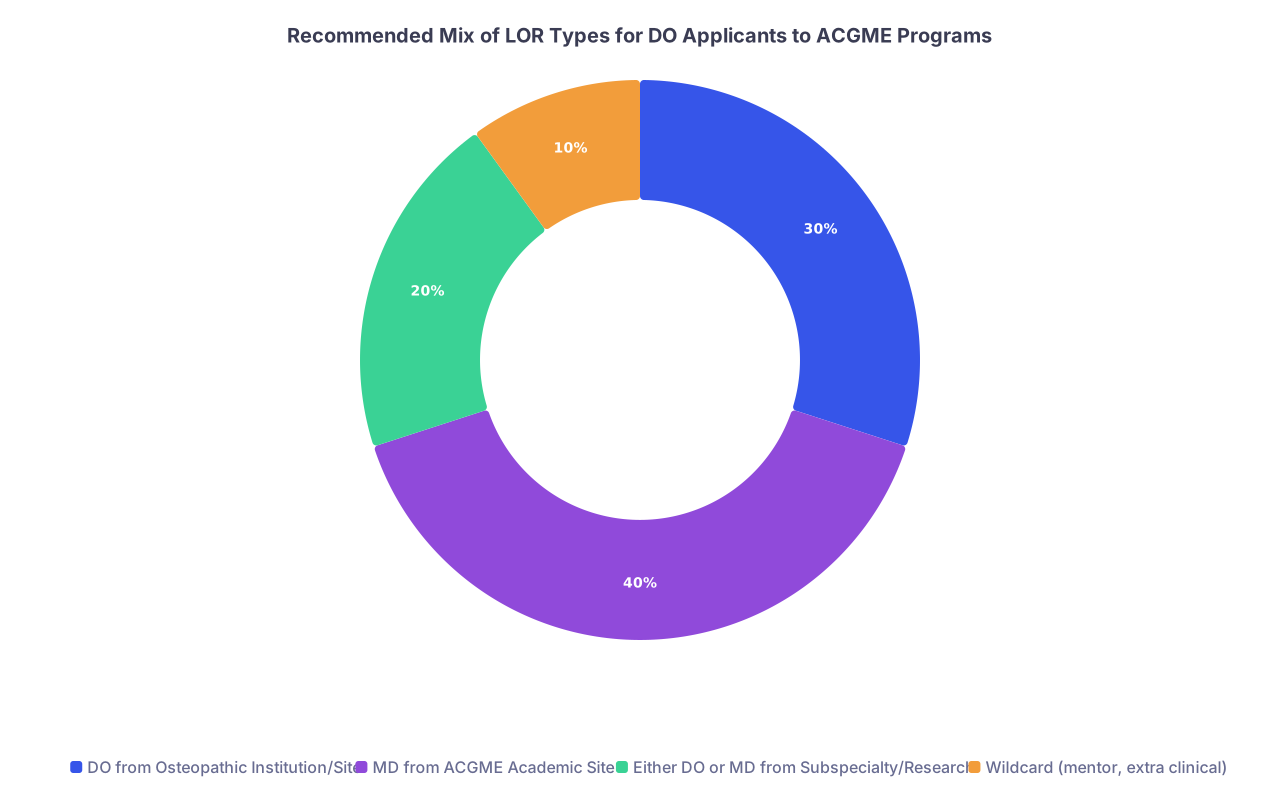
| Category | Value |
|---|---|
| DO from Osteopathic Institution/Site | 30 |
| MD from ACGME Academic Site | 40 |
| Either DO or MD from Subspecialty/Research | 20 |
| Wildcard (mentor, extra clinical) | 10 |
Translation into normal language:
- At least one strong DO letter from a place that actually knows you well and saw you work.
- At least one MD letter from an ACGME academic environment that the committee respects.
- Third (or fourth) letter from whoever knows you best clinically or academically—DO or MD, but with strong specificity.
That MD academic letter acts as “currency translation”: it proves you can function in the ACGME world. Your DO letter shows who you are in your home culture.
Special Case: Applying to Historically DO-Heavy or Former AOA Programs
At those places, you can lean more DO-heavy. Three DO letters that are strong, specific, and from busy osteopathic sites can absolutely carry you.
But here’s the quiet advantage if you bring an MD letter too: it signals versatility. Committees like DOs who can cross both worlds comfortably, especially now that everything’s under one accreditation roof.
What Program Directors Complain About in DO Letters (That You Never Hear)
I’ve sat in rooms where PDs groan after reading otherwise positive DO letters. Not because they hate DOs. Because the letters are useless.
Here are the patterns that quietly sink DO letters in ACGME eyes:
Vague Universals
Things like:
- “Hardworking, compassionate, a joy to work with.”
- “Always arrived on time and was respectful.”
- “Will make an excellent resident in any program.”
That’s not praise. That’s filler. Every average student gets that.
ACGME people want to see: how you think, how you handle pressure, how fast you learn, how independently you function.
No Context for the Environment
A DO letter that never mentions the hospital type, patient volume, or acuity leaves the committee guessing.
They start filling in the blanks with their biases. You don’t want that.
Letters that say:
“We are a 300-bed community hospital with a busy open ICU and EM residents. The student managed 6–8 patients independently on call days…”
Those land differently. Now they can picture it.
Conflicting Tone With the Rest of the File
A glowing DO letter paired with an MSPE that hints at “professionalism issues,” “time management struggles,” or “required close supervision” raises alarms.
The committee thinks:
“Either the DO letter writer is sugar-coating, or they didn’t see the full picture.”
Once that suspicion exists, the DO letter becomes less credible, even if it’s honest.
How Committees Use DO Letters When Ranking You
At the rank meeting, letters don’t usually get you on the list at all. Your scores, school, and interview do that. Letters decide:
- Who gets bumped up a few spots
- Who gets quietly slid down when there’s doubt
- Who gets flagged for “concern” even if the interview was fine
When they scroll your file and hit your DO letters, these are the mental questions floating in the room:
- “Does this reassure us they can function in our environment?”
- “Is there anything here that contradicts the shiny interview version?”
- “Does someone I trust—DO or MD—actually stick their neck out for this person?”
The biggest behind-the-scenes truth:
Neutral letters hurt you more than you think. Strong, specific DO letters—especially when paired with at least one MD academic letter—can absolutely move you upward.
A Quick Reality Check on Osteopathic Letters in ACGME Land
Let me be as direct as possible.
If you’re a DO applying to ACGME programs, this is the ground truth:
- DO letters are not inherently weaker.
- They’re just more variable in how they’re perceived.
- Committees interpret them through their own bias, history with DOs, and familiarity with your training sites.
Your job isn’t to magically erase that. Your job is to stack the deck:
- Choose letter writers from environments ACGME people respect.
- Make sure they actually watched you do hard things, not just be nice in clinic.
- Balance DO letters that show your home identity with MD letters that translate it into ACGME terms.
And if a PD at an ACGME program has had three rockstar DO residents in a row with strong DO letters behind them? Guess what happens to the way they read the next DO letter.
The bias shifts. Slowly. Incrementally. In your favor.

| Step | Description |
|---|---|
| Step 1 | Application Pulled Up |
| Step 2 | Check Scores/School/MSPE |
| Step 3 | Scan Letter Writers |
| Step 4 | Higher Initial Trust |
| Step 5 | Lower Initial Trust |
| Step 6 | Read Phrases and Specifics |
| Step 7 | Boost Confidence / Rank Up Slightly |
| Step 8 | Neutral Impact |
| Step 9 | Move Down Rank List or Remove |
| Step 10 | Any Known Names or Institutions? |
| Step 11 | Strong, Specific Praise? |
| Step 12 | Any Red Flags or Doubt? |
FAQ (exactly 3 questions)
1. If I’m a DO applying to ACGME programs, do I need an MD letter?
You don’t absolutely need one for every program, but for most MD-heavy or academic ACGME residencies, at least one strong MD letter from a credible ACGME environment is a major advantage. It acts as external validation that you can thrive in their style of training. Former AOA and DO-friendly programs may care less, but even there, an MD letter can’t hurt and often helps.
2. Are letters from DOs at small community hospitals taken seriously by ACGME committees?
They can be, if they’re specific, concrete, and describe real autonomy and acuity. The problem isn’t that they’re DOs or community-based. The problem is when they’re vague, generic, and give no sense of the environment. A tightly written letter from a small but busy DO hospital that describes exactly what you handled clinically will beat a fluffy letter from a big-name place every time.
3. If all my letters are DO and from osteopathic sites, am I at a huge disadvantage?
You’re not doomed, but you’re playing on harder mode at some ACGME programs, especially academic and MD-dominant ones. At DO-friendly or community programs, you’ll be fine if the letters are strong. For more competitive or MD-heavy sites, you should compensate with strong interview performance, solid scores, and ideally at least one rotation in an ACGME environment in the future. The earlier you recognize this and plan for mixed DO/MD letters, the easier your application cycle becomes.
Key points to walk away with:
- ACGME committees don’t read DO letters the same way across the board; history with DOs and familiarity with your sites massively shape interpretation.
- Specific, contextual, risk-taking DO letters—especially from known or clearly busy institutions—carry real weight, but bland praise gets quietly ignored.
- A smart mix of DO and MD letters can “translate” your strengths across cultures and neutralize a lot of the unspoken bias that still lingers post-merger.