

It’s 7:42 a.m. You’re sitting in a Zoom waiting room (or a hospital conference room) for your ACGME interview. Your tie suddenly feels too tight, your palms are sweating, and your brain is running only one question on loop:
“What if they don’t think my DO school is good enough? What if they straight‑up question my training?”
That’s the nightmare, right? Not just subtle bias. But them actually saying it out loud:
“So… as a DO, do you feel your training is equivalent to MD programs?”
Or worse:
“We don’t usually take DOs. Why should we trust your training?”
This is the scenario your brain keeps catastrophizing about at 2 a.m. So let’s stop pretending it can’t happen and just deal with it head‑on.
Because yes, it can happen. I’ve seen versions of it happen. And it’s survivable if you’re ready.
Reality check: Are they actually allowed to question your DO training?
Short answer: They will have opinions. They should not insult you. But they can absolutely probe your background, ask about your curriculum, and try to understand your preparation.
Are there still programs and faculty who quietly (or not so quietly) see DO training as “less than”? Yep. Especially in certain regions and older faculty who trained pre‑single accreditation.
But here’s the part your anxiety keeps skipping over:
You are sitting in that interview because, on paper, you already cleared multiple gates:

Programs didn’t invite you as a favor. They saw:
- Your COMLEX/USMLE (if you took it)
- Your transcript
- Your letters
- Your rotations
- Maybe your research, your work, your personal statement
If they hated DOs on principle, you would never have been in that chair or on that Zoom call. Full stop.
So when they “question your training quality,” it’s almost never, “We think you’re garbage.” It’s usually:
- “Help me understand your curriculum.”
- “How did your school handle X?”
- “What was your exposure to Y?”
Your brain hears: “You’re not good enough.”
What they’re actually doing: Risk management and curiosity.
Still stressful? Definitely. But it’s not an interrogation you have to fear if you’ve thought through your responses.
If they directly question your DO degree: what you actually say
Let’s take the worst‑case version your brain is afraid of and script it.
Scenario 1: The blunt question
Interviewer:
“As a DO, do you feel your training is equivalent to that of MD students?”
Your anxiety wants to:
Panic. Overshare. Apologize. Sound defensive. Ramble about OMM and philosophy.
You should instead do this: be calm, factual, and confident without sounding combative.
Something like:
“Yes, I do. My preclinical curriculum covered the same core medical sciences as MD programs: anatomy, physiology, path, pharm, micro. I took [COMLEX‑Level 1 and 2 / USMLE Step 1 and 2] and performed competitively with national averages, which helped validate that knowledge base.
Clinically, I rotated at ACGME‑accredited sites like [Hospital X / System Y], working side‑by‑side with MD and DO students, and was evaluated on the same standards.
The DO piece adds a musculoskeletal and holistic focus with OMM, but I see that as an addition, not a substitute. My training prepared me to work in an ACGME environment, and my rotation evaluations hopefully reflect that.”
Key pieces in there:
- You answer clearly: “Yes, I do.”
- You anchor to shared standards: sciences, exams, ACGME sites.
- You present OMM as a plus, not some weird alternative world.
- You mention evaluations – you’re not just giving your opinion, you’re hinting there’s data.
Scenario 2: The questionable comment
Interviewer:
“Historically, we haven’t taken many DOs. We’re not always sure how the training compares.”
This is the one that stings. You want to shrink. Or snap. Or both.
Try something like:
“I understand, and I appreciate you being direct about that.
One of the things I’ve valued about my training is how much of it occurred in ACGME‑aligned environments. At [Site], my internal medicine rotation was staffed by MD attendings who also work with categorical residents, and my evaluations focused on the same ACGME core competencies.
I’m happy to walk you through what our curriculum and clinical years look like if that’s helpful, and how I’ve sought out experiences that align with ACGME expectations.”
You’re doing three important things:
- You’re not begging to be accepted as “equal.” You’re just calmly laying out that you are aligned with their world.
- You’re willing to educate without being their DO spokesperson/mascot.
- You don’t get defensive. Defensive kills interviews.
How to talk about your school and training without sounding insecure
Here’s the trap a lot of DO applicants fall into:
They assume everyone’s judging them, so they overcompensate and keep bringing up their DO status even when no one asked.
You don’t need to do that.
You only need a few polished anchors in your head:
| Topic | Strong Anchor Example |
|---|---|
| Preclinical | Same core sciences as MD, systems-based, graded rigorously |
| Board Exams | COMLEX (and USMLE if applicable) scores vs. national norms |
| Clinical Sites | ACGME hospitals, MD attendings, side-by-side with MD students |
| OMM/Philosophy | Adds skills, doesn’t replace standard medical training |
| Performance | Strong evals, honors, letters from MD faculty |
From those anchors, you can build natural sentences like:
- “Our curriculum was systems‑based and paralleled traditional MD programs in content.”
- “My COMLEX Level 2 score is [X], which is above the national mean.”
- “On my sub‑I at [ACGME hospital], I worked directly with your categorical residents and was evaluated on the same expectations.”
You’re not saying: “Please believe I’m not inferior.”
You’re saying: “Here’s how I’ve already functioned at your level.”
What if they really are biased against DOs?
This is the dark thought that keeps chewing at you: “What if they’ve already decided I’m lesser because I’m a DO and nothing I say matters?”
Sometimes? That’s true. I won’t sugarcoat it.
There are programs where your initials alone make it an uphill battle. You can’t fix their culture in a 20‑minute interview.
But this is where you need to be brutally practical:
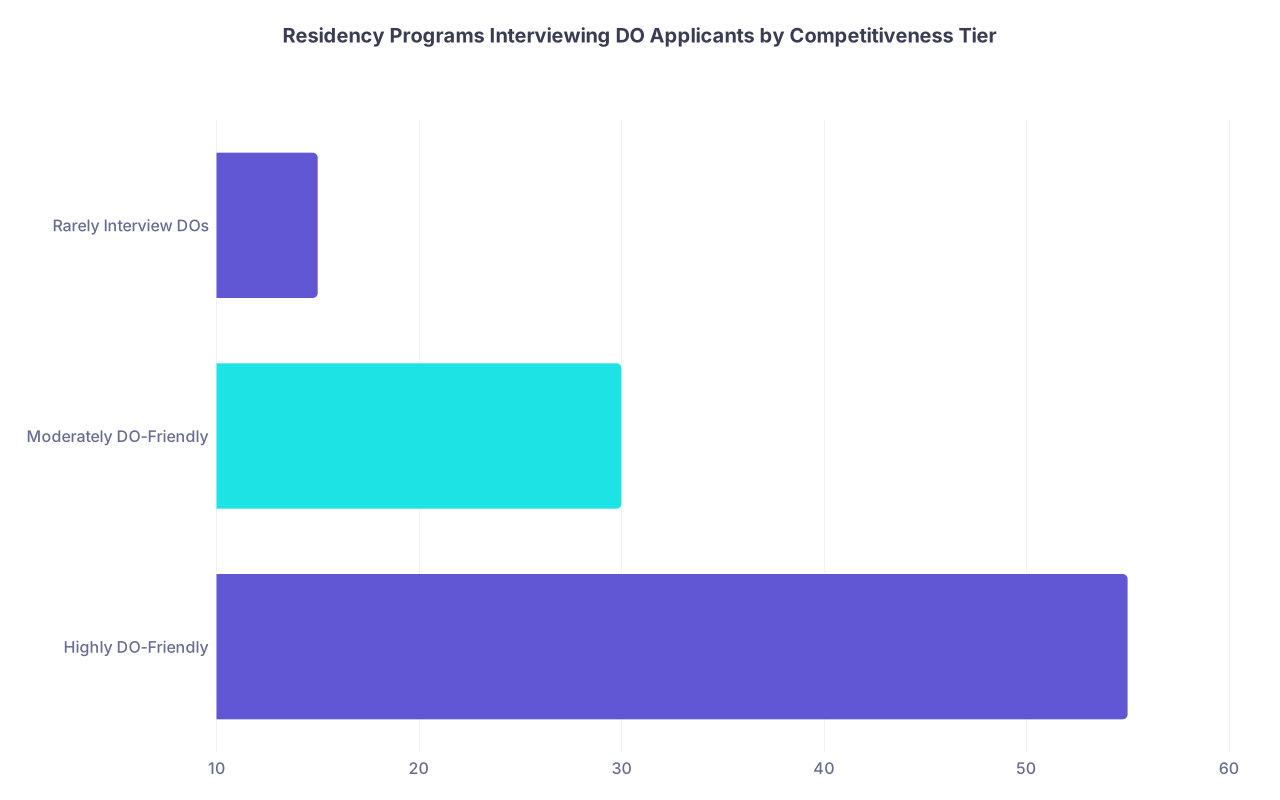
| Category | Value |
|---|---|
| Highly DO-Friendly | 55 |
| Moderately DO-Friendly | 30 |
| Rarely Interview DOs | 15 |
Lots of programs are now DO‑friendly or at least DO‑neutral. The ones that aren’t? You will see it:
- No DO residents listed on their website for years
- Zero DO faculty
- Word of mouth on Reddit/SDN/Discord that’s consistently: “They don’t rank DOs highly”
If you’re there anyway (because you applied wide, you got the invite, you’re curious), use the interview as data gathering as much as audition:
- Do they ask curious questions or condescending ones?
- Does anyone say, “We’ve had strong DO residents here before” or “We’re excited we’re interviewing more DOs now”?
- Or do you get subtle vibes of, “Explain yourself. Justify your existence”?
Here’s the ugly truth:
If, on interview day, they make you feel small now, imagine them with power over your schedule, your evaluations, your promotions. For three years.
Residency is already hard. You don’t need to add “convince them I belong” to your job description.
Sometimes the right move isn’t, “How do I win them over?”
It’s, “Why would I rank a place that disrespects my degree?”
Handling specific awful‑feeling questions (scripts you can steal)
Let’s rapid‑fire some of the nasty‑sounding, anxiety‑inducing questions your brain keeps rehearsing and some solid answers you can adapt.
“Why did you choose a DO school instead of an MD school?”
Temptation: Launch into your MCAT/GPA trauma and sound apologetic.
Better:
“I chose a DO school because I liked the emphasis on patient‑centered care and the additional training in musculoskeletal medicine. I was also drawn to [Your School] specifically for its strong clinical sites like [Hospital Names].
At the end of the day, I knew I’d get a full medical education plus OMM skills, and my goal was always to train in a rigorous residency like this one.”
You’re not saying, “I couldn’t get into MD, so I settled.” Even if that’s partially true, they don’t need that story. They need to see intention and ownership.
“Do you feel disadvantaged coming from a DO program?”
You’ll feel like the right answer is “Yes, but I’ve overcome…” Don’t go there.
Try:
“I think the main ‘disadvantage’ historically has been perception, not capability. In terms of training, I’ve had full exposure to inpatient and outpatient medicine, ICU, electives, and sub‑Is at ACGME‑accredited hospitals.
Where I’ve been intentional is making sure my experiences align with where I want to train – that’s why I did [audition/sub‑I/away] at [Hospital/Program] and worked closely with MD faculty who understand this environment.
So I don’t feel unprepared. If anything, I’m used to having to prove myself a bit more, which has made me pretty motivated and coachable.”
You acknowledge reality without playing the victim.
“We don’t really use OMM here. How is that relevant?”
Anxiety interpretation: “We think OMM is fake.”
Your answer should never be defensive or evangelical. Something like:
“That’s totally fine – I’m not expecting to be doing a lot of OMM in residency.
For me, the value of OMM was twofold: it deepened my understanding of anatomy and biomechanics, and it reinforced a habit of doing very focused physical exams.
I see those as foundational skills I bring with me, even if I’m not actively performing OMM techniques on the wards. And I’m fully comfortable working in settings that don’t incorporate OMM day‑to‑day.”
You’re communicating: “I am not here to convert you. I am here to function as a normal resident.”
“How do your board scores compare if you only took COMLEX?”
This is the one that haunts a lot of DOs who didn’t take USMLE.
Answering it well means being factual and calm:
“I took COMLEX Level 1 and 2 and scored [X and Y], which are [around / above] the national mean.
I understand some programs are more familiar with USMLE data, but COMLEX is designed to test the same core medical knowledge domains.
I’ve tried to make sure the rest of my application – strong clinical evaluations at ACGME sites, letters from MD attendings, and solid performance on sub‑Is – gives you a clear picture of how I function clinically, beyond just the score metric.”
You can’t magically invent a Step score. But you can re‑center the conversation on actual performance.
Mental prep: separating their doubt from your worth
Part of what makes all this so exhausting is that every slightly skeptical question feels like a personal attack. It’s not just “Do they trust DO training?” It becomes “Am I actually an impostor?”
You have to separate three things:
- Systemic bias – Programs that just haven’t caught up or don’t care to.
- Reasonable curiosity – People who genuinely don’t understand your curriculum and want clarity.
- Your personal value – Which, honestly, should not live and die based on how some random APD phrases a question in a 15‑minute block.
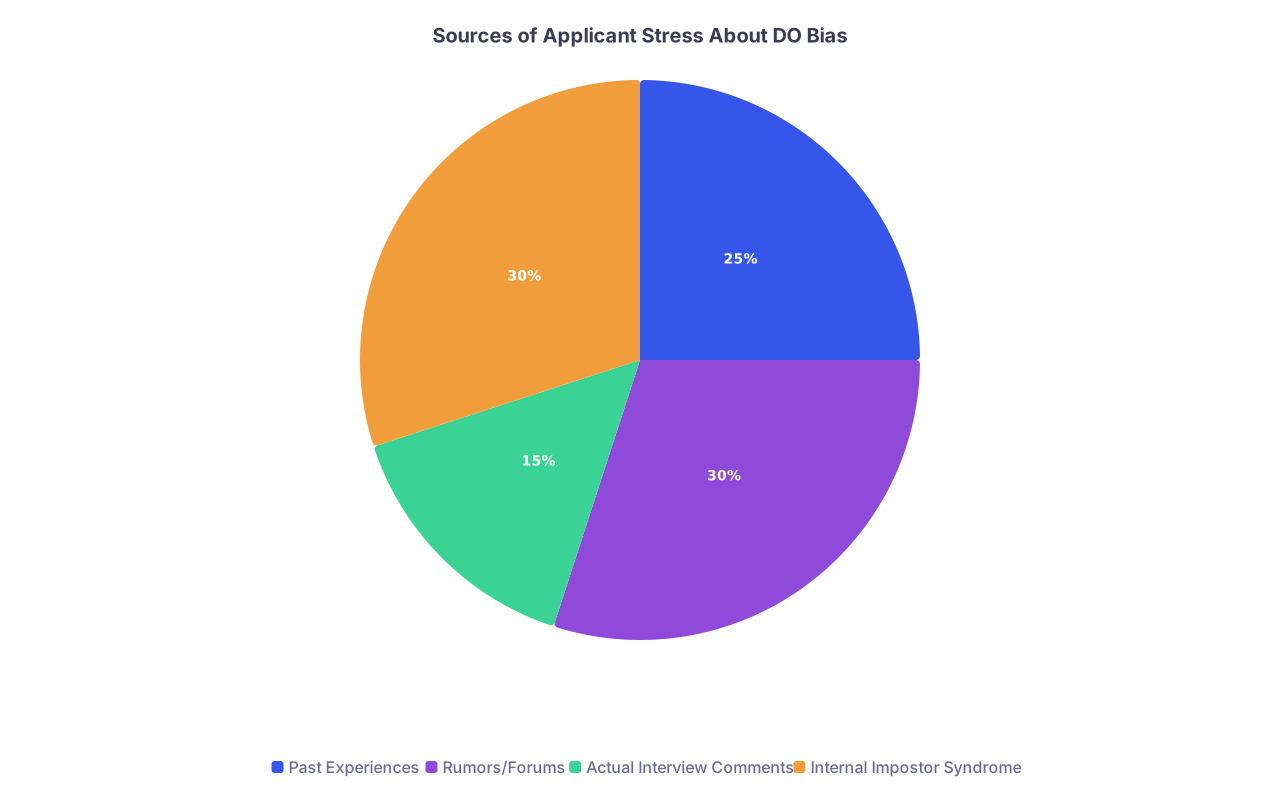
| Category | Value |
|---|---|
| Past Experiences | 25 |
| Rumors/Forums | 30 |
| Actual Interview Comments | 15 |
| Internal Impostor Syndrome | 30 |
A lot of what’s shredding your nerves isn’t what’s happening in real life. It’s what Reddit told you might happen plus your own inner critic doing play‑by‑play.
Practical things you can do:
- Script your answers to the worst questions you’re afraid of. Say them out loud. To a friend, to your phone camera, to your reflection. The first 5 times will be cringe. The 6th will be smoother.
- Know your facts cold – your COMLEX scores, rotation sites, any USMLE scores, key eval strengths, letters from MDs. Confidence is remembering, not improvising.
- Set a boundary for yourself – If a program makes you feel disrespected because of your degree, you are allowed to rank them lower. Or not at all. Matching there is not some prize.
And one more thing:
Plenty of ACGME PDs trained with DOs who were absolute workhorses and rock‑solid residents. When they see “DO” on your app, they’re thinking of those people, not internet stereotypes. You’re not walking into every room at a disadvantage, even if your anxiety swears you are.
Quick internal “checklist” for during the interview
Not a literal checklist you read on screen. Just a mental snapshot you keep in the back of your head:

| Step | Description |
|---|---|
| Step 1 | Interviewer asks about DO training |
| Step 2 | Answer calmly with facts about curriculum, boards, clinicals |
| Step 3 | Stay professional, give concise factual answer |
| Step 4 | Redirect to strengths & experiences |
| Step 5 | Consider program seriously |
| Step 6 | Lower on rank list or exclude |
| Step 7 | Is it hostile or curious? |
| Step 8 | Do I feel respected overall? |
You’re not just being evaluated. You are quietly evaluating them.
FAQ (exactly 5 questions)
1. Should I ever bring up being a DO proactively if they don’t mention it?
You don’t need to. Your application already tells them. If it’s genuinely relevant to a question (like “Why this specialty?” and you want to mention OMM exposure), that’s fine. What you don’t want is to continuously explain or defend your degree when no one has asked. That tends to project insecurity, not strength.
2. What if an interviewer says something clearly disrespectful about DOs?
You maintain your professionalism in the moment. Answer factually, finish the interview, and mentally flag that program. Afterward, you can talk to your dean’s office or mentors about whether it’s worth reporting. But from a practical standpoint: if they show you overt disrespect now, they’re showing you what kind of culture you’d be walking into. Don’t ignore that red flag in your rank list.
3. Is it a mistake that I didn’t take USMLE as a DO applying to ACGME programs?
It can limit you at some programs, especially the ones that blindly screen by Step scores. But it’s not an automatic death sentence. Plenty of DOs match ACGME residencies every year with COMLEX only. Your job now isn’t to regret that decision; it’s to clearly explain your preparation, highlight strong COMLEX scores, and emphasize real‑world performance on ACGME rotations and sub‑Is.
4. How do I keep from sounding defensive when they ask about my DO training?
Short, factual, and neutral is your friend. Don’t start by arguing with an assumption they haven’t stated. Don’t over‑justify. Answer what they actually asked, tie it back to shared standards (science curriculum, board exams, ACGME sites, evals), and then move back toward your strengths and fit for the program. The more you try to “convince” them emotionally, the more defensive you’ll sound.
5. What if I completely freeze when they ask about being a DO?
First, breathe. It’s okay to pause for a second instead of panicking and word‑vomiting. You can buy a little time with, “That’s a good question. Let me think about how to answer that clearly.” Then lean on one of the scripts you’ve practiced: curriculum, boards, clinical exposure, OMM as bonus. If you truly fumble one answer, that alone rarely kills an interview. What matters more is your overall composure and how you handle yourself the rest of the time.
Bottom line, in case your brain is spiraling:
- You’re in the interview because they already see potential in you, DO and all.
- Questions about your training are not proof you’re inferior; they’re chances to calmly show you’re already operating at their level.
- Any program that can’t respect your degree during an interview probably doesn’t deserve three years of your life.


