

You’re staring at your ERAS list, heart racing a little, realizing how many programs say “USMLE preferred” or “USMLE required.” COMLEX-only suddenly feels like a bad joke you played on yourself six months ago when everyone said “You’ll be fine” and you believed them. Now it’s late, apps are in (or about to be), and you’re wondering if you just quietly sabotaged your entire career.
Let’s talk about that sick feeling in your stomach. And what you actually can still do about it.
First: Are You Really Screwed Without USMLE?
Let me be blunt: no, you’re not automatically screwed. But yes, there are doors that are now harder to open.
Here’s the ugly-but-true breakdown:
- Some programs outright require USMLE. Those are probably gone for this cycle.
- Some programs say “USMLE preferred.” Those are not automatically gone.
- Plenty of programs still seriously consider COMLEX-only applicants, especially if:
- You’re applying to primary care, psych, peds, FM, IM (non-competitive tracks)
- Your COMLEX scores are solid
- You have real clinical performance, decent letters, and you didn’t shotgun all your aways in the wrong places
The fear in your head is: “Everyone else has USMLE. I’m the odd one out. I look lazy or weak.”
What most PDs actually see is: “COMLEX-only? Okay, I have to translate this into USMLE language in my head and figure out if this person can hang here.”
Annoying for them? Sure. Impossible for you? No.
To ground this a bit, let me show you relative competitiveness by specialty and how brutal no-USMLE can be:
| Specialty Type | Impact of COMLEX-Only | Reality Check |
|---|---|---|
| Family Med | Low | Many DO-friendly, COMLEX-accepted |
| Psych | Low-Moderate | USMLE helps, but COMLEX-only still viable |
| Internal Med (non-elite) | Moderate | Fewer options, but many community programs open |
| EM | Moderate-High | Increasingly USMLE-focused, but not universal |
| Surgical specialties | Very High | Most competitive programs heavily prefer USMLE |
If you’re gunning for ortho/derm/ENT/ophtho/general surgery at “big name” places and you never took USMLE, yeah, that’s a problem. I won’t sugarcoat it. But most anxious DOs I talk to are applying IM/FM/psych/EM and spiraling as if they just lost derm at Harvard.
So before you catastrophize, be honest:
Are you actually locked out of your intended field, or are you just mad that some shiny programs might be harder to reach?
Option 1: Take (or Retake) USMLE Late – Is That Even a Thing?
Here’s the dark fantasy:
You sign up for USMLE late, cram for 6–8 weeks, crush it, upload the score to ERAS, magically unlock a ton of interviews, and ride off into the Match sunset.
Reality is more annoying and way less cinematic.
You have to ask:
Is the exam available/allowed for you still?
- Are you within your school’s timeline policies?
- Are you still allowed by NBME/ECFMG timing rules?
- Will your school even support this plan or think you’ve lost it?
When would the score realistically post?
- Scores usually take about 2–4 weeks to come back.
- Programs aren’t sitting there refreshing ERAS just to see if you randomly added a score in January.
Will anyone actually care this cycle?
- If your score posts after most interview offers are out, it might not help this Match much.
- It could help for SOAP. Or for a re-application next year, which no one wants to think about but should.
Late-cycle USMLE can still make sense in a few scenarios:
- You’re early MS4, apps not submitted yet, and you can realistically carve out 6–8 weeks to prep without nuking rotations.
- You know you might need to reapply next year (low COMLEX, red flags, failed rotation, etc.).
- You’re trying to pivot from “I’ll take anything” to “I want a shot at better programs or a more competitive specialty,” and you’re willing to risk the stress.
Where it doesn’t make sense:
- You’re mid-cycle, drowning on Sub-I, and talking about squeezing Step in “on weekends.”
- Your COMLEX performance was shaky and you haven’t done any USMLE-style prep in months.
- You’re hoping a last-minute USMLE fixes a fundamentally weak application (mediocre clinical evals, bland letters, no real commitment to the specialty).
If you’re thinking of pulling the late USMLE move, map it visually:

| Step | Description |
|---|---|
| Step 1 | Regret no USMLE |
| Step 2 | Skip USMLE this cycle |
| Step 3 | Consider for SOAP/reapply only |
| Step 4 | Discuss with advisor & schedule Step |
| Step 5 | Still eligible to sit? |
| Step 6 | Score back before main interview season? |
| Step 7 | Have 6-8 weeks to prep? |
If you land on “Yes, take it,” then commit. Half-hearted USMLE late in the game is how you turn “Hmm, maybe I could’ve matched with COMLEX-only” into “Now I have a low USMLE and average COMLEX.”
Option 2: Double Down on a COMLEX-Only Strategy (Without Hating Yourself)
If late USMLE isn’t realistic, then you’re stuck with COMLEX this cycle. So what now?
You stop playing a game you already lost (fantasizing you could’ve fixed this earlier) and start playing the one that’s still winnable.
You can absolutely build a strong COMLEX-only strategy, but it’s not passive. It looks like this:
Be brutally smart about your program list.
This is where most people screw themselves. They build a list like they’re applying with 250+ USMLE scores and then wonder why no one invites them.You should:
- Prioritize community and DO-heavy programs.
- Look up current residents: how many DOs? Any COMLEX-only folks?
- Call or email coordinators with a very specific question:
“Do you consider COMLEX-only applicants on equal footing, or is a USMLE score effectively required?”
Stop ignoring the “mid-tier” and “safety” programs.
I know: no one likes the word “safety.” But you know what sucks more? SOAPing into a specialty you never wanted.You should over-apply on the safer side if:
- COMLEX < ~215–220 (depending on specialty).
- You have failed a class/rotation/COMLEX attempt.
- You’re switching specialties late.
Use every non-test piece of your app to scream competence and commitment.
If they can’t see a USMLE number, they need something else to latch onto:- Strong, specific letters (“They function at the level of a PGY1,” not “They are nice.”)
- A personal statement that actually explains your path, not just “I like helping people.”
- Program signals that match your behavior. Don’t signal EM at top places if your actual app screams “FM backup.”
I’ve seen COMLEX-only DOs match into solid IM, psych, and EM programs because they played the game correctly: realistic list, strong letters, clear story, no delusion about perceived competitiveness.
The ones who tank? Usually the ones who refused to adjust their expectations when they opted out of USMLE.
Option 3: Use This Cycle as Data, Not a Death Sentence
Here’s the fear you’re probably too scared to fully think:
“What if I don’t match because I didn’t take USMLE? What then?”
I get it. That’s the monster under the bed.
Here’s the harsh truth: if you don’t match, it won’t be only because of USMLE. It’ll be:
- Program list too top-heavy
- Weak letters or generic letters
- Poor interview performance
- COMLEX scores that aren’t competitive for your chosen specialty
- Or yes, lack of USMLE on top of all that
The part you control now is: if this cycle goes badly, are you going to be stuck repeating the same mistake or will you actually learn from it?
If you don’t match, you’ll probably be looking at:
- SOAP into a different specialty or location than you want
- A prelim year (IM/surgery) with reapplication the next year
- A research year or non-training clinical work (scribe, prelim, etc.) plus reapplying
In that “gap” year, suddenly:
- Taking USMLE might make sense
- You’ll have time to prep properly
- You’ll be applying with:
- Real clinical experience
- Better understanding of what programs want
- Possibly stronger letters
Not matching sucks. But I’ve seen DOs match stronger the second time because they finally stopped being vague and “open to anything” and actually built an aggressive, targeted strategy—sometimes with USMLE added, sometimes just better COMLEX and better program selection.
How Program Directors Actually See COMLEX-Only
Let me cut through the fantasy: PDs are not sitting around gossiping about how lazy DOs are for not taking USMLE. They’re doing this:
- Opening ERAS.
- Scanning for:
- Scores (whatever form they’re in)
- Red flags
- School, letters, MSPE
- Whether your story fits what their program actually needs.
For USMLE-obsessed programs, no score = auto-filter-out.
For many others, no score = “Okay, let me interpret COMLEX.”
Some PDs are decent at that. Some are clueless and just prefer not to deal with it. You’re not changing that by stressing. You are changing it by applying to places that have proven they actually take DOs and don’t treat COMLEX like a foreign language.
To visualize where your anxiety is vs. reality, think about your app like this:
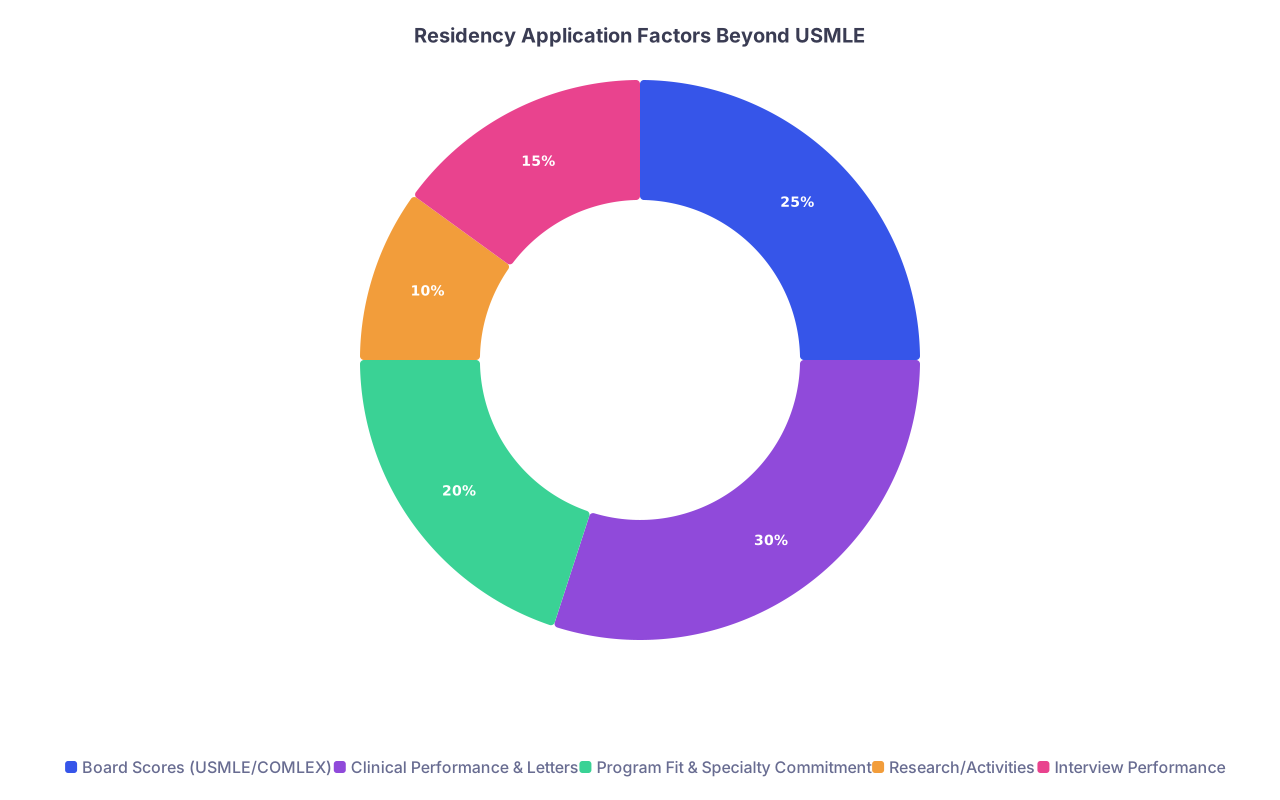
| Category | Value |
|---|---|
| Board Scores (USMLE/COMLEX) | 25 |
| Clinical Performance & Letters | 30 |
| Program Fit & Specialty Commitment | 20 |
| Research/Activities | 10 |
| Interview Performance | 15 |
Is the board score slice important? Yes. Is it your whole application? No. If all you do is obsess over that 25%, you’ll neglect the 75% you still have some control over right now.
What You Can Actually Do This Week
Here’s where I stop hand-holding and just give you the list.
This week, if you’re spiraling about not taking USMLE, do this:
Audit your program list.
- Mark each program as:
- USMLE Required
- USMLE Preferred
- COMLEX Accepted / DO-friendly
- Ruthlessly cut places that are clearly USMLE-only in practice.
- Mark each program as:
Add 10–20 more realistic programs.
- Community-heavy
- DO-heavy
- Places where residents look like you on paper (same school types, board style, etc.)
Email 3–5 program coordinators.
Short, direct email:- “I’m a DO applicant with COMLEX-only scores applying to [specialty]. Do you consider COMLEX-only applicants for interview, or is having USMLE effectively required at your program?”
Talk to one honest advisor.
Not the one who always says “You’ll be fine.” The one who’s willing to say, “You need to apply to more X-type programs.”If you’re still genuinely considering late USMLE, open a calendar.
- Block off potential study time.
- Count the weeks you can realistically devote.
- If that number is under 6, I’d strongly question the wisdom of doing it this cycle.
You can’t go back and retroactively take Step 1 during second year. That version of you made a call based on the info and fear level they had then. Fine. That’s done.
What you can do, starting today:
Open your program list and label every single program as USMLE-required, USMLE-preferred, or COMLEX-friendly. If more than a third of your list is heavily USMLE-biased, start swapping those out now—before your regret becomes something that actually costs you a Match.


