

What if your low COMLEX Level 1 score quietly kills your ACGME chances… even though you “redeemed” yourself on Level 2?
Yeah. That’s the exact spiral this topic triggers.
You’re probably sitting there thinking something like:
“I bombed Level 1, did way better on Level 2, but programs still see that ugly first score. Is this game basically over for me?”
Let’s walk through this the way your 3 a.m. brain actually thinks about it — and then I’ll tell you what’s real, what’s survivable, and where you actually need to worry.
First: How Bad Is “Low” and How Good Is “Decent,” Really?
You can’t fix what you won’t name. So let’s put rough numbers to the vague dread.
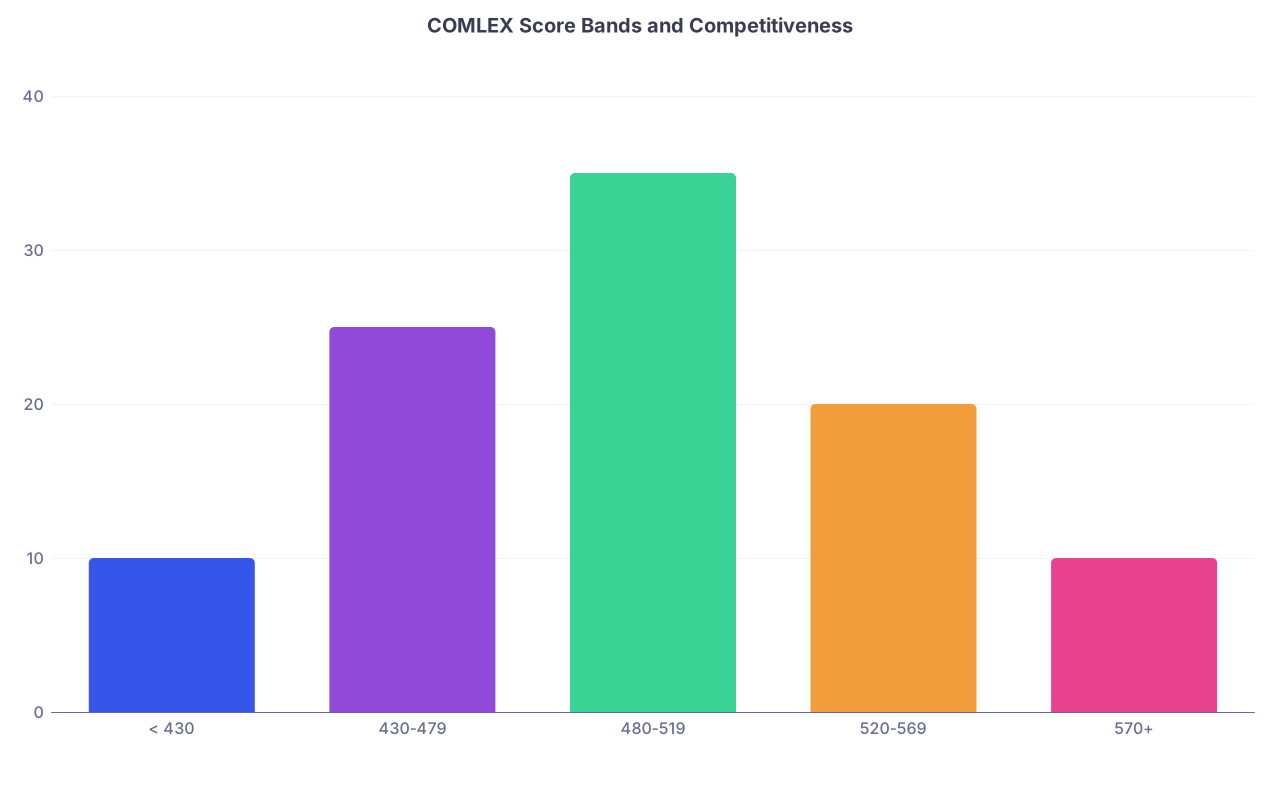
| Category | Value |
|---|---|
| < 430 | 10 |
| 430-479 | 25 |
| 480-519 | 35 |
| 520-569 | 20 |
| 570+ | 10 |
Very rough buckets most programs have in their heads (even if they never say it out loud):
- Sub-400: Red-flag territory. Passing late or by a hair, retakes, or clear academic struggle.
- 400–430: Below average. Not an automatic death sentence, but you’re on thin ice for competitive programs.
- 430–480: Slightly below to low-average. Many community programs are still open to you.
- 480–520: Solid middle of the road for a lot of osteopathic applicants.
- 520+: Comfort zone scores. They don’t make you a star automatically, but they stop the score-based anxiety.
Now “decent” Level 2:
- 480–520: Noticeable improvement if your Level 1 was much lower.
- 520–560: Clearly stronger. Programs pay attention to this.
- 560+: This gets people’s attention even if Level 1 was rough.
So, for example:
- Level 1: 410, Level 2: 520 → That’s a meaningful upward trend.
- Level 1: 420, Level 2: 460 → Technically better, but not dramatic.
- Level 1: 380 (barely passing or failed once), Level 2: 540 → That’s “redemption but still risk.”
If you’re in that first category — ugly Level 1, solid Level 2 — no, you don’t need to panic about all ACGME chances. You need to panic strategically.
What Programs Actually Do With A Low Level 1 / Higher Level 2
This is the part nobody explains honestly. Programs are messy. They don’t all think the same way.
Here’s what I’ve seen over and over:
- Some programs filter hard by Level 1 and never even see your Level 2.
- Some skim Level 1 but then really care about Level 2.
- Some use both, but let a strong Level 2 “forgive” a weaker Level 1.
- A few don’t care much about COMLEX at all if everything else is strong, especially in osteopathic-heavy programs.
That first group? You probably are dead there if your Level 1 is low. That’s just reality.
But that doesn’t mean you’re dead everywhere.
Roughly how different program types tend to react
| Program Type | Low L1 / Strong L2 Reaction |
|---|---|
| Big-name university ACGME | Often filter out by L1 |
| Mid-tier university | L2 helps, but still a risk |
| Community hospital ACGME | Much more open to L2 improvement |
| Historically DO-heavy | Usually more forgiving, context-based |
| Competitive specialties | L1 hurts a lot, even with good L2 |
If you’re aiming for IM, FM, peds, psych, maybe EM at the right places?
A good Level 2 can absolutely keep you in the game.
If you’re aiming for derm, ortho, ENT, ophtho, plastics with a really low Level 1?
You already know what I’m going to say: that’s almost certainly a major uphill fight, and “panic” might be the appropriate word there.
Worst-Case Scenarios (Because That’s Where Our Brains Go)
Let’s just lay out the catastrophic thoughts so we can deal with them one by one.
Catastrophe #1: “Programs will think my Level 2 is a fluke.”
If your Level 1 is, say, 410 and Level 2 is 520, you’re probably imagining a PD saying:
“Eh, they just got lucky the second time.”
Reality: That’s not how most people in academics think. What they’re more likely to think:
- You matured.
- You figured out how to study.
- You were underprepared or anxious early, and you recovered.
If your clerkship grades, narrative comments, and MSPE back up the idea that you improved — strong comments, solid clinical performance — your “fluke” fear doesn’t hold.
The “fluke” concern is more real if:
- Your Level 2 was taken super late (like December/January).
- You have inconsistent academics: failed shelf(s), remediation, poor rotations.
- Your letters are lukewarm.
But the number itself? A big jump usually helps, not hurts.
Catastrophe #2: “One low score means no one will rank me.”
No. What it means is:
- A chunk of programs will auto-screen you out without ever reading about your improvement.
- Another chunk will pause and then look at the whole file.
- A smaller chunk won’t care much as long as you’re above a baseline.
Am I going to tell you you’re totally fine with a 380 Level 1 and a 490 Level 2 if you apply to 20 places? No. That would be a lie.
But if you expand your list, target DO-friendly programs, and apply smartly, I’ve seen people with numbers like that match internal medicine, family medicine, psych, even some community general surgery.
The key variable isn’t “Can I match at all?”
It’s “What do I need to sacrifice — geography, prestige, maybe specialty — to make matching likely?”
Catastrophe #3: “I’ll go unmatched and have to explain this failure to everyone.”
Let’s not sugarcoat this: going unmatched is brutal. But here’s the part people ignore:
The people who tank their chances most with low Level 1 are the ones who:
- Apply to way too few programs.
- Apply way too top-heavy.
- Refuse to consider backup specialties or community-heavy programs.
- Don’t ask for help early.
The low score isn’t the only problem anymore — it’s how stubbornly they pretend it doesn’t matter.
You’re already worrying, which honestly puts you ahead of that group.
How Much Can a Strong Level 2 “Fix” a Weak Level 1?
Let me be specific.
You can loosely think of it like this: the bigger the gap between Level 1 and Level 2, the stronger your “improvement story.”
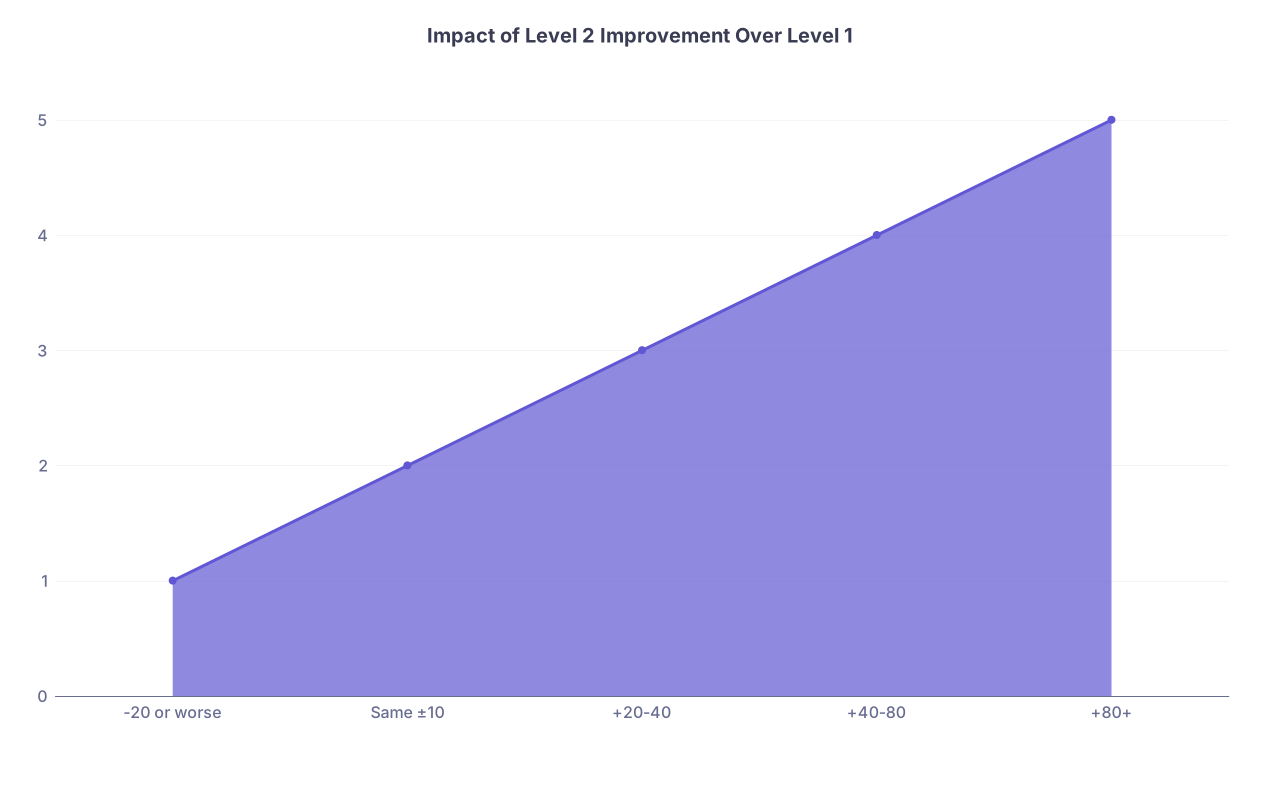
| Category | Value |
|---|---|
| -20 or worse | 1 |
| Same ±10 | 2 |
| +20-40 | 3 |
| +40-80 | 4 |
| +80+ | 5 |
(Scale 1–5 is basically: 1 = concerning, 5 = very reassuring)
Some common scenarios:
Level 1: 420, Level 2: 520
Programs love this. Clear upward trajectory.Level 1: 390, Level 2: 510
Still good. You’ll get questions about what happened on Level 1, but you have something strong to point to.Level 1: 450, Level 2: 460
Not really improvement. You’re stable. That’s okay, but it doesn’t “wash away” the first score.Level 1: 430, Level 2: 480
Mild improvement. Helps a bit, but you’re not rewriting your narrative — you’re just nudging it.
The closer your Level 2 is to “respectable for your specialty,” the more programs will mentally anchor to it and not your Level 1.
For primary care and many community internal medicine / psych programs, a 500–520+ Level 2 can definitely rescue a 420-ish Level 1 in a lot of places.
DO Applicant + ACGME: Where a Low Level 1 Hurts the Most
Let’s talk specifically DO + ACGME, because you’re not applying in a vacuum.
Where the low Level 1 stings:
- University-based categorical positions with lots of MD applicants
- Highly competitive specialties (ortho, derm, ENT, ophtho, urology, neurosurgery)
- EM at big-name academic centers
- Places that never fully embraced DOs even after the merger
Where you still have real shots:
- DO-friendly programs (look at current residents — lots of DOs = good sign)
- Community-based ACGME programs
- Specialties like:
- Family medicine
- Internal medicine (especially community / DO-heavy)
- Psychiatry (still somewhat competitive, but many DOs match here)
- Pediatrics (depends on region)
- Some prelim/transitional year programs
You’re not playing the same game as someone with a 600+ and a fancy home MD program pipeline. And yeah, that’s infuriating. But pretending you are is how people with “decent Level 2” end up unmatched.
What You Can Do Right Now to Offset a Low Level 1
Here’s the part that matters more than spiraling.
1. Get brutal, honest advising
Not the “you’ll be fine!” fluff from classmates. You need:
- Your school’s dean of students / academic advisor
- A faculty mentor in your intended specialty
- If possible, someone who’s actually been on a residency selection committee
Ask for:
- A realistic tier of programs to target
- Whether your specialty choice is appropriate with your numbers
- A number of programs they think you should apply to (and then round up)
2. Target programs intelligently
Stop guessing. Look at:
- Program websites + resident lists (how many DOs? any from your school?)
- Past match lists from your school
- People 1–2 years ahead of you with similar scores — where did they match?
If DOs never match a certain program from your school, and your scores are lower than their usual DOs? That place is likely a lottery ticket.
3. Max out everything non-test-score
You cannot change Level 1. You can still change:
- How strong your letters are (ask people who know you well and can be specific)
- The quality of your personal statement — especially your “redemption” story
- How well your MSPE / dean’s letter reflects your improvement
- How early and complete your ERAS is (do not be the late applicant with a low Level 1 — that’s fatal)
Don’t write a self-pity personal statement. But do briefly own:
- What went wrong with Level 1 (anxiety, wrong study strategy, life issue, etc.)
- What changed before Level 2
- How that change shows up in your clinical performance now
You’re not writing a confession. You’re writing a growth story.
How Timing and Strategy Affect Your Odds More Than You Think
Your scores are fixed. Your strategy isn’t.

| Step | Description |
|---|---|
| Step 1 | Low L1 Score |
| Step 2 | Target broader set of programs |
| Step 3 | Reassess specialty choice |
| Step 4 | Emphasize upward trend |
| Step 5 | Consider backup specialties |
| Step 6 | Apply early and widely |
| Step 7 | Strong L2? |
The people with low Level 1 + decent Level 2 who match tend to:
- Apply early
- Apply widely (like, painfully widely)
- Have a tolerable geographic ego (they’re willing to look outside the coasts and big cities)
- Have a realistic specialty plan (or backup)
The ones who don’t match tend to:
- Apply to 25 programs instead of 80+
- Fixate on 2–3 specific cities
- Refuse to consider backup specialties
- Ignore the warning signs because “my Level 2 is good now”
You cannot treat a 520 Level 2 as if it magically resets a 390 Level 1 to 520. It doesn’t. It just gives you a fighting chance.
What About Programs That Want USMLE Too?
If you didn’t take Step 1/2, skip this part. If you did, you know this is its own spiral.
Some ACGME programs still quietly prefer USMLE scores, even for DOs. A few basically require it.
If your COMLEX Level 1 is low but your Step 2 is strong, that can actually outshine the COMLEX problem at certain places — especially if they understand how weird COMLEX scoring is.
Flip side: if both COMLEX and USMLE show the same low Level 1 / mid Level 2 story, then it just reinforces the same narrative. Not worse. Just not better.
Don’t force Step 3 early as a “fix.” Step 3 is not a magic eraser and can absolutely hurt you if you underperform.
You’re Allowed to Be Scared — But Don’t Be Passive
Here’s the ugly truth nobody says out loud:
Plenty of people match every year with less-than-ideal scores.
Plenty of people don’t match with similar scores.
The difference is rarely just “the numbers.” It’s how seriously they took those numbers when planning.
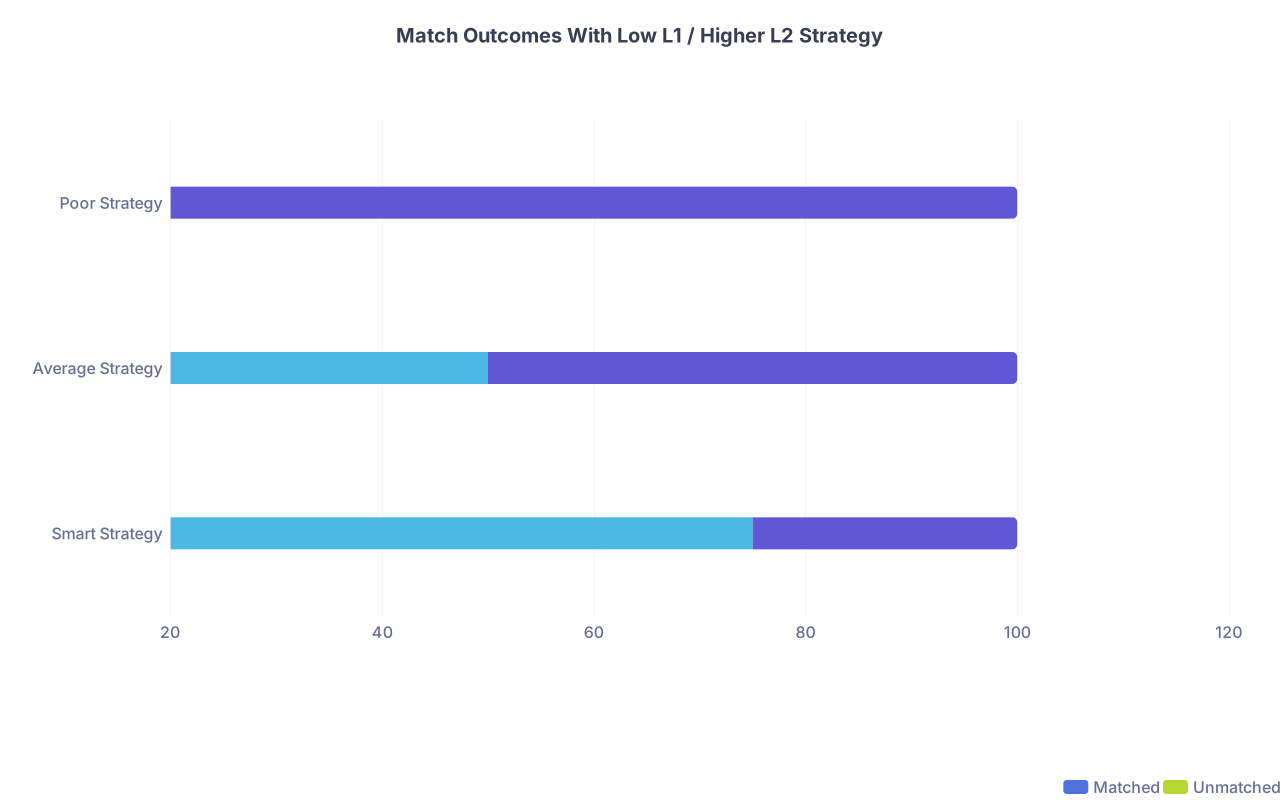
| Category | Matched | Unmatched |
|---|---|---|
| Smart Strategy | 75 | 25 |
| Average Strategy | 50 | 50 |
| Poor Strategy | 20 | 80 |
Not real data, obviously, but that’s the pattern I’ve watched play out.
If you’re reading something like this, worrying about it months before Match, you’re already not in the “totally oblivious” group. Use that.
Quick Reality Check Before You Spiral Again Tonight
Let me cut through it:
No, a low Level 1 does not automatically kill your ACGME chances — especially if your Level 2 is clearly stronger and you aim at DO-friendly, community-heavy programs.
Yes, it absolutely does limit certain doors — big academic names, ultra-competitive specialties, and score-filter-happy places may be effectively off the table. You’re not imagining that.
Your outcome now depends less on the scores and more on your strategy — honest advising, applying widely, realistic specialty and geography expectations, and a clear upward trajectory story.
You’re allowed to be anxious. Just don’t let that anxiety turn into magical thinking or total avoidance. You don’t control your Level 1 anymore.
You do control what you do with it.


