What’s the point of grinding through years of research, abstracts, and posters if your ACGME personal statement quietly convinces programs your work doesn’t matter?
If you’re a DO applying to ACGME residencies, research is already a political topic whether you like it or not. People are still biased. They’ll never say it out loud on interview day, but you will absolutely hear phrases like:
- “For a DO, they actually have a decent research background…”
- “I’m not sure how much of this research was really meaningful.”
- “Looks like a checkbox project with a community doc.”
And way too often, those reactions are triggered not by your CV, but by how you talk about your research in your personal statement.
Let me be blunt: many osteopathic applicants sabotage their own research in their statements. They make their projects sound small, accidental, or fake — even when the work was solid.
Let’s walk through the biggest ways DOs accidentally undermine their research in ACGME personal statements, and how you avoid being that applicant who did the work but got none of the credit.
Mistake #1: Sounding Apologetic About Doing Research at All
A lot of DO applicants write about research like they’re confessing a minor crime.
You see phrases like:
- “Although I attended a DO school, I still tried to be involved in research…”
- “Despite limited research at my institution, I did my best to participate in a project…”
- “I know research is not as emphasized in osteopathic schools, but…”
This language screams:
“I’m not really supposed to be doing research, and I’m not sure it’s good enough.”
That’s catnip for bias. Readers who already assume DOs are “less research-oriented” will see that and think: Exactly. They know they’re behind.
Here’s the quiet reality:
No one on a selection committee needs you to apologize for structural differences between MD and DO training. They already know DOs often have:
- Less built-in research infrastructure
- Fewer in-house NIH-funded labs
- More community-based rotations
You don’t need to explain that. And you definitely don’t need to center it in your personal statement.
The mistake:
Framing research as something you did despite being a DO instead of something you did because you’re serious about your field.
How to fix it:
Stop pointing out the “DO gap” every other paragraph.
No more “despite,” “although,” “even though my DO school…” lines. They weaken you.State your research involvement plainly and confidently:
- “I joined a retrospective outcomes project in my second year…”
- “I contributed to a quality improvement project in the ICU focused on sepsis bundle compliance…”
If you must address limited resources, do it once, and make it about problem-solving, not victimhood:
- Weak: “My school did not offer many research opportunities, so I struggled…”
- Strong: “With limited in-house research, I cold-emailed faculty at an affiliated academic center and joined a multi-site project on stroke outcomes.”
You’re not a victim of your school’s research profile. You’re the person who figured out how to work around it. That’s the story that gets remembered.
Mistake #2: Overcompensating and Overselling Basic Projects
The flip side is just as bad: overselling tiny or routine projects like they’re landmark trials.
I see DO applicants take:
- A single chart review
- A single QI project that never left a poster
- A small student-led survey
…and then write about it like they discovered a new cancer drug.
Selection committees can smell this from a mile away. Especially in research-heavy ACGME programs. They don’t mind modest research. They do mind dishonesty, spin, and puffed-up nonsense.
Red flags in your writing:
- Using “novel” for anything that clearly isn’t
- Writing “I led” or “I designed the study” when you were a data collector
- Making grand claims: “Our work will transform the management of sepsis”
- Pretending a poster at a small regional conference is the equivalent of an oral presentation at ATS, ACC, ASCO, etc.
Let me be clear: you don’t have to be at Harvard with five first-author pubs to be respected. But you do have to be honest and proportionate.
How to avoid overselling while still looking strong:
Describe the scope of your research accurately, then emphasize your role, your learning, and what it says about you.
Bad version:
“I conducted a groundbreaking retrospective study on COVID outcomes, which I presented at a national conference.”
Better version:
“I contributed to a retrospective chart review on COVID-19 outcomes in our community hospital, focusing on data extraction and basic analysis. Presenting our findings as a poster at the state ACP meeting taught me how to communicate data clearly to busy clinicians.”
See the difference?
- No fake “groundbreaking”
- The conference is correctly identified
- Your role is concrete and believable
That’s how you come across as mature instead of insecure.
Mistake #3: Burying Your Research in a Laundry List Paragraph
Another classic DO move:
There’s one huge paragraph in the middle of the personal statement that looks like a mini-CV. It’s just research stuffed into prose:
“During medical school I completed a QI project on heart failure readmissions, worked on a chart review in the ED on trauma protocols, helped with a retrospective study in the ICU on ventilator days, and am currently involved in a study on physician burnout…”
You know what the reader gets from that?
Nothing. Just static.
Programs don’t want a narrative version of your ERAS experiences. They want to know:
- What one or two projects mattered most
- What you actually did
- How it changed the way you think as a physician
The mistake:
Mentioning every project you ever touched instead of selecting and developing 1–2 meaningful examples.
How to do this right:
Pick the research that best supports your story for that specialty. Then go deeper.
- Applying IM? Choose the CHF QI project that taught you about inpatient systems.
- Applying EM? Focus on that trauma protocol study and how it changed your view of efficient care.
- Applying anesthesia? Highlight your ICU ventilator outcomes project.
Then write like this:
- One line to set the context (what the project was)
- Two–three lines about your actual responsibilities (what you did, not what “we” did in vague terms)
- One–two lines tying it to the specialty and your growth
Example:
“In my third year, I joined a QI project aimed at reducing 30-day readmissions for heart failure patients on our medicine service. I helped identify charting inconsistencies and collaborated with nurses to implement a standardized discharge checklist. Tracking our readmission rates over six months taught me how small process changes can meaningfully affect patient outcomes. It also cemented my interest in internal medicine as a field where data and daily practice intersect.”
That sounds like someone who actually understands what they did. No laundry list. No noise.
Mistake #4: Leaning Too Hard on “Osteopathic Philosophy” and Not Enough on Outcomes
This one is specific to DO applicants.
There’s a pattern where research gets wrapped in vague language about “osteopathic philosophy,” “treating the whole patient,” and “mind-body-spirit,” but none of that is linked to concrete outcomes or data.
So you get lines like:
- “My research helped me appreciate the holistic approach of osteopathic medicine.”
- “This project aligned with my belief in treating the whole person, not just the disease.”
That’s… fine. Once. Maybe twice.
But piled up with no specifics, it starts to sound like filler.
ACGME program directors care about whether:
- You can think critically
- You understand basic research principles
- You respect evidence
- You can contribute to QI or scholarly activity during residency
They’re not grading you on how many times you say “holistic.”
How DOs unintentionally water down their research:
- Overemphasizing philosophy and underemphasizing methods and results
- Using generic “whole patient” language instead of explaining what you actually measured or changed
- Making every research paragraph end with some variation of “and this reflects osteopathic principles”
A stronger approach:
You can absolutely tie research to osteopathic values — just do it with specifics.
Weak:
“This research reflected my osteopathic training by focusing on the whole patient.”
Stronger:
“In studying readmission risks, I saw how social factors like transportation and health literacy affected outcomes as much as medication choice. That reinforced my belief that effective care requires understanding the patient’s life beyond the hospital — an approach I value from my osteopathic training.”
See the difference?
- One is a slogan.
- The other is an observation grounded in your research.
You want the second one.
Mistake #5: Ignoring the MD Audience Reading Your Statement
You’re applying to ACGME programs. The readers:
- May never have worked with a DO school
- May barely understand what COMLEX is
- May assume your research is weaker by default
You don’t fix that by whining about bias. You fix it by writing in a way that translates immediately to an MD-dominated environment.
Where DOs often blow this:
- Using too much insider DO language with no context
- Not naming collaborating MD mentors or institutions when relevant
- Failing to show how their research experience would plug directly into an academic or community ACGME program
If you worked with MD faculty at an academic center, and you’re applying to academic ACGME programs, say that directly, once, clearly.
| Weak Framing | Strong Framing |
|---|---|
| “I did a project at my DO school…” | “I worked with faculty at [Hospital/Center]…” |
| Apologizing for limited resources | Showing initiative to find mentors |
| Vague “holistic” language only | Specific outcomes + tie to osteopathic values |
| Laundry list of projects | 1–2 deep, well-explained examples |
| Oversold “groundbreaking” claims | Honest scope with clear personal contribution |
Mistake #6: Letting Research Live in a Different Universe from Your Career Goals
Another subtle way DOs undercut themselves:
They write about research as a separate, accidental part of their life — not integrated into why they’re applying to that specialty or program type.
So you get a personal statement that goes:
- Childhood story
- Rotation story
- “By the way I did research on sepsis…”
- Generic “I want to be an X doctor who is compassionate and team-based”
The reader is left thinking: So why did you do all that research? Was it just to check a box?
This is especially dangerous for DOs in competitive specialties (Derm, Ortho, Anesthesia, EM, IM with fellowship ambitions, etc.). PDs in those fields will absolutely ask themselves:
“Is this someone who will actually contribute academically here, or did they just attach to a project to look better on paper?”
You fix this by making your research clearly support your trajectory.
Don’t just mention your research. Connect it:
- To the specialty you’re applying to
- To the practice environment you want (academic, community, hybrid)
- To the kind of resident you’ll be (QI-focused, data-driven, interested in teaching, etc.)
Example for EM:
“Working on a project examining door-to-CT times in suspected stroke patients showed me how much emergency medicine sits at the intersection of time-critical decisions and systems-level efficiency. I enjoyed discussing our findings with ED leadership and seeing protocol adjustments follow. That experience is a major reason I’m drawn to residency programs where QI and operations research are integrated into daily practice.”
Now research isn’t some weird side hobby. It’s a stepping stone.
Mistake #7: Writing Like a Technician, Not a Thinker
Some DOs go the other way and turn their research paragraph into a methods section:
“We conducted a retrospective chart review of 230 patients admitted for COPD exacerbation between 2017 and 2020. We used SPSS for analysis and chi-square tests for categorical variables and t-tests for continuous variables…”
That kind of thing belongs in your abstract. Not your personal statement.
Selection committees don’t care if you personally ran the chi-squared tests. They care if:
- You understand why the question mattered
- You can interpret the results in a clinically intelligent way
- You can reflect on limitations and next steps without sounding lost
Where people go wrong:
- Overfocusing on technical details to “prove” they did real research
- Listing software names as if that alone is impressive
- Forgetting to say what they learned or how it changed their thinking
Better structure for talking about research in a personal statement:
- Clinical or systems problem (Why did this matter?)
- Core approach (in one sentence)
- Your role (specific, concrete)
- Main insight (clinical, ethical, systems-based)
- How that shaped your approach to patient care or your specialty interest
Example:
“On our internal medicine service, I often saw patients with COPD return within weeks of discharge. I joined a retrospective project to identify risk factors for early readmission, focusing on medication access and follow-up. I helped standardize data collection and presented our preliminary findings to our department. Seeing how something as simple as arranging timely primary care follow-up changed readmission patterns made me appreciate internal medicine as a field where attention to systems can dramatically improve outcomes.”
That’s how you sound like a physician who thinks, not a student trying to impress with statistics vocabulary.
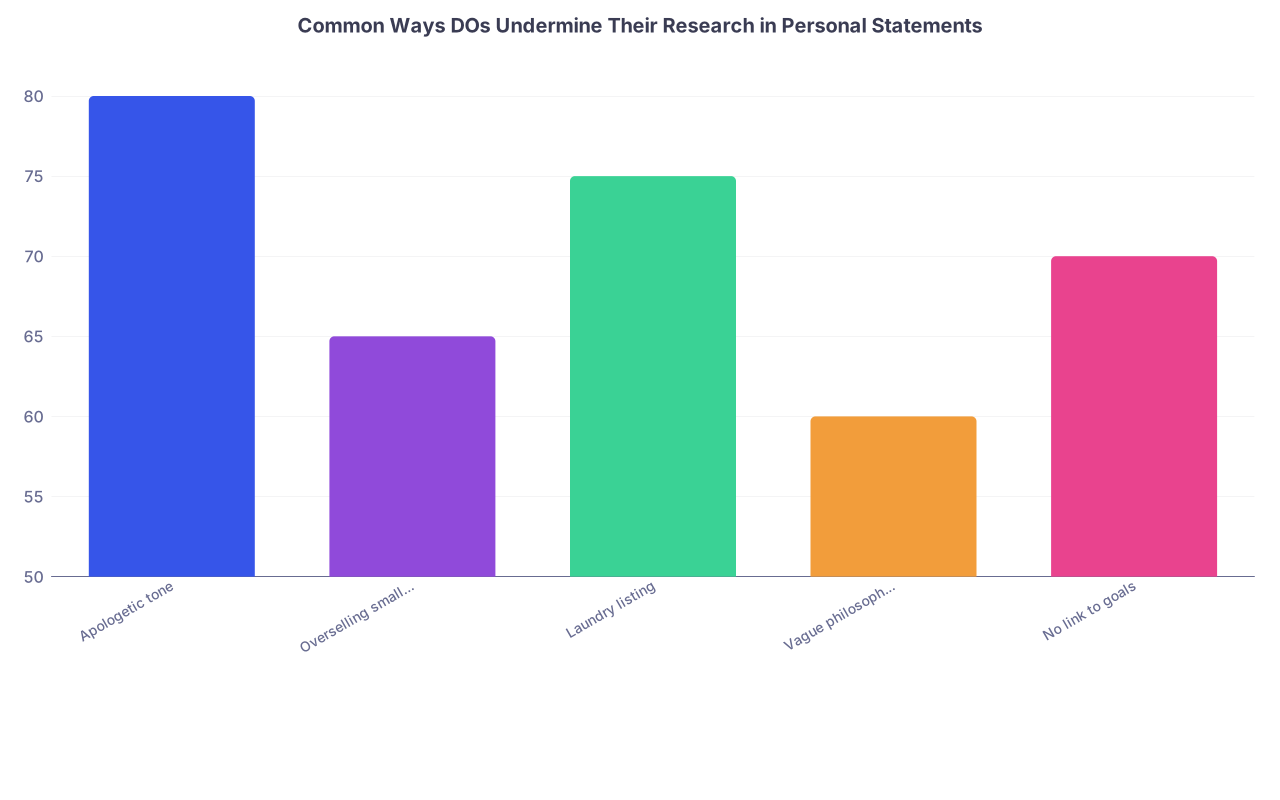
| Category | Value |
|---|---|
| Apologetic tone | 80 |
| Overselling small projects | 65 |
| Laundry listing | 75 |
| Vague philosophy only | 60 |
| No link to goals | 70 |
Mistake #8: Pretending Research Doesn’t Matter for “Community” Programs
This one is insidious.
A lot of DOs tell themselves:
“I’m just applying to community ACGME programs. Research doesn’t really matter there.”
Then they either:
- Skip research in the statement entirely, or
- Mention it briefly as some past, irrelevant thing they did.
Here’s the problem:
Even community programs have ACGME requirements for scholarly activity. They need residents who can:
- Help with QI projects
- Participate in outcomes tracking
- Present at local or state meetings
- Contribute to basic academic metrics to keep accreditation safe
Program directors at these places are tired of residents who cannot or will not do that work.
If you have any research background at all and your PS acts like it’s irrelevant, you’re telling them:
“I might be another resident who doesn’t care about data, QI, or improvement.”
What you should do instead:
You don’t have to pretend you want to be a physician-scientist. You do need to show that:
- You can engage with data
- You see the value of QI and outcomes
- You’re able and willing to contribute at a realistic level
Example for a community IM program:
“While I don’t plan a career in bench research, contributing to QI and outcomes projects is important to me. My experience working on heart failure readmission data showed me how even small interventions, like better discharge instructions, can change patient trajectories. I look forward to contributing to similar efforts in residency — especially in a community setting where resources are limited and thoughtful system changes can have outsized impact.”
This frames you as exactly what they want: realistic, useful, not allergic to scholarly work.

| Step | Description |
|---|---|
| Step 1 | Choose 1-2 Key Projects |
| Step 2 | State Clinical Problem Clearly |
| Step 3 | Describe Your Specific Role |
| Step 4 | Explain Main Insight or Lesson |
| Step 5 | Connect to Specialty Interest |
| Step 6 | Show How It Shapes You as a Future Resident |
Mistake #9: Letting Insecurity About Being a DO Leak Into Every Sentence
This is the underlying pattern behind most of these mistakes.
You’re up against:
- MCAT/Step/COMLEX comparisons
- Program “reputation” tiers
- Constant online noise about “MD vs DO” and “can DOs match X specialty?”
So you try to make your research prove you “belong.” And you overcorrect.
The result:
- Apology language
- Overselling
- Defensive tone
- Over-explaining every choice
- Cramming every research detail into one statement as if you’ll never get another chance
You do not fix DO bias by arguing with it in your personal statement. You fix it by sounding like the kind of person a program will trust:
- Grounded
- Honest
- Clear
- Thoughtful
- Already acting like a junior colleague, not a panicked applicant
Your research paragraph(s) should reflect that.
The 3 Questions to Check Your Draft Against
When you finish your personal statement, especially the research sections, ask yourself:
Do I sound apologetic, defensive, or like I’m explaining why it’s “pretty good for a DO”?
If yes, cut or rewrite those lines.Would a skeptical MD faculty member read this and think, “This person understands what they did and why it matters”?
If not, add clarity on your role and what you learned.Does my research clearly support my specialty choice and the kind of resident I’ll be — or does it feel bolted on?
If it’s bolted on, rework the narrative so research is part of your trajectory, not an afterthought.
If your statement fails those questions, fix it before you send anything.
Quick Summary: What Not to Do
You’ve done the hard part already — you actually did the research. Do not let your personal statement be the weak link.
Keep these core points in your head:
Don’t apologize for being a DO doing research.
Present your work confidently and factually, without “despite my school…” framing.Don’t oversell or laundry-list.
Choose 1–2 meaningful projects, be honest about scope, and show what you did and learned.Don’t disconnect research from your specialty and future role.
Tie your projects directly to why you’re choosing that field and how you’ll function as a resident.
Avoid those three landmines and you’ll already be ahead of a lot of DO applicants who did plenty of work — and then quietly talked programs out of caring about it.