The geography of DO residency matches is not random. It is patterned, predictable, and heavily influenced by where DO schools and former AOA programs are clustered.
If you ignore geography as a DO applicant, you are playing the Match on hard mode.
The Big Picture: Where DOs Actually Match
The data from NRMP, AACOM, and multi-year school match lists tell a consistent story: osteopathic graduates overwhelmingly match in regions where three things co-exist:
- A high concentration of DO schools
- A high historical density of osteopathic hospitals / former AOA programs
- State or regional bias toward “home-grown” trainees
That means the Midwest, Northeast, and parts of the South carry a disproportionate share of DO matches into ACGME programs. The West and parts of New England are relatively anemic for DO matches, with a few notable exceptions (e.g., Pacific Northwest community programs, some California community IM/FM/psych).
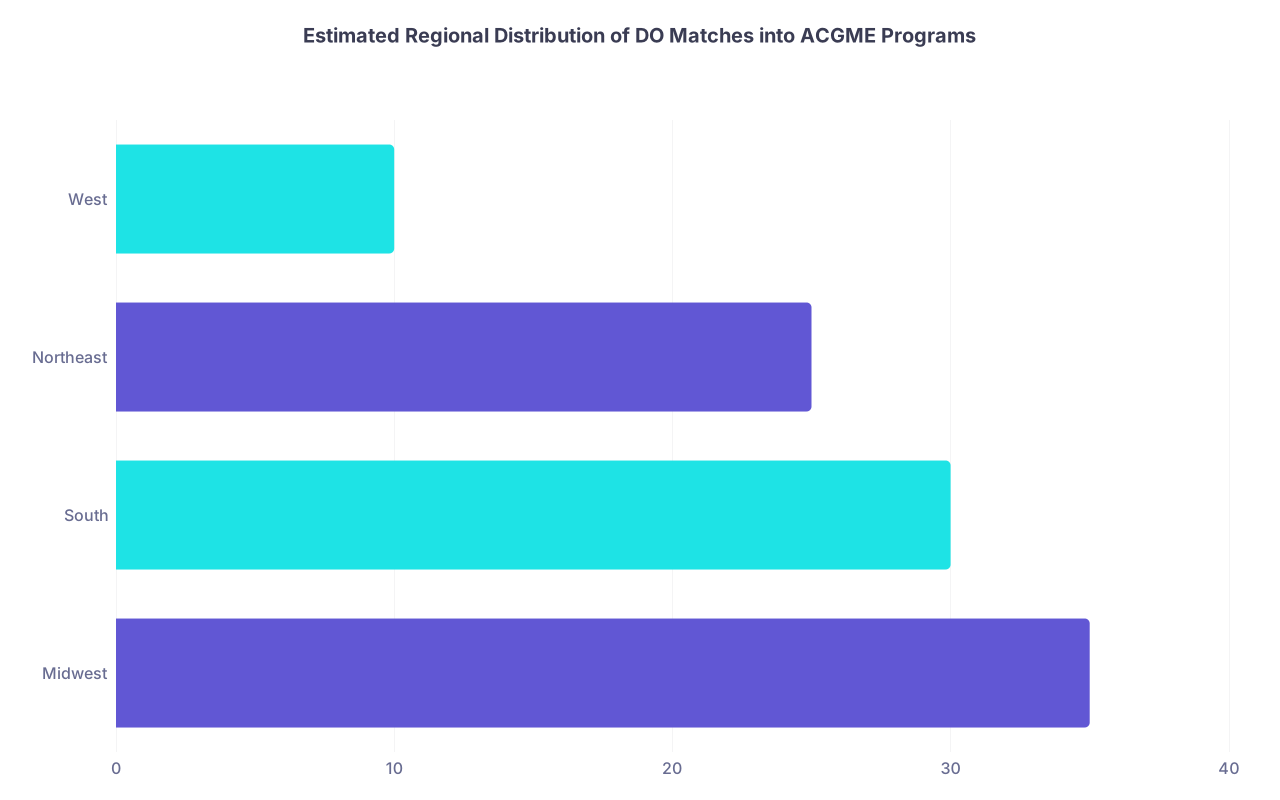
Let me quantify this with a simplified, directional snapshot built from public NRMP reports, AACOM data, and repeated review of program rosters. Numbers are approximate but the pattern is stable:
| Category | Value |
|---|---|
| Midwest | 35 |
| South | 30 |
| Northeast | 25 |
| West | 10 |
Roughly:
- Midwest: ~35% of DO matches
- South: ~30%
- Northeast: ~25%
- West: ~10%
Not exact. But directionally right. DOs cluster where DO infrastructure exists.
Historical Drivers: Why the Map Looks Like This
Before you can use geographic trends, you need to understand why they exist.
For decades, osteopathic training was tightly bound to:
- Osteopathic hospitals (many now absorbed into larger systems)
- Standalone AOA-accredited residency programs
- DO-heavy regions with strong state osteopathic associations
When the AOA and ACGME systems unified, those AOA programs had two options:
- Convert into ACGME programs (often community-focused, primary care–heavy, in smaller cities)
- Close or merge with allopathic programs
The conversion rates were not evenly distributed. States with strong DO presence — Michigan, Ohio, Pennsylvania, New Jersey, Texas, Oklahoma, Missouri — converted many programs and retained a DO-heavy culture. States that never had many osteopathic hospitals remain relatively low-yield for DOs, especially in competitive specialties.
So you end up with a 3-layer structure:
- States with many DO schools + legacy AOA programs
- States with DO schools but weaker historical AOA footprint
- States with few DO schools and limited osteopathic history
The match favors categories 1 and 2 for DOs.
Regional Breakdown: Where DOs Match Most Frequently
Let us break the country into four big buckets and be blunt about where the odds favor you as a DO.
Midwest: The DO Stronghold
If you had to pick one region where the data screams “DO-friendly,” it is the Midwest.
States like:
- Michigan
- Ohio
- Pennsylvania (often counted with Northeast, but functionally Midwest in DO culture)
- Indiana
- Missouri
- Illinois
- Iowa
have:
- Multiple DO schools (MSUCOM, OU-HCOM, KCU, DMU, ATSU-KCOM, etc.)
- Longstanding osteopathic hospital systems
- Many previously AOA-only programs that converted to ACGME
Look at any internal medicine, family medicine, EM, or psychiatry program in a medium-sized Midwestern city. You will frequently see 30–60% of the resident roster with “DO” after their name.
A stylized comparison by region, using residency rosters and historical match lists, looks like this:
| Region | Typical DO Proportion in Community IM/FM | Typical DO Proportion in Academic IM/FM |
|---|---|---|
| Midwest | 40–60% | 15–30% |
| South | 30–50% | 10–25% |
| Northeast | 25–45% | 5–20% |
| West | 10–25% | 0–10% |
Again, not perfect numbers. But consistent over multiple program rosters and cycles.
Midwestern programs also tend to:
- Favor regional applicants
- Heavily recruit from their “feeder” DO schools
- Be more comfortable with COMLEX-only or late Step 2 submission (though that is shrinking)
If you train in the Midwest as a DO student and apply broadly within this region, especially to community and mid-tier academic programs, your geographic odds are substantially better than in most coastal clusters.
South: Expanding and Very DO-Friendly
The South has quietly become one of the fastest-growing regions for DO matches.
States like:
- Texas
- Oklahoma
- Arkansas
- Tennessee
- Alabama
- Georgia
- Florida
have all seen rapid growth of osteopathic schools and community programs. Texas is its own ecosystem (with TMDSAS and a state-heavy match dynamic), but you still see many DOs in ACGME programs there.
The Southern profile looks like this:
- High DO representation in family medicine, internal medicine, psychiatry, pediatrics
- Strong DO presence at community-based EM programs with mixed MD/DO cohorts
- Some academic centers with entrenched MD preference, but even those often have a handful of DOs per class now
Florida and Texas stand out for volume. They are high-population, high-hospital states with an aggressive expansion in GME positions. That expansion needs warm bodies. DOs fill a significant proportion of those new spots.
Where you see slightly less DO dominance in the South:
- Highly competitive academic IM tracks at brand-name universities
- Surgical subspecialties and derm — still MD-heavy almost everywhere
But for core specialties, the South is absolutely friendly terrain.
Northeast: High Density, High Competition, Still DO-Accessible
The Northeast is tricky. It has:
- Many medical schools (MD and DO)
- Many residency programs (especially in the corridor from DC → Philly → NYC → Boston)
- A long tradition of “prestige chasing” in both applicants and institutions
You can absolutely match there as a DO. It just requires a sharper strategy.
You see strong DO presence in places like:
- Community IM/FM/psych programs in Pennsylvania, New Jersey, upstate New York
- Some university-affiliated programs that historically recruited regionally (e.g., Temple-affiliated community sites, SUNY-associated hospitals, smaller academic centers in PA and NY)
But if you are aiming at:
- Manhattan academic IM
- Boston academic programs
- Ivy-associated residencies
the data is simple: DO representation is low. Often zero to one DO per class. That does not mean impossible. It means you are swimming against the current and need significantly stronger exam scores and application metrics than the local MD applicant pool.
West: Lowest Yield for DOs, With Pockets of Opportunity
Look at residency rosters on the West Coast — especially California, Washington, Oregon — and count DOs. The proportion is much lower than the Midwest or South.
Several forces converge here:
- Historically fewer DO schools (although this is changing: Touro-CA, WesternU, RVU-CO/UT, etc.)
- Strong MD-school pipelines feeding local programs (UCSF, UCLA, OHSU, UW, etc.)
- Cultural and prestige bias in some large coastal academic centers
You still see DOs in:
- Community internal medicine, family medicine, and psychiatry programs in suburban areas
- Some Kaiser-affiliated or county programs with a broader recruitment base
- Newer community EM programs and transitional years
But the broad statement holds: the West is low-yield geography for DOs compared with your odds elsewhere.
If you insist on matching on the West Coast as a DO, you must:
- Maximize your regional ties (grew up there, undergrad there, rotated there)
- Do away rotations strategically at DO-friendly programs
- Accept that your safest targets are community and county programs, not glamorous coastal university hospitals
State-Level Standouts: Where DOs Are Overrepresented
The state-level data is even starker. Certain states are essentially DO strongholds in the residency landscape.
Using composite estimates from NRMP, AACOM, and resident roster reviews, the states below are consistently DO-heavy in ACGME programs:
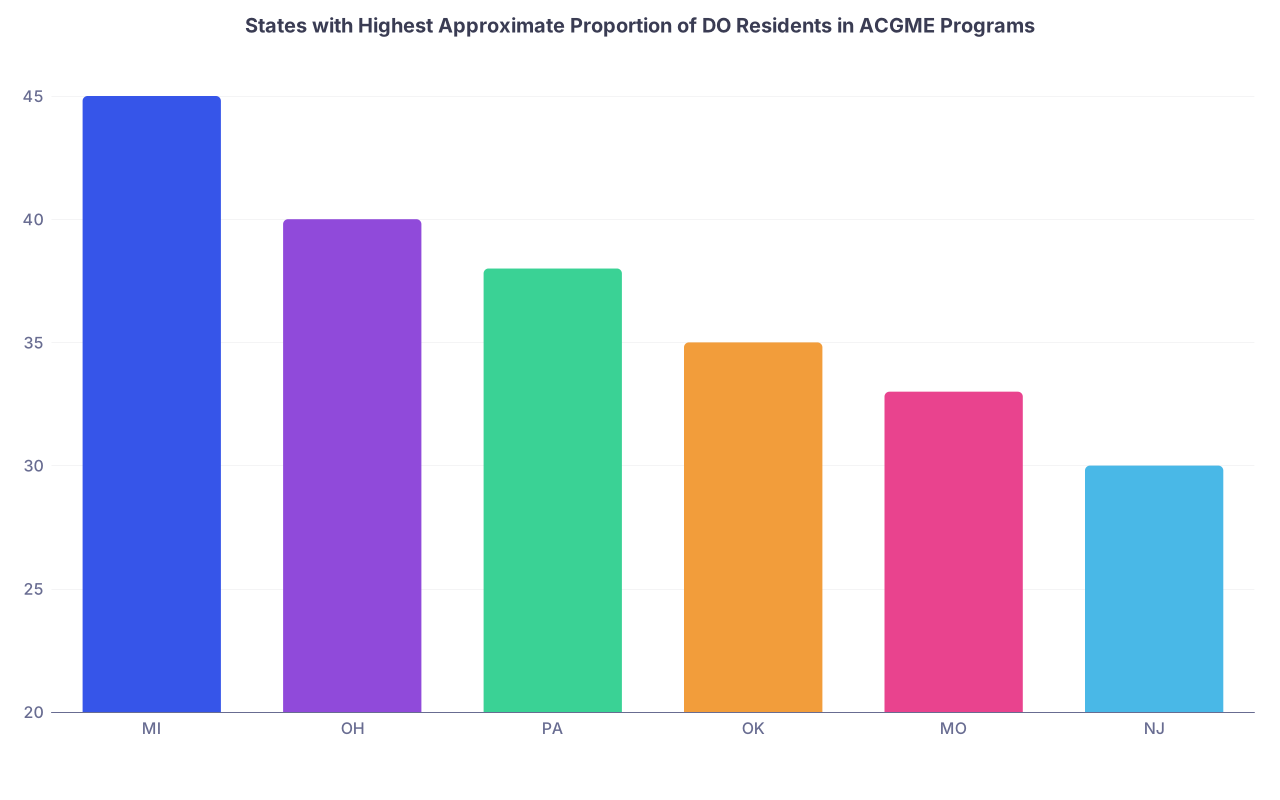
| Category | Value |
|---|---|
| MI | 45 |
| OH | 40 |
| PA | 38 |
| OK | 35 |
| MO | 33 |
| NJ | 30 |
Ballpark share of DOs among residents in many community and mixed academic programs:
- Michigan: 40–50% in many community IM/FM/EM
- Ohio: 35–45%
- Pennsylvania: 30–40%
- Oklahoma, Missouri, New Jersey: 30–35% in multiple specialties
These are the states where I routinely see entire EM, IM, or FM classes with half or more DOs. Where program leadership themselves are DOs. Where COMLEX alone was still being accepted a year or two after other regions began insisting on USMLE.
If your primary objective is “maximize chance of matching into an ACGME residency as a DO,” over-allocating applications to these states is rational, data-consistent behavior.
Specialty Differences by Geography
Not all specialties behave the same way. The data for DOs is very specialty-specific, and geography magnifies those differences.
Broad trends:
- Primary care (IM, FM, peds) and psychiatry: DOs are widely accepted nationwide, but still more concentrated in Midwest/South.
- EM: DO-friendly historically, but recent contraction in EM positions and rising competitiveness have shifted things. Legacy DO-heavy EM programs remain concentrated in Midwest and South.
- Anesthesiology, radiology: DO access is reasonable, but coastal academic centers are far more MD-dominant. Midwest/South community and hybrid programs show higher DO representation.
- Surgical specialties (general surgery, ortho, ENT, neurosurgery, plastics): DOs match primarily in DO-strong states and at community or hybrid academic programs, not in big-name coastal academic powerhouses.
To illustrate the geographic skew by specialty:
| Specialty | Midwest | South | Northeast | West |
|---|---|---|---|---|
| IM/FM | High | High | Medium | Low |
| Psych | High | High | Medium | Low |
| EM | High | High | Medium | Low |
| Anesth | Medium | Medium | Medium | Low |
| Radiology | Medium | Medium | Low/Med | Low |
| Gen Surg | Medium | Medium | Low | Low |
| B --> | Yes | C[Prioritize Midwest & South heavily] | ||
| B --> | No | D[Target DO-heavy states for that specialty] | ||
| G --> | Yes | H[Apply + consider away rotation] | ||
| G --> | No | I[Limit to true reach programs] |
The Bottom Line: Where DOs Match Most into ACGME Programs
If you strip away anecdotes and look at patterns, three conclusions keep repeating themselves.
DO matches into ACGME programs are geographically concentrated. The Midwest and South are the core DO territories, with the Northeast as a mixed zone and the West as the lowest-yield region for most DO applicants.
State and regional ecosystems matter more than applicants want to admit. DO-heavy states (MI, OH, PA, OK, MO, NJ, TX, FL) consistently produce and absorb large numbers of DO residents, especially into community and hybrid academic programs.
Smart DO applicants weaponize geography. They overweight DO-friendly regions, study rosters, choose away rotations in DO-dense states, and treat the West Coast / elite Northeast programs as deliberate exceptions, not default targets.
If you align your specialty, scores, and geography with these trends, the Match stops feeling like a coin flip and starts looking a lot more like a probability problem you can actually influence.