
The myth that “a pass is a pass” on Step 2 CK and Level 2 CE for DO applicants is flatly wrong. The match data show clear, repeatable score thresholds that separate competitive DO candidates from everyone else in ACGME programs.
You are not competing in a vacuum. You are competing against MD and DO applicants whose Step 2 CK and Level 2 CE score patterns follow very predictable distributions. Program directors behave like rational consumers of those numbers. You should, too.
Let me walk through what the data actually show, specialty by specialty, and what that means for a DO applicant trying to match into ACGME programs.
1. The macro picture: DO match, USMLE vs COMLEX
USMLE Step 2 CK and COMLEX Level 2 CE are functionally the only standardized cognitive metrics left in play. Step 1 and Level 1 are pass/fail. That means the pressure has shifted.
Across recent NRMP and NMS data (2022–2024 cycles), a few big patterns stand out:
- DOs taking USMLE Step 2 CK have higher match rates into competitive ACGME specialties than DOs relying on COMLEX alone.
- Programs frequently quote “no minimum” but show de facto cutoffs in their matched cohorts.
- Level 2 CE scores, when used alone, tend to be interpreted through rough conversion heuristics by program coordinators. Those heuristics are blunt and not always favorable.
Let us frame some rough but realistic numeric anchors. Based on combined NRMP, NRMP Program Director Survey, and osteopathic specialty match data, this is approximately where DO applicants landing ACGME categorical spots cluster, by competitiveness tier.
| Specialty Tier | Avg Step 2 CK (DOs who matched) | Typical Range | Approx Level 2 CE Equivalent* |
|---|---|---|---|
| Hyper-competitive | 250–255+ | 245–265 | 640–670+ |
| Competitive | 243–250 | 238–255 | 615–650 |
| Mid-competitive | 235–243 | 230–248 | 595–625 |
| Less competitive | 225–235 | 220–242 | 570–600 |
*Equivalents based on empirical correlation ranges residents and advisors consistently report (there is no official conversion, but the clustering is very consistent).
These are not rigid cutoffs. They are statistical centers of gravity. Outliers exist, but if you are planning a strategy, you plan around the median, not the miracle.
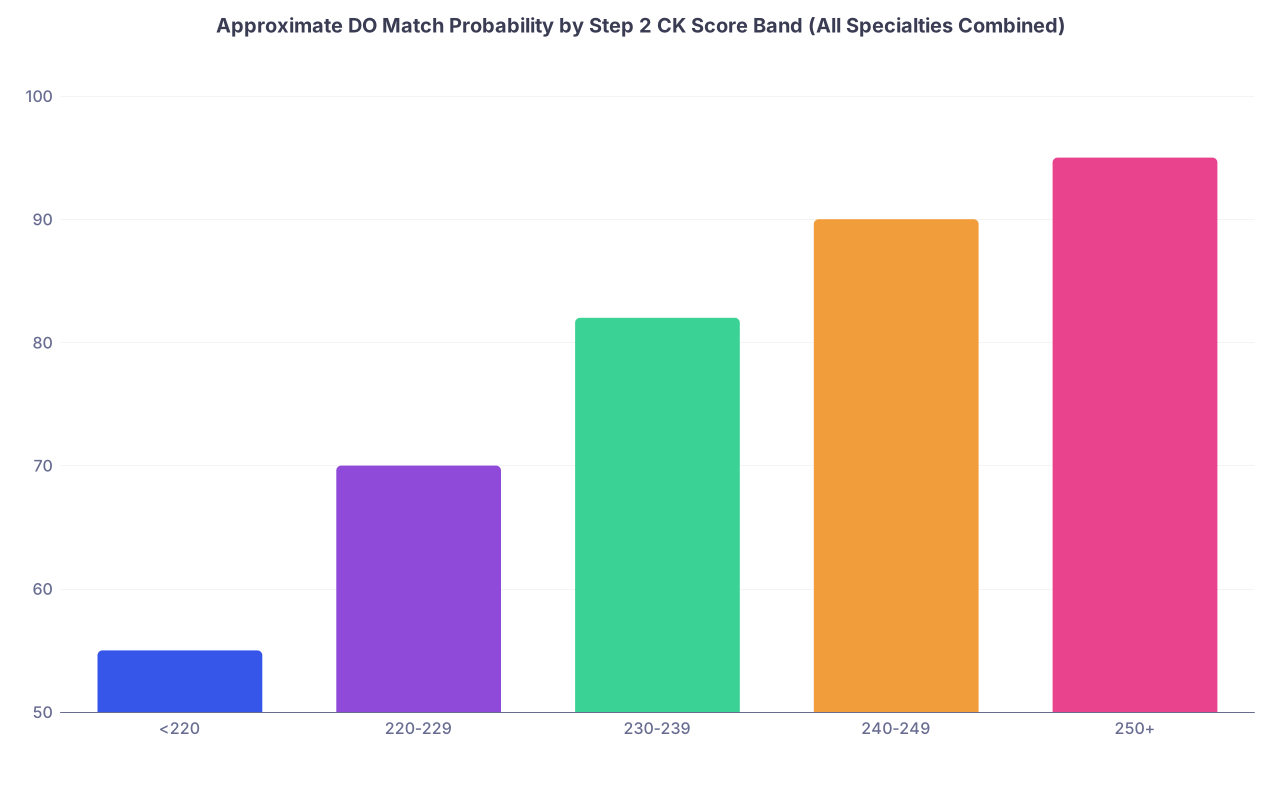
To visualize how DO match probabilities tend to climb by Step 2 CK band, here is a simplified approximation that mirrors published aggregate trends:
| Category | Value |
|---|---|
| <220 | 55 |
| 220-229 | 70 |
| 230-239 | 82 |
| 240-249 | 90 |
| 250+ | 95 |
Below 220, the odds fall off sharply for many ACGME programs. Above 240, you start to look like a safe bet for a broad range of specialties. Above 250, doors to hyper-competitive fields that are often closed to DOs begin to crack open.
2. Converting Level 2 CE to Step 2 CK reality
Most DO students ask the wrong question: “Is my Level 2 CE good?” The useful question is: “What Step 2 CK band does this suggest, and is that competitive for my target specialty?”
Programs vary in how they interpret COMLEX-only applications:
- Some use internal conversion formulas (usually simple linear approximations).
- Some eyeball: “600+ looks solid, 650+ very strong, 700+ exceptional.”
- Some, bluntly, still prioritize USMLE over COMLEX and quietly downgrade DOs without CK.
From years of advising and watching match outcomes, this is the rough mapping that actually matches how programs treat scores:
| Level 2 CE Range | Informal Perception | Approx Step 2 CK Band |
|---|---|---|
| <540 | Below-average / risky | <225 |
| 540–569 | Modestly below average | 225–232 |
| 570–599 | Solid / average | 232–240 |
| 600–629 | Above average | 240–247 |
| 630–659 | Strong | 247–253 |
| 660–689 | Very strong | 253–260 |
| ≥690 | Outstanding / top few % | >260 |
Again, not official. But this is extremely close to how faculty talk in rank meetings.
If you have only Level 2 CE, many PDs will mentally place you into one of these bands and then compare that band to what they usually expect for their matched residents.
One more structural trend that matters: PD surveys consistently show that for DO applicants:
- A majority of allopathic programs “prefer” or “strongly prefer” USMLE scores.
- A non-trivial fraction will not seriously consider DO candidates without Step 2 CK, particularly in competitive specialties.
So the “should I take Step 2 CK as a DO?” question is not really a question anymore. If you are aiming for ACGME and anything above low-competition primary care, you take it.
3. Specialty tiers: where the thresholds really bite
Score thresholds are not uniform. A 235 can make you a star in one field and an automatic screen-out in another. Let me break this down by competitiveness tier and what the data patterns show for DOs specifically.
Hyper-competitive specialties
(Orthopedic surgery, dermatology, plastic surgery, ENT, neurosurgery)
For DOs, these are brutally numbers-driven, often more so than for MDs, because many programs accept only 1–2 DOs across several years or none at all.
Typical patterns:
- Matched DOs in ortho, derm, etc., usually have Step 2 CK ≥ 250, often ≥ 255.
- Level 2 CE alone, even at 650+, is rarely enough if there is no USMLE score.
- A significant number of programs in these specialties simply do not interview DOs, period. Numbers cannot fix that, but high scores are the prerequisite for the subset that do.
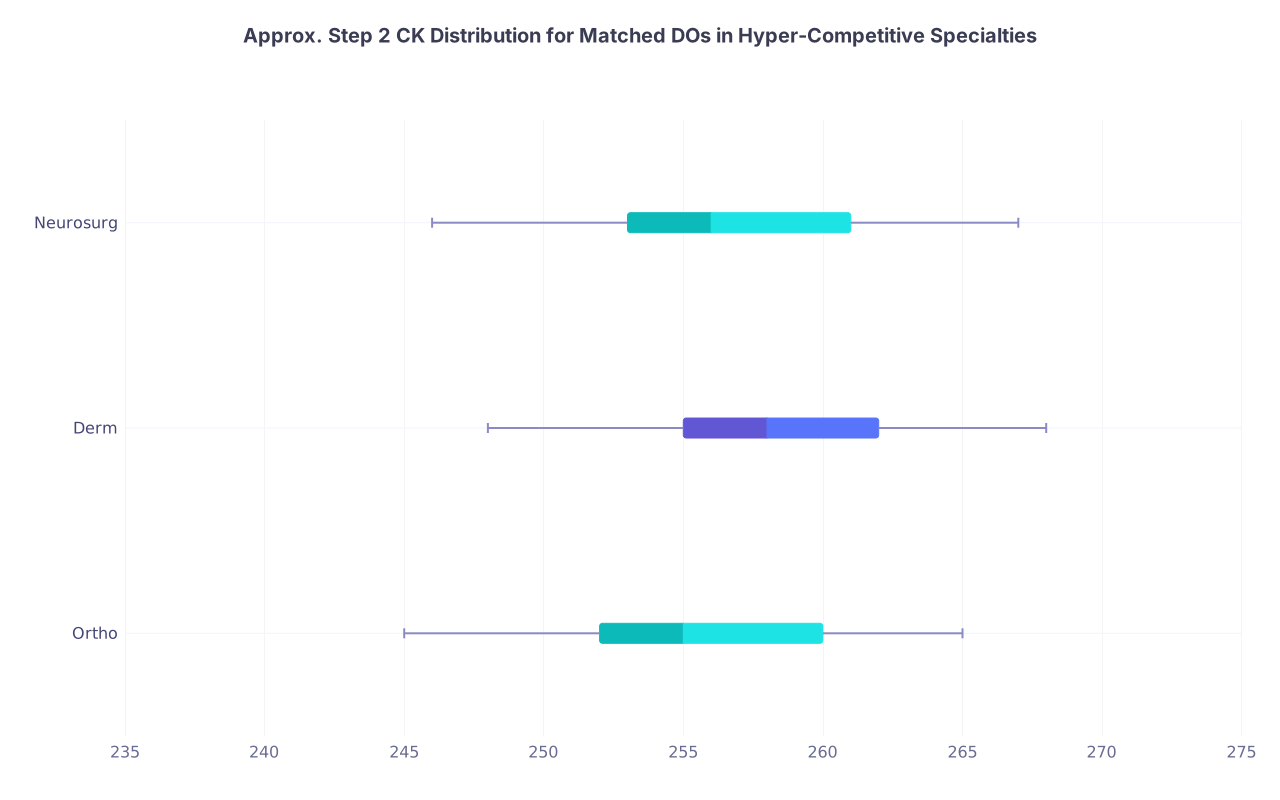
A realistic approximate distribution of matched DO Step 2 CK scores in these specialties looks something like this:
| Category | Min | Q1 | Median | Q3 | Max |
|---|---|---|---|---|---|
| Ortho | 245 | 252 | 255 | 260 | 265 |
| Derm | 248 | 255 | 258 | 262 | 268 |
| Neurosurg | 246 | 253 | 256 | 261 | 267 |
Interpretation:
- 50% of matched DOs in these fields sit around 252–260.
- Outliers below 245 exist, but they almost always have major compensatory factors: home program advantage, strong research with name-brand surgeons, or a prior career.
If your Step 2 CK is <245 or Level 2 CE <630, your odds in these fields are single-digit percentages unless you have an unusually strong network and institution behind you. That is just what the numbers show.
Competitive specialties
(Anesthesiology, diagnostic radiology, emergency medicine, OB/GYN, general surgery)
For these, DOs are more common, but the bar is still materially higher than the overall DO average.
Patterns for DOs who match ACGME categorical:
- Step 2 CK: Typically 243–252.
- Level 2 CE: Roughly 615–650.
- A large block of mid-tier university and strong community programs will quietly anchor their Step 2 “comfort zone” around 240+ for DOs.
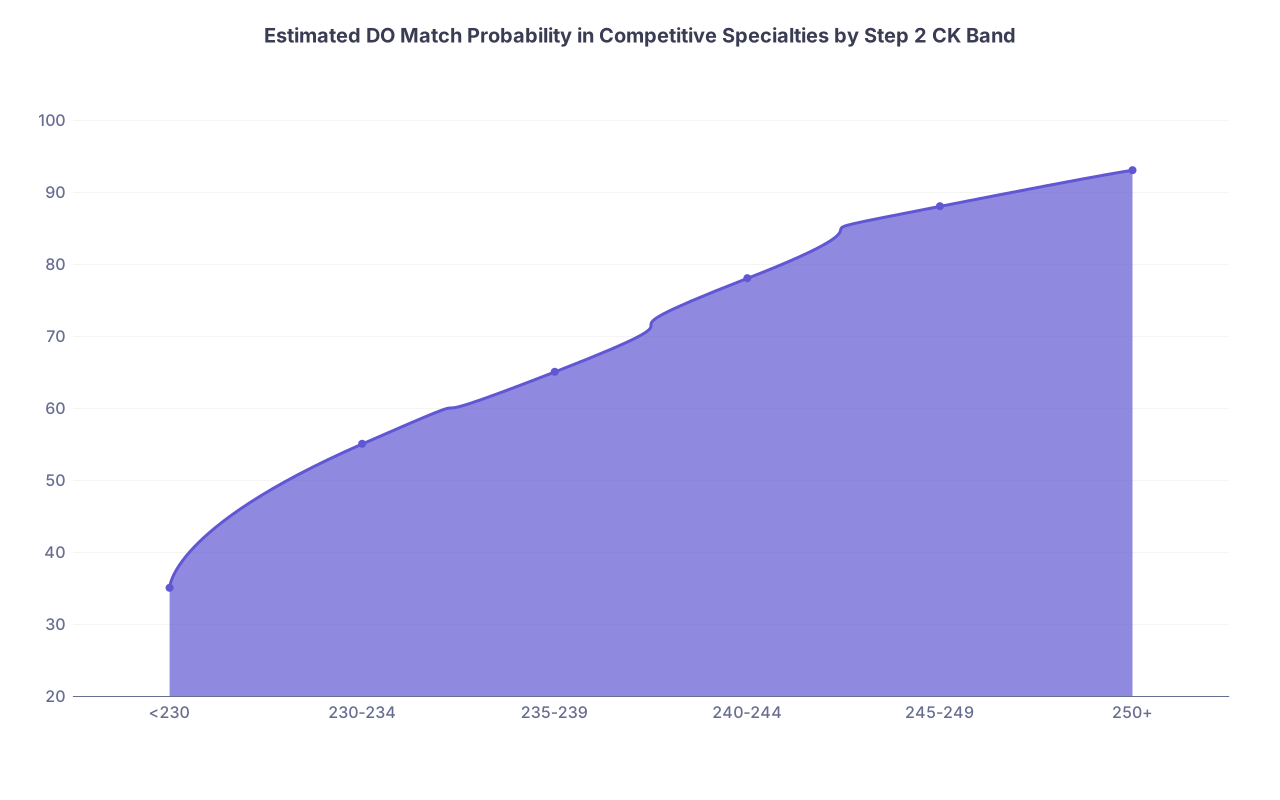
Here is a simplified matching-probability pattern for DOs targeting the “competitive but not insane” group (anesthesia, EM, rads, OB/GYN, gen surg):
| Category | Value |
|---|---|
| <230 | 35 |
| 230-234 | 55 |
| 235-239 | 65 |
| 240-244 | 78 |
| 245-249 | 88 |
| 250+ | 93 |
Three takeaways from this curve:
- Huge jump from sub-230 to even low 230s. Many programs cut off <230 automatically.
- Second big jump around 240; that band looks “safe” to most mid-tier ACGME PDs.
- Marginal gains above 250 still matter for academic/university-heavy lists, but the returns slow.
If you are a DO with a 238 Step 2 CK and solid Level 2 CE, you are not shut out of these fields. But you will feel the difference compared to a 248+ peer when interview season hits.
Mid-competitive specialties
(Internal medicine categorical at university programs, pediatrics, psychiatry, neurology)
This is where most DOs land and where score thresholds still matter, but the curves are gentler.
Typical matched DO patterns:
- Step 2 CK: 235–243 for stronger programs; 225–235 for community-heavy.
- Level 2 CE: 595–625 common; high 500s still workable with strong clinicals and letters.
For IM categorical, there is a clear tiering:
- Top academic IM (think big-name university hospitals): DOs who match generally run Step 2 CK > 245 and often > 250, with research or strong sub-I performance.
- Mid-tier academics / strong community: 235–245 range.
- Broad community programs: low 220s+ are often fine if other parts are on point.
Lower-competition / more DO-friendly specialties
(Family medicine, community internal medicine, community pediatrics, PM&R in some regions, psych in many non-urban settings)
For these, the door is wide open for DOs across a broader score range, but that does not mean scores stop mattering.
Patterns:
- Step 2 CK: Many matched DOs fall in the 220–240 range; >240 starts pushing you toward more selective or urban programs.
- Level 2 CE: 570–600 very common; 600+ often correlates with more choice of geography and program type.
In these fields, a Level 2 CE of 580 or a Step 2 CK of 228 will usually not keep you from matching somewhere. But if you want a specific coastal city, an academic brand name, or a fellowships-heavy program, the same 240+ thresholds start to show up again.
4. Step 2 CK vs Level 2 CE: behavior patterns of ACGME programs
Let me be blunt. A meaningful number of ACGME programs still do not know how to interpret COMLEX Level 2 CE scores with nuance. Their behavior shows this.
What PDs and coordinators actually do:
- They sort by USMLE first.
- They apply COMLEX conversions that compress scores and sometimes under-estimate DO performance.
- They use thresholds differently for MD and DO applicants, even at the same Step 2 band, because they assume more variability in clinical preparation for DOs (sometimes fairly, sometimes not).
I have seen this repeatedly: a DO with Level 2 CE of 650 but no Step 2 CK gets half the interview invites of another DO with Level 2 CE 620 and Step 2 CK 244. Same school, similar letters. The presence of a CK number changes how programs triage.
So from a data-driven perspective, the most reliable behavioral model is:
- For ACGME programs, Step 2 CK is the reference currency.
- Level 2 CE is a useful supporting metric, but rarely the primary decision driver unless it is all they have.
- DOs who supply both tend to outperform COMLEX-only DOs in interview count and in match outcomes, at the same underlying ability level.
5. Strategy: using thresholds to build a realistic application plan
You cannot change your score after the fact, but you can make decisions that align with the thresholds instead of ignoring them. Here is how to reason like a data analyst about your own profile.
Step 1 – Place yourself into a band
Use your actual Step 2 CK and Level 2 CE to classify yourself. Do not sugarcoat it.
- Step 2 CK < 225 or Level 2 CE < 540: You are in a red-flag zone for many ACGME programs. Strategy: favor more DO-friendly specialties, consider backup plans (transitional year, prelim spots, more community-heavy programs).
- Step 2 CK 225–235 / Level 2 CE 540–590: Competitive for many FM, community IM/peds/psych; borderline for anesthesia, EM, rads, OB/GYN, surgery unless you have strong compensating factors.
- Step 2 CK 236–245 / Level 2 CE 590–630: Strong overall. Realistic for most competitive specialties outside the hyper-competitive set, especially if clinical performance and letters are good.
- Step 2 CK >245 / Level 2 CE >630: You are numerically positioned to take a serious shot at nearly any specialty, though DO bias still exists in ortho/derm/plastics/neurosurg/ENT.
Step 2 – Align specialties with your band
Here is a simplified matrix that reflects how DOs at different Step 2 bands fare by specialty tier:
| Step 2 CK Band | Hyper-competitive | Competitive | Mid-competitive | Less competitive |
|---|---|---|---|---|
| <230 | Very low | Low | Moderate | High |
| 230–239 | Very low | Moderate | High | Very high |
| 240–249 | Low–moderate | High | Very high | Very high |
| ≥250 | Moderate | Very high | Very high | Very high |
The “very high” here does not mean guaranteed. It means scores are not your limiting factor.
Step 3 – Adjust program list depth and mix
Once you know your band, you adjust:
- Lower bands (<235) apply broadly and tilt more toward community, osteopathic-friendly, and mid-tier academic programs.
- Mid bands (235–245) can mix academic and community but still need a significant cushion of safer programs.
- Higher bands (>245) can afford more reach, including university and hyper-competitive fields, if the rest of the application aligns.
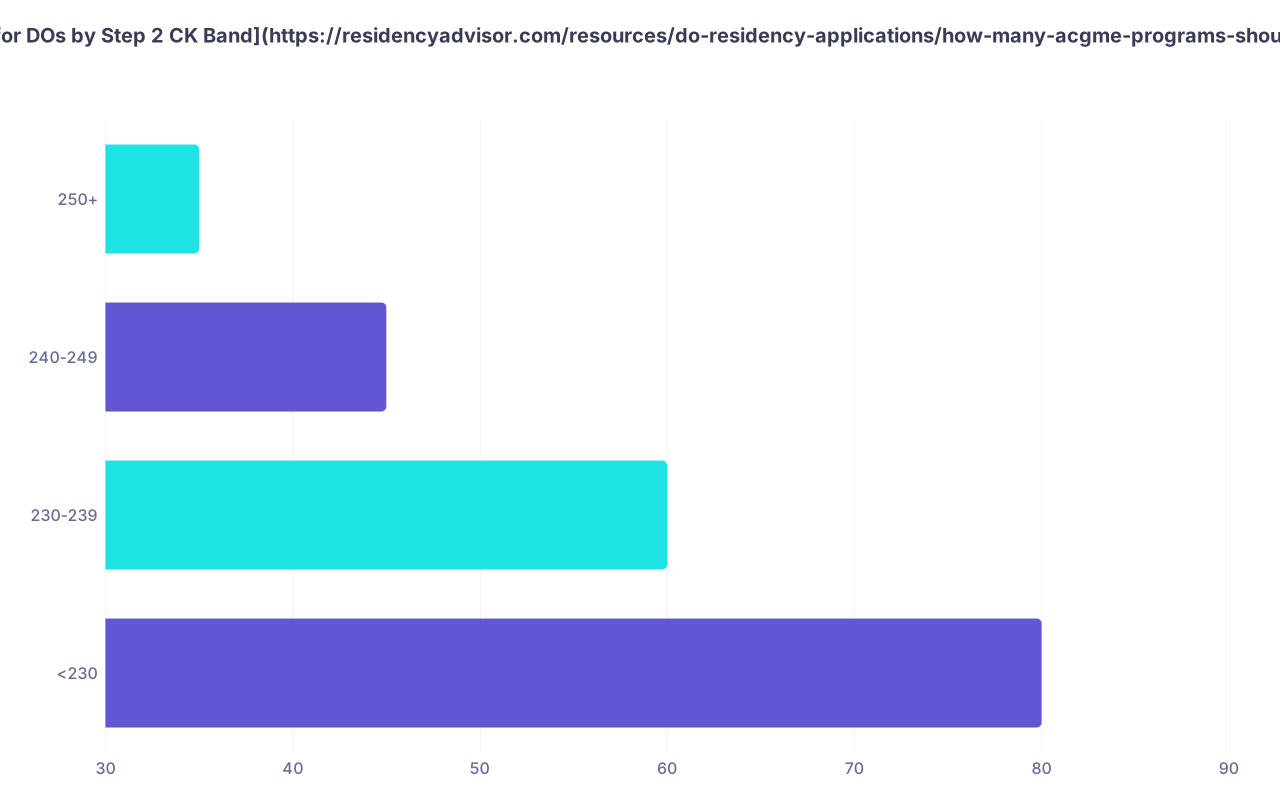
If you want a visual of how many programs you might need given your score band (all else average), the pattern looks roughly like this:
| Category | Value |
|---|---|
| <230 | 80 |
| 230-239 | 60 |
| 240-249 | 45 |
| 250+ | 35 |
Lower scores demand volume. Higher scores allow targeted, curated lists.
6. How timing and trends are shifting pressure onto Step 2 / Level 2
Step 1 and Level 1 going pass/fail did not make things easier. It shifted the entire “numerical gate” downstream to Step 2 CK / Level 2 CE.
Look at how quickly programs have pivoted:
- PD survey data show that within 1–2 cycles of Step 1 P/F, the “importance” rating of Step 2 CK jumped significantly, especially for initial interview offers.
- For DOs, the effect is amplified, because the exam that programs actually trust to compare DO vs MD applicants is Step 2 CK.
The trend line is simple:
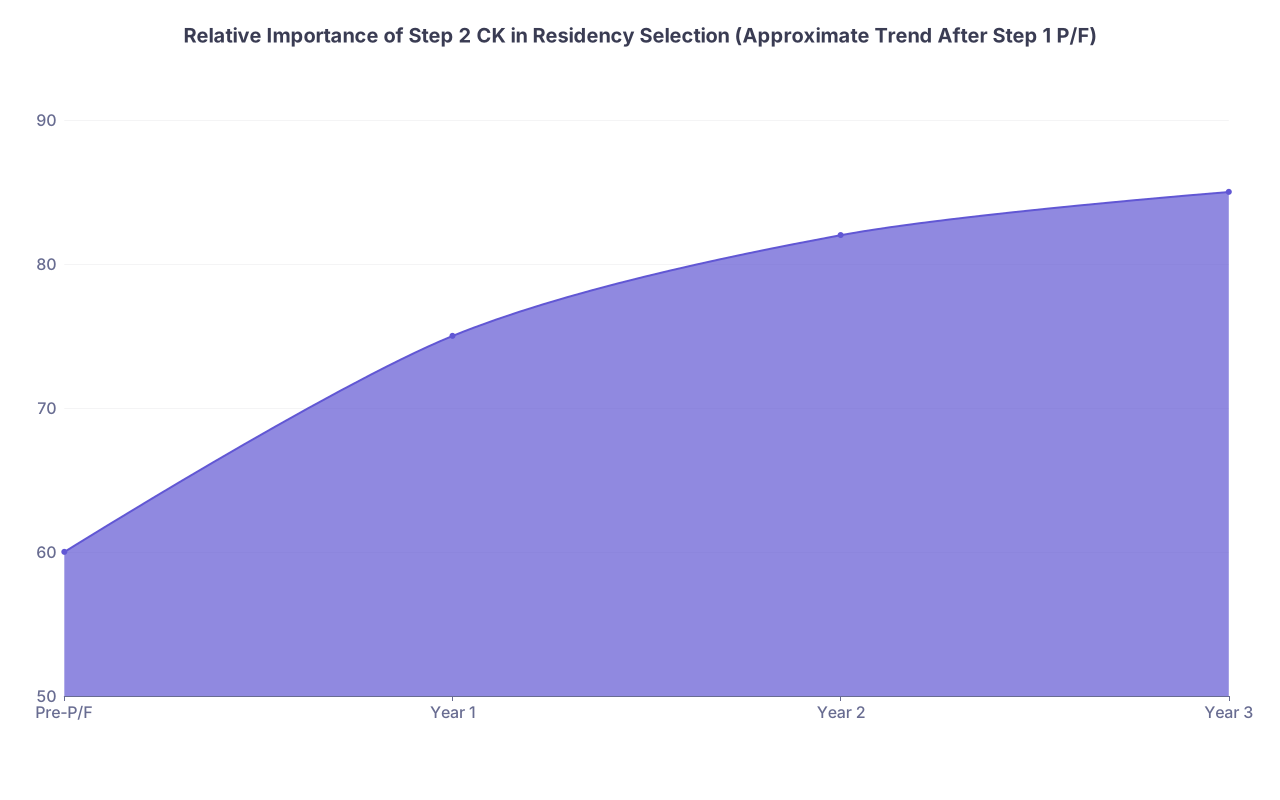
| Category | Value |
|---|---|
| Pre-P/F | 60 |
| Year 1 | 75 |
| Year 2 | 82 |
| Year 3 | 85 |
(Values here are conceptual “importance scores” derived from PD survey shifts; the direction is accurate even if individual numbers vary by specialty.)
If you are an OMS-II or OMS-III reading this, the implication is brutal but clear: your Step 2 CK and Level 2 CE prep deserve the kind of early, structured, data-informed planning that people used to pour into Step 1.
The variance in match outcomes for DOs is increasingly explained by what happens on Step 2 CK and Level 2 CE relative to your peers. Not by what happened on Level 1.
7. Putting it together: what the data say you should actually do
Let me strip the sentiment out and leave you with the operational takeaways.
Treat Step 2 CK as mandatory for serious ACGME ambitions.
Relying on Level 2 CE alone is a strategic handicap in most competitive specialties and many mid-tier academic programs. The empirical pattern of DO match outcomes makes this obvious.Use realistic score bands, not fantasies.
A 238 CK is a good score. It is not, however, competitive for DO ortho at most university programs. Align your targets to the bands: <230, 230–239, 240–249, ≥250, and the corresponding Level 2 CE ranges.Understand that numbers open doors, they do not compensate for everything.
I have seen 255 DOs go unmatched in derm with weak letters and no home support. I have also seen 235 DOs match anesthesia because of strong SLOEs, great rotation impressions, and being smart about program selection. But in both cases, the scores defined which doors they could even knock on.
If you treat Step 2 CK and Level 2 CE as blunt hurdles—“just pass and move on”—you are playing the wrong game. The match is not binary. It is probabilistic. And the probabilities, especially for DOs in ACGME programs, are very tightly clustered around specific score thresholds.
Use that to your advantage. Or ignore it and hope you become one of the statistical anomalies. The data, unfortunately, do not favor the second plan.