The usual “just get as many interviews as you can” advice is lazy. The data show there is a clear, quantifiable point where extra interviews add tiny marginal benefit—and that point is different for DOs in ACGME programs.
You asked the right question: How many interviews does a DO applicant actually need to have a high probability of matching in ACGME programs? Let’s answer it with numbers, not vibes.
The Core Reality: DOs, ACGME, and Match Math
The single most useful dataset for this discussion is the NRMP’s Charting Outcomes in the Match and Results and Data reports. For DOs applying to ACGME programs, three facts jump out every year:
- Interview invites are the choke point, not ranking behavior.
- Match probability rises steeply from 1 to ~8–10 interviews, then the curve flattens.
- DO status shifts the curve slightly to the right in some competitive specialties, because interview counts tend to be lower for DOs, not because the match algorithm treats you differently.
The Match algorithm itself does not care if you are MD or DO. Programs and applicants submit rank lists; the algorithm optimizes based on mutual preferences. So the interview-to-match ratio question is really:
“Given recent NRMP probabilities, at how many ACGME interviews does a DO applicant reach ~80–90%+ chance of matching?”
The exact number depends heavily on specialty.
Global Interview-to-Match Patterns for DOs
Let’s start broad before we slice by specialty.
NRMP publishes “probability of matching by number of contiguous ranks” for different applicant types (US MD, US DO, IMGs). For DOs, in most primary care–leaning specialties, the number of interviews ≈ number of programs you rank (with rare exceptions). That means we can read “contiguous ranks” as “roughly equal to interviews attended.”
Here’s what the curve looks like in plain language, for DOs in less competitive specialties (FM, IM categorical, peds, psych):
- 1–2 interviews: match probability is unreliable and volatile—anywhere from 20–50%.
- 3–4 interviews: you enter the 60–75% range.
- 5–7 interviews: you usually cross ~80–90%.
- 8–10+ interviews: you are in 90–95%+ territory most of the time.
For more competitive specialties (EM, OB/GYN, some IM subspecialty-prelim pathways, anesthesia), the curve shifts:
- 3–4 interviews: still risky (~50–60%).
- 5–7: you approach ~75–85%.
- 8–10: often necessary to feel reasonably safe.
- 12–15: where highly competitive DOs end up if their application is strong and broadly appealing.
That is the data-level overview. Now let’s quantify by category.
How Many ACGME Interviews DOs Need by Specialty Category
I am going to break this into four buckets because that mirrors how the probabilities move:
- Lower-competition primary care (FM, many community IM, peds)
- Mid-range competitiveness (psych, less competitive IM categorical, pathology, PM&R)
- Upper-mid competitiveness (OB/GYN, anesthesia, EM where DOs are still accepted)
- Hyper-competitive (ortho, derm, ENT, neurosurgery, plastics, urology): for most DOs, ACGME access is constrained and the numbers are very different
1. Lower-Competition Primary Care: Family Med, Community IM, Pediatrics
For DOs applying to ACGME family medicine, community internal medicine, and many pediatrics programs, the NRMP curves are frankly forgiving—assuming you land interviews.
NRMP historical patterns (round numbers):
- DOs with 5 contiguous ranks in FM: often ~85–90% chance of matching.
- DOs with 8–10 contiguous ranks: >95% most cycles.
- Drop offs mainly occur for applicants with red flags (fails, LOA, poor geography flexibility).
So a data-backed rule:
- “Target safe” range for DOs in FM / community IM / most peds ACGME programs:
5–7 interviews = reasonable, 8–10 = high safety margin.
Put bluntly: if you are a reasonably competitive DO with:
- COMLEX around 500–550 (or USMLE 220–235 if taken),
- solid but not superstar clinical evaluations,
- and you accept a wide geography,
then 6–8 interviews in FM or community IM usually gives you a very high probability of matching.
The interview-to-match ratio here is close to 1:1 in expectation. Most DOs with 6–8 interviews in this group match somewhere on their rank list.
2. Mid-Range: Psych, IM (more selective), Path, PM&R
Now the numbers tighten slightly.
Psychiatry is a good example because it has risen in competitiveness. For US seniors (combined MD + DO) in recent NRMP data:
- Match probability is roughly:
- ~50–60% at 3 interviews,
- ~75–85% at 5 interviews,
90% around 7–8 interviews.
DO-only curves are not always broken out, but program reporting and DO-specific outcomes trail MDs slightly when interview counts are lower. Main driver: DOs simply get fewer invites at some academic-heavy psych and IM programs.
For DOs targeting mid-range ACGME programs—say:
- University-affiliated but not top-tier psych,
- decent IM categorical with some fellowship pipeline,
- PM&R programs in mid-tier markets,
the practical safe bands look like this:
- 3–4 interviews: significant risk. Many DOs in this band go unmatched in competitive metro areas.
- 5–6 interviews: often around the 80–85% probability zone, assuming the list is mostly realistic programs.
- 7–9 interviews: very high probability (>90%) of matching somewhere on the list.
So for this category:
- Target safe range for DOs:
5–6 = workable but not comfortable, 7–9 = strong, 10+ = diminishing returns.
Again, interview-to-match ratio is still close to 1:1. If you have 8 psych interviews as a DO, the odds that you end up unmatched are small unless your preferences are extremely narrow or your rank strategy is irrational.
3. Upper-Mid: OB/GYN, Anesthesia, EM
This is where DOs feel the squeeze. Not because the algorithm changes, but because:
- Some academic programs simply do not interview DOs (unofficially).
- Many DOs end up with clustered interview lists: several similarly competitive programs in similar regions. If you are not a fit for that cluster, the odds of going 0/6 get real.
Let’s use EM as a cautionary case. Historically, NRMP data for US seniors in EM suggest:
- 1–2 interviews: high risk, often <40% match probability.
- 3–4 interviews: still shaky, maybe 60–70%.
- 5–7 interviews: better, ~80–90% if programs are realistic.
- 8–10+ interviews: going above 90–95%.
For DOs, EM has also been confounded by SLOEs, departmental bias, and fewer ACGME-affiliated EM programs with a history of taking DOs.
OB/GYN shows similar patterns: MD+DO combined data suggests that 7–9 contiguous ranks usually crosses 90% match probability; DOs with only 3–4 OB interviews are routinely in danger.
For DOs targeting these upper-mid specialties in ACGME:
- 3–4 interviews: not enough. This is the danger zone—many of these applicants land in SOAP.
- 5–6 interviews: borderline. Maybe ~75–85% depending on quality, but still not comfortable.
- 7–9 interviews: often where DOs start to breathe.
- 10–12+ interviews: the zone where additional interviews start to show diminishing return.
So a concise rule for this tier:
- Target safe range for DOs in OB/GYN, EM, anesthesia (ACGME):
7–9 interviews minimum to feel reasonably confident; 10–12+ if you have any red flags or are geographically picky.
The interview-to-match ratio here is more like:
- 5 interviews → match probability maybe 0.7–0.8
- 10 interviews → match probability ~0.95+
That is still not linear, but your risk above 8–10 interviews drops sharply.
4. Hyper-Competitive: Ortho, Derm, ENT, Neurosurgery, etc.
For most DOs in ACGME, this is not about “how many interviews do I need” but “can I get interviews at all?”
Data from recent cycles:
- Many ACGME ortho, ENT, derm, neurosurg programs do not routinely interview DOs.
- Those that do often expect:
- Very high COMLEX/USMLE scores,
- Significant research,
- Strong institutional connections.
When a DO applicant does break into this tier and gets ACGME interviews:
- They typically have a small N: 3–7 interviews.
- Going into rank list submission with 2–3 interviews in ortho, ENT, or neurosurgery is high risk even for stellar DOs.
- Successful DOs in these specialties often hedge with an AOA or less competitive backup specialty.
A realistic takeaway:
- For hyper-competitive ACGME specialties, a DO with:
- <5 interviews is at substantial risk of not matching that specialty.
- 5–8 interviews still faces notable risk.
- Many of the DOs who do match in these fields have something unusual: strong home program, research year, inside letters, or dual-application strategies.
Comparative Snapshot: Safe Interview Ranges for DOs by Specialty Tier
Let us put this into a structured comparison.
| Specialty Tier | Examples | “Workable” Range | “Safer” Target Range |
|---|---|---|---|
| Lower-Competition Primary | FM, community IM, many peds | 5–6 | 7–10 |
| Mid-Range | Psych, pathway IM, PM&R, path | 5–6 | 7–9 |
| Upper-Mid | OB/GYN, EM, anesthesia | 6–7 | 8–12 |
| Hyper-Competitive | Ortho, derm, ENT, neurosurg, plastics | 5–7 | 8–12+ (often unrealistic for many DOs) |
These ranges assume:
- You rank all places that do not throw up major red flags for you.
- You are not restricting yourself to one small metro or a single region.
- Your application is reasonably aligned with the competitiveness of the programs interviewing you.
The Diminishing Returns Curve: Where Extra Interviews Stop Helping Much
You should see a pattern:
- The first 3–4 interviews dramatically increase your chance of matching.
- The jump from 4 → 6 is big. 6 → 8 still meaningful.
- Beyond ~10 interviews, the incremental benefit per additional interview drops quickly unless you are in a very competitive field.
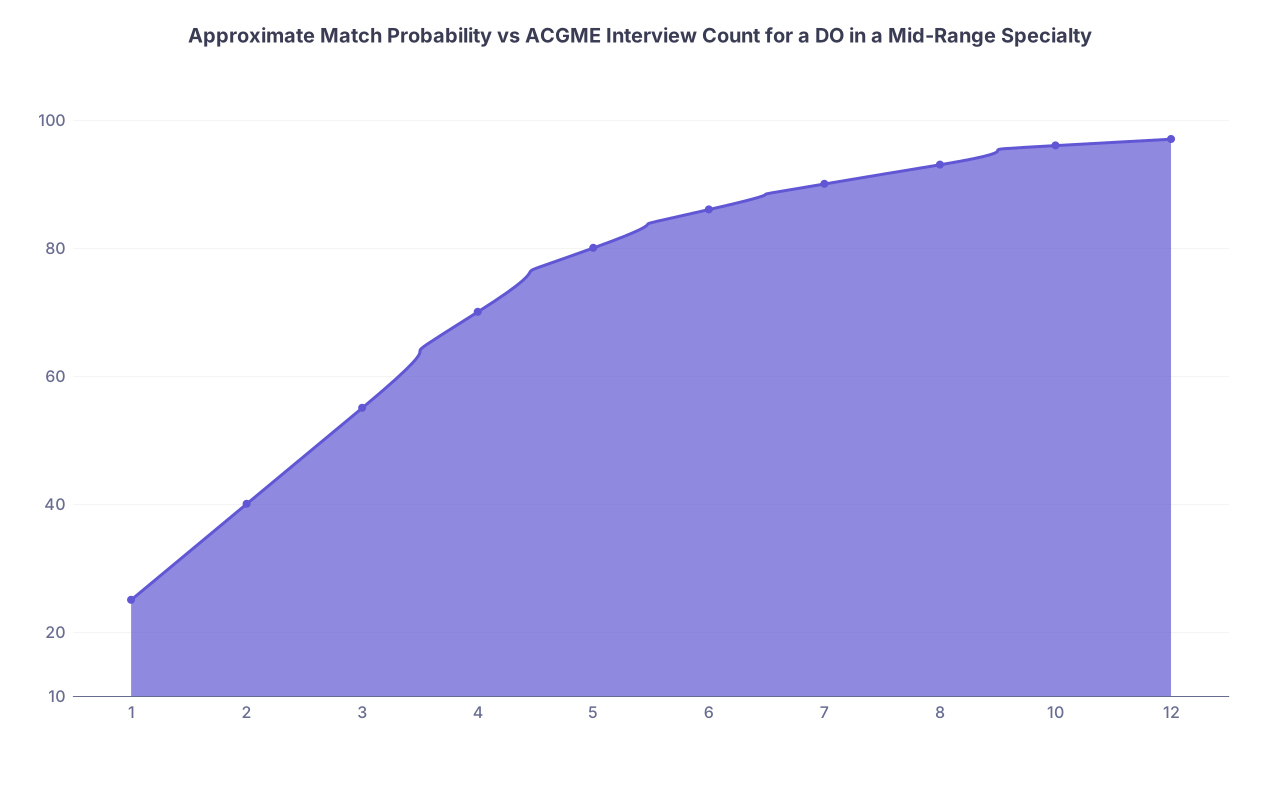
To visualize this, think about a simplified probability curve for a DO in a mid-range specialty:
| Category | Value |
|---|---|
| 1 | 25 |
| 2 | 40 |
| 3 | 55 |
| 4 | 70 |
| 5 | 80 |
| 6 | 86 |
| 7 | 90 |
| 8 | 93 |
| 10 | 96 |
| 12 | 97 |
Obviously these exact numbers vary by year and specialty, but the shape is consistent:
- Going from 2 → 6 interviews may add ~40+ percentage points.
- Going from 8 → 12 might add only ~4–5 points.
This is why blindly chasing 20+ interviews as a DO in ACGME programs is rarely rational. Time, travel, and fatigue carry costs. Once you are in the 8–12 zone for your specialty tier, the data show that you are already very likely to match.
DO-Specific Factors That Shift Your Needed Interview Count
Now, the nuance. Two DOs in the same specialty with the same interview count do not always have the same risk. The following factors push your needed “safe” number up or down.
1. Score Profile (COMLEX and USMLE)
If you are a DO with:
- COMLEX I and II well above national mean (e.g., 600+),
- Plus USMLE Step 2 in the high 240s or above,
then your risk per interview is lower. Programs that interviewed you probably already pre-screened heavily. Your 7 psych interviews are safer than someone’s 7 psych interviews with COMLEX barely passing.
Opposite is also true. Scores near the bottom of a program’s range magnify risk.
2. Red Flags
Anything in this category:
- Exam failures (COMLEX or USMLE),
- Course or clerkship failures,
- Professionalism concerns,
- Gaps without a strong explanation,
pushes your required “safe” number up. A DO with one exam failure and 7 OB/GYN interviews is not in the same risk bucket as a clean-application DO with 7 interviews.
I have watched students in this situation match with 5–6 interviews. I have also seen people with 10+ interviews miss because most programs quietly ranked them low. Red flags compress the effective “quality” of each interview.
3. Program List Composition
Ten interviews at a mix of:
- 3 aspirational academic centers,
- 4 solid university-affiliated community programs,
- 3 community programs in less competitive regions,
is not the same as ten interviews that are all mid-tier university programs in the Northeast corridor.
Your actual risk tracks relative competitiveness of programs, not just a raw count. A DO whose entire interview slate is stretching upwards should mentally adjust their “safe” target by +2–3 interviews.
4. Geography Rigidity
If you are DO-only-accepting of:
- a few cities,
- or a single state where programs heavily favor local MD schools,
then you are functionally reducing your match space. This again inflates your required “safe” N. Conversely, DOs who are willing to match “anywhere reasonably safe” can afford to be at the lower end of the recommended ranges.
Strategy: How to Use These Numbers Before and After Interview Season Starts
You should not just wait until November to count interviews and panic. Use these targets to drive behavior from the start.
Before Applications Go Out
You should be honest and stratify yourself:
- If your stats and experiences place you average among DOs in your specialty:
- Apply broadly enough to plausibly generate at least the “safer target range” in the table for your tier.
- If you are below average:
- Assume you need the top end of the range to feel secure.
- If you are excellent (top decile scores, strong research, honors-heavy transcript):
- You can aim for the lower to middle of the safe range, especially in primary care and mid-range specialties.
Mid-Season: Interpreting Your Interview Count
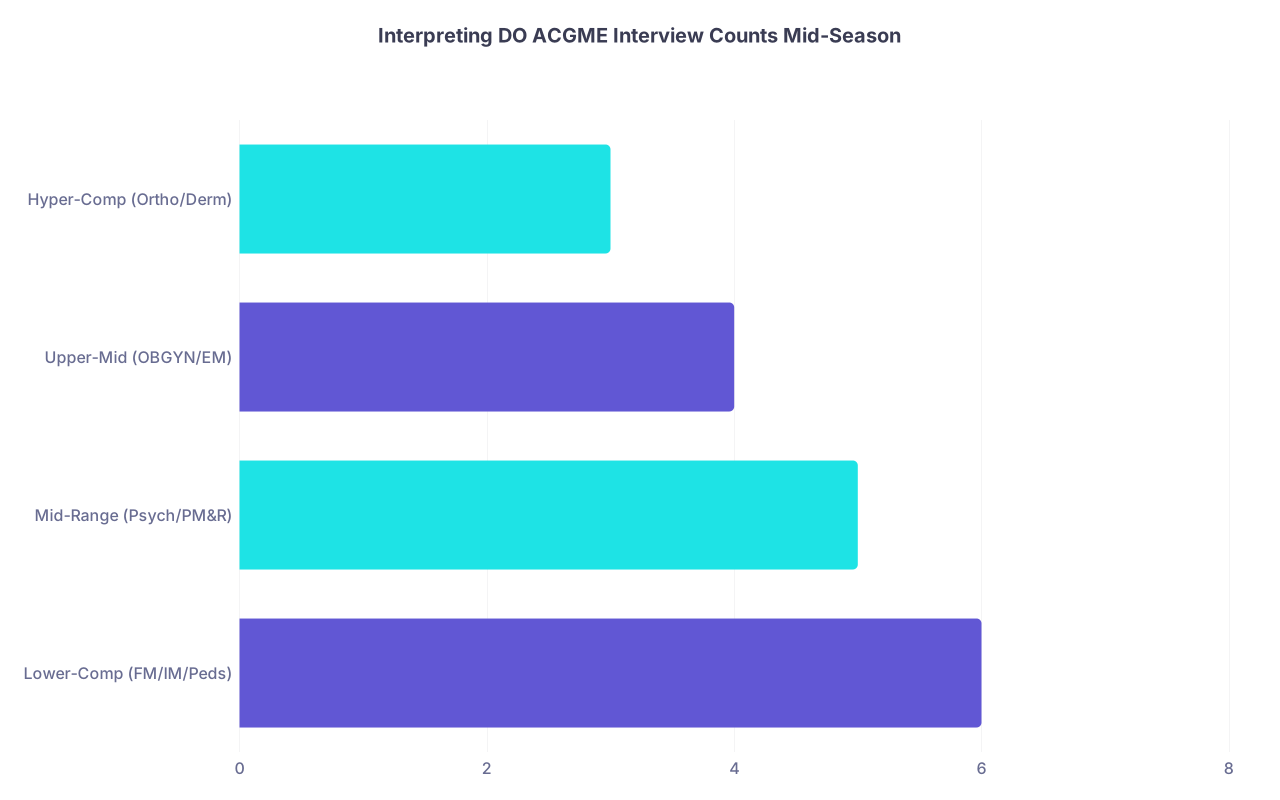
Let’s say you are a DO midway through invite season. Here is how I would interpret your situation numerically.
| Category | Value |
|---|---|
| Lower-Comp (FM/IM/Peds) | 6 |
| Mid-Range (Psych/PM&R) | 5 |
| Upper-Mid (OBGYN/EM) | 4 |
| Hyper-Comp (Ortho/Derm) | 3 |
If by late November you are at or below the “values” listed above in your tier, you should:
- Strongly consider backup options (additional specialties, SOAP planning).
- Aggressively contact programs with interest letters, especially where you have any tie.
- Check whether there are osteopathic-friendly ACGME programs that you under-applied to.
If you are above the safe range early (e.g., 10 FM interviews by October as a DO), you can:
- Selectively decline a few far-out or poorly fitting programs to control burnout.
- Focus preparation on the interviews that align best with your goals.
Process Overview: From Interview Count to Rank List
The last piece: how these numbers feed into your rank strategy. If you understand the process, your interview-to-match logic gets cleaner.

| Step | Description |
|---|---|
| Step 1 | Applications Submitted |
| Step 2 | Interview Invites Received |
| Step 3 | Assess Total Interview Count vs Target Range |
| Step 4 | Add Backup Programs/Contact PDs |
| Step 5 | Focus on Prep & Fit |
| Step 6 | Create Rank List |
| Step 7 | Rank All Acceptable Programs |
| Step 8 | NRMP Match Algorithm |
| Step 9 | Match Outcome |
Two non-negotiables that the data repeatedly support:
Rank every program where you can reasonably see yourself functioning.
DOs who “shorten” rank lists because they disliked a resident lunch often regret it.Do not game the algorithm.
You do not increase your chances by ranking fewer programs. A DO with 8 interviews who ranks all 8 has a much better shot than a DO with 8 who ranks only 5 trying to send a “message.”
Visual Summary: Interview Count vs Comfort Level for DOs
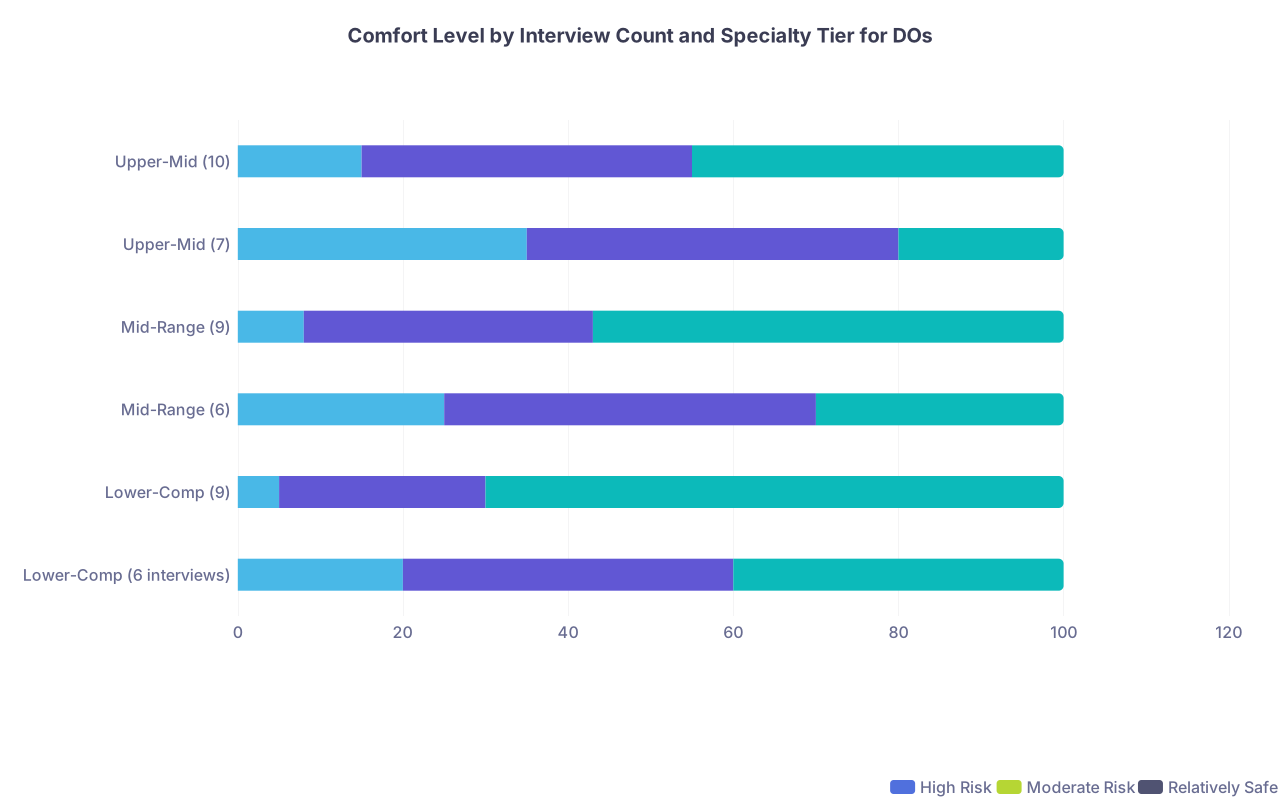
To close the loop, here is a simple “comfort” grid that matches the qualitative reality many DOs describe, based on their specialty tier and interview count.
| Category | High Risk | Moderate Risk | Relatively Safe |
|---|---|---|---|
| Lower-Comp (6 interviews) | 20 | 40 | 40 |
| Lower-Comp (9) | 5 | 25 | 70 |
| Mid-Range (6) | 25 | 45 | 30 |
| Mid-Range (9) | 8 | 35 | 57 |
| Upper-Mid (7) | 35 | 45 | 20 |
| Upper-Mid (10) | 15 | 40 | 45 |
These percentages are schematic, not from a single table, but they match the trend:
- Lower-competition specialties become “relatively safe” for DOs somewhere around 6–9 interviews.
- Mid-range specialties feel comfortable closer to 7–9.
- Upper-mid specialties often need 8–10+ before the applicant stops constantly calculating SOAP probabilities.
Where This Leaves You
The data are blunt:
For most DOs targeting ACGME primary care:
5–7 interviews usually gets you into reasonably safe territory; 8–10 is where the anxiety finally begins to drop.For DOs in mid-range specialties (psych, PM&R, solid IM):
You want 7–9 interviews to feel secure, with 5–6 as the “doable but edgy” zone.For DOs chasing upper-mid specialties (OB/GYN, EM, anesthesia):
You should be aiming for 8–12 interviews. Fewer than 6 is a legitimate warning sign.For DOs in hyper-competitive ACGME fields:
The question is less “how many interviews” and more “do I have a parallel plan.” Even 5–7 interviews can be risky.
So the next step in your journey is not panicking about a magic number. It is using these ranges to:
- Plan your application breadth intelligently.
- Track your live interview count against realistic, specialty-specific targets.
- Decide early whether you need a backup specialty, more geographic flexibility, or a SOAP strategy.
Once you have your interviews lined up and reasonably close to these ranges, the game shifts. The limiting factor is no longer “how many.” It becomes “how well you perform” and “how you build a rational rank list.”
That is the next data problem to solve—how interview performance and rank ordering influence where, not just whether, you match. But that is a story for another day.