Most osteopathic students waste their limited research by presenting it badly. The issue is not always how little you did. It is how poorly you package, extend, and align it with ACGME expectations.
You are not trying to impress a tenure committee. You are trying to convince program directors you can function as a resident who understands evidence, can complete projects, and will not embarrass the program when the ACGME comes asking for scholarly output.
You can absolutely turn a thin DO research record into a solid ACGME‑ready scholarly profile. You just have to stop thinking “I only did one poster in OMS‑2, I am doomed” and start thinking like a resident who needs deliverables.
Let me walk you through exactly how to do that.
Step 1: Reframe What “Counts” as Scholarly Activity
Most DO students I talk to have more scholarly work than they realize. They just do not call it “research” because it does not look like an R01‑funded randomized trial.
ACGME does not require you to be a basic science prodigy. They require scholarly activity. That is broader than you think.
Here is what can legitimately count (and how programs actually view it):
| Activity Type | ACGME Perception |
|---|---|
| Peer-reviewed paper | Strong |
| Case report/series | Solid, practical |
| Poster presentation | Valuable entry-level |
| QI/QA project | Highly relevant |
| Clinical guideline | Very relevant |
| Book chapter/review | Respectable |
If you have done any of the following, you already have raw material:
- Osteopathic manipulative medicine (OMM/OMT) project or outcome tracking
- Case report with your preceptor that never got written up
- QI project at a community hospital (e.g., reducing readmission rates, tracking compliance)
- Student research elective with no publication yet
- Chart review that stalled at “we pulled the data”
Most DO students underestimate:
Case reports and case series. These are ACGME‑friendly. Especially if they involve:
- Unusual presentations
- Rare but important complications
- Clear learning points or diagnostic challenges
Quality improvement (QI) and patient safety work. Many community ACGME programs care more about this than wet‑lab research. They need residents who understand PDSA cycles, run charts, and basic outcome tracking.
Educational projects. Structured teaching sessions that you convert into:
- A workshop abstract
- An education poster
- A MedEdPortal submission
Action: Build Your Baseline Inventory
Take 20–30 minutes and list:
- Every project you touched (even if unfinished)
- Every presentation you gave (student, local, regional)
- Every poster you co‑authored (even if just your preceptor’s project)
- Any QI/QA things you helped with (order set changes, pathway creation, etc.)
Give each item a status:
- Completed and presented/published
- Completed but never disseminated
- Started but stalled
- Only an idea / data collection phase
You are going to mine this list hard in the next steps.
Step 2: Extract Maximum Value from Each DO Project
Most limited DO research looks weak because it is one‑layer deep. One abstract. One poster. Then abandoned.
You fix that by turning each project into multiple scholarly outputs.
Example Scenario
You did:
- One OMM clinical project OMS‑2: “Effect of OMT on low back pain in clinic patients”
- One internal medicine case presentation at a local DO conference
- Helped with a chart review that never made it beyond a meeting
On paper that looks like: “1 poster, 1 oral presentation, 1 vague ‘research experience’ line.”
You can do much better.
Convert each project into outputs:
OMM Project
- Current: Single DO‑school research day poster
- Potential:
- Revise and submit poster to a regional AOA or specialty conference
- Turn into a brief original article or short report in an osteopathic journal
- Spin off a focused case report from your most interesting patient
Case Presentation
- Current: One-time local talk
- Potential:
- Write it as a case report for a specialty‑relevant journal (even a small one)
- Create a teaching handout or diagnostic algorithm and upload to an education repository (if appropriate)
- Develop an updated literature review and submit as a short “clinical vignette” abstract to a national meeting
Stalled Chart Review
- Current: Abandoned project with partial data
- Potential:
- Clean up the data and aim for a small retrospective report in a lower‑impact or regional journal
- At minimum, structure it into a poster you can present at a conference before applications
Your guiding principle:
One real project can often yield 2–3 legitimate CV lines if you are disciplined about dissemination.
Step 3: Match Your Profile to ACGME Expectations by Specialty Level
You cannot change your past, but you can pick targets that make sense.
A DO student with limited research trying to go categorical neurosurgery at a high‑end university program is fighting physics. But that same student applying IM, FM, psych, EM, or even mid‑tier anesthesia can build a profile that is “enough” with clever work.
Here is a rough, honest calibration:
| Specialty Type | Research Expectation for DO Applicants |
|---|---|
| Highly academic (Derm, NSGY) | Multiple pubs, strong mentorship, likely gap year |
| Competitive mid (Rad Onc, ENT) | Some pubs/posters, ideally in-field |
| Mid-competitive (EM, Anes, Rads) | 1–3 solid outputs, some specialty-aligned |
| Core (IM, FM, Peds, Psych) | Any genuine scholarly activity helps; not mandatory |
You are trying to become:
- “Clearly engaged” for core specialties, or
- “Respectably competitive” for mid‑competitive fields.
That usually means:
- 1–3 tangible outputs (posters, abstracts, or manuscripts) with your name on them
- At least 1 item clearly relevant to your target specialty
If you have zero in specialty‑relevant work, fix that aggressively. Which leads to the next part.
Step 4: Build Specialty-Relevant Scholarly Activity Quickly
You can add specialty‑aligned projects in 6–9 months if you stop waiting for the “perfect” basic science lab.
You need fast‑cycle projects. Resident‑style projects. Stuff you can actually finish while on rotations.
Fast project types that work for DOs
Case reports / case series
- Identify cases on your core or audition rotations
- Ask: “This is interesting. Has anyone written this up?”
- Use preceptors who like to teach; many will say yes if you do the writing
Retrospective chart reviews
- Focused, narrow questions:
- “Characteristics of patients admitted with X”
- “30‑day readmission rates for Y and associated factors”
- Start with a small sample if you have to. You are not rewriting guidelines.
- Focused, narrow questions:
QI projects
- Examples:
- Improving vaccination rates in a clinic
- Reducing inappropriate imaging for low‑back pain
- Increasing screening rates (PHQ‑9, fall risk, etc.)
- Examples:
Educational projects
- Design a teaching session for students/juniors:
- Turn it into a workshop abstract
- Or a poster at a local medical education day
- Design a teaching session for students/juniors:
How to do this in practice on rotation
Here is a simple decision flow you can realistically follow:

| Step | Description |
|---|---|
| Step 1 | Start rotation |
| Step 2 | Ask about cases or QI ideas |
| Step 3 | Identify interesting case yourself |
| Step 4 | Propose case report |
| Step 5 | Propose small QI project |
| Step 6 | Outline + lit review in 1 week |
| Step 7 | Define simple outcome + collect data |
| Step 8 | Draft, then target journal/conference |
| Step 9 | Interested preceptor? |
| Step 10 | Case or QI? |
You are not asking for miracles. You are asking for a preceptor to say “Sure, if you do the heavy lifting, I will be on it.”
I have seen DO students on a single 4‑week FM rotation walk away with:
- One case report manuscript under review
- One QI poster submitted to a state meeting
Because they were intentional from day 1.
Step 5: Make Your Limited Output Look Organized and Strategic on ERAS
You can do all this work and still look random if you present it badly.
ACGME programs are not just counting publications. They are assessing whether:
- You understand the scientific process
- You can finish projects
- Your work connects—at least loosely—to your chosen field
How to structure your ERAS entries
Cluster your work in a way that tells a story:
Label experiences clearly
- “Clinical Research Assistant – Osteopathic Manipulative Medicine”
- “Quality Improvement Project – Inpatient Medicine”
- “Case Report Author – Emergency Medicine”
Use active verbs and outcomes
- “Designed and executed a retrospective chart review of 120 patients with…”
- “Led data collection and abstract preparation that resulted in poster presentation at…”
- “Primary author of case report describing…”
Highlight completion
- “Manuscript under review at [journal]”
- “Abstract accepted for presentation at [conference, date]”
- “Project completed; implementation plan presented to hospital QI committee”
Do not hide DO‑specific work
- OMM/OMT research is fine. Just connect it to real clinical outcomes when you can.
Example: Turning one weak line into three strong ones
Weak ERAS entry:
“Participated in OMM research project. Helped collect data and present poster.”
Reworked as separate, stronger entries:
Experience: Osteopathic Manipulative Medicine Clinical Outcomes Project
Role: Student researcher- Designed data collection forms for prospective OMT clinic cohort
- Collected and managed data for 75 patients receiving OMT for low back pain
- Conducted basic statistical analysis (paired t‑tests, descriptive stats) with faculty guidance
Presentation: Poster – ‘Impact of OMT on Patient‑Reported Low Back Pain Outcomes’
- First author poster presented at [School Research Day, 2023]
Manuscript: ‘Osteopathic Manipulative Treatment for Chronic Low Back Pain in an Outpatient Clinic’
- Co‑authored manuscript prepared for submission to [Journal X]; under faculty review
Same underlying work. Very different impression.
Step 6: Fill Gaps with Smart, Lightweight Add-ons
If you are truly light on research and time is short, you can still add lower‑lift scholarly touches that help your profile.
No, they will not turn you into a derm superstar. But they can move you from “nothing” to “this applicant is at least engaged.”
Lightweight options that still count
Short invited or student‑written pieces
- Department newsletters
- Specialty society student sections
- Hospital blog posts summarizing new guidelines
Evidence-based presentations with documentation
- Journal club presentations (get slides saved, sometimes listed on CV as local presentations)
- M&M contributions where you lead the literature review
National registry or database work (if offered)
- Many DO schools or hospitals contribute to registries. Offer to help with data entry + get authorship on a group paper.
Where students waste time
- Starting basic science lab projects late OMS‑3 with no chance of completion before ERAS.
- Chasing big‑name PIs who will never actually give them meaningful authorship.
- Spending months formatting a paper instead of just getting a solid case report or QI poster out.
Your goal: fast, honest, finished. Not perfect. Not glamorous. Finished.
Step 7: Be Ready to Talk About Your Work Like a Resident, Not a Student
Programs care far more about how you talk about your research than how many lines you have.
ACGME program directors want to hear:
- You understand the question you were asking
- You can explain your methods simply
- You know what the results actually mean clinically
- You learned something about practice or systems of care
They do not want:
- Jargon you clearly do not understand
- Overinflated conclusions
- “We found what other people already knew” without any reflection on why that matters
Prepare 2–3 “research stories”
For each real project, be able to answer, cleanly:
- “What was the clinical or educational problem?”
- “What did you actually do?” (your role, not your PI’s)
- “What did you find?”
- “How does this affect patient care or training?”
- “What did you personally learn about doing research / QI?”
You are aiming for a 60‑second, no‑BS answer per project. Something like:
“On my internal medicine rotation we saw frequent 30‑day readmissions for heart failure. My attending and I designed a small QI project looking at whether patients actually received standardized discharge education. I built a data collection tool, reviewed 80 charts, and we found that structured discharge documentation and med reconciliation were inconsistent in about 40 percent of cases. We presented the data to the unit QI committee, and they adopted a simple discharge checklist. What I took from this is that even small, low‑budget projects can identify fixable system problems, and that closing the loop with the committee is as important as collecting the data.”
That answer sounds like a resident. Programs like that.
Step 8: Use Your DO Identity as a Hook, Not a Handicap
You are osteopathic. Stop pretending you are not.
You actually have a built‑in niche that can be useful if you are smart about it.
Ways to weaponize your DO background in research:
OMM/OMT as a comparative or adjunctive angle
- “We looked at outcomes in low back pain with and without adjunctive OMT.”
- “We implemented an OMT clinic for hospitalized patients and tracked pain scores.”
Whole‑person, primary care‑oriented topics
- Chronic pain management
- Opioid risk mitigation
- Behavioral health integration
- Social determinants of health and readmissions
Education around OMM in ACGME settings
- Workshops you have given to MD colleagues
- Short curricula you helped develop
Programs in FM, IM, PM&R, EM, and even anesthesia do not hate this. Many appreciate having someone around who can both:
- Practice evidence‑informed OMT
- And think critically about when it actually helps or does not
If your only research is in osteopathic topics, your job is to:
- Connect it clearly to mainstream outcomes: pain, function, LOS, patient satisfaction, cost
- Show that you understand limitations and are not dogmatic about OMT
Step 9: Build a Realistic 6–12 Month Turnaround Plan
Let me give you one concrete roadmap. Assume:
- You are a DO student late OMS‑2 or early OMS‑3
- You have 1 weak poster already done
- You are aiming for an ACGME IM or FM program, maybe slightly academic but not top‑5
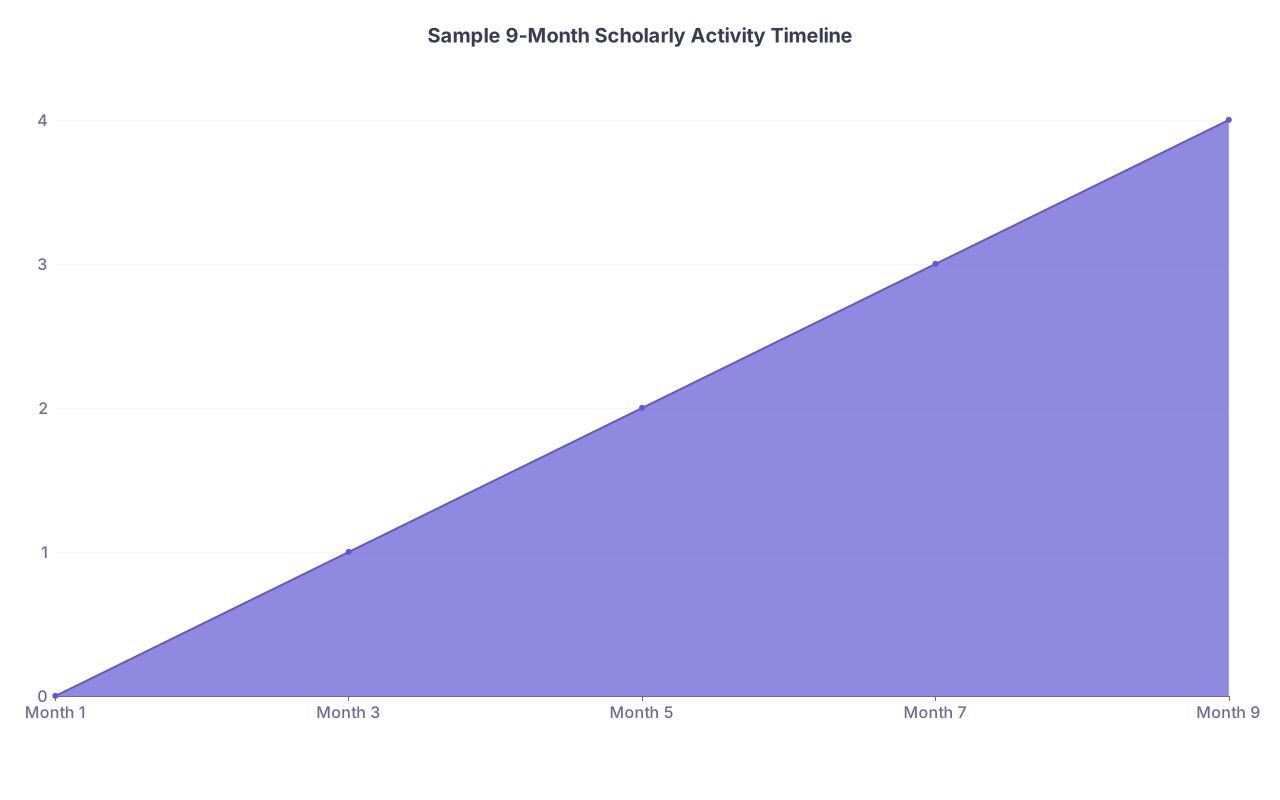
Here is what 6–12 months could look like:
| Category | Value |
|---|---|
| Month 1 | 0 |
| Month 3 | 1 |
| Month 5 | 2 |
| Month 7 | 3 |
| Month 9 | 4 |
Month 1–2
- Inventory all prior work
- Identify 1–2 preceptors who are research/QI‑friendly
- Commit to 1 case report + 1 small QI project
Month 3–4
- Write and submit your first case report with a preceptor
- Launch QI project data collection (keep it simple: 50–100 patients max)
Month 5–6
- Turn completed QI data into a poster abstract for a state or regional meeting
- Revise your original DO‑school poster and submit it to a broader conference
Month 7–9
- Aim to have:
- 1 case report submitted or under journal review
- 1–2 posters accepted or presented
- 1 QI project with a clear outcome, even if small
By the time ERAS opens, your CV might show:
- 1 published or submitted case report
- 2–3 poster presentations
- 1 named QI project with concrete outcomes
That is enough for many ACGME programs to say: “This DO student took scholarship seriously.”
Step 10: Do Not Oversell. But Do Not Apologize Either.
You have limited DO research. Fine. Own that.
What you should not do:
- Lie about authorship level
- List “manuscripts in preparation” that do not exist
- Pad your CV with vague “research assistant” roles with no product
What you should do:
- Present every completed thing clearly
- Explain the impact honestly
- Make it obvious that you finish what you start
Most attendings and PDs can tell in 30 seconds whether your research entries are real. You are better off with:
- Two real, modest projects you can discuss in depth
Than:
- Six padded lines you barely remember
Final Tight Summary
- You can turn limited DO research into a credible ACGME scholarly profile by squeezing more output from each project, adding 1–2 fast, specialty‑relevant projects, and packaging your work clearly on ERAS.
- Focus on finishable work—case reports, small QI, short clinical projects—and be able to talk through each one like a resident who understands the question, the method, and the clinical meaning.
- Stop apologizing for being osteopathic. Use OMM/primary care‑oriented work as a niche, connect it to mainstream outcomes, and show programs you are exactly the type of resident who will complete the scholarly work they need to stay in good standing.