The lack of a home residency program as a DO student is not a disadvantage. It is a filter. Program directors see immediately who figured out how to compensate and who drifted through fourth year hoping it would work out.
You do not need a home program. You need a plan. And you need to execute it better than the MD student down the street who has three built-in away rotations and a chair who can make a phone call.
Here is how you impress ACGME faculty when you are a DO with no home program and no automatic advocates.
Step 1: Choose Targets Like a Strategist, Not a Tourist
Randomly applying to 80+ programs because “I heard they take DOs” is how you burn money and end up at the bottom of every rank list.
You need to build a rational target list with three criteria:
- They accept and actually match DOs.
- They can see you clinically (aways, sub-Is, or at least structured virtual experiences).
- Your stats are within striking distance.
Start with data, not vibes.
| Program Type | DO-Friendly? | Away Rotation? | Your Stats Competitive? |
|---|---|---|---|
| Mid-tier community IM | Yes | Yes | Yes |
| University affiliate FM | Yes | Limited | Strong |
| Top-10 university Neuro | Rare DOs | Yes | Weak |
| Community EM | Yes | Yes | Borderline |
| New ACGME program | Unknown | Yes | Strong |
You should be doing this specialty by specialty:
- Pull 3 recent years of match lists, see which programs list DO grads.
- Check FREIDA and program websites to confirm DOs in current residents.
- Look at Step 2 scores for recent matches (there are crowdsourced spreadsheets for EM, IM, anesthesia, etc.).
If a program has no DOs in the last 5 years, has not answered DO-related questions on EMRA/AAIM/ specialty forums, and posts “USMLE required” in bold: that is a low-yield target for you without a home program.
Build three tiers of programs
Core realistic (60–70% of your list):
- DOs consistently matched
- Strong community or university-affiliated programs
- Your Step 2 score and class rank around their historical average
Reach (20–30%):
- University programs that match a mix of DOs and MDs
- Your score slightly below their mean but with strong clinicals and letters
Safety (~10–20%):
- Heavy DO presence
- Community-based, maybe newer or in less desirable locations
- Programs that respond positively to DOs rotating
If you are applying to something competitive (derm, ortho, ENT) with no home program, you will need to be ruthless. That often means pivoting early to a more realistic specialty or doubling down on aways plus research at a handful of truly DO-friendly academic centers.
Step 2: Use Away Rotations as Your “Synthetic” Home Program
Your aways are your home program. Treat them that way.
ACGME faculty are not impressed by your school’s name. They are impressed by:
- How you perform for 4 straight weeks when tired.
- Whether the residents would actually want you back.
- Whether attendings can imagine you carrying an intern pager.
So you weaponize away rotations.
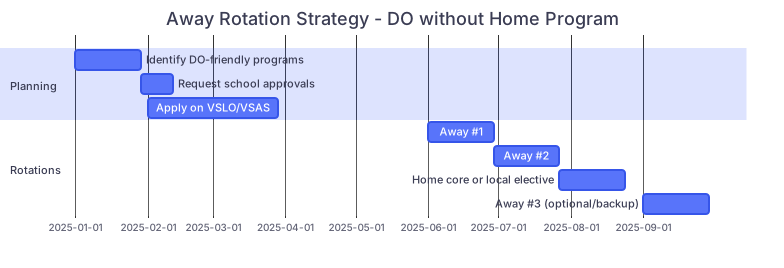
| Task | Details |
|---|---|
| Planning: Identify DO-friendly programs | a1, 2025-01, 4w |
| Planning: Request school approvals | a2, after a1, 2w |
| Planning: Apply on VSLO/VSAS | a3, 2025-02, 8w |
| Rotations: Away #1 | b1, 2025-06, 4w |
| Rotations: Away #2 | b2, after b1, 4w |
| Rotations: Home core or local elective | b3, after b2, 4w |
| Rotations: Away #3 (optional/backup) | b4, 2025-09, 4w |
How many away rotations?
- Competitive specialties (ortho, EM, gen surg, anesthesia, radiology):
Aim for 2 strong aways at your realistic target level, plus maybe 1 backup in a safer program. - Less competitive specialties (FM, psych, peds, pathology):
1 targeted away at a program you like is often enough. Use extra time for research or higher-yield electives.
Do not scatter 4–5 mediocre aways. Two killer rotations with strong letters beat five months of “I think they liked me.”
Before you step foot on the service
You cannot show up “cold” anymore. The bar is higher when you are an outsider.
Before Day 1:
- Get the team’s typical workflow from prior rotators or the coordinator:
- Rounding time
- Note templates
- Call schedule
- Admission process
- Preload:
- Read the last 2–3 years of program-specific case reports or publications.
- Review the hospital’s standard order sets or protocols if accessible.
- Email the chief or rotation contact:
- Brief, professional, 3–4 sentences.
- Ask for tips so you can be productive from Day 1.
Example email:
Dr. Smith,
I will be joining your service as a visiting MS4 from [Your COM] from [dates]. I am applying to [specialty] this year and want to be as useful as possible for the team. If there are any resources, note templates, or pre-reading that you recommend before starting, I would appreciate your guidance.
Best,
[Name], OMS-IV
Faculty see this as uncommon. In a good way.
Step 3: Behave Like the Intern They Want, Not the Student They Expect
On aways, you are “the DO from somewhere else.” You can either confirm their biases or blow them up.
Here is how you blow them up.
The performance checklist that actually matters
Pre-round like you are already on the team
- Know your patients better than anyone except the intern.
- Walk in with:
- Overnight events
- Updated vitals and labs
- Imaging read
- “One thing” to advance care today (de-escalate antibiotics, wean O2, advance diet).
- Your SOAP notes should not just recap. They should propose a safe, reasonable plan.
Know your basic management cold
If you are rotating on internal medicine and cannot outline first-line management for:
- DKA
- COPD exacerbation
- CHF exacerbation
- Sepsis workup
…then you are wasting the away.
You do not need to manage them solo. But you must be able to say:
“For this COPD exacerbation, I would continue duonebs, systemic steroids, consider azithromycin, check VBG, and ensure noninvasive ventilation if needed.”Be visibly helpful
The students who get remembered are the ones who quietly make the day move:
- Volunteer for:
- Discharge summaries
- Calling families with updates (with supervision)
- Tracking consult recs
- Carry more than your “assigned” patients when the team is slammed.
- Stay until the work is actually done, not until the “expected” student cut-off.
- Volunteer for:
Be low-maintenance with high output
Faculty love students with this combination:
- Rarely complain.
- Never ask “Can I go home early?” when others are drowning.
- Do not require hand-holding for simple tasks.
- Deliver consistently solid work.
I have watched faculty rave about a student with average Step scores because they simply made the service less painful for a month.
Step 4: Turn Faculty into Letter Writers (Without Being Awkward)
Letters are your currency. As a DO without a home program, almost all your high-impact letters will come from aways or regional electives at ACGME sites.
You need 2–3 letters that say, essentially:
“This DO student performed at or above our home MS4s, and I would be pleased to have them as an intern.”
That is better than any school brand name.
Who should you target for letters?
- Core faculty with real influence:
- Program director / associate PD
- Clerkship director
- Well-known subspecialist in your field (with teaching reputation)
- Senior people who directly observed your work for at least 2 weeks:
- Not “saw you present once on rounds.”
- They know how you think, write notes, and interact with staff.
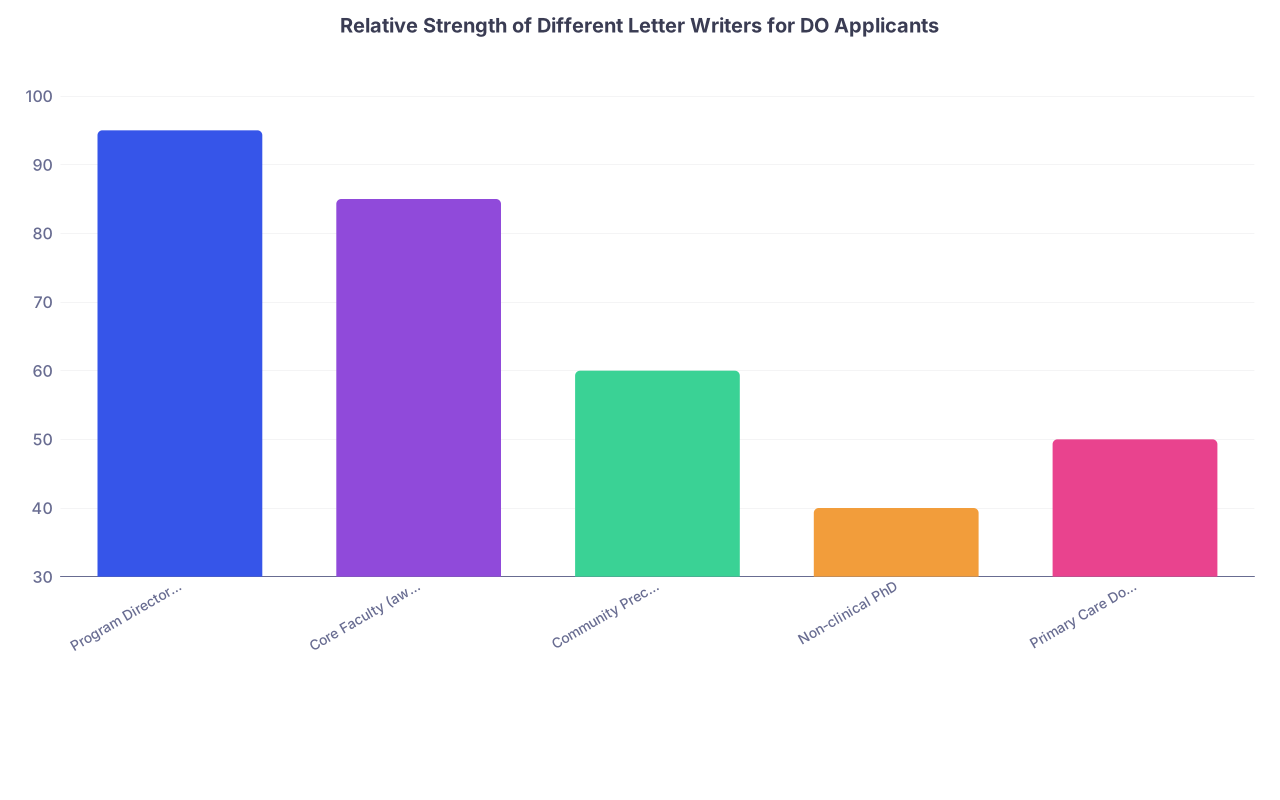
| Category | Value |
|---|---|
| Program Director (away) | 95 |
| Core Faculty (away) | 85 |
| Community Preceptor | 60 |
| Non-clinical PhD | 40 |
| Primary Care Doctor from OMS-III | 50 |
How to secure the letter without sounding desperate
Week 2–3 of the rotation:
- Ask for feedback first:
- “Dr. Lee, I am really enjoying working with your team. I am applying to [specialty] and would value any feedback on how I am doing and what I could improve in the next two weeks.”
Listen. Implement the feedback. Then, near the end:
- Direct ask:
- “Given your feedback and our work together this month, would you feel comfortable writing a strong letter of recommendation for my residency applications?”
The word strong matters. It gives them an honest exit if they cannot do it, which is better than a lukewarm letter.
When they agree:
- Provide:
- Your CV
- Draft personal statement (even if rough)
- Short bullet list:
- 3–4 cases you managed together
- Specific contributions (e.g., QI idea, teaching you did for juniors)
- Any specialty-specific letter format (SLOE for EM, SLOR, etc.)
Do not ghost them after the letter. Keep them updated about interviews and match. That long-term professional relationship will matter later.
Step 5: Fix Your Paper Application So It Does Not Scream “No Home Program”
Programs will notice you do not have a home residency. They will not care if the rest of your application looks polished and intentional.
Step 2 and COMLEX
If you are a DO without a home program applying to an ACGME residency, here is the blunt rule:
- Take USMLE Step 2 unless you have very strong specialty-specific evidence that COMLEX-only is accepted and common.
- Target:
- Step 2: at or above the national mean for your specialty’s matched applicants.
- COMLEX Level 2: comfortably above 550, ideally 600+ for more competitive fields.
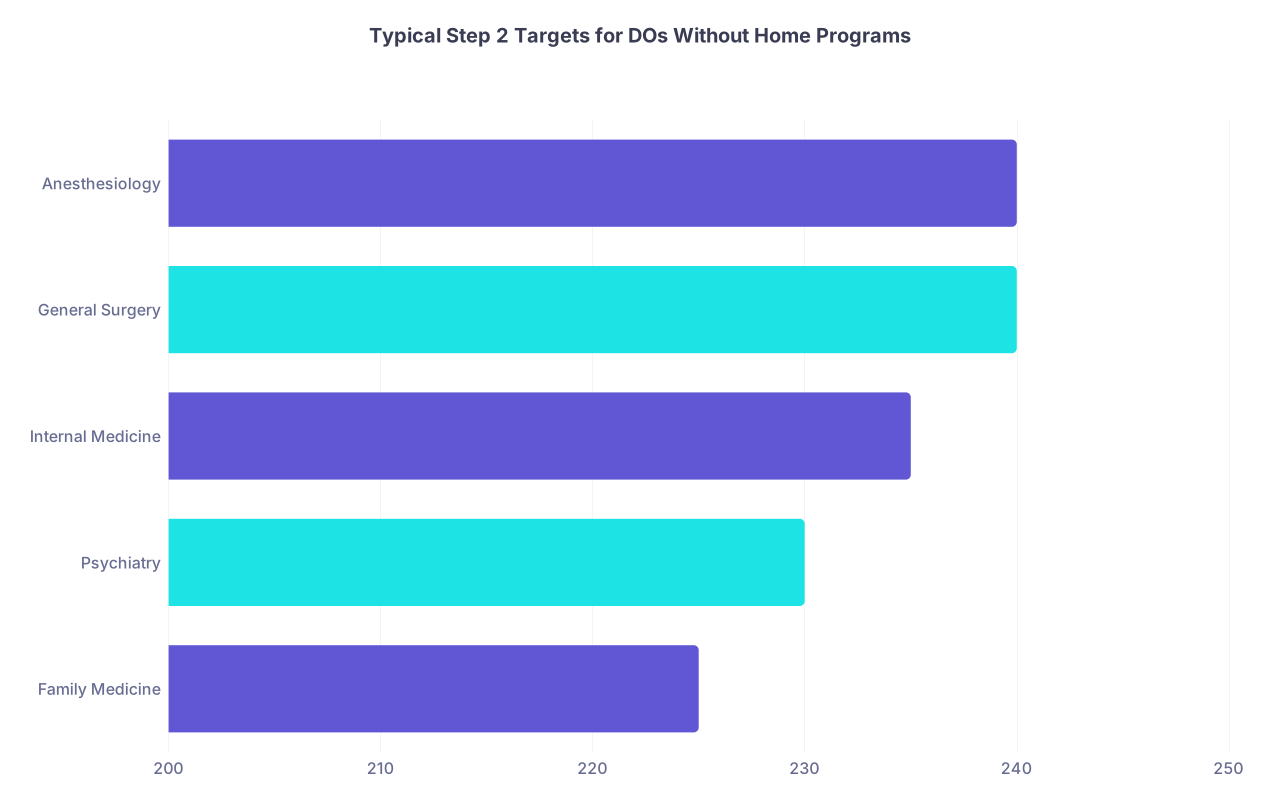
| Category | Value |
|---|---|
| Family Medicine | 225 |
| Psychiatry | 230 |
| Internal Medicine | 235 |
| General Surgery | 240 |
| Anesthesiology | 240 |
If your Step 1/Level 1 were weak or pass-only, Step 2/Level 2 is your chance to show upward trajectory. Programs care about that more than you think.
Personal statement: stop sounding apologetic
You do not explain or apologize for lacking a home program. That is dead weight.
Your statement should quietly accomplish three things:
- Show clear, specific commitment to your specialty.
- Demonstrate that you know what residency in that field actually looks like.
- Signal that you thrive in environments like theirs.
Example pivot:
Bad:
As a DO student without a home internal medicine program, I have had to seek out other opportunities…
Better:
My clinical year demanded that I build my own version of a home internal medicine program. I chose rotations where I could see high-acuity patients, take primary responsibility for follow-up, and work directly with teaching attendings who evaluate residents. That deliberate path is why I am most at home on inpatient medicine, sorting through six active problems on a patient who arrived at 2 a.m.
You are not the victim of your school’s structure. You are the person who built your own path anyway.
Step 6: Network Without Being Smarmy
99% of “networking” advice is useless. But as a DO without a home program, you cannot skip relationship-building entirely.
You need three kinds of touchpoints:
- Pre-rotation contact
- On-rotation reputation
- Post-rotation maintenance
Pre-rotation: short, professional, purposeful
For a program you really want:
- Email the program coordinator and/or associate PD 4–6 months before application season to:
- Confirm away rotation availability.
- Express specific interest with one or two program details.
Keep it tight:
Dr. Patel,
I am an OMS-III at [Your COM] very interested in [Program Name] because of your [X feature: strong cardiology exposure, county hospital, resident-run clinic]. I will be applying for an away rotation through VSLO for [dates]. I would be grateful for the opportunity to learn from your team and see if I would be a good fit for your residency.
Respectfully,
[Name]
You are not asking for special treatment. You are signaling you are serious and informed.
On rotation: make the PD hear your name naturally
The PD should hear from residents:
- “The visiting DO student is actually really good.”
- “They pick things up fast and stay late.”
You cannot say that about yourself. You earn it by:
- Asking for teaching cases.
- Helping interns with scut they hate.
- Being prepared enough to give 3-minute chalk talks on basic topics.
If the PD or APD never sees you, ask politely:
“Dr. X, if you have a moment this week, I would appreciate any feedback on how I am doing and whether you see me as someone who would fit your program.”
You are not begging for a spot. You are asking if you are on the right track. Huge difference.
Post-rotation: one email that keeps the door open
2–3 weeks after the rotation:
- Send a concise email to key faculty:
- Thank them.
- Update them that you are applying.
- Mention you ranked them highly in your preferences for interviews.
Later, after interview invites:
Dr. Jones,
I wanted to thank you again for the opportunity to rotate with your team in July. That month confirmed that [Program Name] is exactly the kind of residency where I learn best. I have submitted my ERAS application and wanted you to know that your program is at the top of my list of places where I hope to train.
Sincerely,
[Name]
Short. Direct. Respectful.
Step 7: Use Regional Electives and Community Sites as Your “Shadow Network”
Not every impactful connection comes from name-brand university hospitals.
If your COM has strong relationships with community hospitals that send grads to ACGME residencies every year, those attendings often have:
- Former residents in academic programs.
- Relationships with PDs from sending their grads year after year.
- Credibility as good judges of work ethic and clinical readiness.
Leverage that.
How to turn a community rotation into ACGME currency
On a high-quality community rotation:
- Treat it like an audition:
- Same intern-level behavior as your aways.
- Ask directly if they have prior graduates in your field.
Then:
- Ask if they would be willing to reach out (or at least mention you) to:
- Alumni in your target programs.
- PDs they know in your specialty.
You do not script this. You say:
“If you know of any programs where my application would be a reasonable fit, I would appreciate any suggestions or introductions.”
Some will ignore. Some will email a PD with, “We have another solid grad this year.” That single sentence sometimes moves your file from the 200-application pile to the 30-we-actually-look-at pile.
Step 8: Interview Like Someone Who Knows Exactly What They Are Getting Into
By the time you reach interviews, the “no home program” issue is in the background. What matters now:
- Do you sound like someone who has actually lived the specialty?
- Do you understand how training works at their specific site?
- Do residents believe you will do the work without drama?
Prepare with a program-specific one-pager
For every interview, create a one-page cheat sheet the night before. Include:
- 2–3 concrete reasons you like this program:
- Specific clinics
- ICU exposure
- Research niche
- Pathology mix
- Names of:
- PD
- APD
- Chief residents
- One specific question for each:
- About their experience, not something easily Googleable.
Use that page on the morning of. On the drive. In the lobby. You will sound like someone who actually cares, because you did the homework.
Handle DO-related questions without insecurity
If someone asks about your DO training or lack of a home program:
Bad:
Yeah, my school does not have a home program so I did not have the same opportunities as some MDs…
Better:
My school’s structure meant I had to be very deliberate. I built a clinical year that functioned like a home program by doing multiple months at ACGME sites where faculty actively evaluate residents. That has given me a broad view of different systems and made me comfortable adapting quickly to new teams.
You are not less-than. You took a different path and extracted value from it.
Step 9: Have a Backup That Does Not Feel Like Failure
One reality check: if you are a DO without a home program aiming at a highly competitive specialty with mid-range scores and limited research, you must have a backup plan.
This is not pessimism. It is risk management.
Reasonable backup structures:
- Primary: EM, Backup: IM or FM with strong EM exposure.
- Primary: Ortho, Backup: Surgery prelim or IM transitional year at a DO-friendly place.
- Primary: Derm, Backup: IM or FM at an academic center where you can continue research.
You impress ACGME faculty when you look like an adult who understands risk and still bet on yourself. Not a gambler who thinks “it will all work out somehow.”
Step 10: Concrete 90-Day Action Plan If You Are Behind
If you are reading this late in OMS-III or early OMS-IV and feel behind, here is a blunt 90-day plan.
Days 1–7: Reality assessment
- List:
- Current scores (Step 2/Level 2 if taken, or test date scheduled).
- Clinical grades.
- Research, leadership, anything real.
- Decide:
- Primary specialty.
- Backup specialty if needed.
- Build:
- Tiered program list (at least 15–20 realistic core programs).
Days 8–30: Secure impactful rotations
- Apply to aways at:
- 2 DO-friendly academic/community hybrid programs.
- 1 safety-level program that clearly likes DOs.
- Lock in:
- At least one high-yield community or local ACGME rotation where letters will count.
Days 31–60: Prep to crush the next rotation
- Study:
- Specialty’s basic management issues (via a trusted review book or question bank).
- Draft:
- Personal statement v1.
- Updated CV.
- Identify:
- 2–3 faculty from prior rotations to request letters from.
Days 61–90: Execute and collect letters
- On rotation:
- Implement everything from Step 3: perform like a strong sub-I.
- End of rotation:
- Ask for strong letters.
- Send CV and PS.
- Application side:
- Finalize program list.
- Polish personal statement with concrete examples from your new rotations.
This is what taking control looks like. Not scrolling Reddit threads about how DOs “never” match at certain places.
Core Takeaways
- You do not need a home program; you need deliberate aways and strong letters that say you function at the level of their own MS4s.
- Your behavior on rotation—reliability, initiative, intern-level thinking—impresses ACGME faculty much more than your school’s name ever will.
- A targeted, realistic strategy with program data, good exams, and honest networking beats blind mass-applying every single time, especially for a DO without a built-in home base.