Low COMLEX Level 1, Better Level 2: Reframing Your Story for ACGME PDs
A weak COMLEX Level 1 score stops being a liability the moment you learn how to weaponize Level 2.
Most students do this backward. They cringe at Level 1, mumble something about “test anxiety,” and hope PDs just focus on the higher Level 2. That is not a strategy. That is wishful thinking.
Here is the reality:
- A low Level 1 will raise questions.
- A better Level 2 can absolutely neutralize it.
- Whether it helps or hurts depends almost entirely on how you present it.
You are not just “submitting scores.” You are building a narrative a program director can understand in 20–30 seconds. Your job is to turn:
“Why did this student bomb Level 1?”
into:
“This is someone who figured things out, adapted, and is now on an upward trajectory. Safe to interview. Probably safe to rank.”
Let us fix this step by step.
Step 1: Understand Exactly How PDs Read Your Scores
Start by thinking like a program director, not like an anxious M3 refreshing Reddit threads.
Most ACGME PDs do something like this when they open your ERAS:
- Check:
- COMLEX Level 1 (if they care / still use it)
- COMLEX Level 2
- USMLE scores (if present)
- Scan for patterns:
- Consistent performance vs. outlier
- Upward vs. downward trend
- Any failures or red flags
- Decide in under a minute whether you:
- Go into the “interview likely” pile
- Go into “maybe later”
- Go straight to “no”
They are not psychoanalyzing you. They are making a fast risk assessment.
What makes you look “risky” to a PD?
- COMLEX Level 1 clearly below their usual range
- A fail on any board exam
- Declining scores from Level 1 to Level 2
- Level 2 just barely scraping by when Level 1 was already low
- No clear change in behavior or performance after a bad exam
What makes you look “salvageable” or even “interesting”?
- Significant improvement from Level 1 to Level 2 (e.g., 30–60+ points)
- Clear evidence of adjustment: remediation, new study methods, faculty support
- Strong clinical clerkship performance aligned with the Level 2 jump
- Letters that explicitly mention growth, reliability, and clinical excellence
You cannot change the numbers now. But you can absolutely control which category you fall into in the PD’s mind.
Step 2: Quantify Your Score Story (Before You Spin It)
You cannot reframe a story you have not analyzed honestly.
Sit down with your scores and write them out:
- COMLEX Level 1: ___
- COMLEX Level 2: ___
- Any USMLE scores? Step 1: ___, Step 2 CK: ___ (if applicable)
Now quantify the change.
| Level 1 → Level 2 Change | PD Interpretation (Typical) |
|---|---|
| 0–10 points | Flat; no evidence of improvement |
| 10–25 points | Mild improvement; helpful but small |
| 25–40 points | Solid improvement; story to use |
| 40–60 points | Strong improvement; major positive |
| >60 points | Dramatic; begs for an explanation |
If your Level 1 was:
- Below 400 and Level 2 is >450 – you are moving in the right direction.
- 390–420 and Level 2 is >480–500 – that is a real turnaround.
- Low but passing and Level 2 is close to or above the national mean – that is gold for your narrative.
- Weak Level 1 COMLEX, strong Step 2 CK = huge asset in ACGME world.
- Weak Level 1, mediocre Step 2 CK = more complex, but still manageable with a tight narrative.
Own the numbers. You will be using them very explicitly in your story.
Step 3: Diagnose Why Level 1 Was Low (The Real Reason, Not the Pretty One)
PDs do not want drama. They want causality and resolution.
You must identify a cause for the poor Level 1 that:
- Makes sense,
- Is contained in the past,
- Has clearly been addressed.
Here are the common real reasons I hear from students, and how to think about them:
Poor strategy, not poor ability
- You brute-forced content memorization
- Started serious prep too late
- Barely did question banks
- Treated COMLEX like an extended school exam
Personal or health issues (short-term, now resolved)
- Family crisis during dedicated
- Untreated anxiety, depression, ADHD at the time
- Physical illness or fatigue that wrecked dedicated
Environmental or structural problems
- Weak pre-clinical curriculum
- Massive testing right before boards
- No guidance on COMLEX-specific prep
You just underestimated the exam
- Overconfident from doing well in coursework
- Did not simulate full-length practice tests
- Misread early practice scores
Now, one rule:
Do not blame your school or “test anxiety” alone and stop there. That sounds like deflection.
Your explanation must end with:
“…and here is what I changed after that, which led to my higher Level 2.”
That transition is where your power lives.
Step 4: Build a Clear “Redemption Arc” Narrative
You are writing a short, controlled redemption story. Not a confession.
The structure is simple:
- Acknowledgement of problem
- Specific cause(s)
- Specific actions taken
- Objective proof of improvement (Level 2 + clinical work)
Compress it down to three or four tight sentences. Something like:
“My COMLEX Level 1 score was below my potential because I approached it like a school exam: heavy on passive review, light on timed questions, and I started structured prep too late. After that experience, I overhauled my process. I completed two full question banks under exam-like conditions, took multiple practice tests with detailed error analysis, and worked closely with faculty to address gaps. The result was a ___-point improvement on COMLEX Level 2 and strong performance on my core clerkships.”
Or, if personal issues were substantial:
“During COMLEX Level 1 dedicated, a significant family issue pulled my focus and I did not have adequate support or coping strategies in place. That period affected my preparation and my score reflects that. Once the situation stabilized, I sought counseling, worked with academic support, and rebuilt my study system around active learning and question-based review. My COMLEX Level 2 score, up by ___ points, aligns much more closely with my performance throughout clinical rotations.”
Notice the pattern:
- You admit the problem.
- You give a controlled reason.
- You show you fixed the system.
- You point to Level 2 as proof.
That is what PDs want: a closed loop. Problem → intervention → evidence.
Step 5: Decide Where and How to Tell This Story
You have four main tools:
- ERAS application (Experiences + Education section)
- Personal statement
- MSPE / Dean’s Letter
- Letters of recommendation
You are not writing an apology tour. You are using these tools strategically.
1. ERAS: Subtle but Concrete
You do not need a dedicated “I bombed Level 1” essay in ERAS. Instead:
- In your Experiences, highlight:
- Tutor roles
- Academic support involvement
- Board-review course leadership
- Any structured remediation you helped lead or completed
Those items quietly support your “I fixed my process and now help others” narrative.
2. Personal Statement: One Tight Paragraph, Max
Your personal statement is about your specialty and your fit. Not your trauma with Level 1.
Use at most one short paragraph. Example:
“Early in medical school, my COMLEX Level 1 score did not reflect my abilities or the expectations I set for myself. I evaluated my approach, shifted from passive review to rigorous question-based learning, and sought mentorship from faculty and residents. That process not only led to a ___-point improvement on COMLEX Level 2, but also informed the way I prepare for rotations, procedures, and patient encounters. The same structured, adaptive approach is how I plan to grow as a resident in [specialty].”
Then move on. If you dwell, it starts to look like an unresolved issue.
3. MSPE / Dean’s Letter: Use Institutional Language
Ask your dean’s office (politely, early) whether they can mention your improvement trajectory, especially if:
- You had formal academic support or remediation.
- Your clerkship grades are strong and align with Level 2.
Something like:
“Following a COMLEX Level 1 score below her expected performance, [Student] engaged proactively with academic support services to refine her preparation strategies. She demonstrated substantial improvement, as evidenced by a significantly higher COMLEX Level 2 score and consistently strong performance in clinical clerkships.”
That kind of sentence in the MSPE does a lot of quiet heavy lifting.
4. Letters of Recommendation: Third-Party Validation
This is where many students miss an opportunity.
Ask one trusted attending or clerkship director who knows you well to include something like:
“Although [Student]’s early board performance was not reflective of his abilities, his COMLEX Level 2 score and his work on our service demonstrate a clear upward trajectory. He consistently prepared thoroughly, responded well to feedback, and performed at or above the level of his peers on the rotation.”
That external confirmation tells PDs:
“This is real improvement. Not just spin.”
Step 6: Align Your Clinical Performance With Your New Story
A high Level 2 with mediocre clinical work is a red flag. It suggests test-taking without translation into patient care.
Your goal: make your clinical record match your “I figured it out” theme.
Concrete moves:
- Prioritize strong performance on:
- Core rotations in your chosen specialty
- Internal medicine and surgery (for most fields)
- Push for Honors / High Pass where your school allows it.
- Show growth within rotations:
- Early feedback → rapid correction
- Active reading on your own patients
- Volunteering for procedures / presentations
Then make sure these things show up in:
- Narrative comments in clerkship evaluations
- Letters that highlight:
- Work ethic
- Reliability
- Ability to improve quickly over a month
Your Level 2 score tells PDs: “I learned how to learn medicine.”
Your clinical evals tell them: “I learned how to apply it to patients.”
They need both.
Step 7: Know How Different Programs Will View You
Not all ACGME programs think the same way about COMLEX and about trajectories.
| Program Type | How They Usually React |
|---|---|
| Highly competitive academic programs | Very score-sensitive, trend matters, USMLE valued |
| Mid-tier university programs | Trend helps; strong Level 2 can offset |
| Community programs with DO history | Very open to COMLEX, trajectory valued |
| Newer / smaller programs | Flexible, focus on reliability and fit |
A few patterns from what I have seen:
Competitive specialties (ortho, derm, ENT, neurosurg)
- A very low Level 1 is often fatal at top programs, even with a big Level 2 jump.
- Mid- and lower-tier programs may still listen to your growth story, especially if you have strong away rotations and letters.
Moderate-competitiveness specialties (EM, anesthesia, radiology, OB/GYN)
- Upward trends matter. A strong Level 2 with solid clinical work can keep you in the game.
- USMLE Step 2 CK, if strong, carries significant weight.
Bread-and-butter specialties (IM, FM, peds, psych)
- Many PDs care more about Level 2 + clinical work than Level 1.
- They tend to like comeback stories if backed by consistent performance.
So you tailor:
- Where you apply (program selection)
- How prominently you mention the improvement
- How much you lean on Level 2 vs. other strengths
Step 8: Handle Interviews Without Sounding Defensive
If your application does its job, the interview question will sound like:
“I see there is a difference between your Level 1 and Level 2 scores. Can you tell me about that?”
You are not surprised. You are ready.
Use this structure:
- Brief description of what happened (1–2 sentences)
- What you changed (2–3 sentences)
- What you learned and how it applies to residency (1–2 sentences)
Example:
“Level 1 was a turning point for me. I relied too heavily on passive studying and underestimated how different boards were from our school exams, and the result was a score that did not match my potential. After that, I shifted to a question-heavy approach, treated practice tests like real exams, and met regularly with mentors to refine my plan. My Level 2 score reflects that new system, but more importantly, I now apply that same structured preparation to patient care—reading in depth about my patients, seeking feedback daily, and adjusting quickly. I would use the same approach as a resident here.”
Things to avoid:
- Long emotional stories
- Blaming your school, test, or “the system”
- Over-sharing about personal health issues
Keep it professional, factual, and forward-looking.
Step 9: Back Up Your Story With Data and Structure
You want your “I changed my approach” line to be concrete, not vague.
Describe (to yourself first, then selectively to PDs) the specific changes you made for Level 2:
Daily schedule structure:
- Set number of practice questions per day
- Dedicated time for review, not just doing questions
- Timed blocks simulating exam conditions
Resources:
- COMBANK / TrueLearn / UWorld COMLEX mode
- COMLEX-specific resources for OMM and weird question styles
- One primary resource per subject, not five
Feedback:
- Regular check-ins with an advisor or faculty
- Honest review of practice test performance and weak areas
You can even show this shift visually to yourself.
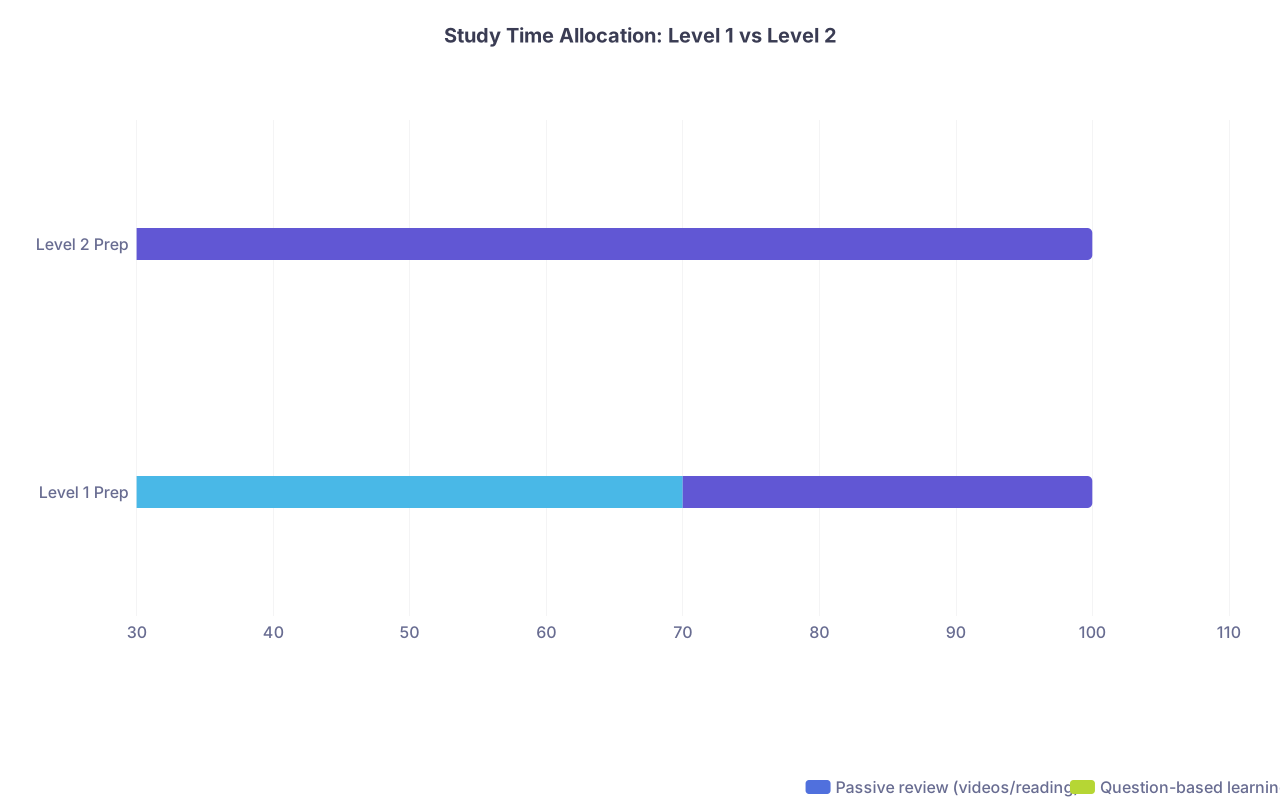
| Category | Passive review (videos/reading) | Question-based learning |
|---|---|---|
| Level 1 Prep | 70 | 30 |
| Level 2 Prep | 30 | 70 |
You do not need to show this chart to PDs, obviously. But you should be able to say, confidently:
“For Level 2, I flipped my prep from mostly passive review to mostly question-based learning and active recall. Roughly 70% of my time was now questions and detailed review.”
That sounds real. Because it is.
Step 10: Be Strategic With Your Application List
Even with a better Level 2, you cannot just throw darts at a map and hope.
Be smart:
Apply broadly.
Over-apply, then be selective later. Especially if:- Level 1 was significantly below average
- You lack USMLE scores
- You are going for a competitive specialty
Target DO-friendly ACGME programs.
Look for:- Historically many DO residents on current rosters
- Programs in regions with strong DO schools (MI, PA, OH, MO, etc.)
- Community or university-affiliated community programs
Use your improved Level 2 in targeted communication.
For programs where you are a good geographic or mission fit, a brief, professional email from you or a mentor can highlight:- Your Level 2 improvement
- Strong clinical performance
- Specific interest in their program
Do not beg. Just connect the dots for them.
Step 11: Fix the One Thing You Still Control – How You Perform Now
PDs are hiring someone for July 1 next year. Not the scared M2 who sat for Level 1.
Your daily behavior now should match the story you are selling:
- Show up prepared on rotations.
- Read on your own patients.
- Ask for feedback, then implement it fast.
- Be the reliable one: notes done, calls returned, tasks tracked.
Then when PDs talk to each other and your name comes up, what they hear is:
“Yeah, early boards were a bit low, but on our service they were excellent. Hard worker. Good judgment. Would take again.”
That sentence gets people matched.
Key Takeaways
- A low COMLEX Level 1 with a stronger Level 2 is not an automatic rejection; it is a story problem. Your job is to present a clear, closed-loop narrative of problem → intervention → improvement.
- You must show that Level 2 is not a fluke: align your improved score with stronger study habits, better clinical performance, and letters that confirm your growth and reliability.
- Be surgical in how you address Level 1—one tight paragraph in the personal statement, concise explanation in interviews, and supportive language in MSPE and letters—then move on and let your current performance do the heavy lifting.