

It’s mid-March. Your phone has stayed silent through Match Week. No “Congratulations, you have matched.” Just that one brutal email: “We are sorry to inform you that you did not match to any position.”
You went through SOAP. Fired off applications. Maybe got a nibble or two. Maybe nothing. Thursday came and went. Still unmatched.
Now you’re here: DO graduate (or about to be), no ACGME spot, watching classmates post “PGY‑1 incoming!” and badge photos. You’re googling “reapplying to residency as a DO unmatched” at 1 a.m., wondering if you just tanked your career.
You didn’t. But if you reapply the same way you did last cycle, you might.
Let me walk you through how to rebuild strategically as a DO reapplicant after an unmatched ACGME cycle—what to do, what to fix, and where people in your exact spot blow it.
Step 1: Get brutally honest about why you didn’t match
You can’t fix what you won’t name. And “I was unlucky” is not a plan.
You’re going to start by doing a postmortem on your last cycle. Not hand‑wringing. Data.
Pull out your ERAS application, your program list, and your interview calendar. Then go line by line.
Ask yourself:
- Where would most PDs have screened me out?
- Where would an interviewer have red‑flagged me?
- Where was I simply not competitive for what I applied to?
At this point, DO applicants usually fall into one or more of these buckets:
| Profile | Typical Issues |
|---|---|
| Overreach | Applied mostly to highly competitive specialties or top-tier programs |
| Under-applied | Too few programs, narrow geography, late apps |
| Paper cut death | Several minor weaknesses that add up |
| Major red flag | Failures, professionalism issues, large gaps |
| Invisible | Decent stats but no story, no advocacy, weak letters |
Now be specific. Examples:
Scores / exams
Specialty choice
- You’re a DO who applied to dermatology, orthopedics, or radiology with mid stats and zero significant research.
- Or you shotgun‑applied to EM during the most chaotic EM market in decades.
Application behavior
- Applied to 40 IM programs, but 20 were university, big‑name, mostly MD.
- Didn’t apply broadly to community or DO‑friendly sites.
- Submitted ERAS late October. Personal statement was generic. Letters were weak or last‑minute.
Interview performance
- Got several interviews but no rank‑list hits. That usually means something was off: odd interpersonal vibe, shaky answers, too negative, or clearly “backup” energy.
Do this next: pick 1–3 trusted people who saw your app and your behavior last cycle. That might be:
- A faculty advisor who’s honest, not just “supportive”
- A PD or APD from a program that interviewed you (yes, you can email politely and ask for feedback)
- A chief resident who liked you on rotation
Ask them directly:
“I’m reapplying after going unmatched. Can you help me understand where my application was weakest and what I need to change to be competitive?”
You are looking for themes. If more than one person says “Your specialty choice was too competitive for your stats” or “You didn’t apply broadly enough to community DO‑friendly programs”—that’s your starting point.
Step 2: Decide your path: same specialty vs pivot
This is the fork that most unmatched DOs are terrified to face.
Here’s the blunt truth: some of you absolutely should reapply in the same specialty. Others would be lighting another year on fire if you tried.
Use this as a rough framework:
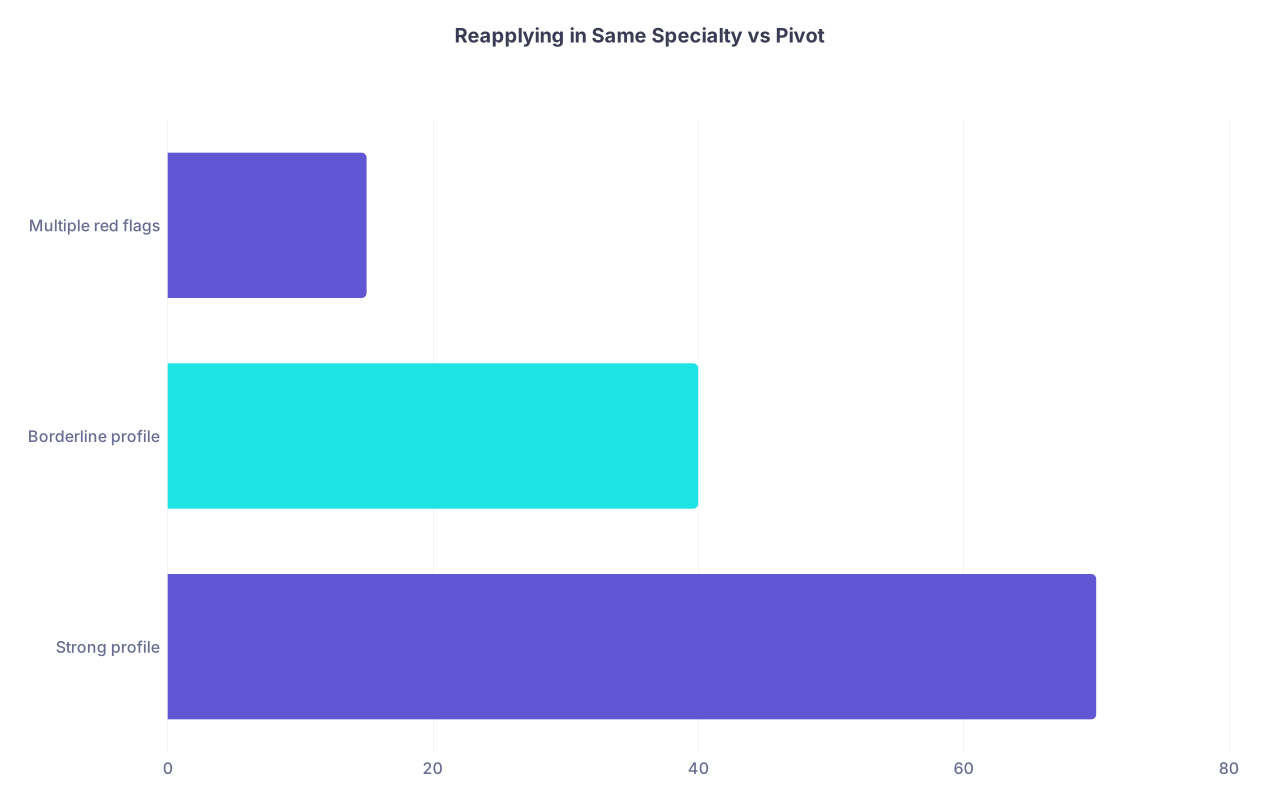
| Category | Value |
|---|---|
| Strong profile | 70 |
| Borderline profile | 40 |
| Multiple red flags | 15 |
Interpretation: strong profiles often can try again in the same specialty; borderline and red‑flag profiles more often need a pivot or major rebuild.
You can reasonably reapply to the same specialty if:
- You got multiple interviews (3–6+) in that specialty.
- Your scores are at least near the mean for matched DOs in that field.
- You don’t have a catastrophic red flag (multiple failures, major professionalism issue).
- Your feedback is: “You were close; you just needed broader applications / slightly stronger letters / earlier submission.”
Example:
DO with COMLEX 540/555, Step 2 CK 238, applied IM, had 6 interviews but over‑ranked university programs and didn’t show strong commitment to community programs. That person can absolutely reapply IM, fix targeting, and likely match.
You should seriously consider pivoting if:
- You got 0–1 interviews total.
- Your stats are way below that specialty’s usual range.
- You’re trying to break into a very competitive field (ortho, derm, ENT, neurosurgery, plastics, urology, rad onc, historically EM in the recent crunch).
- Your DO school advisors said last year: “This is a stretch,” and you applied anyway.
For DOs, strategic pivots often include:
- From EM → IM, FM, psych
- From gen surg → IM, FM, prelim + SOAP strategy
- From anesthesia → IM, FM
- From ortho → IM, FM, PM&R (if you can build that story), sometimes psych
This is where pride hurts people. I’ve seen grads spend two years chasing a specialty they were never realistically going to match, just because “I’ve always wanted X.” That’s not strategy. That’s denial.
Your job right now isn’t to defend last year’s dream. It’s to build a career that exists.
Step 3: Choose how you’ll spend your gap year (or pre‑reapply year)
If you’re reading this right after going unmatched, you essentially have three categories of options:
- Clinical “bridge” roles
- Research or academic positions
- Non‑clinical work while rebuilding quietly
Let’s go through them the way PDs see them.
1. Clinical bridge roles (best for most DOs)
Anything that keeps you in medicine, with patients, under supervision, with evaluators who can write letters is gold.
Options:
- Transitional year or prelim year (if you SOAPed into one)
- Full‑time clinical research coordinator with patient contact
- Clinical instructor / teaching fellow roles at your school
- Hospitalist extender / inpatient APP‑like roles (if allowed locally for MD/DO grads)
- Scribe positions tied to strong letter writers (better than nothing, but lower tier vs above)
The hierarchy in a PD’s head usually goes like this:
Prelim year with good evals > structured academic/clinical position > research‑only > random non‑clinical job.
Your priority: whatever you do, make sure:
- You have direct supervision from physicians in your target specialty or adjacent.
- Someone can observe you over months and write: “This person functions like a competent early intern. I would rank them highly.”
2. Research or academic positions
Good for:
- Those still aiming for a moderately competitive field
- People without strong third‑year clinical evals
- Applicants needing more structure and mentorship
But make it real research. Not “volunteering vaguely in a lab once a week.”
Look for:
- 1–2 known faculty in your target specialty (or clearly adjacent)
- Clear deliverables: posters, abstracts, maybe a manuscript
- Direct mentoring and potential for a personalized, powerful LOR
If you’re going into primary care (FM, general IM), clinical excellence and continuity often matter more than a mediocre research year. Don’t hide in a lab if your issue was interview skills and narrow applications.
3. Non‑clinical work
People do this for money, visas, family, or burnout. PDs are mixed on it.
If you must:
- Keep at least some clinical involvement (per diem clinic volunteering, free clinic, local precepting, case reviews).
- Be able to clearly explain why: “I had to support my family,” “visa timing,” etc.
- Have a parallel “application rebuild” story: extra course, board retake, publication, improved language skills, etc.
The worst look: year off with no clinical, no educational activity, and vague explanations.
Step 4: Fix your board exam story (COMLEX, USMLE, and retakes)
If you’re a DO reapplicant after an ACGME miss, your board exam profile is under a microscope.
Let’s be direct:
- Below ~480 COMLEX with no USMLE usually hurts you for many ACGME programs, especially non‑primary care.
- Failures (COMLEX or USMLE) are not automatic death, but they force you to be more strategic with specialty and program list.
You have a few levers:
Take (or retake) Step 2 CK if it helps you
If you:
- Didn’t take USMLE at all, and
- Have time and bandwidth this year
A solid Step 2 CK score can partially offset weaker COMLEX, especially in IM, FM, psych, peds. Not so much in the most competitive fields if your base is way off, but it can move you from “auto‑screen reject” to “okay, let’s look closer.”
On the other hand, if your test‑taking track record is already shaky (multiple barely passing exams, anxiety, limited bandwidth), a rushed Step 2 CK with another mediocre score can hurt more than help. Do not rush this just to “have a USMLE.”
How PDs read improvement
They love an upward trend:
- COMLEX 1: 440 → COMLEX 2: 525 → Step 2 CK: 235.
That’s a story: “I matured, improved my study strategy, and my clinical knowledge is now solid.”
They hate plateau or decline without an explanation:
- COMLEX 1: 490 → COMLEX 2: 470 → no USMLE → no explanation.
That screams stagnation.
If you have a failure, your job is:
- Own what went wrong (without oversharing or blaming).
- Show objective improvement since: better scores, stronger clinical performance, more responsibility.
Step 5: Rebuild your application materials like a new person, not a recycled file
Too many reapplicants just tweak their old personal statement and add one line to their experiences. PDs notice. It looks lazy.
Personal statement: rewrite from scratch
You’re not writing “Why I like internal medicine” again. You’re writing:
- Why you’re still committed to this field after a setback.
- What you’ve done this past year that makes you a better intern.
- How you function in a team, handle stress, and add value.
You do not have to say “I went unmatched.” PDs can see the dates. But you can reference growth directly:
“Over the last year working full‑time in inpatient medicine, I’ve had the chance to function in a role similar to an intern—managing cross‑coverage calls, presenting on rounds daily, and collaborating with nurses and case management. That experience has confirmed that internal medicine is the right field for me and has made me more prepared to hit the ground running as a PGY‑1.”
That’s the tone. Calm, adult, forward‑looking.
Letters of recommendation: get new and stronger ones
If your letters weren’t a problem, great. But most unmatched applicants underestimate this piece.
You want:
- At least one letter from this gap year—ideally someone who supervised you for months.
- Specialty‑aligned letters. Applying IM? You should have IM letters. Applying FM? Get outpatient and inpatient family docs if possible.
Tell your letter writers the truth:
“I went unmatched this year and am reapplying. I’d appreciate an honest assessment and a letter only if you can strongly support my application.”
You’d be shocked how often a polite version of that filters out lukewarm letters. Which is exactly what you want.
Step 6: Fix your program list and application behavior
This is where a lot of DO reapplicants kill their chances. Not with their CV. With their program strategy.
Build an actually DO‑friendly list
You’re not applying to “good names.” You’re applying to places that actually take people like you.
Look at:
- Programs with a visible history of DO residents (website photos, resident lists)
- Community programs vs big‑name university hospitals
- Geographic regions where DOs historically match well (Midwest, South, some Northeast community systems)
If you’re a DO with mid stats reapplying IM, and your list is 50% university programs that graduated 90% MDs last year, you’re wasting fees.
How many programs?
Depends on specialty and your risk profile, but as a reapplicant you err on the side of more, not fewer.
Rough ideas (not gospel, but realistic):
- IM reapplicant DO: often 80–120+ programs
- FM: 40–70+ (but choose wisely, many are DO‑friendly)
- Psych: 70–120+ (it’s tightened up)
- Peds: 60–100+
- EM, surgical: usually needs very tailored strategies or a pivot
If that sounds like a lot, it is. You’re climbing out of a hole. Pretending otherwise is how people become 3‑time reapplicants.
Timing and completeness
You cannot afford to be “late but strong” as a reapplicant. You need:
- ERAS submitted within the opening window.
- All letters uploaded or very close.
- Personal statement final, not “I’ll fix that later.”
- Step 2 / Level 2 scores in by the time programs start offering interviews, if at all possible.
Late + reapplicant + DO = triple disadvantage. Don’t stack the deck against yourself.
Step 7: Clean up interview performance and your “story”
If you had decent interview numbers but no match, your interview skills might have quietly killed you.
Common DO reapplicant interview mistakes I’ve seen:
- Sounding bitter about going unmatched.
- Over‑explaining a failure or red flag until the whole conversation is about that.
- Giving generic answers that do not show any self‑reflection.
- Coming off as clearly uninterested in community or DO‑heavy programs (“I really want to do sub‑specialty X at a university program later” said at a small community hospital interview—PDs remember that).
You need to rehearse answers to:
- “Tell me about yourself.”
- “What have you been doing since graduation?”
- “Why this specialty, and why now?”
- “Tell me about a time you failed or faced a setback.”
- “What did you change this time around?”
Practice with someone who will stop you and say: “That sounds defensive,” or “You’re rambling.” Preferably a physician, or someone who interviews applicants.
The goal: you come across as:
- Grounded
- Reflective
- Over the shame part
- Ready to work
Not as someone still half‑in shock from last Match.
Step 8: If you’re more than 1 year out: deal with the “older grad” problem
If this will be your second reapplication, or you’re 2+ years from graduation, the clock is louder.
PDs worry about:
- Skills atrophying
- Motivation
- Board scores expiring (for some states)
You combat that by:
- Staying in continuous clinical work if at all possible.
- Having a clear, coherent timeline: “Graduated 2023 → research + clinical 2023–24 → unmatched → full‑time inpatient clinical role 2024–25 → now applying.”
- Being absolutely bulletproof on “Why now?” and “Why didn’t you match before?” without sounding like a victim.
At some point—especially 3+ years out—some DOs have to strongly consider:
- Less competitive specialties they previously ignored.
- Community‑heavy geographic areas they initially refused.
- Even non‑residency clinical careers if they cannot get traction after multiple rebuilt, truly improved cycles.
Harsh, but real.
Step 9: Common DO reapplicant traps to avoid
I’ve watched people do all of these:
- Reusing 90% of last year’s application.
- Applying to the exact same list of programs that already passed on them.
- Delaying Step 2 CK “until after Match” again.
- Writing personal statements full of vague “passion for medicine” instead of concrete growth.
- Hiding the gap year activities because they’re “not impressive enough,” leaving their timeline looking empty.
- Refusing to broaden specialties or geography out of pride.
If you recognize yourself in that list, good. Change course now.
What you should do today
Do something concrete in the next 24 hours. Not more doom‑scrolling.
Here’s the move:
Open a blank document.
Create three headings:
- “Why I didn’t match”
- “What I will change this year”
- “Who can help me”
Under “Why I didn’t match,” force yourself to write at least 5 specific reasons from your own application (not “the system is broken”).
Under “What I will change,” write one actionable fix for each of those reasons.
Under “Who can help me,” list at least 3 names: advisors, attendings, chiefs, alumni. Then send one email today asking for a candid review of your last cycle and advice for your reapplication.
Do that, and you’re no longer “the DO who went unmatched.” You’re now the reapplicant who’s actually running a strategy. That’s the person programs take seriously.


