Most osteopathic applicants are weaponizing OMM in exactly the wrong way.
They either bury it in vague buzzwords (“holistic,” “hands-on care”) or throw a disorganized pile of techniques, workshops, and random certificates at program directors who do not speak that language. Then they are surprised when ACGME PDs either ignore it or quietly flag the file as “odd fit.”
Let me be very clear: a strong OMM portfolio can help you. A scattered, jargon-heavy OMM portfolio can hurt you.
Let’s fix that.
1. What ACGME PDs Actually Think When They See “OMM”
Stop guessing what program directors want. This is what I have heard in real selection meetings:
- Internal medicine PD: “If their osteopathic background translates into better physical exam and patient communication, I care. I do not care how many cranial courses they took.”
- EM PD: “OMM is fine, but if they talk more about muscle energy than managing sepsis, that is a problem.”
- Surgery PD: “As long as they can operate and not disappear to ‘do treatments’ for 30 minutes, we’re fine.”
You are dealing with three broad PD phenotypes:
| PD Type | View of OMM | Risk for You if Portfolio is Bad |
|---|---|---|
| OMM-Positive / Curious | Mild–strong interest | Lost opportunity |
| OMM-Neutral / Pragmatic | “Nice but not central” | You look unfocused |
| OMM-Skeptical / Concerned | “Potential distraction” | You look like a mismatch |
The trap: your OMM portfolio is often read first by people in the neutral or skeptical buckets.
Your job is not to “sell” OMM. Your job is to make three things obvious, even to someone who barely believes in it:
- You are a physician first, DO second, OMM-provider third. In that order.
- Your OMM training improves core ACGME competencies (clinical reasoning, communication, procedural skill, systems-based practice).
- You will not be a workflow problem. No “15-minute OMM sessions” in a 5-minute follow-up slot.
If your portfolio does not transmit those three messages, it will confuse or weaken your application.
2. The Core Structure of a Clean OMM Portfolio
Think of your “OMM portfolio” as everything an ACGME PD will see that signals osteopathic identity:
- ERAS experiences and descriptions
- Personal statement
- Letters of recommendation (especially from OMM faculty)
- OMM-related research / QI / presentations
- OMM electives, tracks, or leadership roles
- How you talk about it in interviews
The problem is not usually content. It is structure and translation. You are writing in “OMM dialect” to an “ACGME dialect” reader.
Translate. Ruthlessly.
The Three Buckets Test
Every OMM-related activity you include should clearly fall into one of these buckets:
Enhances diagnostic / procedural skills
Example: palpation precision, ultrasound correlation with physical findings, MSK exam quality.Enhances patient care or safety
Example: non-opioid pain strategies, hospital LOS reduction, improved patient satisfaction.Enhances teaching / leadership
Example: curriculum development, teaching MS1/2, leading workshops that align with program goals.
If you cannot quickly assign an activity to one of those three, it probably does not belong as a major emphasis on ERAS. Or it needs to be reframed.
3. ERAS Experiences: How to Write OMM Without Losing PDs
This is where most osteopathic applicants create confusion. They either:
- List “OMM Clinic” with a vague, heavily jargonized description
- Or they hide OMM completely, then wonder why their DO training looks generic
You want a middle path: explicit, concise, translated.
Anatomy of a Strong OMM Experience Entry
Bad version (I have seen variations of this too many times):
“OMM Fellow – Performed HVLA, FPR, Still, cranial, and visceral techniques in diverse outpatient populations; integrated osteopathic structural exam and facilitated self-healing and holistic management of somatic dysfunction.”
That sounds like a brochure. It does not tell a PD anything useful.
Strong version:
“OMM Fellow – Co-managed outpatient MSK and chronic pain patients using focused physical exam and manual techniques as adjuncts to standard care. Emphasis on diagnosing mechanical contributors to pain, reducing unnecessary imaging, and supporting non-opioid management strategies. Taught first- and second-year students fundamentals of MSK exam and ergonomics.”
Notice the changes:
- No technique alphabet soup
- Clear signal: adjunct to standard care, not replacement
- Explicit links: MSK exam, imaging stewardship, non-opioid management, teaching
You can mention techniques, but anchor them in outcomes or skills that PDs care about:
“Used soft tissue, muscle energy, and HVLA for acute low back pain in ED fast-track patients, focusing on reducing return visits and facilitating earlier mobilization.”
Keep the words “somatic dysfunction,” “self-healing,” and “cranial” to a minimum in ERAS descriptions unless you are applying to OMM-specific programs.
How Many OMM Entries Is Too Many?
If half your experiences are OMM-centric, you look narrow. For most non-OMM residencies, aim for:
- 1–2 focused OMM clinical experiences
- 1 teaching / leadership experience (e.g., OMM tutor, lab TA, OMM club leader)
- 0–2 research/QI entries (only if they are substantive)
The rest should be standard clinical, leadership, volunteering, and research every MD applicant could understand.
If you had a full OMM fellowship or NMM track, that counts as one major longitudinal clinical/teaching experience, not six micro-entries about every duty you had.
4. Personal Statement: Integrating OMM Without Turning It Into a Philosophy Essay
Many DO students destroy otherwise solid personal statements with a 3-paragraph detour on “the osteopathic philosophy” that reads like a first-year assignment.
Program directors do not need your philosophy. They need:
- Why this specialty
- How your specific training (including OMM) will make you effective in their setting
- Evidence you understand what their residents actually do
So where does OMM go?
The “Single Paragraph Rule”
For non-NMM residencies, you almost always want OMM in:
- One main paragraph (4–7 sentences), in the middle of the statement
- Possibly one short reference later if tied to a specific case or project
Structure it like this:
- One sentence on your osteopathic background.
- One or two concrete examples of how that training shaped your patient care in this specialty.
- One or two sentences on how you will apply that lens moving forward in residency.
Example for internal medicine:
“My osteopathic training has pushed me to start with the question, ‘What is the mechanical or functional contributor to this patient’s problem, beyond the lab results?’ On my internal medicine sub-internship, this lens changed how I approached a patient with ‘refractory’ GERD and chronic neck pain. Careful attention to posture, MSK strain from his warehouse job, and visceral hypersensitivity led us to adjust his ergonomics, simplify his medications, and use targeted manual techniques to reduce his symptom burden. I do not expect to use OMM every day in residency, but that habit of integrating structural, functional, and psychosocial contributors to disease is how I want to practice internal medicine.”
That reads like a physician who happens to be DO, not an OMM evangelist.
What you must avoid:
- Defining OMM for multiple sentences
- Arguing for its legitimacy
- Suggesting you expect to run parallel OMM consult clinics in every rotation
If you are applying to an NMM/OMM residency or dual program, that is different. Then OMM is central, and you should have a dedicated statement or a clearly NMM-heavy framing. But you do not send that same essay to categorical IM or EM programs.
5. OMM Letters of Recommendation: Use Them Strategically, Not Reflexively
A strong letter from an OMM faculty member can be helpful. A generic “great student, loves OMM” letter can hurt by crowding out a more relevant clinical letter.
For non-NMM residencies, your priority is still:
- At least one letter from a core specialty rotation (IM letter for IM, EM letter for EM, etc.)
- One from a strong clinical experience with heavy patient care (sub-I, ICU, etc.)
- Optional: OMM/osteopathic faculty letter that speaks to teaching, MSK skill, and work ethic
If you use an OMM letter, coach the writer. Not by telling them what to say, but by explaining what PDs need to hear.
You want the letter to hit:
- Clinical competence and reliability in patient care
- How OMM training improved your physical exam, diagnostic reasoning, and patient communication
- Professionalism and teachability (no “goes rogue to do treatments in the hallway” vibes)
Bad pattern in OMM letters:
“She is passionate about osteopathic principles and always eager to do OMT on her patients. She often volunteers to provide OMT even when others are not thinking of it.”
That can read as: “She is more enthusiastic about doing treatments than about following the team’s priorities.”
Better framing:
“On our inpatient OMM consult service, he consistently integrated manual treatment only after clarifying the primary team’s goals and the patient’s medical stability. His notes clearly tied each intervention to the patient’s clinical status and functional goals, such as improving pulmonary mechanics post-operatively or reducing pain to facilitate early mobilization.”
That signals alignment with team-based, safety-conscious practice.
6. Research, QI, and Presentations: Show Outcomes, Not Ideology
OMM-related research can be an asset, but only if you present it as you would any other clinical or QI project.
Do not lead with “proving that OMT works.” Lead with:
- A clear clinical question
- Methods that a PD recognizes as legitimate
- Outcomes that connect to patient care, systems, or education
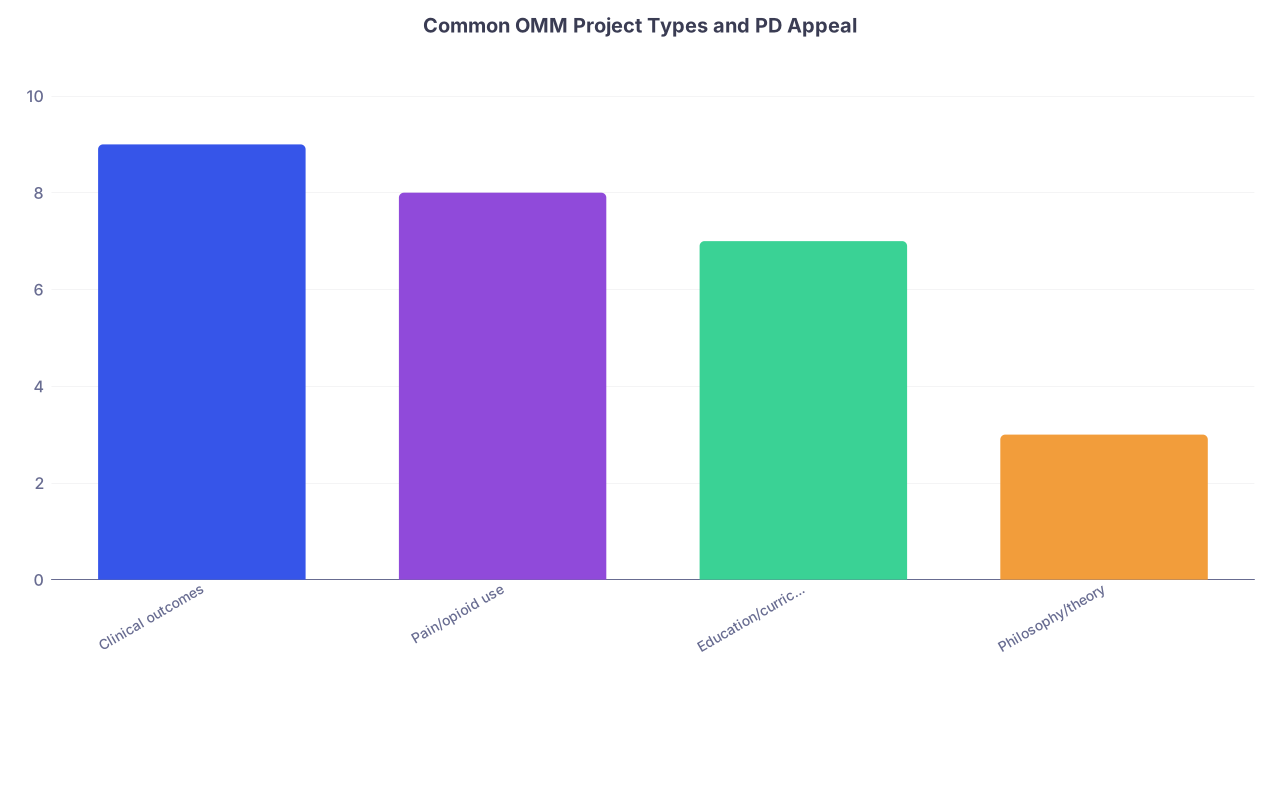
| Category | Value |
|---|---|
| Clinical outcomes | 9 |
| Pain/opioid use | 8 |
| Education/curriculum | 7 |
| Philosophy/theory | 3 |
If you have an OMM project that is basically a small pre-post series with weak methodology, do not oversell. Be precise:
“Pilot QI project evaluating feasibility of integrating 10-minute OMT interventions for hospitalized patients with acute on chronic low back pain, measuring pain scores, mobility, and opioid requirements.”
Then add the real outcomes. Even if the results were mixed:
“We observed modest reductions in reported pain and earlier ambulation in a small cohort; there was no clear reduction in opioid use. The main barrier was scheduling and resident workflow, which informed our proposal for a consult-based rather than routine OMT approach.”
Now the PD sees you as someone who can think in systems, not as a zealot.
Conference posters and workshops should be treated the same way: briefly, clinically framed, no technique catalogues unless you are going into NMM.
7. How to Talk About OMM in Interviews Without Setting Off Alarm Bells
This is where many DO applicants unintentionally hurt themselves. They finally get a PD who asks, “So tell me about OMM” and they:
- Start describing cranial rhythms
- Talk about “energy” or “self-healing”
- Or sound like they want to practice as a part-time OMM consultant inside the residency
That may be entirely fine at an NMM program. It will not land well at a busy county EM residency.
You need a default interview script with three components:
- A plain-language, non-ideological definition
- A concrete example in the PD’s specialty
- A statement about how you will use it practically during residency
Example answer for an EM interview:
“For me, OMM is a set of hands-on exam and treatment skills that help me understand and sometimes directly influence the mechanical and functional contributors to a patient’s problem. In the ED, that has mainly meant more precise MSK exams and being able to offer a quick manual intervention for things like acute neck strain or certain types of low back pain, alongside standard care. I do not expect to use OMM on every shift or with every patient, but I have seen how it can improve patient satisfaction and reduce repeat visits for minor MSK issues, and I would use it when it fits the flow of care and the team’s goals.”
Notice what is missing: no technique jargon, no alternative-medicine language, no implication that you will sidestep protocols.
You should also be prepared for a direct challenge:
- “Do you think OMM actually works?”
- “What do you say to people who think it is pseudoscience?”
- “Will you be trying to convert our residents?”
Stick to data and humility:
- Acknowledge limited evidence in some domains
- Highlight stronger areas (MSK pain, some perioperative / pulmonary applications)
- Emphasize that you follow evidence and program culture
8. Adapting Your OMM Portfolio to Different Types of ACGME Programs
You do not send the same OMM signal to every program. That is naive.
Think of programs on a spectrum:
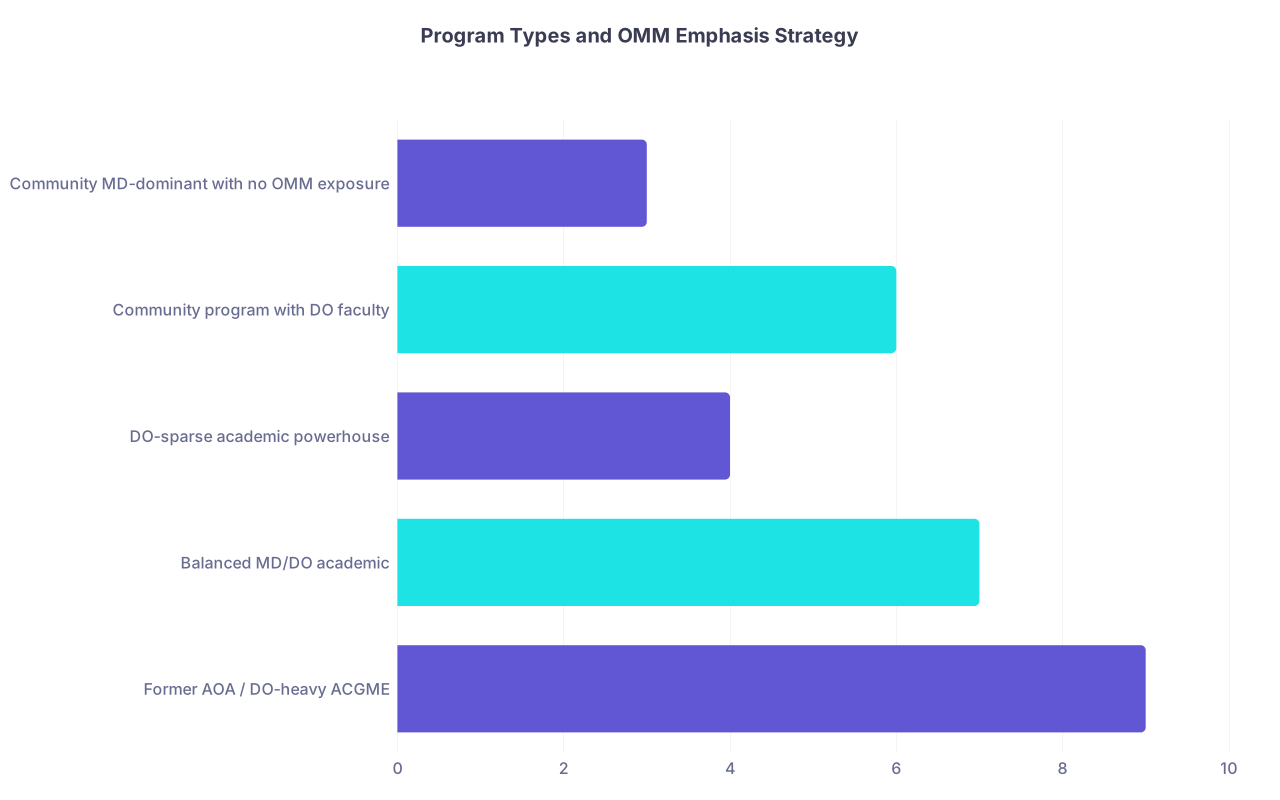
| Category | Value |
|---|---|
| Former AOA / DO-heavy ACGME | 9 |
| Balanced MD/DO academic | 7 |
| DO-sparse academic powerhouse | 4 |
| Community program with DO faculty | 6 |
| Community MD-dominant with no OMM exposure | 3 |
The higher the “OMM receptivity” score, the more explicit you can be.
Former AOA / DO-heavy Programs
Here, OMM is normal. You can:
- Mention OMM more clearly in your personal statement
- Use an OMM letter more confidently
- List OMM teaching roles prominently
You still should not be sloppy. But you can assume some shared language.
Balanced Academic Programs with DO Faculty
These are your sweet spot for a well-structured OMM portfolio. Emphasize:
- Patient care impact
- MSK skills
- Teaching contributions
Keep pure philosophy low-key.
DO-Sparse Academic Powerhouses, MD-Dominant Community Programs
Here, the goal is “reassure and mildly differentiate,” not “convert.”
- One clean OMM clinical entry
- One teaching or leadership entry, max
- Single-paragraph mention in personal statement
- OMM letter only if your other clinical letters are already very strong
You want them to think: “Good clinician, happens to have extra manual skills, not a problem.”
9. Common OMM Portfolio Mistakes That Turn Off ACGME PDs
Let me just call these out. If you see yourself in this list, fix it now.
Technique Listing Mania
Every experience description packed with: HVLA, FPR, BLT, Still technique, cranial, visceral.
Translation: “I am more in love with techniques than with clinical reasoning.”Philosophy Essays Everywhere
Personal statement, ERAS descriptions, even research blurbs all filled with “body-mind-spirit,” “self-healing,” “harmony,” etc.
Translation: “I may not be grounded in evidence and standard practice.”Over-Saturation
Five separate OMM experiences, two OMM letters, three OMM research posters, plus an OMM-dominant personal statement for non-NMM programs.
Translation: “I might be better suited for an NMM or OMM-heavy track, not a standard program.”Workflow Red Flags
Descriptions of spending long periods doing OMT without mentioning coordination with team or time constraints.
Translation: “May be disruptive or unrealistic in our clinical environment.”Zero Translation
Writing about “improving somatic dysfunction” without connecting it to pain, function, or other recognizable outcomes.
Translation: “This is a foreign language; I am skipping it.”Defensive or Combative Tone
Statements that sound like you are preemptively arguing with skeptics.
Translation: “Chip on the shoulder. Potential culture mismatch.”
If your current materials hit two or more of these, you need a full rewrite, not just tweaks.
10. Practical Checklist: What To Actually Do This Week
You are busy. Let me give you a concrete, realistic process.

| Step | Description |
|---|---|
| Step 1 | Collect All OMM-Related Content |
| Step 2 | Sort Into 3 Buckets |
| Step 3 | Rewrite ERAS Entries in Clinical Language |
| Step 4 | Edit Personal Statement OMM Paragraph |
| Step 5 | Review Letter Strategy with Advisor |
| Step 6 | Create 2-3 Interview Talking Points on OMM |
Step-by-step:
- Pull everything OMM-related: CV, ERAS draft, PS, abstracts, certificates.
- Label each item as:
- Clinical care
- Teaching / leadership
- Research / QI
- Pure philosophy (most of these get cut or heavily reframed)
- For each clinical or teaching item, rewrite the description:
- Remove technique lists unless truly necessary
- Add 1–2 clear outcomes or skills PDs care about
- Trim your personal statement so OMM lives in one strong, concrete paragraph.
- Decide now:
- Will you use an OMM letter?
- If yes, which clinical letters are already locked? You do not sacrifice a core specialty letter to make room for an OMM letter.
- Draft 2–3 short, PD-friendly responses to:
- “What does OMM mean in your practice?”
- “How do you see yourself using it in residency?”
- “What would you do if your attending does not value OMM?”
Practice those answers out loud. With an MD friend if possible. If they look confused, you need more translation.
FAQ (Exactly 6 Questions)
1. Should I include an OMM-specific personal statement for some programs and a different one for others?
Yes, if you are applying to any NMM/OMM or dual programs, you should have a separate, clearly OMM-forward statement for those. For standard categorical ACGME programs (IM, EM, surgery, etc.), use a more mainstream statement with a single, well-crafted OMM paragraph. The mistake is sending the NMM-style statement to non-NMM programs.
2. How many OMM-related experiences are “too many” on ERAS for a non-NMM specialty?
For most applicants: 2–4 total, depending on your overall experience volume. One longitudinal OMM clinic or fellowship entry, one teaching/leadership entry (OMM TA, tutor, club officer), and possibly one research/QI project. Once OMM-related entries begin to outnumber your core clinical experiences in the specialty, you look unbalanced.
3. Is it risky to have an OMM faculty write one of my letters of recommendation?
It can be risky if it replaces a key clinical letter or if the writer emphasizes passion for OMM without demonstrating robust clinical skills and team-based professionalism. It is safer when: you already have strong specialty-specific letters, the OMM faculty has seen you manage real patients, and they can credibly speak to exam skill, communication, and reliability, not just enthusiasm for manipulation.
4. Can I talk about cranial OMM in my application at all?
You can, but sparingly and strategically. For non-NMM programs, do not lead with cranial and do not frame it as mystical. If it appears, it should be in the context of a specific patient scenario, with clear, observable outcomes and humility about evidence limitations. If a PD appears skeptical in an interview, do not die on that hill; pivot to broader MSK and functional benefits.
5. What if my strongest research is OMM-related but methodologically weak?
You still can include it, but you must be honest and technically precise. Do not oversell small, uncontrolled series as definitive evidence. Emphasize what you actually learned: feasibility issues, workflow barriers, patient acceptability, hypothesis generation. That makes you look like a thoughtful early-stage investigator instead of a zealot stretching data to match a belief.
6. How do I reassure a skeptical PD that I will not disrupt workflow with OMM?
Say it explicitly. In both written materials and interviews, emphasize that OMM is an adjunct, not a replacement, for standard care; that you always prioritize team goals, patient safety, and time constraints; and that you only use OMM when it integrates cleanly into existing workflows. Concrete phrases like “I only offer it when it fits the visit structure and the attending is comfortable” are powerful. You want them to think: “Value-add, not a problem to manage.”
Key takeaways:
- Translate your OMM experience into ACGME language: clinical impact, exam skill, patient outcomes, teaching.
- Contain OMM in your application: a few strong entries, one focused PS paragraph, and carefully chosen letters—no technique catalogues or philosophy essays.
- Your message to every PD: I am a solid clinician first, with extra manual tools I will use judiciously and in alignment with your program’s culture.