
The biggest threat to a DO applicant in residency interviews is not your COMLEX score. It is how badly you handle bias-laced questions when the stakes are highest.
Let me break this down specifically. You are walking into interview rooms where:
- Some faculty have never seriously learned what COMLEX scores mean.
- Some PDs publicly “accept DOs” but privately see you as a backup applicant.
- A few still think osteopathic training is “less rigorous” than MD.
If you handle those moments clumsily—even once—your otherwise solid application can slide quietly down the rank list.
This is fixable. But not with generic “be confident and sell your strengths” advice. You need targeted prep for DO-specific bias and COMLEX questions, with rehearsed, nuanced answers that sound natural, not defensive.
The Landscape: Where DO Applicants Actually Lose Ground
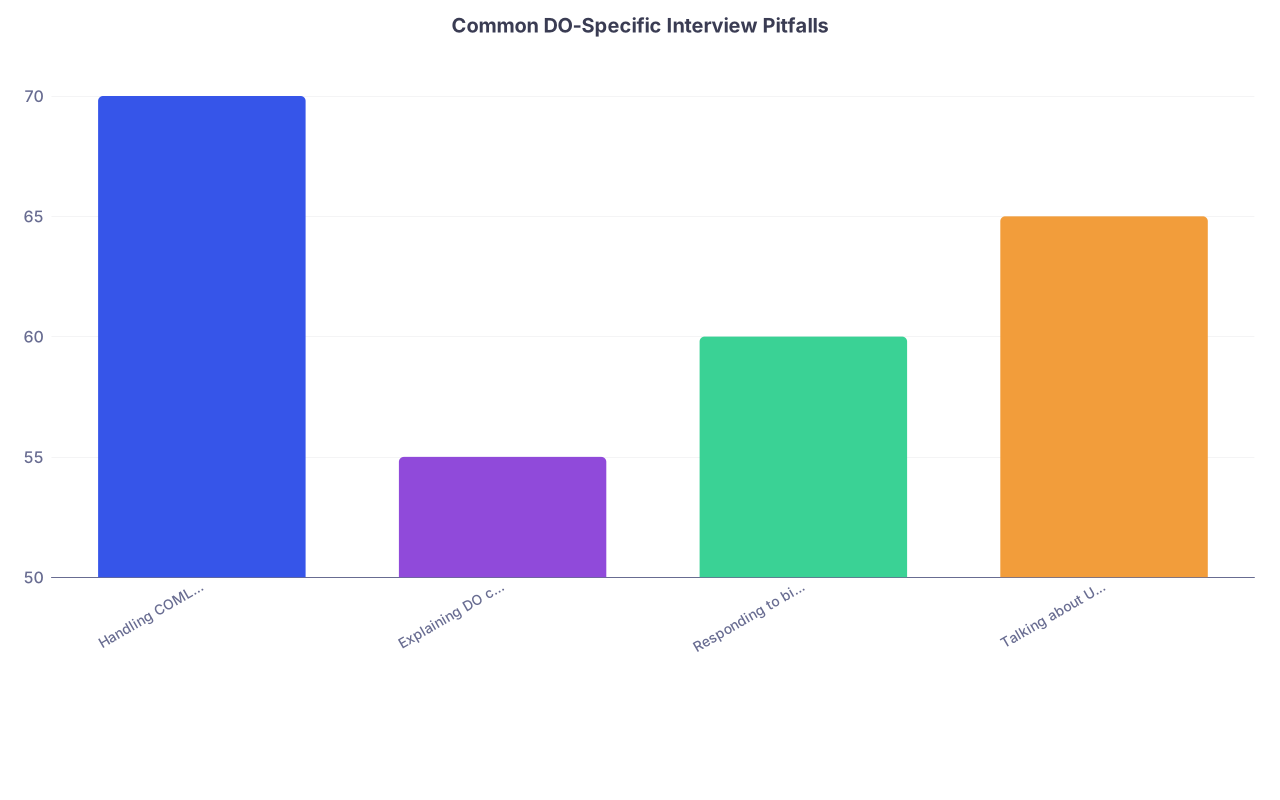
| Category | Value |
|---|---|
| Handling COMLEX questions | 70 |
| Explaining DO choice | 55 |
| Responding to bias | 60 |
| Talking about USMLE/score conversion | 65 |
I want you to see where the landmines really are. They are not random.
I consistently see DO applicants stumble in four predictable areas:
- Explaining why they chose a DO school without sounding second-choice or apologetic.
- Responding to “Do you feel equal to MD grads?” without getting visibly irritated or overly meek.
- Talking about COMLEX-only vs COMLEX+USMLE in a way that reassures PDs about their ability to compare you.
- Handling blunt or semi-inappropriate bias questions—especially in competitive or formerly MD-only programs.
Here is the uncomfortable truth: a good number of interviewers do not know how to interpret COMLEX, and some will test you—explicitly or subtly—on whether you belong in their “MD-dominant” training environment.
Your job is not to win a philosophical debate about osteopathic medicine. Your job is to demonstrate three things, repeatedly and calmly:
- You understand and respect both pathways (DO and MD).
- You can compete at the same level as your MD peers.
- You are not fragile, defensive, or easily rattled by outdated views.
If you do those three, you outperform most DO applicants in the room.
Core Framework: How to Answer DO- and COMLEX-Specific Questions
Think in frameworks, not scripts. The content will vary, but your structure should be stable.
1. The 3-Part Structure for DO-Related Answers
For any question about being a DO, DO school, or osteopathic vs allopathic:
Anchor in your values/decision.
Why this path made sense for you.Demonstrate equivalence or competitiveness.
Concrete evidence you perform at the same level as any strong MD applicant.Add a forward-looking benefit.
How your DO training improves the care or perspective you will bring to their program.
Example skeleton:
- “I chose the DO route because…” (values / decision)
- “In terms of training and performance…” (equivalence / competitiveness)
- “This translates to your program as…” (benefit)
Memorize that structure. You will reuse it 10+ times in different forms.
2. The 4-Part Structure for COMLEX Questions
When they ask about COMLEX, score interpretation, or not having USMLE:
- State what you took. COMLEX only, or COMLEX + USMLE.
- Give the short, comparative signal. Where your scores place you.
- Show insight into their problem. You know they need to compare across applicants.
- Offer a bridge. Percentiles, NBME/UWorld performance, school ranking, etc.
Example skeleton:
- “I took COMLEX Level 1 and 2…”
- “My Level 2 score of ___ is around the ___ percentile…”
- “I recognize comparing COMLEX and USMLE can be tricky…”
- “To give you a benchmark, on NBME/UWorld… / class rank / other metrics…”
If you do not offer that bridge proactively, you force them to guess. That rarely helps you.
Handling Classic COMLEX and Score Questions
Here is where DOs either look polished or instantly out of their depth.
Common Question 1: “Why did you only take COMLEX and not USMLE?”
This is one of the most mishandled questions. Rambling explanations about schedule, money, or “my school did not push USMLE” sound weak if that is all you say.
Use a clean, concise, confident structure:
- Acknowledge fact.
- Provide a reason that does not sound like “I was scared I’d fail.”
- Reassure on comparability.
Example answer:
“I took COMLEX Level 1 and Level 2 but did not take USMLE. Early in second year, I made a deliberate decision to focus fully on COMLEX preparation, given my goal of applying primarily to programs with a track record of accepting COMLEX.
My Level 2 was a 6xx, around the [X]th percentile, and I consistently scored in the [Y]s on NBME-style assessments. So although I do not have a USMLE number, my performance data line up with what you would expect from a competitive MD applicant.”
Then stop talking. Do not oversell. Let them ask a follow-up if they want more detail.
If you also have a very DO-friendly specialty or region (FM, IM community, peds, certain EM programs), you can add one line:
“Given the specific programs and regions I was targeting, program leadership confirmed COMLEX alone would be sufficient as long as the scores were strong.”
You are signaling that you planned, asked, and were strategic—not that you hid from USMLE.
Common Question 2: “How would your COMLEX score translate to USMLE?”
Never give a fake “conversion.” There is no official, precise conversion. The more you pretend there is, the worse you look.
What you can do is give a range/benchmark anchored in real data:
“There is no perfect 1:1 conversion, but based on publicly available correlations and my own NBME/UWorld performance, my COMLEX Level 2 of 6xx and 8x percentile would likely correspond to roughly a mid‑230s to low‑240s Step 2 range.
More practically, in my clinical rotations I have consistently performed at or above expectations, and my shelf-equivalent exams and evaluations have been in the top quartile of my class.”
You are giving them a mental box to place you in, then reinforcing it with another metric (class rank, clinical performance).
Common Question 3: “Why did you choose to take USMLE in addition to COMLEX?”
Here the trap is sounding like you are apologizing for being DO and “proving” you can hang with MDs. You want to sound strategic, not insecure.
Example:
“I took both COMLEX and USMLE because I knew I wanted to be competitive for programs that traditionally reviewed primarily USMLE scores.
My goal was to remove any barrier to comparing me with MD peers. I scored a ___ on Step 2 and ___ on Level 2, which are consistent with each other and place me in a competitive range for this specialty.
Taking both also forced me to master both COMLEX-style and USMLE-style question formats, which I think ultimately strengthened my clinical reasoning.”
Short, clean, and you make it about program flexibility, not personal insecurity.
Common Question 4: “Your Level 1/2 score is a bit lower than some of our applicants—what happened?”
Do not blame COMLEX format, “tricky questions,” or DO vs MD content. That sounds like excuse-making.
Instead:
- Own the number.
- Give a brief, specific reason.
- Show improvement or mitigation.
- Tie it to current performance.
Example for a weak Level 1, stronger Level 2:
“You are right, my Level 1 of ___ was below where I wanted it. I struggled with content breadth and test strategy early in board prep.
I changed my approach going into Level 2—focused heavily on UWorld and COMBANK, built a strict schedule, and took more practice exams. That led to a Level 2 of ___, which is around the ___ percentile.
The same disciplined approach is what I brought into my core rotations, where I have been consistently evaluated in the top third of my class.”
No drama. No emotional overshare. Just a clear arc of growth.
Direct Bias: “Why DO?” And Worse.
This is where you separate yourself from the rest of the pack.

The Standard “Why DO?” Question
If your answer sounds like: “I really believe in holistic medicine and treating the whole person,” you sound like every other DO applicant who memorized the brochure.
You need to sound like a person who made a conscious, high-level training decision.
Here is a sharper, more grounded approach:
“I chose a DO program because I wanted a strong foundation in general medicine with additional training in hands-on diagnosis and management.
I did not see DO and MD as ‘better’ or ‘worse,’ but as two paths to the same endpoint with slightly different emphases. The DO route offered me small-group anatomy, early patient contact, and OMT training that has made me more comfortable with physical exam, especially in musculoskeletal complaints.
Functionally, my day‑to‑day training looks identical to my MD counterparts: same core clerkships, same hospitals, same expectations. The osteopathic component adds tools rather than limiting anything.”
You are:
- Avoiding sounding like you “settled” for DO.
- Not bashing MD.
- Emphasizing real, concrete training features.
The Subtle Bias Question: “Do you think DOs are as well trained as MDs?”
This is a test. They are not really asking about DO vs MD. They are asking: “How do you react when your professional identity is challenged?”
The worst answers:
- Defensive rant about “DOs actually see MORE patients!”
- Flippant: “Oh absolutely, we are better.”
- Overly meek: “I hope so, I think I can keep up.”
You want calm, factual, and confident:
“My experience has been that the training quality depends far more on the specific school, clinical sites, and the student’s own effort than on whether the degree says DO or MD.
At my school, our clinical rotations are in the same hospitals and clinics that MD students rotate through. We are evaluated on the same ACGME milestones and expected to hit the same benchmarks.
I fully expect to be held to the same standard as any MD resident, and my goal is that my performance, not my degree letters, is what you remember.”
Short, firm. No apology. No trash talk.
The Blunt or Inappropriate Bias Question
Yes, it still happens. Variants I have heard, verbatim:
- “Why should we take a DO when we get plenty of MDs?”
- “You know this is a historically allopathic program, right?”
- “Do you feel like you are at a disadvantage being from a DO school?”
This is where people either get angry or crumble. Both reactions hurt you.
You need a “prepared neutralizer”—a sentence or two that acknowledges the bias without escalating.
Example 1:
“I am aware that historically many programs have taken mostly or exclusively MDs. I see that not as a barrier but as an opportunity to demonstrate that my training and work ethic match what you expect from your residents.
At the clinical level, I am confident I can perform on par with any of my peers, regardless of degree.”
Example 2:
“I understand some programs are still more familiar with MD training paths. My goal here is for you to see me as an individual applicant: my clinical evaluations, my work with [specific rotation or project], and how I would fit on your team. The DO letters are part of my background, but they do not limit what I can do for your patients.”
You are not trying to convert the faculty member into a DO advocate. You are showing emotional control and professional maturity under pressure. That is what PDs care about.
Advanced Tactics: Reframing and Redirecting
There are two techniques that separate advanced interviewees from everyone else: reframing and redirecting.
Reframing a Loaded Question
Reframing means you slightly adjust the question to one you can answer powerfully.
Example:
Interviewer: “Do you think coming from a DO school means you have gaps compared to MD graduates?”
You do not accept the “gaps” framing. You reframe:
“What I can say is that my training has thoroughly prepared me in the core areas you expect for an incoming resident: managing common inpatient and outpatient conditions, working within multidisciplinary teams, and communicating clearly with patients and staff.
If there are program-specific expectations—like heavy exposure to [ICU / trauma / OB / etc.]—I am more than willing to put in additional time to meet and exceed those standards.”
You are subtly moving the conversation from “Are DOs deficient?” to “Here is what I bring and how I will meet your bar.”
Redirecting Without Dodging
Redirecting is not about avoiding the question. It is about answering briefly, then moving to something that showcases your strengths.
Example:
Interviewer: “Do you feel discriminated against as a DO?”
You do not launch into a therapy session.
“There are certainly moments where I have been aware of bias or outdated stereotypes. I try not to dwell on that.
What motivates me is the feedback I get from patients and my teams—for example, on my [X] rotation at [hospital], I was commended for [specific praise]. That is the standard I use to measure myself.”
You acknowledged reality, but you dragged the conversation back to performance and fit.
Using OMT and Osteopathic Training Without Sounding Gimmicky
Programs are not dying to hear about HVLA techniques on every patient. But they are interested in how your osteopathic background changes how you approach care.

| Step | Description |
|---|---|
| Step 1 | Question about DO/OMT |
| Step 2 | Briefly define your training |
| Step 3 | Give 1-2 concrete clinical examples |
| Step 4 | Link to skills relevant to specialty |
| Step 5 | Emphasize flexibility & evidence-based use |
Here is the structure that works:
- Briefly define your OMT exposure (not a lecture).
- Provide 1–2 specific clinical anecdotes where OMT or osteopathic thinking helped.
- Connect that to skills the specialty values (exam skills, MSK, pain, function).
- Emphasize that you use OMT when appropriate, not as a religion.
Example for IM or FM:
“I have about 200+ hours of formal OMT training plus clinical use in family medicine and internal medicine clinics. A simple example: I had a patient with chronic low back pain whose imaging was unremarkable but who had clear somatic dysfunction on exam.
Using OMT along with exercise counseling and medication adjustment, we saw a meaningful improvement in his pain and function over several visits.
More broadly, that training makes me very deliberate about hands-on exams and musculoskeletal assessment, which I think is especially valuable in primary care. I use OMT as one tool among many, guided by evidence and patient preference.”
You sound like a thoughtful clinician, not a zealot.
Program Types: How Aggressively to Address DO/COMLEX
Not all programs are the same. Your strategy should adjust based on their history with DOs and COMLEX.
| Program Type | DO Representation | COMLEX Familiarity | Your Approach |
|---|---|---|---|
| Historically MD-only, academic | Rare DOs | Low–Moderate | Proactive, clear on equivalence and scores |
| Mixed MD/DO, community | Several DOs | Moderate–High | Light DO emphasis, focus on fit and work |
| DO-heavy or osteopathic-affil. | Many DOs | High | Minimal DO defense, highlight strengths |
| Competitive subspecialty fellow | Varies | Variable | Very data-driven, emphasize performance |
In practice:
MD-heavy university program:
You proactively mention how your COMLEX maps to typical Step ranges, emphasize shared clinical environments with MD students, and address DO bias once or twice clearly, then move on.Mixed community program:
You do not need to oversell. One or two clean DO/COMLEX answers are enough. Spend more time on “here is why I fit your program.”DO-heavy program:
They already know what DO means. Over-explaining DO vs MD can sound insecure. Address COMLEX briefly, then focus on your clinical performance, personality, and long-term plans.
Nonverbal and Delivery: The Part People Neglect
Content is only half of this. The other half is how you come across when these questions land.
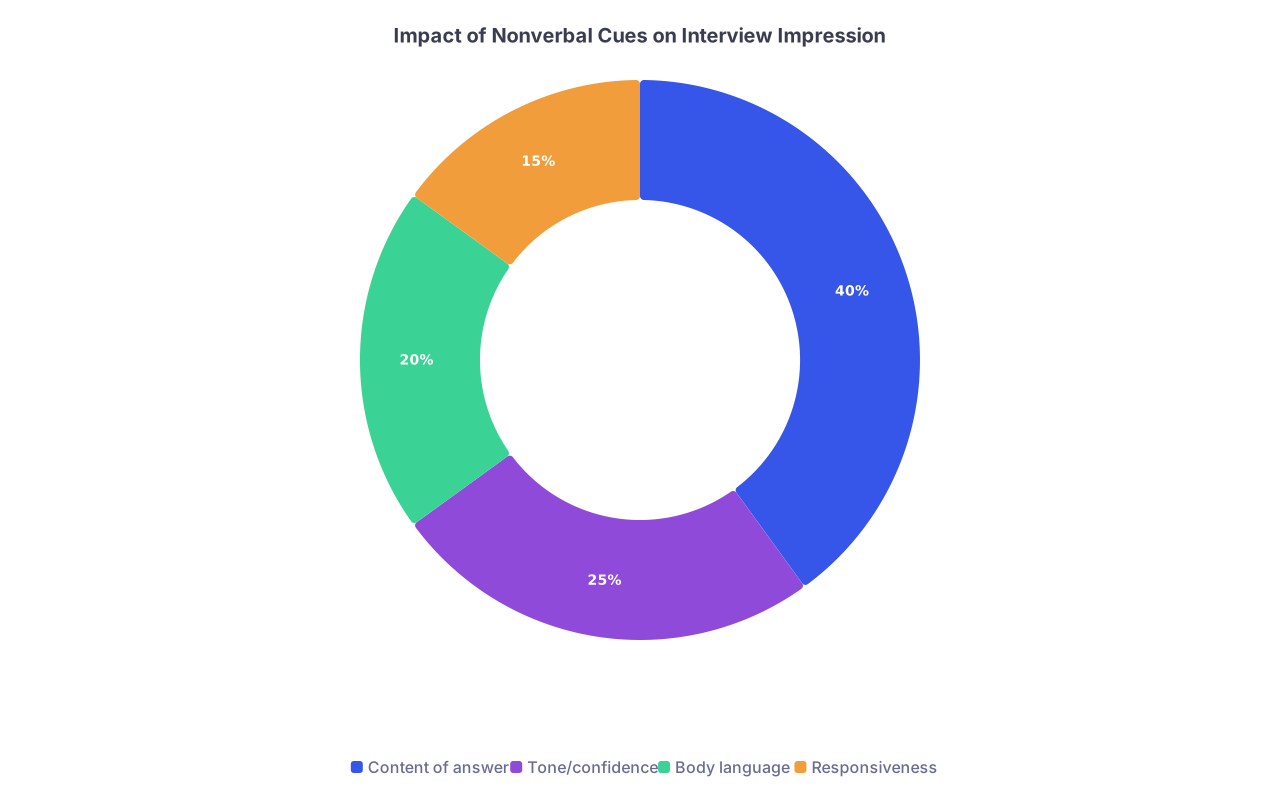
| Category | Value |
|---|---|
| Content of answer | 40 |
| Tone/confidence | 25 |
| Body language | 20 |
| Responsiveness | 15 |
Here is what interviewers actually notice when they throw a bias or COMLEX question at you:
- Do your shoulders tense?
- Do you talk faster or slower?
- Do you become overly formal and stiff?
- Do you ramble because you are uncomfortable?
You want to rehearse until you can:
- Maintain normal eye contact.
- Keep your pace steady.
- Answer in 3–6 sentences, max, for most DO/COMLEX questions.
- Smile briefly when appropriate, not grimace.
Two drills that work:
Bias Question Lightning Round
Have a friend or mentor hit you, rapid-fire, with the worst DO/COMLEX questions they can think of:- “So you could not get into MD school?”
- “Are DOs real doctors?”
- “Why should we pick you over an MD?”
Your job is to answer each in under 30 seconds, calmly, without raised voice or rushed speech. You are building muscle memory.
Video Yourself Answering 3 Questions
Record yourself answering:- “Why DO?”
- “Why no USMLE?” (or “Why take USMLE?”)
- “Do you think DOs are as good as MDs?”
Watch with the sound off first. Just body language. If you look defensive, fidgety, or angry, fix that before you touch the words.
Putting It Together: A Mini Mock Interview Flow
Let me show you what a solid DO/COMLEX interview sequence sounds like when integrated.
| Step | Description |
|---|---|
| Step 1 | Question about DO/OMT |
| Step 2 | Briefly define your training |
| Step 3 | Give 1-2 concrete clinical examples |
| Step 4 | Link to skills relevant to specialty |
| Step 5 | Emphasize flexibility & evidence-based use |
Abbreviated example:
Interviewer: “So tell me about yourself.”
You give your normal, polished 60–90 second overview. Then:
Interviewer: “You went to a DO school. Why did you choose that route?”
“I saw DO and MD as two strong paths to the same endpoint. The DO programs I applied to offered early clinical exposure, smaller group teaching, and additional hands-on training through OMT, which appealed to how I learn best.
Functionally, my training has been very similar to MD students at the same hospitals—same core rotations, same expectations—but the osteopathic component sharpened my physical exam skills and my focus on function and quality of life.”
Interviewer: “You only took COMLEX, correct? Why not USMLE?”
“Correct. I took COMLEX Level 1 and Level 2. Early in third year, I decided to focus my time and energy on excelling on COMLEX and on my clinical rotations, especially since I was targeting programs with a strong history of accepting COMLEX.
My Level 2 score of ___ is around the ___ percentile. On NBME-style practice exams I was scoring consistently in the [X]s, which would roughly align with a mid‑230s Step 2, to give some context.”
Interviewer: “Do you feel you are at a disadvantage compared to MD applicants?”
“I think occasional bias still exists, mostly from lack of familiarity. But at the level of day-to-day clinical work, I do not feel disadvantaged.
I rotate in the same hospitals, care for the same patients, and am held to the same clinical standards as my MD colleagues. My goal is that when attendings and residents evaluate me, what stands out is my work ethic, clinical reasoning, and how I function on the team, not the letters after my name.”
Then you pivot toward program-specific discussion: why their rotations, their patient population, their fellowship outcomes. You have acknowledged the DO/COMLEX issues clearly once. You do not let them dominate 30 minutes.
Final Calibration: What You Should Practice Before Interview Season
You do not need 50 perfect scripts. You need 8–10 well-prepared, flexible responses you can adapt on the fly.
At minimum, rehearse answers for:
- “Why did you choose a DO school?”
- “Do you think DOs are as well trained as MDs?”
- “Why did you only take COMLEX?” or “Why did you take USMLE too?”
- “How should we interpret your COMLEX score compared with USMLE scores?”
- “Your Level 1/2 is lower than some applicants. What happened?”
- “Do you feel you are at a disadvantage as a DO?”
- One or two OMT/osteopathic training questions.
- One fully integrated “tell me about yourself” that naturally embeds your DO background without sounding like a disclaimer.
If you can deliver those with:
- Clear structure.
- Controlled tone.
- Zero visible defensiveness.
Then you are already in the top tier of DO interview performance.
Key Takeaways
- Most DOs lose ground not on paper, but in how they react to bias and COMLEX questions—fixable with structured, rehearsed answers.
- Use stable frameworks: 3-part for DO (“decision–equivalence–benefit”) and 4-part for COMLEX (“what you took–where you stand–their comparison problem–your bridge”).
- The real test is composure. Calm, concise, non-defensive answers to provocative questions do more to raise your rank position than any long speech about “holistic care.”