The biggest mistakes DO students make with MSPE addenda are trying to sound “inspirational” and ignoring what ACGME program directors actually care about.
Let me be blunt. An MSPE addendum is not a personal statement, not a therapy note, and not a place to argue with your school. It is a surgical tool to neutralize red flags and translate a non‑standard DO trajectory into ACGME-friendly language.
I am going to walk you through exactly how to do that.
What “ACGME‑Friendly” Really Means
Program directors do not read your addendum asking “Do I feel inspired by this story?” They ask three much colder questions:
- Can I trust this applicant clinically and professionally?
- Does this trajectory make sense or is it chaos?
- Will this person finish residency without blowing up our CCC or GME office?
“ACGME‑friendly” MSPE language speaks directly to those questions. It does three things:
- Clarifies the structural context of the issue (curriculum, grading system, leave policies).
- Describes the trajectory (what changed, when, and what has been stable since).
- Addresses risk (probability of repeating the same problem during residency).
Your audience:
- ACGME PDs in both AOA‑legacy and historically MD programs.
- Selection committees that skim 60+ files a night.
- Sometimes a GME office that screens for risk before a PD even sees your application.
Your job is to package your “non‑standard” DO path into their language, not yours.
Step 1: Know When You Actually Need an Addendum
Many DO students try to “pre‑explain” everything. That backfires. Over‑explaining minor issues signals anxiety and immaturity.
You should seriously consider an MSPE addendum if you have:
- Extended or non‑linear curriculum
- 5+ year graduation
- LOA (medical, personal, academic)
- Part‑time terms or reduced load
- Failures / significant academic events
- Course or COMLEX failure
- Remediation of core rotation
- Academic probation or professionalism probation
- School transitions / unusual structures
- Transferred DO schools
- OPP‑heavy or systems-based curriculum that complicates timelines
- Post‑bacc that your MSPE barely mentions but your transcript highlights
- Board examination irregularities
- Multiple COMLEX attempts
- Major gap between Level 1 and 2 timing
- Took USMLE after (or instead of) COMLEX in a way that confuses the timeline
- Major life disruption intersecting with your training
- Significant health issue
- Caregiver responsibilities that caused schedule changes
- Pregnancy/parenting with adjusted rotations
You typically do not need an addendum for:
- A single low COMLEX score with no failures.
- Normal 4‑year curriculum with one “B-” in OMS I.
- Minor professionalism comment already explained and resolved in MSPE.
If you are not sure, ask yourself: “If I were a PD glancing at my transcript and MSPE, would anything prompt ‘What actually happened here?’” If yes, that is addendum territory.
Step 2: Understand the ACGME Lens on “Non‑Standard DO Trajectories”
ACGME PDs are used to MD schools with relatively uniform MSPE structures. DO schools are far more variable. Some still have narrative-heavy dean’s letters. Some have weird grading language. Some barely explain leaves or failures.
So PDs carry certain biases when they see a “non‑standard” DO path:
- “Is this a chronic academic issue or a single episode?”
- “Is this due to the school’s structure or the applicant’s inconsistency?”
- “Did they hide anything? Are there surprises waiting for my GME office?”
- “Do their current performance and clinical evaluations match what they are claiming?”
An ACGME‑friendly addendum reassures them on three fronts:
- Clarity – The story is clean and chronological.
- Maturity – You take ownership without dramatics.
- Predictability – There is a stable, upward (or at least flat) trajectory from the event onward.
Your addendum must be boringly professional. No emotional spikes. No blaming. No self‑flagellation. Just data + concise interpretation.
Step 3: Decide Who Writes It and Where It Lives
This part is often misunderstood.
There are three main options:
Embedded within the official MSPE
- Written or at least signed off by the Dean’s office.
- Best for major structural issues: LOA, probation, extended curriculum, transfers.
- Program directors trust this most because it is institutional.
Separate Dean’s letter / supplemental MSPE letter
- Sometimes called “Dean’s Addendum,” “Supplemental Academic Letter,” etc.
- Used when the main MSPE is already finalized/frozen but you need clarification.
- Uploaded to ERAS under “MSPE” or “Other Document” depending on your school’s workflow.
Applicant-authored personal statement paragraph or separate note
- Least ideal for serious issues.
- Acceptable for contextual nuance: scheduling oddities, late addition of USMLE, etc.
- If your school will not document something that clearly affects your file, this is the fallback.
Whenever possible, push hard for an institution-authored addendum for anything that involved official status changes:
- Academic probation
- LOA
- Remediation of required clerkships
- Graduation delay
PDs discount self-serving applicant explanations. They trust a registrar/GME/Dean note that gives dates and status.
Step 4: Core Structure of an ACGME‑Friendly Addendum
Think of the addendum as four short moves, in this order:
- Context – One or two sentences setting the structural scene.
- Event – What actually happened, concretely, with dates.
- Response – What changed (behavior, remediation, supports).
- Current status / trajectory – Evidence that the issue is resolved and no longer active.
Do not deviate into:
- Graphic medical details
- Family drama narratives
- “I learned so much about resilience” fluff
- Long-winded justifications
PDs want a clean incident report with a positive outcome, not a memoir.
Step 5: Common Non‑Standard DO Scenarios and How to Handle Them
Let me walk through specific osteopathic paths that create MSPE complications and show you how to frame them.
1. Extended DO Curriculum (5 or 6 Years)
Red flags for PDs:
- “Was this extra time due to academic difficulty or external factors?”
- “Is this someone who will struggle to keep up with residency pace?”
Your addendum should:
- Specify why the curriculum extended (academic vs personal vs structural).
- Emphasize completion of requirements without ongoing issues.
- Show time since event with stable performance.
Example Dean-authored language:
“Student X matriculated in August 2019 in the standard four‑year DO curriculum. In May 2021, Student X was granted a one‑year extension of curriculum due to a personal health condition requiring treatment and temporary reduction of academic load. During this period, Student X successfully completed all required coursework and clinical rotations, without any additional academic or professionalism concerns.
Student X returned to full‑time status in July 2022 and has since completed all remaining clinical clerkships on schedule. Recent evaluations from core rotations (Internal Medicine, Surgery, Family Medicine, and Emergency Medicine) reflect performance at or above the level of their peers. The underlying health condition has been stable without impact on attendance or performance since their return to full‑time training.”
Note the pattern:
- Dates.
- Clear reason.
- “No ongoing impact” line.
- Objective markers of stability (rotations, evaluations).
2. LOA (Medical, Personal, Academic)
PDs care less why you took an LOA and more whether the factors are still active and likely to disrupt residency.
You need:
- Start and end dates.
- General category (medical/personal/academic) without HIPAA violations.
- Confirmation of good standing now and absence of ongoing restrictions.
Applicant-authored (if Dean’s office refuses to expand):
“During my second year, I took a leave of absence from November 2021 to June 2022 for a personal health issue that required intensive outpatient treatment. This was a planned and time‑limited intervention. I returned to the curriculum cleared for full participation and have since completed pre‑clinical and core clinical requirements without further interruption or accommodation.
My subsequent evaluations in core clerkships and my COMLEX‑USA Level 2‑CE performance reflect consistent, reliable functioning at the expected level.”
Do not name diagnoses. Do not overexplain. You are not applying for disability benefits; you are reassuring about performance capacity.
3. Course or COMLEX Failure
This is where most DO applicants completely miss the mark. They either:
- Minimally mention the failure and overhype the “growth,” or
- Lay out a blow‑by‑blow of their mental health and family background.
Neither helps.
PDs are trying to distinguish:
- Single, contained event with solid improvement
vs - Pattern of borderline performance and poor insight
Key elements to hit:
- Exact exam/course that was failed.
- Concrete cause(s) in performance language (study strategy, timing, volume).
- Specific remediation steps.
- Objective follow‑through (later scores, clinical evals).
Example for a COMLEX Level 1 failure:
“Student X did not pass COMLEX‑USA Level 1 on the first attempt in June 2022. Contributing factors identified in consultation with faculty included an overreliance on passive review resources, limited question bank utilization, and taking the exam at the earliest available date without sufficient dedicated time.
Student X completed a structured remediation plan that emphasized high‑yield content review and a significant increase in timed practice questions. They successfully passed COMLEX‑USA Level 1 on the second attempt in October 2022. Since that time, Student X has demonstrated improved performance on standardized assessments, including a first‑attempt pass on COMLEX‑USA Level 2‑CE and strong evaluations in core clinical rotations.”
That is ACGME‑friendly. It shows problem → intervention → sustained improvement.
4. DO to DO Transfer / Campus Transfer / Curriculum Restructure
This often looks messier than it actually is. PDs just need to know you did not get expelled or flee an academic disaster.
Clarify:
- Reason for transfer (geographic/family vs academic).
- Standing at the time of transfer.
- How credits/courses mapped.
Example:
“Student X completed the first year of medical school at [DO School A] in good academic standing. In 2020, due to a permanent family relocation, they transferred to [DO School B] with full credit for completed OMS I coursework. The curricular structure at [DO School B] differs from [DO School A] (systems‑based vs discipline‑based), which accounts for the appearance of non‑sequential course titles on the transcript.
Student X has remained in good standing at [DO School B] and completed all subsequent pre‑clinical and clinical requirements without academic probation or remediation.”
You are translating transcript weirdness into a clean narrative.
5. Heavy OPP / Unique DO Curricula that Confuse Timelines
ACGME PDs, especially in historically MD programs, sometimes misinterpret DO transcripts because of OPP integration, block structures, or longitudinal rotation models.
If your school already does a good MSPE explanation, you may not need more. If they do not, a short clarifier helps.
For example, if OPP runs in parallel and makes it look like you overloaded or delayed:
“At [School], Osteopathic Principles and Practice (OPP) is delivered as a longitudinal course spanning OMS I–IV, with recurring entries on the transcript. This design reflects continuous skills development rather than repeated enrollment due to academic difficulty. The OPP course series was completed on time and without remediation.”
Simple. Objective. Removes suspicion.
Step 6: Tone, Language, and Common Phrasing Mistakes
Your language choices matter more than you think. A few rules I hold my own students to:
Avoid therapy‑speak.
Phrases like “struggled with imposter syndrome,” “processed my grief,” or “began a journey of self‑discovery” scream “not ready for residency.”Translate to performance terms: “had difficulty with exam pacing,” “took leave during a period of bereavement,” “was managing increased non‑academic responsibilities.”
Skip victimhood and martyrdom.
PDs do not want to read:
“Despite being the first in my family…”
“In the face of overwhelming adversity…”
Keep it neutral and factual.Own your part without self‑sabotage.
“I did not yet have effective strategies for cumulative exam preparation” is fine.
“I was lazy and unfocused” is not.Keep it short.
For almost all scenarios, your total explanation should be 1–2 short paragraphs. Longer only if multiple distinct events.
Here is a quick comparison of bad vs acceptable language:
| Situation | Avoid This | Use This Instead |
|---|---|---|
| LOA reason | "I was battling severe depression and anxiety" | "I took a medical leave of absence for a time‑limited health condition" |
| Failure cause | "I was overwhelmed and my personal life fell apart" | "My study approach was inefficient and I underestimated the volume of material" |
| Resilience | "This made me stronger and more empathetic" | "Since then, my academic performance and clinical evaluations have been stable" |
| Family issues | "I became the sole emotional support for my family" | "I assumed increased family responsibilities that temporarily impacted my bandwidth" |
You are writing for risk‑assessment professionals, not for an alumni magazine.
Step 7: Handling COMLEX / USMLE Complexity
Osteopathic students often have board patterns that confuse MD-trained PDs:
- COMLEX Level 1 taken late or after LOA.
- USMLE Step 1 taken before COMLEX due to advising or scheduling.
- Level 2‑CE far delayed relative to expected graduation.
You can preempt misinterpretation.
Example: Late COMLEX Level 2‑CE
“Due to a curriculum extension following a medical leave, Student X’s COMLEX‑USA Level 2‑CE examination occurred in December 2023, several months later than the typical schedule for their class. This timing reflects the adjusted clinical sequence rather than exam failure or delay in readiness. Student X passed COMLEX‑USA Level 2‑CE on the first attempt and completed all core clerkships prior to testing.”
Example: Took USMLE Step 1 and COMLEX Level 1 out of standard order
“Student X sat for USMLE Step 1 in April 2022 based on initial specialty interests and faculty advising. COMLEX‑USA Level 1 was scheduled subsequently in July 2022 to align with school requirements. Both exams were passed on the first attempt. The apparent inversion of usual exam order is due solely to scheduling choice, not remediation.”
The theme: remove ambiguity about why the timeline looks odd and emphasize that the current board status is clean and complete.
Step 8: Integrating the Addendum with the Rest of Your Application
An ACGME‑friendly addendum only works if it matches the rest of your file. Inconsistencies are a red flag.
Checklist:
Transcript vs MSPE vs addendum
Dates, course names, and statuses must line up. If your MSPE says “academic difficulty” and your addendum claims “personal reasons only,” PDs will spot the contradiction immediately.LORs consistent with story
If you had a performance issue early, at least one later letter should implicitly or explicitly speak to reliability, growth, and current competence. It does not have to mention the past; it just needs to show that you function well now.Personal statement alignment
If the issue was major (LOA, failure, probation), have 1–2 sentences in your personal statement that match the MSPE wording. Do not spin a totally different narrative.Interview stance
Whatever is in your addendum is fair game on interview day. Prepare crisp, 60‑second answers that echo the same structure: brief context → what happened → what changed → how you have performed since.
Step 9: Sample Templates You Can Adapt
I will give you a few concrete skeletons. Do not copy them verbatim, but mirror the structure and tone.
Template A: Dean’s Addendum – Academic LOA + Return
“Student [Name] began coursework at [School] in August [Year] in the standard four‑year curriculum. In [Month Year], they were granted a medical leave of absence for a time‑limited health condition. The leave extended from [Month Year] to [Month Year].
During this period, Student [Name] remained in good standing with the institution. Upon return, they resumed coursework with an adjusted schedule to complete remaining pre‑clinical requirements. They subsequently completed all core clinical rotations and COMLEX‑USA examinations without additional interruption, failure, or academic probation. Clinical evaluations from [Year–Year] consistently describe performance at or above the expected level for training.”
Template B: Applicant Paragraph – Late Graduation, No New Problems
“I will graduate in May 2025, one year later than the original target date. This adjustment reflects a prior medical leave of absence and associated schedule changes rather than any ongoing academic difficulty. Since returning to full‑time status, I have completed all core clinical clerkships and COMLEX‑USA Level 2‑CE on first attempt, with stable evaluations and no further interruptions.”
Template C: Applicant Explanation – COMLEX Failure, Clean Since
“I did not pass COMLEX‑USA Level 1 on my first attempt in June 2021. My study strategy at that time focused heavily on passive review and insufficient timed practice questions, and I underestimated the amount of dedicated time I needed. Working with our academic support office, I developed a structured plan emphasizing question‑based learning and weekly self‑assessment. I passed COMLEX‑USA Level 1 on my second attempt in October 2021 and have since passed COMLEX‑USA Level 2‑CE on the first attempt while maintaining solid performance in my core clinical rotations.”
Step 10: Process and Timing – How to Actually Get This Done
Conceptually, this all makes sense. Practically, DO schools can be bureaucratic and slow, and MSPE release is tightly scheduled.
Here is how I advise students to sequence this.
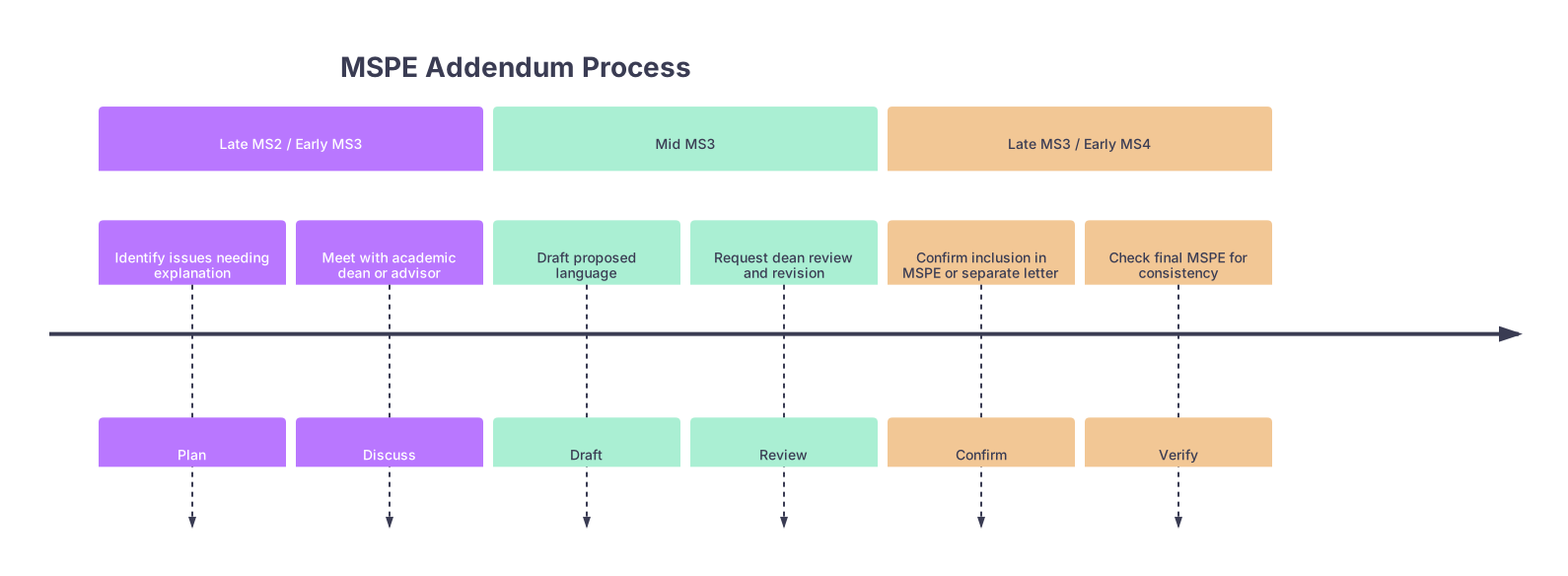
| Period | Event |
|---|---|
| Late MS2 / Early MS3 - Identify issues needing explanation | Plan |
| Late MS2 / Early MS3 - Meet with academic dean or advisor | Discuss |
| Mid MS3 - Draft proposed language | Draft |
| Mid MS3 - Request dean review and revision | Review |
| Late MS3 / Early MS4 - Confirm inclusion in MSPE or separate letter | Confirm |
| Late MS3 / Early MS4 - Check final MSPE for consistency | Verify |
A few very practical tips:
- Bring draft language to your Dean. Many will use your structure almost verbatim if it is professional.
- Ask explicitly: “Will this appear in the body of the MSPE, or as a separate addendum?” Push for inclusion in the official document when possible.
- Verify the final version. Do not assume. Read your MSPE line by line for dates and wording errors.
- If your school refuses to mention something substantial (it happens), decide if you will:
- Address it in your personal statement, or
- Upload a separate applicant-authored note in ERAS (under “Other Documents,” if appropriate for that cycle).
And do not wait until September. MSPE edits move at the speed of committee meetings.
A Note on Specialty Competitiveness and Risk Tolerance
The bar for “acceptable explanation” is not the same for all specialties.
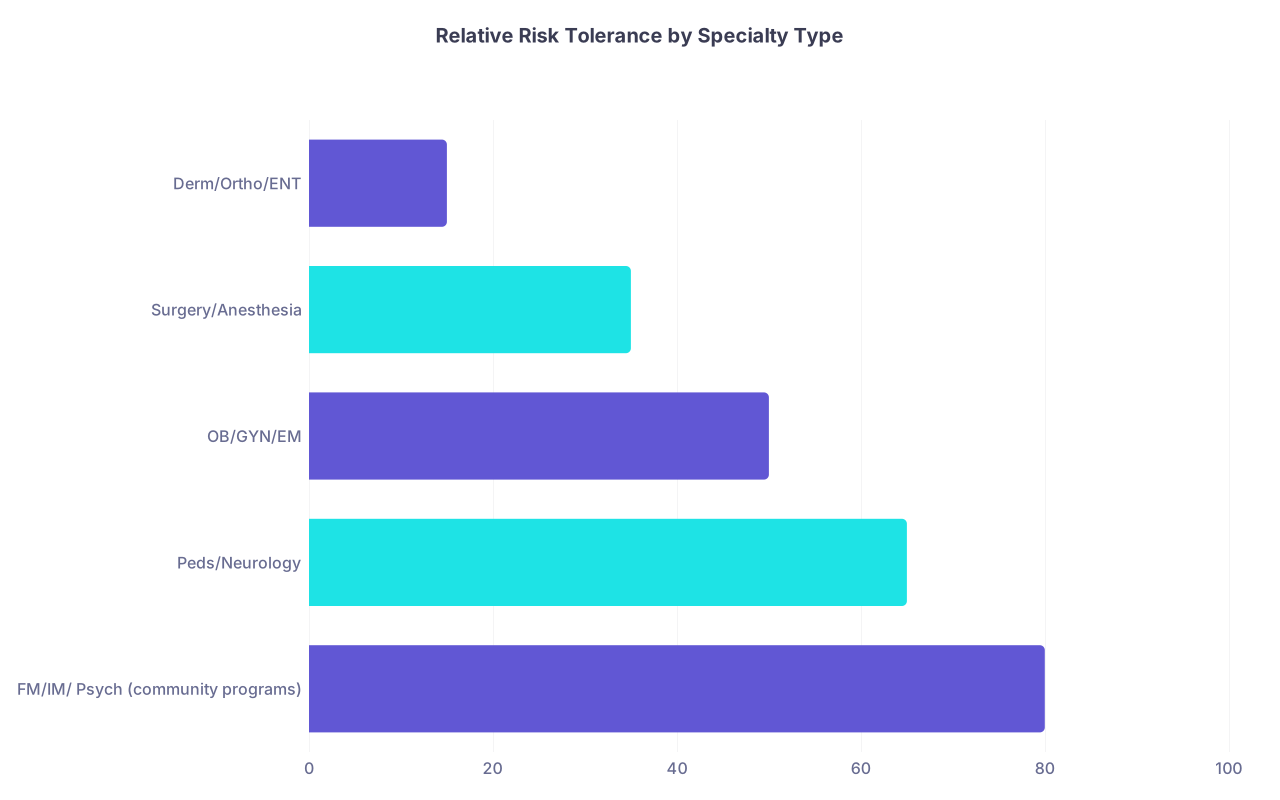
| Category | Value |
|---|---|
| FM/IM/ Psych (community programs) | 80 |
| Peds/Neurology | 65 |
| OB/GYN/EM | 50 |
| Surgery/Anesthesia | 35 |
| Derm/Ortho/ENT | 15 |
Here is the reality:
- Community FM/IM/psych programs are generally more willing to accept a clean, well‑explained non‑standard path if the recent trajectory is strong.
- Surgical and ultra‑competitive subspecialties often have too many “clean” applicants to take a chance on unexplained or messy trajectories.
That does not mean you cannot match into tougher fields, but your addendum must be especially tight and your recent performance indisputably strong.
Example: Putting It All Together for a Realistic DO Case
Let me give you a composite of what I see frequently:
- DO student, matriculated 2019.
- LOA mid‑OMS II for depression, 8 months.
- COMLEX Level 1 failed once, then passed.
- Graduation delayed 1 year.
- Now applying IM and FM, with solid core evals and a decent Level 2‑CE.
A coherent, ACGME‑friendly package might look like:
MSPE (Dean’s paragraph):
“Student X began study at [School] in August 2019. In January 2021, they were granted a medical leave of absence, which extended through August 2021. Upon return, Student X completed the remaining pre‑clinical curriculum on an adjusted schedule.
Student X did not pass COMLEX‑USA Level 1 on the first attempt in June 2022. They worked with our academic support office, completed a structured remediation program, and passed COMLEX‑USA Level 1 on the second attempt in October 2022. Since that time, they have progressed through the clinical curriculum without additional academic difficulty, completing all core clerkships and COMLEX‑USA Level 2‑CE (first attempt pass) while maintaining good standing.”
Personal statement 2–3 lines:
“Earlier in my training, I took a time‑limited medical leave and subsequently required a second attempt for COMLEX‑USA Level 1. With structured support, I changed my approach to studying and time management. Over the last two years, I have completed all core clerkships and COMLEX‑USA Level 2‑CE on schedule, with consistent, reliable clinical performance that I now bring to residency.”
Interview answer (60 seconds):
“During my second year I took a medical leave for several months. When I returned, I underestimated how much that disruption would affect my preparation for Level 1 and did not pass on the first try. Working with our academic support office, I changed my approach—much more active, question‑based studying on a realistic schedule—and passed on the second attempt. Since then I have had no further interruptions, passed Level 2‑CE on the first attempt, and completed all core rotations with strong evaluations. The issue was time‑limited, I addressed it directly, and my performance over the last two years shows how I function now.”
Everything lines up. No drama. No gaps.
Visual Snapshot: What PDs Want to See in Your Trajectory
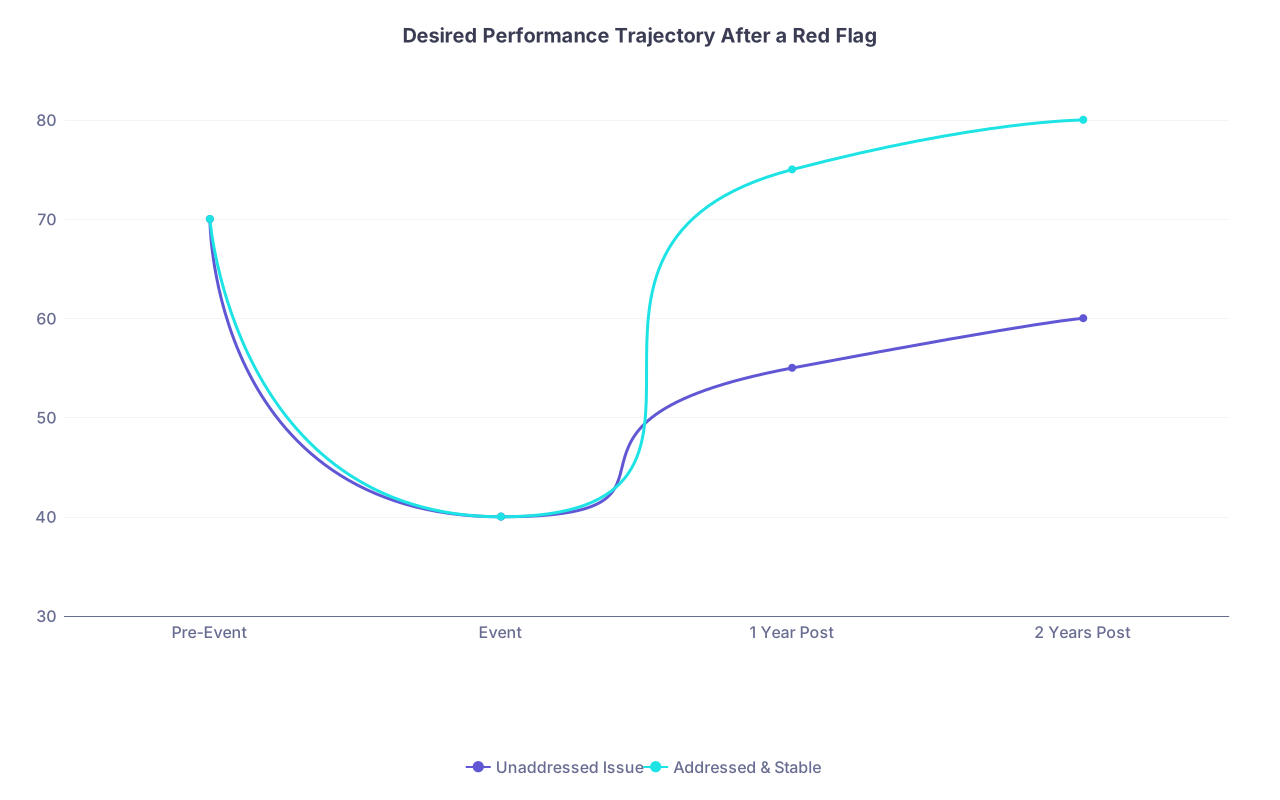
| Category | Unaddressed Issue | Addressed & Stable |
|---|---|---|
| Pre-Event | 70 | 70 |
| Event | 40 | 40 |
| 1 Year Post | 55 | 75 |
| 2 Years Post | 60 | 80 |
They are fine with a dip. They are not fine with a permanent wobble. Your addendum should help them see which line you are on.
Final Checks Before You Hit Submit
Use this as a hard filter before you sign off on anything:
- Does every sentence in the addendum provide concrete information, not fluff?
- Could a PD read it in 15–20 seconds and understand what happened?
- Is the problem clearly in the past, with objective evidence of resolution?
- Does the language match your MSPE, transcript, and interview story?
If the answer to any of those is “no,” revise. Or push your Dean’s office to.
Key Takeaways
- An ACGME‑friendly MSPE addendum is short, factual, and focused on trajectory and risk, not on inspiration or emotion.
- For significant non‑standard DO paths (LOA, failures, extended curriculum), push for a Dean‑authored explanation embedded in or attached to the MSPE, then align your personal statement and interview story to that same narrative.
- The winning formula is always: brief context → concrete event → specific remediation/response → clear evidence of stable performance since.