Framing Osteopathic Core Rotations in MD‑Dominated ACGME Specialties
Most osteopathic students are underselling their core rotations. Especially in MD‑heavy ACGME fields where the default bias is against you before you even open your mouth.
If you treat your third‑year clerkships like generic checkboxes—“did OB, did IM, did surgery”—you are handing away leverage in the exact specialties that are hardest for DOs to break into: categorical internal medicine at big academic centers, surgery, anesthesiology, EM, radiology, even competitive hospitalist‑feeder community programs.
Let me break this down specifically: your core rotations are not just where you learned to write H&Ps. They are your primary evidence that you can function inside an MD‑run, ACGME‑styled ecosystem. If you frame them correctly, they become your strongest argument that you are not “the risky DO”; you are a plug‑and‑play intern.
We will walk through exactly how to do that.
The Problem: DO Cores Viewed Through an MD Lens
ACGME PDs in MD‑dominated fields think in a very particular way about clinical experience. They care about three things more than anything else:
- Can this person survive on my wards or in my OR.
- Will they slow us down.
- Will they embarrass us in front of attendings, patients, QI, or the hospital C‑suite.
Everything else is noise.
Now layer on the DO factor. Many MD‑dominant specialties and institutions—academic IM at university hospitals, large surgical residencies, radiology at tertiary centers—still, in 2026, subconsciously (sometimes explicitly) categorize DO clinical training as:
- Variable quality
- Less exposure to high‑acuity, subspecialty care
- Less rigorous evaluation formats
- Less experience in large academic systems
That is the bias you are up against. Denying it is foolish. You defuse it by reframing your core rotations, not by pretending the bias does not exist.
The mistake I see over and over: DO students describe cores with vague, soft language and zero operational detail:
- “I worked closely with attendings”
- “I had exposure to a variety of cases”
- “I developed my clinical reasoning skills”
This reads as filler. PDs have read those lines 5,000 times from people they did not rank.
What you need to do instead is convert each major core into proof of one or more of the following:
- You functioned in an MD‑style environment (Epic, Cerner, team structure, handoffs).
- You operated at or above the level of MD students from the same site.
- You handled volume, autonomy, and complexity that look like their residency.
That takes specifics. Concrete scenarios. Numbers. Names. Responsibilities.
Step 1: Map Your Cores to ACGME Expectations
Start with ruthless clarity: what does your target specialty actually expect a strong MS3 to have seen and done?
A PD in academic internal medicine is looking for something very different than a PD in anesthesiology or EM.
For Internal Medicine, for example
They care about:
- Managing 6–10 patients per day, following them for multiple days.
- Presenting succinct, accurate SOAPs on rounds.
- Writing full daily progress notes and admission notes in the EMR.
- Calling consults, presenting cases to subspecialists.
- Participating in discharge planning, med reconciliation, transitions of care.
- Exposure to bread‑and‑butter high‑acuity: DKA, CHF exacerbation, COPD, sepsis, GI bleed.
Surgeons care more about pre‑op assessments, post‑op management, and OR behavior. EM cares about initial stabilization and throughput. Radiology cares about clinical context, appropriate ordering, and image‑driven reasoning.
You cannot just say “did well on IM.” You must translate your core IM rotation into their language.
Make a quick grid. On the left: your cores (IM, surgery, peds, OB/GYN, psych, FM, EM). On the top: your target specialty’s priorities.
Then explicitly connect the dots.
| Anesthesia Priority | Core IM Evidence to Highlight |
|---|---|
| Pre-op risk stratification | Managed CHF/COPD pre-op clears |
| Post-op medical management | Co-managed surgical patients on wards |
| Hemodynamics, fluids | Managed sepsis, GI bleed, DKA |
| Interdisciplinary teamwork | Daily rounds with surgery, ICU, cards |
Do this mapping before you write a single line of your personal statement or experiences.
Step 2: Identify Which Rotations “Count” for MD‑Dominant Fields
Not all core rotations are equal in how MD programs perceive them. There are tiers. You should lean heavily on the ones that carry MD “credibility signals.”
The rotations that carry disproportionate weight
Internal Medicine (inpatient, especially at large hospitals)
This is the gold mine for almost every hospital‑based ACGME specialty. IM wards are where PDs test: can this person carry a list, synthesize data, and not crumble when the census jumps to 18.General Surgery (especially at trauma/academic centers)
Shows work ethic, willingness to suffer a bit, basic OR flow. For anesthesia, EM, radiology, critical care–bound IM applicants—this matters more than students realize.Emergency Medicine (if done at an ACGME site)
High face validity for EM, anesthesia, IM, and transitional year programs. Even one solid EM rotation at a known MD site will outweigh three vague community FM cores when PDs are reading between the lines.ICU/CCU experiences (even if technically sub‑core)
Night float, ICU weeks, or an IM subrotation where you lived in the unit—those are big signals for MD PDs who fear fragile interns.
Rotations that help but need better framing
- Family Medicine: often seen as low‑acuity unless you name the scope and complexity.
- Psychiatry: can count, but only if you talk about med‑psych, delirium management, safety planning, team communication.
- OB/GYN and Peds: important for OB and peds obviously, but for IM/EM/anesthesia/surgery you must pull out the cross‑cutting skills (resuscitation, peri‑operative medicine, communication).
Your job is not to inflate. It is to extract every MD‑relevant, ACGME‑facing detail from what you actually did.
Step 3: Translate Osteopathic Sites into MD‑Understandable Context
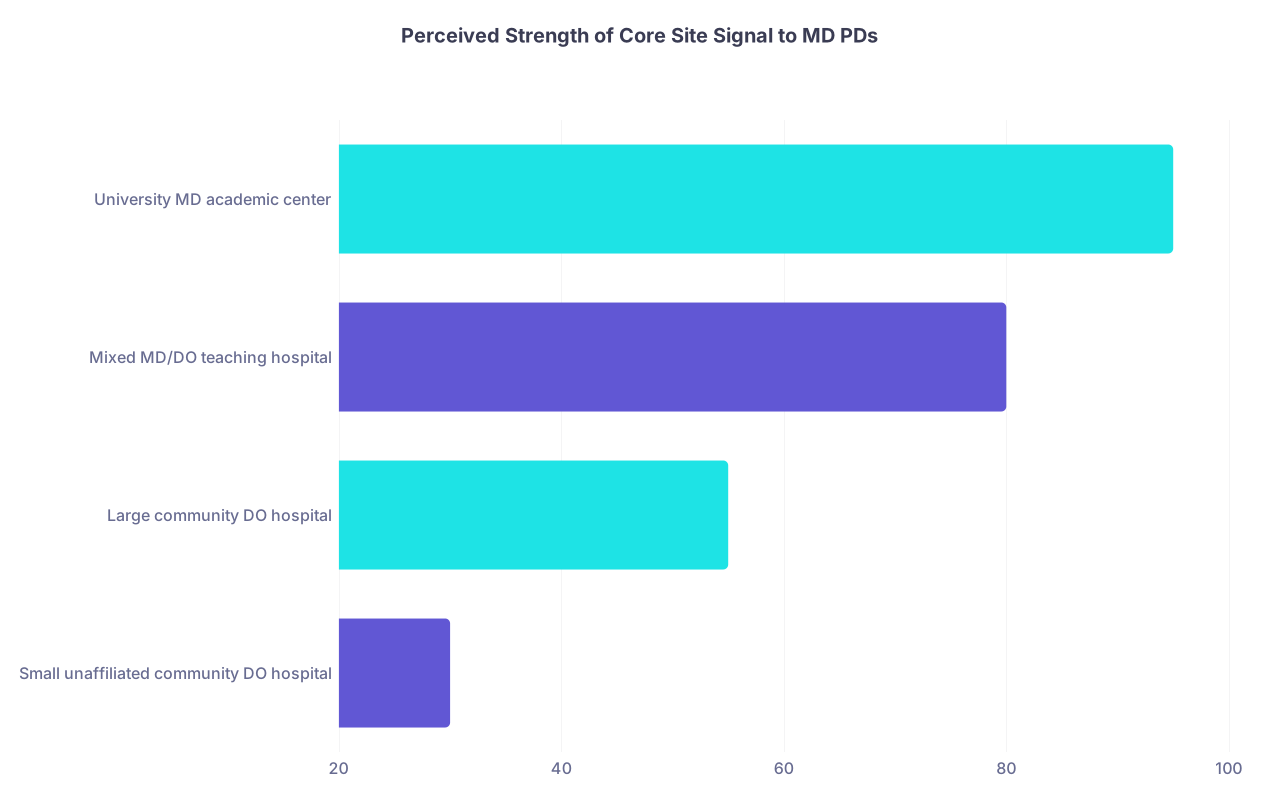
The single best way to de‑risk DO cores for MD PDs: describe the training environment in operational terms they recognize.
Instead of:
“Internal Medicine – DO Hospital, City, State. 8 weeks.”
Say something closer to:
“Internal Medicine – 500‑bed tertiary community hospital, primary teaching site for multiple MD and DO programs. 8‑week inpatient rotation on resident‑run teams using Epic EMR.”
You are doing three things there:
- Giving bed size (volume proxy).
- Signaling teaching culture (resident‑run teams).
- Naming the EMR (shows modern documentation exposure).
Same rotation. Completely different perception.
If you shared the site with MD students from a known school (for example, “site hosts NYMC and PCOM students”), that is often worth a brief mention in an ERAS experience description or in a LOR if the attending is willing to write it.
| Category | Value |
|---|---|
| Small unaffiliated community DO hospital | 30 |
| Large community DO hospital | 55 |
| Mixed MD/DO teaching hospital | 80 |
| University MD academic center | 95 |
The goal is not to sound like a brochure. Keep it dry, factual, and brief—but concrete.
Step 4: Use Case Volume, Responsibility, and Autonomy as Currency
MD PDs are trying to estimate: “How many reps has this student had?”
You rarely have perfect numbers. That is fine. Give honest, approximate ranges, but be specific enough that the reader can picture the work.
Instead of:
“I was exposed to a wide variety of cases…”
Say:
“On IM wards I typically followed 6–8 patients daily, wrote all notes in Epic, and presented them during attending rounds. Cases included decompensated CHF, COPD exacerbations, DKA, upper GI bleeds, and septic shock.”
Exactly what an IM or anesthesia PD wants to read.
On surgery:
“Scrubbed into 3–5 cases per day on a busy general surgery service (lap chole, hernia repairs, colectomies, emergent laparotomies). Responsible for pre‑op H&Ps, immediate post‑op orders (with supervision), and daily progress notes on 5–7 post‑ops.”
On EM:
“Managed 8–12 patients per 8‑hour shift in a Level II trauma center ED, under direct supervision. Performed initial evaluations, wrote ED notes and orders, and presented to both EM attendings and off‑service residents (IM, surgery, pediatrics).”
That level of detail signals: this is not soft. This is not purely shadowing. This looks like what MD students at academic centers are doing.
Step 5: Convert OMM/Primary Care Flavor into ACGME‑Friendly Strengths
Yes, you are DO. Yes, your curriculum had OMM, longitudinal primary care, probably a lot of outpatient. MD‑dominant fields will not rank you higher for that alone, but you can convert pieces of it into qualities they actually value.
Here is how:
- OMM clinic → Manual skills, patient rapport, procedural comfort.
- Longitudinal FM continuity clinic → Follow‑through, chronic disease management, understanding hospital readmissions from the outpatient side.
- Holistic DO training → Systems thinking, psychosocial context, managing complex multimorbidity.
But again, you must speak their language.
Do not say:
“My osteopathic training emphasized holistic care…”
Say:
“Longitudinal family medicine continuity clinic allowed me to follow complex multimorbid patients (CHF, CKD, diabetes with complications) across the outpatient‑inpatient interface, which now informs my discharge planning on inpatient services.”
For OMM:
“OMM training strengthened my hands‑on examination skills and comfort with physical contact, which translated into early confidence with line checks, wound assessments, and procedural setups on surgery and ICU rotations.”
The message is: this ‘DO stuff’ made me a better ACGME intern. Not a separate, niche practitioner.
Step 6: Rewriting Your ERAS Experiences Around Cores
Most DO students underutilize the “Experience” section on ERAS. They describe cores in generic ways or do not list them at all beyond the scheduled education section.
If a core rotation is directly relevant to your target specialty, you should almost always give it an entry with:
- Position: “Core Clinical Clerkship – Internal Medicine”
- Organization: “XYZ Medical Center (500‑bed teaching hospital)”
- Experience description: 3–5 tight, targeted lines that speak PD‑language.
Example for an anesthesiology applicant:
Core Clinical Clerkship – Internal Medicine
XYZ Medical Center (500‑bed teaching hospital, Epic EMR)
- 8‑week inpatient IM rotation on resident‑led teams.
- Carried 6–8 patients daily, wrote full notes, and presented on attending rounds.
- Managed pre‑ and post‑operative medical issues for general surgery and orthopedics (CHF, COPD, anticoagulation, pain control).
- Called and presented consults to cardiology and nephrology; participated in peri‑operative risk discussions.
You are explicitly connecting IM → perioperative medicine → anesthesia.
For an EM applicant, same rotation reframed:
- Primary student on high‑acuity service with frequent ED admissions (sepsis, GI bleed, DKA).
- Coordinated with ED physicians for admission workups and disposition; followed ED boarding patients from arrival through admission.
- Participated in rapid responses and early ICU triage decisions.
Same rotation. Different framing for a different MD‑dominated field.
Step 7: Letters of Recommendation – Script Your Attending (Subtly)
Most attendings, especially at community DO‑heavy sites, do not instinctively know how to “argue” for you in MD‑competitive specialties. You need to help them.
No, you do not write the whole letter. But you absolutely can send:
- Your CV.
- Your draft personal statement.
- A one‑page “summary of my work on your service and my goals.”
In that summary, you want to highlight:
- Your typical patient load.
- Areas of responsibility (notes, orders, presentations).
- Moments they commented on your performance (“You run the list like an intern,” etc.).
- Your target specialty and the kind of program you are aiming at.
You explicitly ask them (politely) to comment on:
- How you compared to MD students they have worked with.
- Your readiness for internship.
- Your performance in a busy, ACGME‑style environment.
That last piece is critical. You need phrases like:
- “Comparable to, if not stronger than, MD students from [School X] who rotate here.”
- “Functioned at the level of a sub‑intern by the end of the rotation.”
- “Handled a patient load similar to our interns with minimal prompting.”
Those lines erase a lot of DO stigma in one shot.
Step 8: Personal Statement – Replace Generic Core Mentions with Surgical Strikes
Most personal statements waste their rotation mentions. Sentences like:
- “On my internal medicine rotation I discovered my love for complex patients.”
- “On surgery I realized how much I enjoy procedures.”
You need one or two surgical uses of core rotation anecdotes that do three things simultaneously:
- Show your performance in an MD‑style environment.
- Tie directly to the skill set of the specialty.
- Quietly prove that your DO training is not a liability.
Example for radiology:
During my internal medicine core rotation at a 450‑bed teaching hospital, I noticed that my presentations were consistently anchored by imaging. I found myself in the reading room between patients, asking the senior resident to walk me through CTA findings in our PE workups, or CT abdomen signs in our SBO admissions. By the midpoint of the block, the team was turning to me during rounds with “What did radiology say?” because they knew I would have already reviewed the images and reports before we got to the bedside.
That one paragraph tells the PD:
- Busy, structured IM site.
- You hustled.
- You were comfortable initiating contact with radiology.
- You think in images, not just labs.
No fluff, no melodrama. Directly relevant.
Step 9: Anticipating and Answering PD Concerns in Interviews
PDs in MD‑dominated specialties will not always say this out loud, but their internal questions about a DO applicant usually sound like:
- “Have you ever worked in a hospital like ours?”
- “Will this person fall apart on nights?”
- “Can they handle our documentation and throughput expectations?”
- “Are they going to be slower than our MD interns?”
Your answers should be grounded in your core rotations, not in abstract qualities.
When they ask, “Tell me about a challenging rotation,” do not default to vague “work‑life balance” stories. Pull from:
- Your busiest IM or surgery block.
- Your toughest EM month.
- The first time you were effectively running the list on a ward team.
For example:
My heaviest block was an 8‑week IM rotation at ABC Medical Center, where our census routinely hit 18–20 on a single team. By the second half, I was following 8 patients independently, pre‑charting before 6 a.m., entering draft orders, and pre‑rounding on post‑call patients before attending rounds. That month forced me to structure my notes, prioritize problems quickly, and still maintain accuracy with orders and communication. I frankly expect that experience to make my transition to intern year smoother.
That statement is doing quiet psychological work: reassuring them you have already been near their workload and survived.
Step 10: When Your Core Sites Were Weak – Damage Control and Offsetting
Sometimes your core sites were genuinely limited:
- Small rural hospital, low census.
- No residents, mostly shadowing.
- Paper charts.
- Few high‑acuity cases.
You cannot fabricate volume or complexity. But you can:
- Be honest and neutral describing those cores (do not oversell).
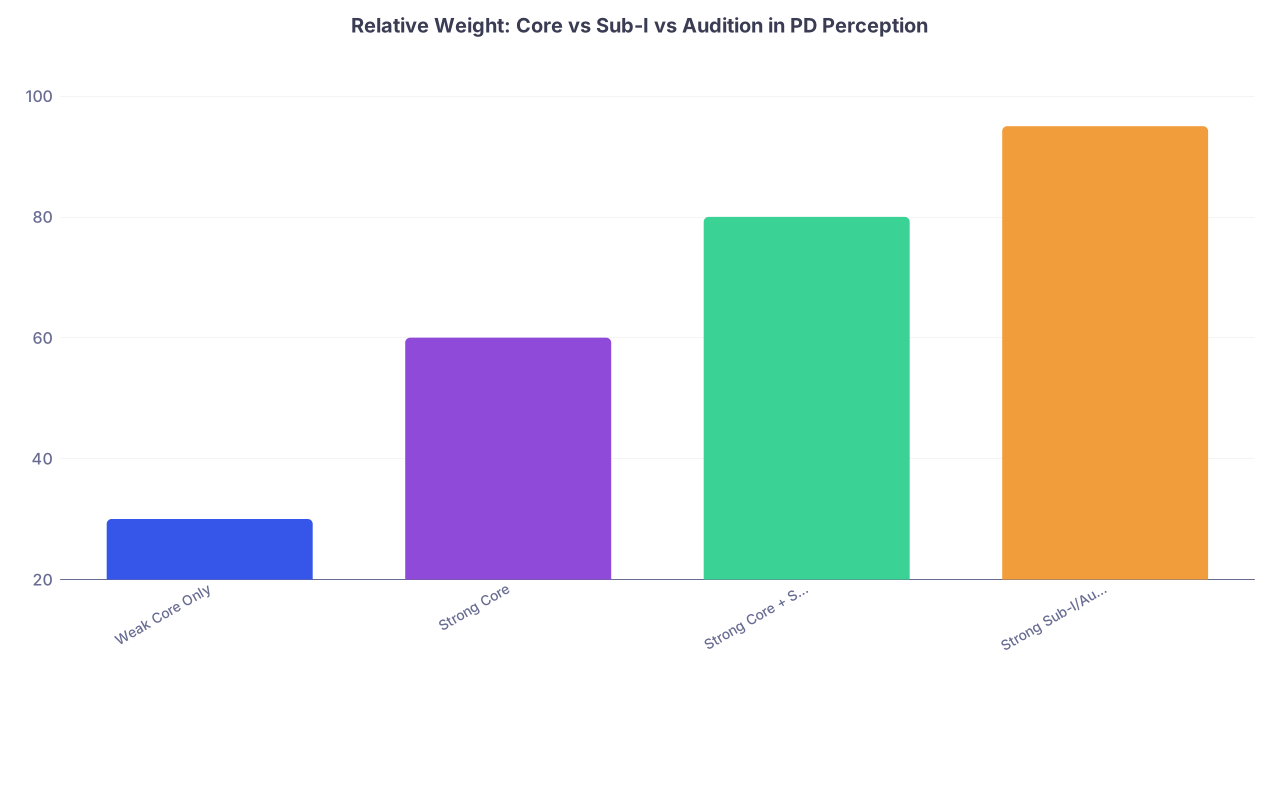
- Aggressively leverage any audition rotations / sub‑Is at stronger ACGME sites to prove you can handle more.
- Emphasize skills that transfer: efficiency, communication, adaptability, willingness to seek higher volume.
For those weaker cores, your ERAS descriptions might look like:
4‑week inpatient IM rotation at a 120‑bed community hospital with attending‑run teams. Managed 2–3 patients daily under close supervision, wrote progress notes on paper charts, and participated in family meetings and discharge planning.
You then immediately counterbalance with a strong sub‑I at an MD site:
Acting Internship – Internal Medicine, University Hospital
900‑bed academic center, Cerner EMR. Carried 7–10 patients daily on a resident‑run team, wrote all orders and notes in the EMR, performed admissions and cross‑cover under resident and attending supervision, and took overnight call every 4th night.
If the PD sees both, they will weight the sub‑I more heavily and understand the context of your cores without penalizing you as much.
| Category | Value |
|---|---|
| Weak Core Only | 30 |
| Strong Core | 60 |
| Strong Core + Sub-I | 80 |
| Strong Sub-I/Audition at MD Center | 95 |
Step 11: Specialty‑Specific Framing Nuances
Let me be even more concrete. Here is how you slant core rotation framing by specialty.
Internal Medicine (academic, MD‑heavy programs)
- Emphasize: inpatient volume, complex comorbidity, subspecialty exposure, QI involvement.
- Name: ICU/stepdown weeks, night float experiences, any senior‑level responsibilities on sub‑Is.
- Downplay: pure outpatient FM flavor unless it tied to readmissions, med reconciliation, or transitions of care.
General Surgery
- Emphasize: pre‑op assessments, post‑op management, OR count and case types, time in trauma bay, hours and call.
- Highlight: moments where attendings gave you increased responsibility (closing skin, running parts of the case, managing drains and tubes independently).
Anesthesiology
- Emphasize: hemodynamic management in IM/ICU, airway exposures in ED or ICU, understanding of peri‑operative risk.
- Use: any time you were present for intubations, central line placements, code blues, rapid responses.
Emergency Medicine
- Emphasize: patient per hour counts, triage responsibilities, differential breadth, procedures.
- Name: EMS interactions, handoffs to inpatient services, boarding management.
Radiology
- Emphasize: your habit of pre‑reading images, spending time in reading rooms, adjusting workups based on imaging.
- Use: specific cases where imaging changed management that you were involved in.
Competitive fellowships (cards, GI, etc.) starting from IM
For IM applicants gunning for cardiology or GI out of MD‑heavy programs, make sure your core and sub‑I narratives show:
- Comfort with very sick patients (ICU, CCU).
- Ownership of data and follow‑up (tracking troponins, INR, imaging follow‑ups).
- Ability to interact intelligently with consultants.
Step 12: Common Mistakes That Sink DO Cores in MD Eyes
Let me be blunt about the patterns that get DO applicants quietly deprioritized.
Vague site descriptions.
“Community hospital” with no sense of size, volume, or team structure. PDs assume the worst.Zero EMR mention.
In 2026, not naming an EMR when you talk about heavy inpatient experiences raises questions. If you used one, say it.No numbers anywhere.
Never mentioning patient loads, number of cases, or frequency of call. Reads as fluff and exaggeration.Overselling primary care when applying to acute‑care fields.
FM continuity is great. It is not what a big academic EM or anesthesia PD cares about primarily.Hiding behind “osteopathic principles” without functionally translating them.
If you invoke holistic care, tie it directly to something like complex discharge planning, not vague philosophy.Ignoring weaker cores instead of contextualizing them.
PDs understand that not every site is a tertiary center. They do not tolerate spin, but they can work with context plus a strong sub‑I.
Pulling It All Together
Your osteopathic core rotations are probably stronger than they look on paper right now. The gap is not in what you did. It is in how you are telling the story to an MD‑dominated audience that has a narrow attention span and a long history of DO prejudice.
You fix that by:
- Translating your cores into the specific workload, responsibilities, and environments ACGME PDs recognize.
- Giving numbers, team structures, and EMR details instead of clichés.
- Explicitly tying each high‑yield core to your target specialty’s priorities.
- Using letters, ERAS descriptions, and personal statement anecdotes as three coordinated angles on the same story:
“I have already functioned in your world. I will not be your weak link.”
Think of your application as a cross‑examination. Every vague phrase invites doubt. Every concrete detail from your cores is evidence.
You have one more major lever beyond what we discussed here: strategically chosen audition rotations and sub‑internships at MD‑heavy ACGME programs that prove everything you are claiming. That is its own playbook—how to pick them, how to perform, how to extract letters that actually move the needle.
With your core rotations properly framed, you are finally ready for that next step: turning one or two high‑impact auditions into the thing that gets your name circled in the rank meeting. But that is a strategy for another day.