Most fourth-year DOs are designing sub-I rotations backwards. They pick locations, not leverage. That is a mistake.
If you are a DO going for an ACGME residency, your sub-internships are not “extra clinical time.” They are currency, and programs value that currency very differently depending on your specialty, your scores, and your school’s name. Let me walk through how to make those months work for you, not just for some random service that needs an extra pair of hands.
We are going to be specific: program types, which months, how many rotations, which specialties absolutely require away sub-Is, and where DOs reliably get burned.
1. Clarify the Real Job of a Sub-I for a DO
A sub-internship has four primary functions. Everything else is noise.
- Generate a powerful, specialty-specific letter of recommendation (SLOR/SLOE/SPA-style if applicable).
- Give a program concrete evidence that you function like an intern in their system.
- Let you prove that your DO background is a strength, not a liability.
- Signal serious interest in a program or region.
If a proposed sub-I does not obviously hit at least two of those, it is probably a poor strategic choice.
For DOs, there is a fifth, ugly reality: some ACGME programs will not really “see” you unless you show up in person. I have watched this play out too many times. Great paper application; no interview until they rotated there. Suddenly, interview + high rank. Nothing else changed.
So before you even think about geography, friends, or convenience, you answer three questions:
- What specialty am I targeting?
- Where does my application sit relative to that specialty (strong / middle-of-the-road / salvage mode)?
- How DO-friendly is the average program in that field?
Your sub-I strategy flows directly from those three.
2. Know Your Specialty: Which Fields Demand ACGME Sub-Is?
Some specialties basically function on an unwritten “no sub-I, no real shot” rule for most DO applicants. Others are more flexible.
Here is the blunt version for DOs looking at ACGME programs.
| Specialty | Sub-I Priority | Away Rotations Typical | DO-Friendly Overall* |
|---|---|---|---|
| Orthopedic Surgery | Critical | 2–3 | Low–Moderate |
| Neurosurgery | Critical | 2–3 | Very Low |
| ENT (Otolaryngology) | Critical | 2–3 | Low |
| Dermatology | Very High | 1–2 | Low |
| EM (3-year ACGME) | Very High | 1–2 | Moderate |
| General Surgery | High | 1–2 | Moderate |
| Anesthesiology | Moderate | 0–2 | High |
| IM (university) | Moderate | 0–1 | Moderate |
| Pediatrics | Low–Moderate | 0–1 | High |
| FM/IM community | Low | 0 | Very High |
*“DO-Friendly Overall” is not magical. It reflects historical match trends and how often DOs appear on resident rosters.
If you are going into FM at a community program that already has DO residents from your school, you do not need to burn your summer on an away sub-I to “prove yourself.” If you are chasing ortho or neurosurgery, you do. Period.
3. Build a Timeline That Does Not Sabotage You
Fourth year can collapse on you quickly if you scatter your months randomly.
Here is a sane structure for most DO students targeting competitive or mid-competitive ACGME specialties.
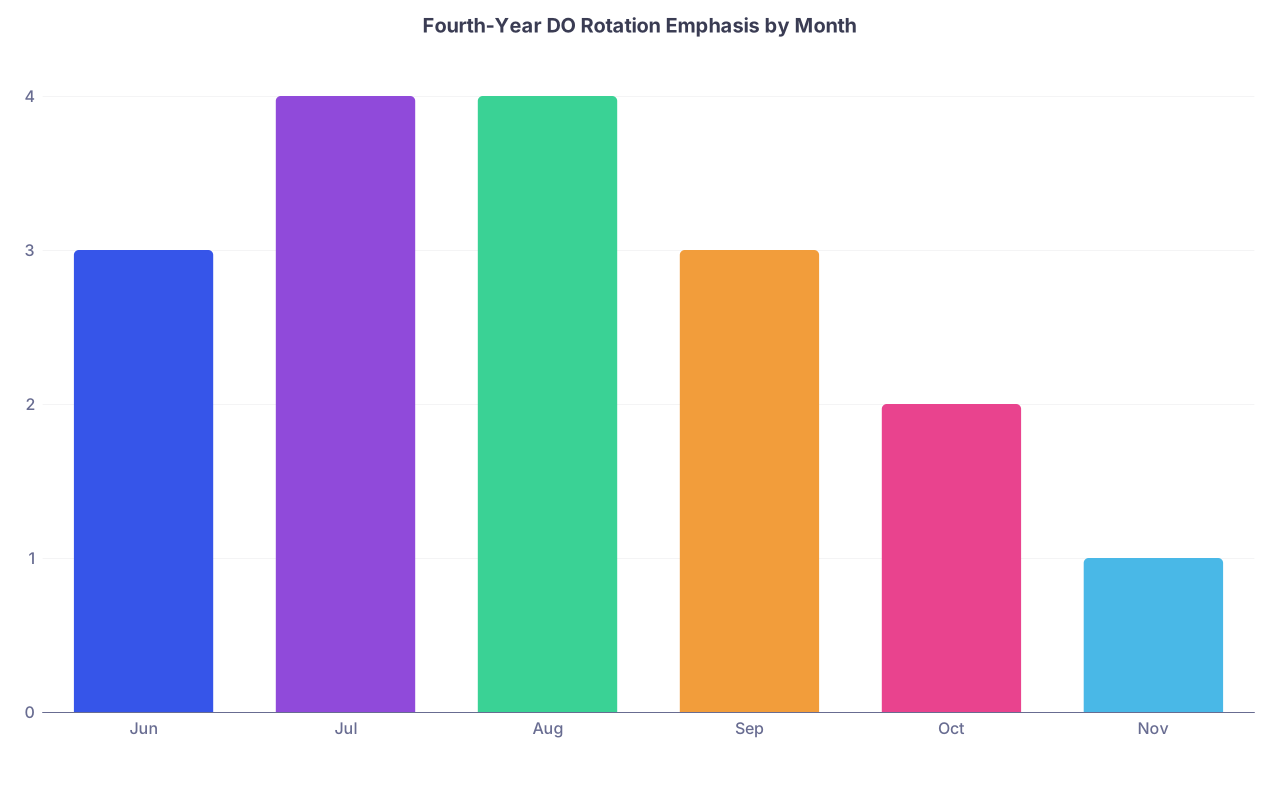
Ideal Sub-I Timeline (US DO, ACGME-bound)
| Category | Value |
|---|---|
| Jun | 3 |
| Jul | 4 |
| Aug | 4 |
| Sep | 3 |
| Oct | 2 |
| Nov | 1 |
Think of those “values” as intensity / competitiveness of rotations (4 = high-stakes sub-I, 1 = lighter elective).
June–August:
Core sub-Is and most important away rotations.
- 1 home sub-I in your chosen specialty (if available).
- 1 away sub-I at a realistic target program.
- 1 “swing” month: either another away sub-I at a high-yield site or a backup specialty / prelim-style rotation if you are at risk.
September–October:
- One more away or home sub-I if your specialty expects 2+ letters from your field.
- A strong sub-I in a related heavy-service field (e.g., IM for cards-neuro; surgery for EM; medicine ICU for anesthesia).
- Build some breathing room for interviews starting late October / November.
November–December:
- Lighter electives or niche rotations.
- Interview-heavy months. Do not sabotage yourself with a brutal, inflexible ICU sub-I during peak interview season unless you have no choice.
I have watched DOs tank interview opportunities because they scheduled their kingmaker away sub-I in November. Programs fill almost all interview invites off August–October impressions and letters. Do not be the one whose best letter arrives after the rank lists are half-designed.
4. How Many Sub-Is, and Where?
Over-rotating is a common DO mistake. You do not need to “audition” at 6 places. You need 2–3 well-chosen sites that:
- Historically take DOs.
- Are within your competitiveness band.
- Actually give sub-Is meaningful responsibility.
Reasonable Numbers by Specialty
Orthopedic Surgery, Neurosurgery, ENT:
- 1 home sub-I (if available).
- 2 away sub-Is.
- Rarely a 3rd away if:
- You lack a true home program, and
- You have the stamina and funding.
Emergency Medicine (ACGME 3-year; not “just any” EM):
- 1 home EM sub-I that yields SLOE.
- 1 away EM sub-I at a DO-friendly academic or strong community program.
- A 3rd EM month only if your first SLOE is weak or delayed.
General Surgery:
- 1 home sub-I (mandatory).
- 1 away sub-I at a realistic university or hybrid community-academic program.
- That is usually enough for a DO, especially with strong Step 2.
Internal Medicine (academic focus):
- 1 home IM sub-I or advanced ward month.
- Optional 1 away at a DO-friendly university (especially for cards, GI, heme-onc aspirations).
Primary Care (FM/Community IM):
- Often 0 required away sub-Is.
- One sub-I at a dream geographic location can help with regional ties, but this is not mandatory.
5. Targeting Programs Strategically as a DO
This is where DOs lose a ton of ground. They pick “Top 10” or “big city” rather than “places that actually rank DOs into categorical spots.”
Here is how I would have you screen before you even email a coordinator.
Simple DO-Friendliness Screen
Look at current residents on the program’s website.
- Do you see DOs in PGY-1 to PGY-3 (or PGY-5 for surgery/ortho/neuro)?
- Are they only in prelim spots, or fully categorical?
Check recent match lists from your school and peer DO schools.
- Does this program appear with DO names more than once over several years?
Ask upperclass DOs and recent grads.
- “Did DO rotators there actually get interviews and match? Or were they used as workhorses?”
If a program has zero DOs and no DOs have matched there from your region in several years, you should treat that rotation as a long-shot, even if they “accept DO students.” Rotating there might still be useful for a letter, but do not pretend it is high-probability for a spot.
| Category | Description | DO Match Likelihood |
|---|---|---|
| DO-Present Univ | University with multiple DOs | Higher |
| DO-Sparse Univ | University with 1 token DO | Moderate–Low |
| Hybrid Community | Big community, some fellowships | High |
| Pure Community | No fellowships, strong DO presence | Very High |
If you are a mid-range DO applicant, your best shot at good training is often the “Hybrid Community” and “DO-Present Univ” categories, not the famous name-brand ivory towers.
6. Designing the Mix: Home vs Away vs Backup
You have four levers when designing sub-Is:
- Home institution/clerkship network.
- Away rotations at aspirational but realistic sites.
- Away rotations at safety/high-yield sites.
- Backup specialty sub-I.
Let me break down combinations that work and combinations that are a waste.
If You Have a Strong Home Program in Your Specialty
Example: DO at an osteopathic school affiliated with a robust ACGME-general surgery program that routinely fills with DOs.
Rotation design:
- June: Home surgery sub-I. Become known. Get at least one letter.
- July or August: Away #1 at a DO-friendly university or hybrid program in your target geographic region.
- September: Away #2 or medicine ICU / consult service that deepens your profile.
- October: Lighter elective or second-choice specialty exploration.
Your home program letter is often your anchor; away rotations are your reach and your regional alignment.
If You Have No Real Home Program
Example: DO school without its own ACGME ortho or EM program, just scattered affiliates.
Rotation design for ortho/EM-level competitiveness:
- June: “Pseudo-home” sub-I at your school’s main affiliate that writes recognizable letters.
- July: Away #1 at a DO-friendly mid-tier program.
- August: Away #2 at another DO-friendly program (one slightly safer, one more aspirational).
- September: Related heavy-service rotation (e.g., trauma surgery for EM, IM wards for derm).
You cannot fake a home program, but you can create a de facto home base by repeatedly working with the same department at a key affiliate. You want at least one letter from someone who truly knows how you work over 4+ weeks.
If You Need a Backup Specialty
This is where most DOs get timid. They try to keep all doors open and end up with half-committed evidence for both fields.
If your backup is real (e.g., Ortho → General Surgery; Derm → IM; EM → IM/FM), then:
- Two rotations in primary specialty (one home-style, one away) by August.
- One sub-I in backup specialty by September at a place you would actually rank for backup.
- One flexible elective month to pivot if letters or feedback are poor.
Do not wait until November to “try” your backup. By then, letters are late and interview invites are mostly gone.
7. What Makes a Sub-I Rotation High-Yield vs Useless?
You want to avoid becoming “the extra student” on a service where residents barely remember your name. That yields weak, generic letters and no advocacy at rank meetings.
High-yield sub-Is for DOs tend to have:
- Clear resident culture of teaching. Residents that say, “We usually keep sub-Is at 2–3 patients and let them write notes” rather than “Just shadow and help with scut.”
- Attending exposure. You are on rounds every day with 1–3 attendings who get enough reps with you to see growth, not just a snapshot.
- Autonomy calibrated to your level. You are writing full notes, doing orders (even if they are co-signed), and presenting plans. You look like an intern in training, not a premed.
- A defined evaluation / letter process. EM has SLOEs. Some surgery/IM services have structured evaluations that convert into letters.
Useless or low-yield sub-Is often show up as:
- You are the 3rd or 4th student on service. No one really needs you.
- Most of your time is scut: chasing labs, wheeling patients, fetching food.
- You rarely present solo to attendings.
- The department chair or PD barely knows you exist.
You cannot always predict this from the outside, but asking PGY-1s and PGY-2s directly usually exposes the truth. “If you were me, would you rotate there again? Did rotators from your year actually match there?”
8. Specialty-Specific Nuances for DOs
Let me be more concrete by field, because the patterns are very different.
Emergency Medicine (3-year ACGME EM)
For DOs, EM is still reasonably DO-friendly, but the bar has risen. Many programs expect:
- 2 SLOEs from “standardized” EM rotations.
- Step 2 score ready by early fall.
- Evidence you know what an EM resident’s life looks like.
Rotation design:
- One EM rotation at a site that routinely produces SLOEs and has DOs in its resident classes.
- One EM away at a DO-friendly, mid-tier academic or hybrid program in your preferred region.
- A third acute-care rotation (ICU, trauma, anesthesia) can round out your profile; does not have to produce a SLOE.
Important EM nuance:
Do not waste an EM month at a place that “does not really do SLOEs” or where you never work with the PD or APD. Your grade there is worth less than one solid SLOE at a normal-volume EM residency site.
General Surgery
For DOs, many mid-tier academic and high-volume community surgery programs are seriously open to you, but they want proof that:
- You can handle intern-level floor/OR work.
- You are not going to fold under call pressure.
- You have at least one strong surgery letter.
Yes, AOA is nice; Step 2 in the 245+ range is very helpful. But a mediocre step with a truly powerful letter from a respected surgeon can still play.
Rotation design:
- Home sub-I in general surgery where you take call, manage 3–5 patients, write daily notes, scrub regularly.
- Away at a DO-present academic or hybrid program; aim for services that let sub-Is take true responsibility (trauma, HPB, colorectal, etc.).
- Consider an ICU sub-I or a high-acuity consult service (e.g., acute care surgery) as your “third” big month.
Internal Medicine (University-track)
For DOs wanting cards/neuro/GI at bigger centers:
- An IM sub-I at your strongest affiliate (or main teaching site) is mandatory.
- One away at an academic center with DO residents improves your odds of an interview.
- A letter from a subspecialist in your target field (cards, neuro, etc.) can help, but not if it replaces a strong ward letter from an IM hospitalist.
You do not need three aways. You need one or two rotations that prove “This DO has already functioned in a university-style system.”
Ortho / Neurosurgery / ENT / Derm
These are blood-sport specialties for DOs.
Patterns I have actually seen:
- DOs matching ortho after 2–3 away rotations, with obvious performance, at mid-tier community or hybrid programs that regularly take DOs.
- Neurosurgery DOs matching at smaller, less-name-brand programs that deliberately recruit DOs they have seen on rotation.
- Derm DOs matching after strong research portfolios and one carefully chosen away that produced a killer letter, often at a site where they had done research earlier.
If you are in this cohort, your rotation design is not optional; it is existential.
- Three aways may be justified, but only if each site meets the “high-yield” criteria.
- You must be brutally honest about your score / class rank / research profile and choose targets where a DO actually matched within the last 3–5 years.
9. How to Actually Get the Good Sub-I Spots
High-yield sub-Is are scarce. You are competing for them with MD students from all over the country. You cannot casually submit VSLO requests in August and expect premium slots.
Basic rules:
- Submit VSLO applications early. Many EM/surgery away slots get snapped up as soon as systems open (often March–April).
- Email coordinators and, when appropriate, the clerkship director with a concise, professional interest statement. Not a novel; 3–4 sentences that connect your background, your DO status, and your interest in their program.
- Explicitly ask about evaluation and letters. “Do your sub-I rotations typically result in letters from faculty who work with us?” If they dodge or say “sometimes,” be cautious.
And do not ignore your school’s rotation office. Some DO schools have quietly strong relationships with certain programs; they can get you in where random MD students struggle.
10. DO-Specific Pitfalls That Cost You Interviews
I have watched these mistakes repeat every cycle.
Overweighting “name brand”:
Rotating at a famous university that never takes DOs and never writes you a strong letter is worse than going to an unglamorous, DO-friendly hybrid program where the PD actually advocates for you.Late Step 2:
You schedule heavy sub-Is in June/July and push Step 2 to late August or September. Then programs sit on your application until your score appears. Many DOs do better with Step 2 earlier, followed by sub-Is.Four “audition” months in a row:
You burn out, performance slips, and your most important letter (from month #3 or #4) comments on your fatigue. Two truly intense sub-Is plus one heavy but slightly lower-intensity month is often the maximum most students can sustain.No clear backup:
You design all sub-Is for a long-shot specialty with no real plan B. When reality hits in October, it is too late to build a robust backup application.Letters from the wrong people:
Great letter from a basic scientist in second year. Mediocre letter from the PD in your target specialty. Guess which one programs care about.
11. Process Map: Designing Your Sub-I Plan Step-by-Step
Let me lay out a simple decision flow so you do not get lost in details.
Walk through this seriously with your advisor, not just in your head.
12. Two Concrete Example Schedules
To make this less abstract, here are two realistic DO scenarios.
Example 1: DO Student Targeting ACGME General Surgery
Stats: COMLEX strong, Step 2 ~245, mid-class rank, no home university hospital but a solid community affiliate.
- June: General Surgery sub-I at main community affiliate (become “one of theirs,” get PD letter).
- July: Away sub-I at DO-present university program in your preferred region.
- August: Trauma / Acute Care Surgery at a hybrid community-academic site (potential letter).
- September: Medical ICU (shows you can handle sick patients, also backup for IM interest if surgery fails).
- October: Lighter elective (radiology or anesthesia), interview-friendly.
- November–December: Flexible outpatient or non-critical care electives, keep free days for interviews.
Example 2: DO Student Targeting EM (with IM backup)
Stats: COMLEX solid, Step 2 ~235, EM is moderate reach, IM is realistic backup.
- June: EM sub-I at home-affiliate EM program that produces SLOEs.
- July: EM away at a DO-friendly academic EM program in the region you want.
- August: Inpatient IM sub-I at a strong teaching hospital (potential IM letter).
- September: ICU rotation (relevant to both EM and IM).
- October: Outpatient IM or cardiology consults (lighter, interview-flexible).
- November–December: Electives, higher availability for interviews.
Now if EM interviews underwhelm, you already have 1–2 good IM letters and heavy inpatient experience. You can pivot without panic.
13. How to Behave on Sub-I So the Strategy Pays Off
Design is half the game. Execution is the other half.
I am not going to give you generic “work hard” fluff. You know that already. Instead:
- Act like a low-supervision intern from day 3 onward. Carry a manageable census, know every lab/value, anticipate daily plans.
- Be relentlessly reliable. If you say you will follow up on something, it is done. Residents learn quickly who they actually trust at 2 a.m.
- Ask for feedback in a direct, un-needy way: “Is there one thing I can do this week to function more like your interns?” Then actually change your behavior.
- Signal interest in the program explicitly by week 3. “I would be very interested in training here. Is there anything else I should do to be a strong applicant for this program?” This matters for DOs more than you think.
And at the end, you do the slightly awkward but necessary thing: look your key attending in the eye and ask if they would be comfortable writing you a strong letter of recommendation. That word “strong” forces a bit of honesty. If they hesitate, you pivot to someone else.
14. Quick Visual: Balancing Risk vs Yield
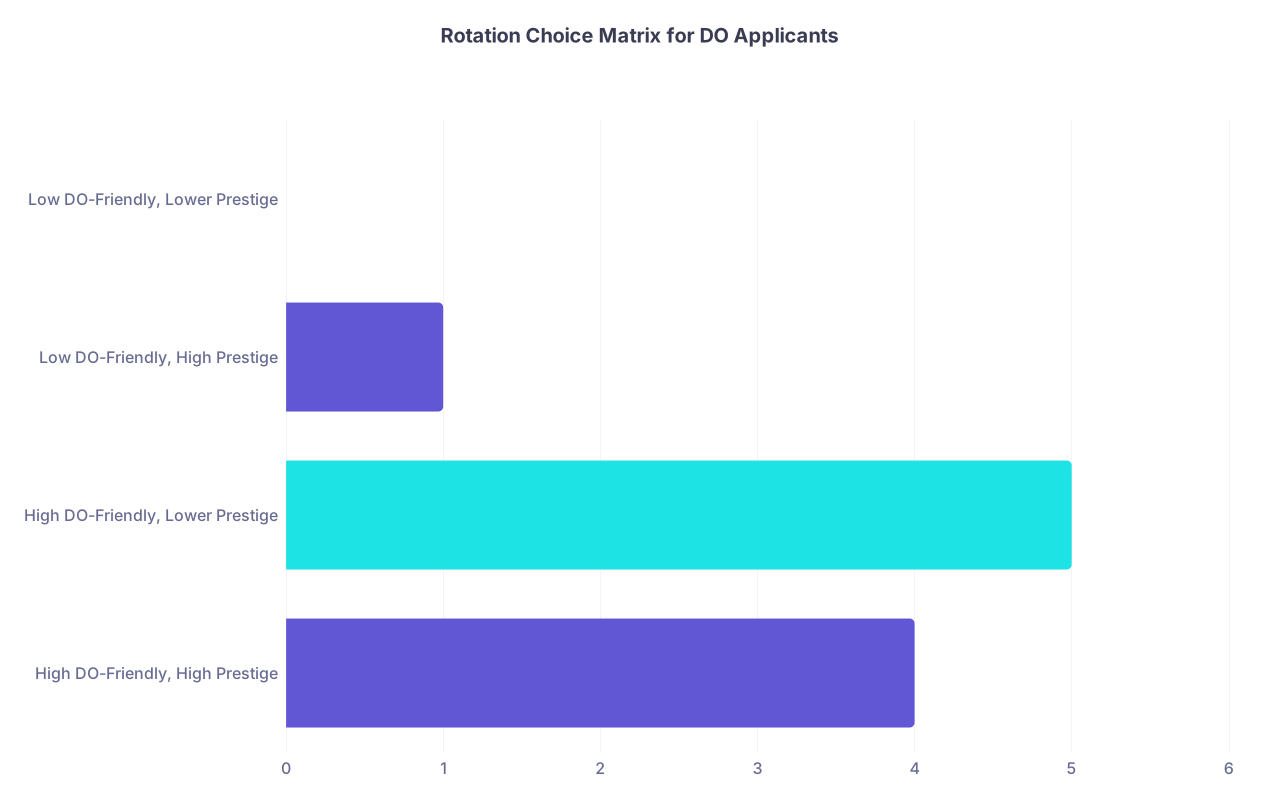
To keep yourself honest, think of each potential rotation on a simple 2×2 grid in your head: DO-friendliness vs prestige.
| Category | Value |
|---|---|
| High DO-Friendly, High Prestige | 4 |
| High DO-Friendly, Lower Prestige | 5 |
| Low DO-Friendly, High Prestige | 1 |
| Low DO-Friendly, Lower Prestige | 0 |
You want most sub-Is in the first two categories:
- High DO-friendly, high prestige: gold standard, but rarer.
- High DO-friendly, lower prestige: where a lot of DOs quietly build excellent careers.
You take an occasional shot at “low DO-friendly, high prestige” only if everything else in your app justifies the risk and you already have safer letters lined up.
Final Takeaways
- Sub-I rotations for DOs are leverage, not tourism. Design them to produce strong letters at DO-friendly, realistic programs, not just famous names.
- Front-load your highest-yield sub-Is into June–September, with 1–3 total away rotations depending on specialty competitiveness and presence of a home program.
- Evaluate every rotation choice through a DO-specific lens: actual DO residents there, demonstrable match history, and a structure that treats you like an intern, not a disposable shadow.