
Optimizing ERAS for DOs: COMLEX, USMLE, and Score Reporting Nuances
Most DO students underestimate how much ERAS score reporting can quietly kill their application. Not the scores themselves—how they are presented, interpreted, and filtered by programs.
Let me be blunt: if you are a DO and you treat COMLEX and USMLE reporting as an afterthought, you are handing away interviews. The good news is that this is fixable with planning and ruthless clarity about what programs actually see and how they think.
I will walk through this the way I do with my own advisees: stepwise, specialty-specific, and with concrete “if X, then Y” rules. No vague “it depends.”
1. What Programs Actually See: COMLEX vs USMLE on ERAS
The first mistake DO students make is assuming PDs “just see my scores.” That is not how it works.
ERAS delivers two separate score report streams:
- COMLEX-USA transcript
- USMLE transcript
Programs choose, at the ERAS level and at the filter level, what they want and how they screen.
| Aspect | COMLEX | USMLE |
|---|---|---|
| Source | NBOME transcript | NBME/ECFMG transcript |
| Score Type | 3-digit numeric | Step 1: Pass/Fail, Step 2: Numeric + Pass/Fail |
| Filters Commonly Used | Minimum Level 1, sometimes Level 2 | Minimum Step 2 CK score; Step 1 often for pass only |
| Seen by Program if You Authorize | All taken COMLEX levels | All taken USMLE Steps |
| Perceived Familiarity (Historically) | Lower for MD-heavy programs | High across all programs |
How ERAS transmission works in practice
You do not manually type your COMLEX or USMLE scores into ERAS. You:
- Assign COMLEX transcript via ERAS from NBOME.
- Assign USMLE transcript via ERAS from NBME/ECFMG.
- Every program you designate gets the entire authorized transcript for that testing family. No cherry-picking Step 2 only, or only your best attempt.
If you authorize USMLE transcript release, they will see:
- All Steps taken
- All attempts and failures
- All numeric scores where applicable
Same idea for COMLEX:
- Every Level taken
- Every attempt
- Numeric score plus pass/fail
There is no “I will just send them Step 2, not Step 1.” That is fantasy.
2. Core Strategy by Specialty: When COMLEX Alone Is Enough, When You Need USMLE
I will cut through the noise. Here is the actual decision tree most DO students should be using.
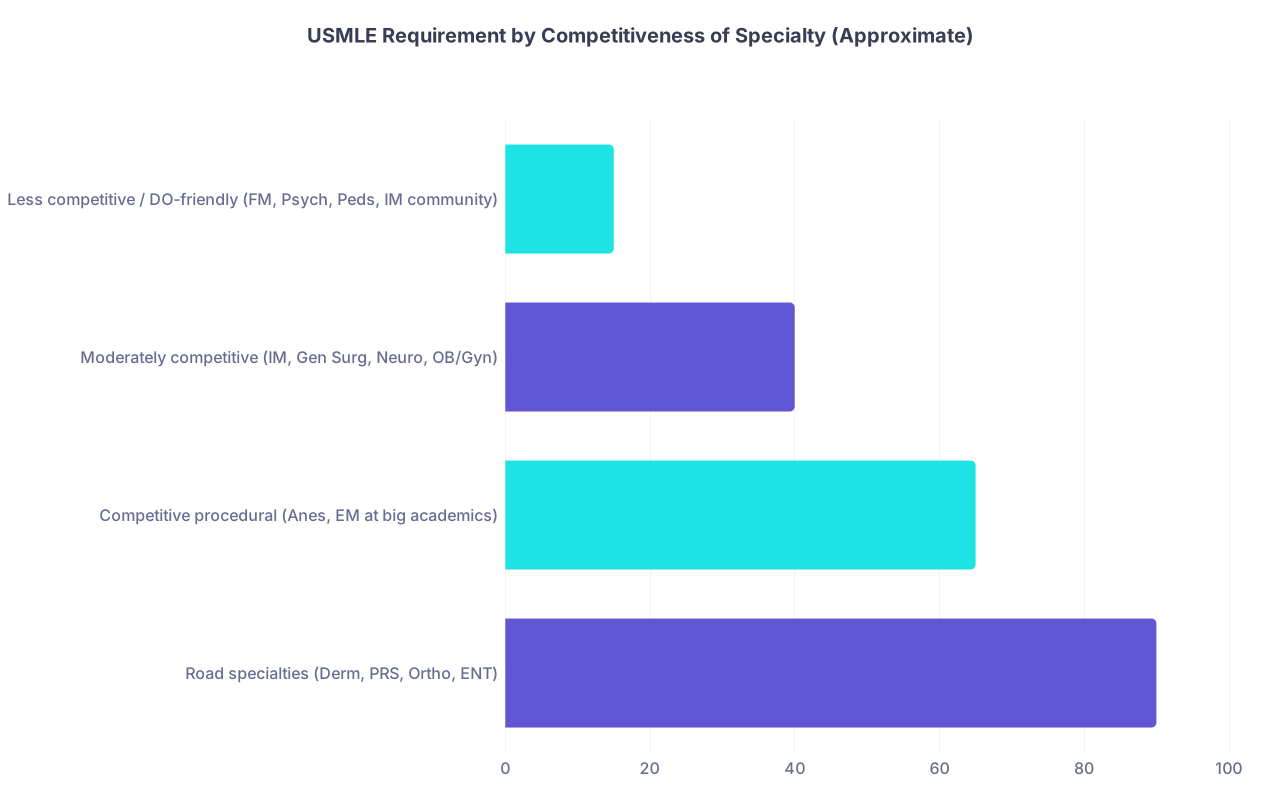
| Category | Value |
|---|---|
| Road specialties (Derm, PRS, Ortho, ENT) | 90 |
| Competitive procedural (Anes, EM at big academics) | 65 |
| Moderately competitive (IM, Gen Surg, Neuro, OB/Gyn) | 40 |
| Less competitive / DO-friendly (FM, Psych, Peds, IM community) | 15 |
Those numbers are rough and regional, but they capture the reality: the more competitive and academic the specialty, the more USMLE is either required or silently expected.
Specialties where USMLE is essentially mandatory for DOs
If you are targeting these as a DO and skipping USMLE, you are intentionally closing most doors:
- Dermatology
- Neurosurgery
- Plastic surgery
- Otolaryngology (ENT)
- Orthopedic surgery (especially ACGME programs)
- Interventional radiology / diagnostic radiology (academic-heavy)
- Integrated vascular surgery, CT surgery
- Many academic anesthesiology programs
- Competitive EM in academic centers (less absolute than before, but still relevant)
Could you match one of these with COMLEX-only into a very DO-friendly or home program? Rarely, but yes. Relying on that is a bad strategy.
Specialties where USMLE is strongly advisable but not always mandatory
- Categorical internal medicine at university hospitals
- University-affiliated general surgery
- Neurology at larger academic programs
- OB/Gyn at academic or large urban programs
- PM&R at bigger tertiary centers
- Competitive psych programs in big cities
You will find a subset of programs that:
- Explicitly accept COMLEX-only, but still “prefer” or “encourage” USMLE
- Filter initially by USMLE Step 2 for simplicity, then manually review COMLEX-only DOs
Here, taking Step 2 CK significantly expands your interview pool.
Specialties where COMLEX-only can be fully viable
- Family medicine (even academic tracks, many are fine with COMLEX-only)
- Community internal medicine programs
- Community pediatrics
- Many community psychiatry programs
- Transitional years linked to DO-friendly networks
- Some community EM or FM/EM combined tracks, especially DO-oriented
You can match very well with COMLEX-only here—if your scores are solid and your application is coherent.
3. The Real Nuances: Score Patterns That Change Your Strategy
Now we get into the actual tricky part. Not “should I take USMLE generically,” but how your specific score pattern should dictate what you send and how you talk about it.
Scenario A: High COMLEX, No USMLE Yet
Example:
- COMLEX Level 1: 650
- COMLEX Level 2: TBD
You are in a strong position numerically for:
- IM (almost anywhere, if the rest of your app is good)
- EM (most programs, with awareness of their COMLEX cutoffs)
- Anesthesia, neuro, PM&R, OB/Gyn at many places
- Very strong for FM, psych, peds
Strategic choices:
- If targeting academic IM / anesthesia / EM / neuro: Take USMLE Step 2 CK.
- If targeting FM/psych/peds/community IM only: COMLEX-only is acceptable, but Step 2 CK can still help you clear filters at mixed MD/DO programs.
What PDs think: “650? This is roughly ~240–250 Step 1 equivalent.” It is not a perfect translation, but that is the mental shortcut. Strong applicant.
If you add Step 2 CK and it is in the 240s+ range, you become “safe” at most mid-to-upper programs.
Scenario B: Average COMLEX, Above-average Step 2 CK
Example:
- COMLEX Level 1: 520
- COMLEX Level 2: 545
- Step 2 CK: 247
This is exactly the kind of pattern that helps you at MD-dominant programs. Many PDs are more comfortable interpreting 247 quickly:
- IM: Comfortable for most academic IM, except the very top-tier.
- Anesthesia: Competitive for mid-tier academic and strong community.
- EM: Reasonable for many EM programs if the rest of the app fits.
Your COMLEX is fine, but not eye-catching. The Step 2 CK becomes the anchor for their impression.
In your ERAS experiences and PS:
- Subtly lean towards “I sought USMLE to be competitive at a wide range of programs.”
- Do not over-explain or apologize. Let the score speak for itself.
Scenario C: Strong COMLEX, Weak USMLE
Example:
- COMLEX Level 1: 620
- COMLEX Level 2: 640
- Step 2 CK: 222
This is where a lot of DOs come to regret taking USMLE late and under-prepared.
Harsh reality:
- You cannot hide Step 2 CK if you authorize USMLE. All programs see 222.
- Some PDs will anchor on the 222 and mentally downgrade you even if your COMLEX is great.
Should you report USMLE at all?
If you have already taken it, you do not have a choice for NRMP certification—it must be in the system for MD licensing pathways eventually, but you do have control over whether to send the USMLE transcript via ERAS to specific programs.
Key nuance:
- MD programs almost always want USMLE if taken; some even require applicants who have taken it to submit it.
- Some DO-heavy or COMLEX-comfortable programs only care about COMLEX and may not insist on USMLE.
You can:
- Withhold USMLE transcript from very DO-friendly programs that do not require USMLE.
- Send USMLE to MD programs where having some USMLE, even low, might still be preferable to “no USMLE at all.”
But be prepared on interview day:
- You may get asked about why the USMLE is lower than your COMLEX pattern would suggest.
- Your answer should be concise: early attempt, limited dedicated time, rotated focus, whatever is honest—but do not sound defensive.
Scenario D: COMLEX-only with a blemish (low pass or failure)
Example:
- COMLEX Level 1: Pass on second attempt
- COMLEX Level 2: 510
Programs will absolutely see:
- Fail, then pass
- Score on second attempt
You need to decide whether adding USMLE helps or hurts.
If you already have a COMLEX failure:
- A solid Step 2 CK (let’s say ≥ 230 for most core specialties) can partially rehabilitate perception: “This student struggled early on but then performed well on a widely recognized exam.”
- A mediocre Step 2 CK (low 220s) will not fix it and just adds another average data point.
For many of these students, I tell them:
- Focus on a very strong Level 2 (and possibly Level 3 later).
- Avoid adding a mediocre USMLE unless your target specialty essentially demands it.
4. How Programs Filter: The Invisible Gate You Must Plan Around
People love to hand-wave about “holistic review.” Yes, that exists—after filters. Programs do not have time to individually open 3,000 applications.
The typical pipeline:
- ERAS import.
- Automated filter by:
- USMLE Step 2 CK ≥ cutoff (e.g., 225, 230, 240)
- OR COMLEX Level 1/2 ≥ cutoff (for programs that care)
- Sometimes: must have USMLE score present for MD-leaning programs.
- From the filtered pool, they review holistically.

| Step | Description |
|---|---|
| Step 1 | Application Received |
| Step 2 | Auto Screen Out |
| Step 3 | Borderline - Maybe Manual Review |
| Step 4 | In Initial Review Pool |
| Step 5 | USMLE Taken? |
| Step 6 | Step 2 CK >= Cutoff? |
| Step 7 | Program Accepts COMLEX-only? |
| Step 8 | COMLEX Also Above Cutoff? |
| Step 9 | COMLEX >= Program Cutoff? |
Different programs wire this differently, but that is the skeleton logic.
Common filtering patterns DO students run into
MD-dominant academic IM programs:
- “Minimum Step 2 CK 225. Step 1 must be pass.”
- DOs without Step 2 CK either:
- Get screened out automatically, or
- Get manually screened in only if the PD specifically champions COMLEX-only DOs. Rare.
Community programs with real DO experience:
- “Minimum COMLEX Level 1 450 or Step 1 pass; Level 2 470 or Step 2 CK 220.”
- They often have separate columns for COMLEX and USMLE filters.
EM programs (pre-SLOE/Standardized letters revolution, and now):
- Some still use numeric thresholds, some do not.
- A subset are explicitly COMLEX-friendly and have published COMLEX cutoffs.
If your strategy ignores these filters, you get burned silently. You never see the rejection; you just never see the interview invite.
5. How to Actually Set Up ERAS: Reporting Tactics and Timing
Let us talk mechanics. The actual knobs you can turn.
Deciding when to release transcripts
You can:
- Submit ERAS without attaching USMLE or COMLEX transcripts on day one.
- Add/transmit them later once scores are available.
You cannot:
- Retroactively hide a score after transmitting that exam family’s transcript to a program.
Practical approach I use with DOs:
COMLEX:
- If Level 1 is already done and passed: attach Level 1 transcript from the start.
- If Level 2 is pending but you expect a strong score and your target programs screen heavily with Level 2:
- Some students choose to wait a couple of weeks to submit ERAS until Level 2 is posted.
- Most just submit early and then automatically transmit updated transcripts when Level 2 posts.
USMLE:
- If Step 2 CK is scheduled close to ERAS opening:
- You can either submit ERAS without the USMLE transcript, then add it as soon as the score is in.
- If you have a borderline prior USMLE score:
- Be selective about which programs actually receive the USMLE transcript.
- For some DO-friendly programs, you might only send COMLEX.
- If Step 2 CK is scheduled close to ERAS opening:
Selective transcript release: who gets what?
You cannot hide specific steps within USMLE or specific levels within COMLEX. But you can choose:
- Program Group A: gets both COMLEX + USMLE (e.g., MD-heavy academic IM, Anesthesia, EM).
- Program Group B: gets COMLEX only (e.g., DO-heavy FM, psych, peds, osteopathic community IM).
That is legitimate strategy when:
- Your COMLEX is strong.
- Your USMLE is mediocre and would not add value to programs that already respect COMLEX.
Is it ever deceptive? Not if:
- You follow program instructions. If they explicitly say “All applicants who have taken USMLE must submit USMLE scores,” then withholding it is not acceptable.
- You are prepared to explain on interview why you did or did not sit for USMLE.
6. Mapping COMLEX to USMLE in Program Minds: The Quiet Conversion
No, there is no official COMLEX-to-USMLE conversion. Yes, PDs and advisors still do mental conversions. They should, because they need fast heuristics.
Rough, commonly used mental anchors:
- COMLEX 400s → borderline passes; akin to low 210s/teens USMLE range.
- COMLEX 500s → average to slightly above average; call it ~220–235.
- COMLEX 600s → solidly above average; roughly 240–255ish.
- COMLEX 650+ → “strong,” pushing into ~250+ mental territory.
This is not math. It is pattern recognition from seeing thousands of apps. But you should understand this mental map, because:
- A COMLEX 520 is not “bad”; it is middle-of-the-road. Good for community IM, FM, peds, psych. Less compelling for derm or ortho, obviously.
- A COMLEX 620 puts you in a conversation for a wide range of academic programs with the rest of your app aligned.
If you pair a COMLEX 620+ with a Step 2 CK in the mid-240s or better, you now look robust in both exam families. That is the ideal.
7. Common Pitfalls and How to Avoid Them
Let me go through problems I see every single cycle.
Pitfall 1: Taking USMLE Step 2 CK “just because everyone else is” with minimal prep
This is how you turn a strong osteopathic transcript into a confusing mixed picture.
If you are going to take USMLE Step 2 CK:
- Treat it like a high-stakes exam, not an afterthought.
- Leverage your COMLEX prep but close the USMLE-specific gaps (biostat nuances, CCS-style thinking, NBME-style question cadence).
- Aim for a score that at least matches the implied level of your COMLEX performance.
If your goal is FM at a DO-heavy program and your COMLEX is fine, there is zero need to martyr yourself on USMLE if you are drowning on rotations.
Pitfall 2: Submitting ERAS before understanding program-specific score expectations
Students click “apply all” to 50 programs in a specialty without doing basic homework:
- Do they require USMLE? (Many PD websites say this explicitly.)
- Do they publish average matched scores?
- Do they mention COMLEX equivalence or familiarity?
Two hours of targeted research will save you hundreds of dollars and rounds of silent rejections.
Pitfall 3: Ignoring Level 2 / Step 2 timing
For DOs, Level 2 is often more important than Level 1 by the time you apply. A mediocre Level 1 can be partially rescued by a strong Level 2.
But if:
- You take Level 2 very late (October/November),
- You delay score reporting, you are asking programs to either:
- Rank you without seeing your Level 2, or
- Waitlist you until scores come in, by which point most interview slots are gone.
Better pattern:
- Take Level 2 and/or Step 2 by June/July.
- Have scores in by September or early October at the latest for the main wave of interview offers.
Pitfall 4: Writing about exams awkwardly in your application
You almost never need to discuss your exam performance in your personal statement. Exceptions:
- A failure or major gap that demands a brief, controlled explanation.
If you must address it:
- Keep it to 2–3 sentences, somewhere other than the emotional core of your PS.
- Focus on what changed in your approach and how your later performance improved.
Do not build your narrative around “I became resilient through my exam struggle.” PDs want to see resilience, yes, but they do not want your entire identity to be remediating failure.
8. Concrete Specialty-Specific Snapshots
Let me go rapid-fire through a few specialties DOs often ask about, framed around COMLEX/USMLE strategy.
Internal Medicine (categorical)
- Community / DO-heavy:
- COMLEX-only is perfectly fine.
- COMLEX ≥ 480–500 opens many doors; ≥ 550 broadens you significantly.
- Academic / university:
- Step 2 CK strongly recommended.
- Step 2 CK ≥ 230 is a reasonable bar to clear; higher obviously better.
- COMLEX ≥ ~550 plus Step 2 CK ≥ 235 gives you a very solid shot at mid-tier academics.
Family Medicine
- One of the easiest to match without USMLE.
- COMLEX ≥ 450 is often enough; 500+ makes life comfortable.
- USMLE only necessary if:
- You want a very academic FM program or combined tracks (FM/psych, FM/EM).
- You are keeping IM/anesthesia/EM as backup possibilities.
Psychiatry
- COMLEX-only acceptable at many community and several academic programs, especially DO-friendly ones.
- Competitive urban psych (NYC, SF, LA, Boston):
- Step 2 CK helps a lot.
- Step 2 CK ≥ 230 strengthens your candidacy; with strong letters, you are competitive.
Emergency Medicine
- Wildly variable. Some programs historically demanded USMLE; others explicitly publish COMLEX cutoffs.
- If you want the broadest EM options:
- Take Step 2 CK.
- Pair it with strong SLOEs and good COMLEX.
- For DO-heavy EM programs:
- COMLEX-only can work, but you must know the individual program stance.
Anesthesiology
- Increasingly competitive again.
- Academic anesthesia:
- Step 2 CK is extremely helpful.
- 235+ keeps you in the game for many programs; 245+ makes you a serious contender.
- Community / hybrid:
- Some are fine with COMLEX-only, but many still like at least one USMLE.
9. Putting It Together: A Concrete Planning Template
Here is how I would have you sketch your plan on one page.
- Target specialties (primary and backup).
- Program type mix:
- % academic vs community
- % DO-heavy vs MD-heavy
- Current exam status:
- COMLEX Level 1: score, date
- COMLEX Level 2: scheduled? projected date?
- USMLE Step 1 (if taken pre-pass/fail era): score?
- USMLE Step 2 CK: scheduled?
- Decision rules:
- If target mix includes ≥ 30–40% academic MD-heavy programs:
- Commit to Step 2 CK with full preparation.
- If your entire target is DO-heavy and community:
- COMLEX-only is viable; USMLE optional.
- If target mix includes ≥ 30–40% academic MD-heavy programs:
- ERAS reporting plan:
- Which programs get COMLEX-only.
- Which programs get COMLEX + USMLE.
- Timing for when transcripts get attached.
You want zero surprises on October 1. By the time you press “submit” on ERAS, your exam narrative should already be baked and coherent.
Key Takeaways
Programs do not just “see your scores”; they filter them through rigid, often USMLE-centered screens. Your job is to decide deliberately whether and how to show them USMLE alongside COMLEX.
For DOs, USMLE Step 2 CK is a strategic tool, not an automatic requirement. It is close to mandatory for competitive and academic specialties, optional for many DO-heavy community paths, and dangerous if you take it casually and underperform relative to strong COMLEX scores.
You control which transcripts each program receives, but not what is on them. Build a specialty-specific, program-specific ERAS plan that aligns your COMLEX and USMLE pattern with the filters and preferences of the programs you actually want, instead of hoping they will interpret scattered scores generously.