You, your DO story, and an ACGME program director who is not going to connect the dots for you
It is August. You are staring at a blank Word document titled “Personal Statement – ACGME programs.”
You have a draft from last year’s COMLEX scholarship essay, you have your generic “Why internal medicine?” paragraph, and you have… zero idea how much osteopathic content to include.
You have heard all of the following, usually within the same week:
- “Do not mention OMT. They do not care.”
- “Lean hard into your DO identity. That is your edge.”
- “Just use the same PS for DO and MD programs. No one reads them anyway.”
Someone is wrong. Probably several someones.
Let me be specific: for ACGME programs, an osteopathic-specific personal statement should do three jobs at once:
- Prove you are a strong, competitive applicant in that specialty.
- Make your DO training look like an asset, not something they have to “tolerate.”
- Reassure them that you understand their environment (often MD-majority, sometimes still figuring out how to integrate DOs) and you will fit.
If your statement only does #1, you look interchangeable with every MD applicant.
If it focuses only on #2, you risk sounding niche or defensive.
If it ignores #3, you miss an easy chance to calm hidden biases.
I will walk through how to build a statement that does all three, line by line, section by section.
Step 1: Understand what ACGME PDs actually look for from a DO
Most DO students radically misjudge this. They either oversell OMT like a magic wand or bury it completely.
Here is what I have seen ACGME program directors (PDs) actually want to know when they see “DO” on ERAS:
- Can this person handle our training demands?
- Does their DO background come with strengths we can use?
- Are they going to be weird about MD culture or are they comfortable in mixed environments?
- If they emphasize osteopathic principles, does it translate to better patient care or is it just branding?
That is the frame for your entire personal statement.
Translate “osteopathic” into outcomes PDs care about
Do not write “I believe in treating the whole person” and stop there. Everyone says that. MDs, NPs, PAs, chiropractors, wellness coaches on Instagram.
Rephrase every osteopathic concept into something that lives in PD language:
- “Whole-person care” → longitudinal follow-up, biopsychosocial assessment, care coordination
- “Mind–body–spirit” → patient-centered communication, motivational interviewing, attention to mental health and social determinants
- “OMT” → reduced opioid use, shorter LOS, improved function, fewer consults, faster symptom relief
- “Preventive care” → guideline-based screening, chronic disease management, population health
Your goal: an ACGME PD should be able to read your statement and forget whether you are DO or MD until you choose to highlight it in a way that helps you.
Step 2: Choose the right kind of osteopathic story
You need one clear osteopathic thread. Not five. One.
There are three main categories that work well for ACGME programs:
- Clinical application of osteopathic thinking (with or without hands-on OMT)
- How DO training shaped your approach to patients, systems, or teams
- How being DO has influenced your career goals (certain populations, settings, or subspecialties)
Bad approach: a laundry list of OMT techniques you used or a lecture on the 4 osteopathic tenets.
Good approach: one or two concrete moments that show how your DO background changed what you did.
Example archetypes
Let me give you some concrete patterns that actually land.
1. The “OMT as one of many tools” story (FM, IM, PM&R, EM)
You describe a patient with a complex pain complaint. You walk through:
- You did a solid standard evaluation (neuro, red flags, imaging as appropriate).
- You considered guidelines, meds, PT, consults.
- You incorporated OMT in a targeted way, with a specific goal.
- You tied this to reduced meds, improved mobility, or patient satisfaction.
The point is not the technique. The point is that you think like a physician who has one extra tool, not like a “manual therapist” in search of a justification.
2. The “DO lens on complex chronic disease” story (IM, FM, psych, peds)
You recount a diabetic or CHF patient with social barriers and low engagement.
You show how your DO training made you:
- Ask different questions about work, family, stress, housing.
- Frame treatment plans around function and life goals, not just lab targets.
- Collaborate with social work/behavioral health.
You make it obvious that “whole person” is not a slogan you learned on a poster in OMM lab; you use it to avoid readmissions and burnout.
3. The “DO in an MD world who adapts well” story (surgery, EM, radiology, anesthesiology)
You briefly show that you have rotated in MD-majority hospitals, worked with mostly MD attendings, and been evaluated by them – and that you did well.
You do not whine about COMLEX vs USMLE or explain what OMT is to them. You demonstrate that:
- You understand their workflows and expectations.
- Your DO background gives you a slightly different way of thinking that helps the team (e.g., pain assessment, positioning in the OR, airway anatomy appreciation, functional outcomes, etc.).
No one wants a resident who spends PGY-1 trying to “prove DOs are as good as MDs.” Your statement should say, without saying: that fight is over; I am already at your level.
Step 3: Structure – where the osteopathic content actually goes
This is where most people flop. They stuff generic osteopathic lines into the opening or closing and hope that is “DO-specific enough.” It is not.
Here is a structure that actually works for ACGME programs, with specific osteopathic placement.

| Step | Description |
|---|---|
| Step 1 | Hook: Clinical vignette or motivation |
| Step 2 | Why this specialty |
| Step 3 | Core strengths & clinical experiences |
| Step 4 | Osteopathic-specific paragraph |
| Step 5 | Program fit & future goals |
Let me break down each section.
1. Opening: not about being a DO
Your first paragraph should be about:
- A specific patient vignette, or
- A moment that crystallized why you want this specialty
Not about “I chose osteopathic medicine because…”
You are applying to an ACGME residency, not reapplying to a DO school. PDs need to see specialty clarity before they see degree branding.
Example internal medicine opener (compressed):
On my first night admitting at the county hospital, a 52-year-old man with decompensated cirrhosis arrived short of breath and furious. Furious at the system, at his own choices, at another night in the ED hallway. Ninety minutes later, as his breathing eased and we talked through how this admission might be different, I realized that what drew me to internal medicine was not solving a single problem. It was staying long enough to untangle how he reached this point and what might actually keep him out of the hospital.
No “as an osteopathic student” yet. That comes later.
2. Why this specialty – in language MD and DO PDs both respect
Second paragraph: explicitly tie your experiences to that specialty.
- For IM/FM: continuity, diagnostic complexity, chronic disease, systems-based care
- For EM: resuscitation, undifferentiated complaints, team-based acute care
- For surgery: decisive interventions, anatomy, longitudinal perioperative care
- For psych: longitudinal relationships, complex biopsychosocial integration
You are still not talking about DO vs MD. You are proving basic fit for the field.
Then, once that is established…
3. Core clinical strengths – then weave in osteopathic concepts
This is your main body section. You do three things:
- Describe clinical experiences that show you can perform at the level their interns need.
- Show how you think, especially when cases are not straightforward.
- Introduce osteopathic elements as part of your decision-making, not as a parallel track.
Sample pivot sentence to bring in osteopathic content:
My osteopathic training has shaped how I approach these encounters, not by changing the guidelines I follow, but by changing what I pay attention to and how I build plans patients can actually follow.
Notice: no lecturing, no philosophy quotes. Just a smooth pivot.
Then you give 1–2 specific examples.
Step 4: Writing the osteopathic-specific paragraph that does real work
This is the heart of the article. This is the paragraph most DO students either waste or avoid.
Your osteopathic paragraph for ACGME programs should check four boxes:
- It is concrete and patient-centered.
- It links directly to the specialty you are applying to.
- It uses OMT or osteopathic principles as a means to an end PDs care about.
- It shows you respect all evidence-based tools, not just OMT.
Template you can adapt
Here is a template. Do not copy this word-for-word; the structure is what matters.
During my third-year rotations, my osteopathic training became less about memorized techniques and more about disciplined observation. On our inpatient medicine service, I cared for a woman with chronic low back pain and poorly controlled diabetes who had been labeled “noncompliant.” By paying attention to how she moved, where she splinted, and how stress at home amplified her pain, I realized our escalating opioid doses were not addressing the real barrier: she could not stand long enough to prepare the meals we were counseling her to cook. Using gentle OMT to improve her mobility, involving PT early, and simplifying her regimen transformed our visits from arguments about numbers into conversations about what she could actually do at home. That experience reinforced what my osteopathic faculty had modeled: hands-on skills matter, but only when they are integrated into a broader plan that respects the rest of the team’s work and the patient’s reality.
Why this works:
- No grand claims about OMT curing everything.
- It shows you understand function, social context, non-OMT modalities.
- It maps directly onto what IM/FM PDs worry about: nonadherence, readmissions, chronic pain.
Adjust the details for your specialty.
Specialty-specific osteopathic angles that actually land
Let me give you some straight guidance. These are angles that tend to work with ACGME PDs by specialty.
| Specialty | Strong Osteopathic Angle |
|---|---|
| Internal Medicine | Chronic disease, functional goals, pain management with limited opioids |
| Family Medicine | Whole-family dynamics, preventive care, OMT in outpatient musculoskeletal cases |
| PM&R | Function-centered care, targeted OMT integrated with rehab plans |
| Emergency Medicine | Acute pain management, anatomy-based exam, non-opioid options |
| Pediatrics | Development, family context, hands-on reassurance, gentle OMT where appropriate |
| Psychiatry | Biopsychosocial formulation, somatic symptoms, mind–body interface |
For more procedural or less “hands-on” specialties (radiology, pathology, anesthesia), you pivot slightly:
- Emphasize anatomy, physiology, pattern recognition, and system-level thinking tied to osteopathic education.
- For anesthesia: perioperative optimization, airway and respiratory mechanics, pain pathways.
- For radiology: structural-functional thinking, correlation of imaging with physical findings.
OMT itself may barely appear. That is fine. You are not auditioning for an NMM+ radiology hybrid that does not exist.
Step 5: Addressing DO-specific landmines without sounding defensive
There are two DO topics that can creep into personal statements and derail them:
- Board exams (COMLEX vs USMLE)
- Perceived bias against DOs
Your personal statement is almost never the right place to litigate these. But you can quietly defuse concerns.
Board exams: minimal, surgical mention if needed
If you only took COMLEX and you are worried, your PS is not the fix. Your program list is.
If you took USMLE and did well, you can slip a short, factual line into your “academic strengths” paragraph:
The rigor of preparing for both COMLEX and USMLE Step 2 strengthened my test-taking discipline and reinforced gaps in my understanding of renal physiology and infectious diseases that became central on my sub-internship.
That is it. No rant about how Step 1 went pass/fail and disadvantaged you. Save that for Twitter, not ERAS.
Bias against DOs: show, do not argue
Never write: “As a DO student, I have had to work twice as hard to prove myself.” I have seen PDs roll their eyes at that line.
Instead, show that you have already thrived in MD-majority settings:
Rotating at [Large Academic Hospital] where I was often the only osteopathic student on the team, I appreciated that my attendings evaluated me by the same standards as my MD peers: quality of presentations, ownership of patient care, and ability to synthesize data into plans. Those expectations pushed me to refine my clinical reasoning and communication until my degree became the least interesting thing about me.
You are not asking for points because you are DO. You are stating: “I have already been in your world and done well. You can trust me in your system.”
Step 6: Program fit for ACGME – how DO-specific should you be?
Your final paragraph should not be “I want to advance the field of osteopathic medicine.”
You are applying to their program, which may have 0, 1, or 10 DO faculty. Tailor accordingly.
Here is a spectrum:
Highly DO-friendly ACGME programs (lots of DO grads/faculty):
You can be slightly more explicit: mention interest in teaching OMT workshops, participating in integrative care clinics, etc.Mixed programs (some DO presence):
Signal you will bring your skillset but are not here to convert anyone. Phrase like, “I hope to contribute my osteopathic training when it benefits our patients and aligns with the team’s goals.”Historically MD-heavy with few DOs:
Understate. Focus on shared principles (patient-centered care, evidence-based practice, team-based care) and let osteopathic specifics be a quiet value-add, not the headline.
A generic but acceptable closing for mixed ACGME programs:
I am drawn to ACGME programs that combine strong inpatient training with meaningful continuity clinics, emphasize evidence-based, team-oriented care, and welcome residents from diverse educational backgrounds who share a commitment to patient-centered medicine. I hope to bring my work ethic, my osteopathic training, and my interest in [research/education/quality improvement] to a residency that will challenge me to grow into a thoughtful, reliable internist who improves systems as well as individual lives.
You are not pretending to be MD. You are not preaching DO. You are describing a physician identity that fits comfortably in both worlds.
Step 7: Concrete examples – weak vs strong osteopathic lines
You need to hear what this sounds like on the page.
Weak, generic osteopathic language
- “As an osteopathic medical student, I have learned the importance of treating the whole person, not just the disease.”
- “OMM has shown me how powerful the body’s ability to heal itself can be.”
- “My DO background differentiates me from other applicants.”
These sentences tell a PD nothing. They sound like brochure copy.
Strong, specific alternatives
“My DO training pushed me to ask why my patient’s COPD kept landing him in the hospital even when his inhalers were correct and his oxygen was set properly. Looking beyond his PFTs to his home environment and daily routines revealed that what he really needed was a walker, home health support, and a simplified regimen he could remember.”
“Using OMT for a patient with acute neck pain after a motor vehicle collision, I saw how a few minutes of targeted myofascial release and muscle energy could reduce his pain enough for him to participate in physical therapy the same day, avoid escalation of opioids, and leave the ED with a realistic plan.”
“What most distinguishes my DO education is not the number of techniques I memorized, but how consistently we were taught to connect structural findings to functional limitations that matter to patients: whether they can work, sleep, carry their child, or climb their own stairs.”
See the pattern? Each line ties osteopathic training to outcomes, function, or behavior.
Step 8: One ACGME-focused DO personal statement skeleton you can actually use
Here is a compressed skeleton for, say, internal medicine. Adjust the details for your specialty, but keep the logic.
Paragraph 1 – Hook:
Specific patient or moment that encapsulates what you love about IM. No DO talk yet.Paragraph 2 – Why IM:
Broaden from that vignette to what you value about internal medicine as a field: complex problem-solving, continuity, multidisciplinary care, etc.Paragraph 3 – Core clinical growth:
Describe your medicine rotations, sub-I, responsibilities you assumed, growth in reasoning and communication. Include one short example of handling a challenging case.Paragraph 4 – Osteopathic paragraph:
Use the template from Step 4. Show how your DO training changed how you approached a patient or problem in an IM-relevant way. One, maybe two, tight vignettes.Paragraph 5 – Professional identity and strengths:
Summarize what you bring: work ethic, communication style, team orientation, interests (QI, research, education). Briefly reference success in MD-majority environments if relevant.Paragraph 6 – Program fit & future goals:
Describe the kind of ACGME program you want and what you aim to become (e.g., community internist with strong inpatient skills, hospitalist with QI focus, future fellowship). Include a subtle nod to osteopathic training as one tool among many you will contribute.
If you follow that skeleton, you end up with a statement that:
- Feels like a normal, solid ACGME personal statement
- Happens to have a carefully engineered osteopathic paragraph in the middle
- Signals “DO” as a plus, not a crusade
Step 9: Editing with a DO–ACGME lens
During revision, run each osteopathic sentence through three filters:
Would an MD PD understand this without needing a primer in OMT jargon?
If you say “counterstrain,” you do not have to explain the full technique, but you should anchor it: “a gentle, indirect OMT technique to reduce muscle spasm.”Does this claim something OMT or osteopathic care actually can back up?
Avoid magical thinking. “Improved function and reduced analgesic use” is believable. “Cured her chronic migraines” is not.Is this about me looking special, or about patients and teams doing better?
If half your osteopathic sentences contain the word “I” and none contain “patient,” “team,” or “outcome,” you have written an ego piece, not a residency statement.
Step 10: Quick reality check with numbers and time
You are not writing a thesis on osteopathy. Your whole statement is ~650–750 words. How much explicit DO content is enough?
Look at this distribution:
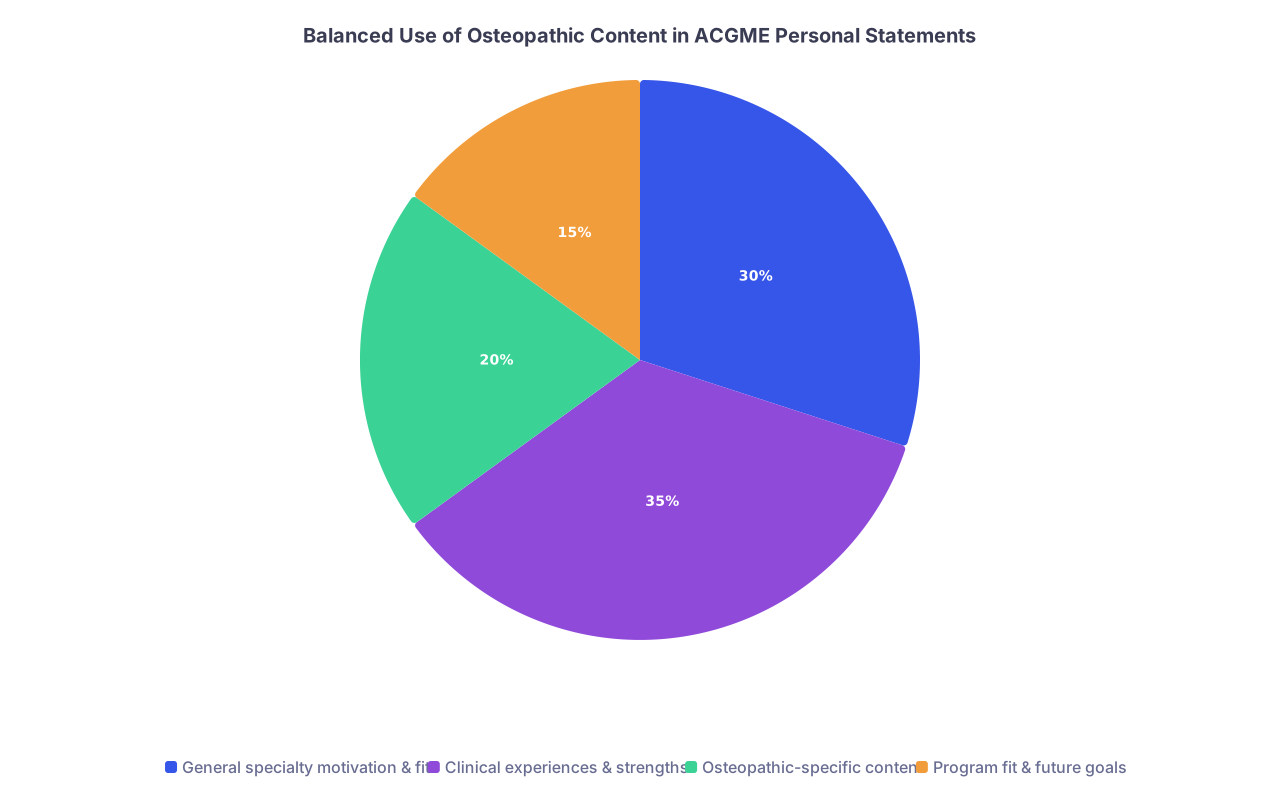
| Category | Value |
|---|---|
| General specialty motivation & fit | 30 |
| Clinical experiences & strengths | 35 |
| Osteopathic-specific content | 20 |
| Program fit & future goals | 15 |
About 20% of the statement being explicitly osteopathic is usually the sweet spot for ACGME programs. The rest is you as a strong future intern, surgeon, PM&R doc, etc.
Too little, and you might as well be MD.
Too much, and you risk looking like you applied to an AOA-only match that no longer exists.
Three key takeaways
- Make your osteopathic training serve your specialty, not the other way around. Tie OMT and osteopathic principles directly to patient outcomes and team-based care PDs already value.
- Use one focused osteopathic paragraph, grounded in specific clinical stories, rather than scattered generic DO slogans. Specifics win; philosophy bullets lose.
- Show that you are already comfortable in MD-majority ACGME environments, where being DO is a functional advantage, not something you are still trying to justify.