
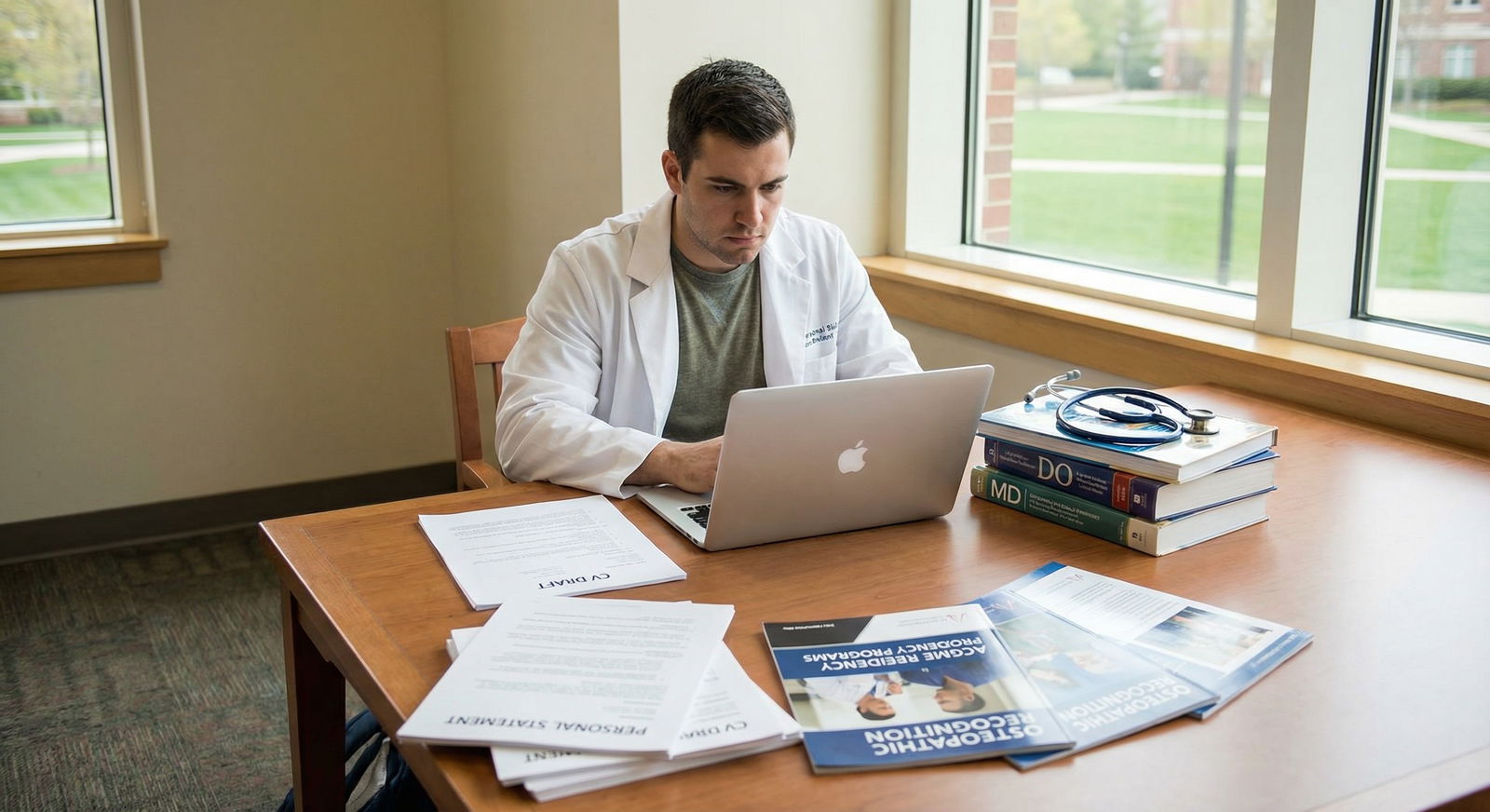
The system is not built for you if your DO school lacks strong ACGME affiliations. So you either build your own path—or you get boxed into a limited set of options.
This is about building your own path.
You’re at a DO school with weak or nonexistent ACGME relationships. No built‑in audition rotations at big university programs. Maybe the “affiliates” your school lists are mostly small community hospitals or old COMLEX‑only sites. You’re staring down the match and thinking, “How the hell am I supposed to get seen?”
Good. That means you’re asking the right question. Now let’s get concrete.
Step 1: Get Absolutely Clear On What You’re Up Against
You can’t fix a problem you’re sugar‑coating.
Here’s your actual situation:
- ACGME programs, especially competitive ones, often favor students they’ve seen in person.
- Your school might not have automatic blocks at those sites.
- Some programs now unofficially expect “home” or affiliated students to fill many of their spots.
- You probably need away rotations more than your MD peers. And more than DO students at schools with stronger networks.
That doesn’t mean you’re doomed. It means you need to be deliberate and early.
Before you do anything else, you need three data sets:
- What specialties you’re realistically targeting.
- Where DOs like you have actually matched from your school.
- Which programs:
- Take DOs,
- Accept COMLEX alone vs require/like USMLE,
- Take visiting students from DO schools without pre‑existing affiliation.
Start building that list now. Not “later when third year starts.” Now.
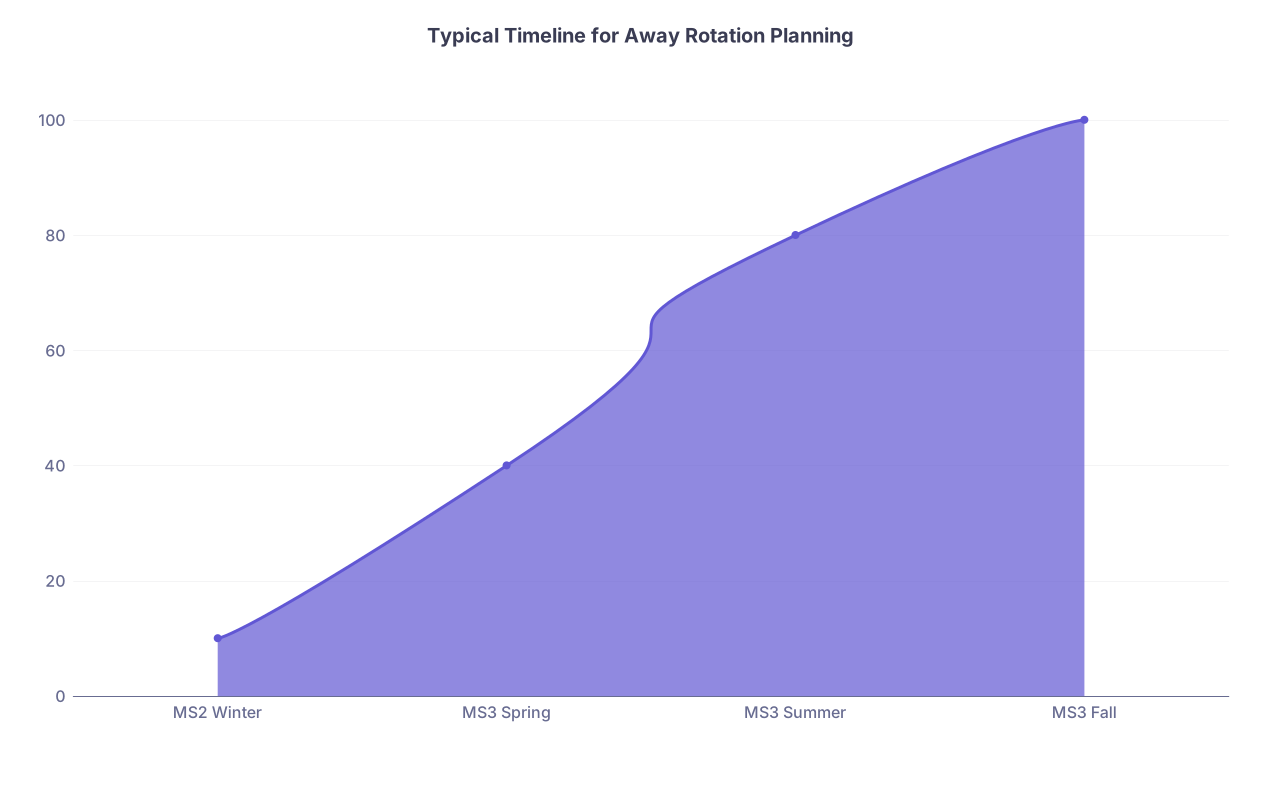
| Category | Value |
|---|---|
| MS2 Winter | 10 |
| MS3 Spring | 40 |
| MS3 Summer | 80 |
| MS3 Fall | 100 |
That 10–100 curve? That’s how much of the groundwork should be done by each phase. If you’re reading this as a late MS3 with nothing started, you’re behind. Not dead. Just behind.
Step 2: Build a Target List That Actually Makes Sense
If your school doesn’t hand you ACGME spots, your list has to do double duty: realistic + strategic.
Create a spreadsheet. Columns like:
- Program name
- Specialty
- Location
- DO‑friendly? (Yes / Some / Rare)
- COMLEX only accepted? (Y/N)
- USMLE required or “strongly preferred”?
- Historically taken DOs from any school?
- VSLO/VSAS or external form?
- Requires affiliation? (Y/N/Sometimes)
- Rotations offered (Inpatient, Sub‑I, ICU, clinic, etc.)
- Application open date
- Application deadline
- Rotation blocks available (months)
- Contact email / coordinator
- Notes
Then you separate programs into rough tiers:
| Tier | Description | Your Priority |
|---|---|---|
| A | Dream / Top choice but realistic DO track record | 1–2 rotations |
| B | Solid mid-range, DO-friendly, realistic | Most of your applications |
| C | Backup / safety, often community-based | 1–3 options |
You’re not “only” building audition rotations. You’re building a safety net. You want at least some places where if you show up, work hard, and interview decently, you have a real chance at ranking and matching.
Step 3: Understand How Programs Actually Take Visiting Students
Programs don’t all follow the same rules. If you’re going to create your own rotations, you need to understand the channels.
Channel 1: VSLO (VSAS) – the standard path
Most MD schools and many DO schools use VSLO. Your school may or may not be fully integrated, or they might throttle how many apps you can send. Typical issues I’ve seen:
- Your school is slow to approve your VSLO access.
- They limit how many active applications you can have.
- They require internal paperwork before you can even apply.
Push them. Politely at first, then less politely if you must. You’re not asking for a favor; you’re asking to not be disadvantaged compared with every MD student applying through the same system.
Channel 2: Program-specific visiting student portals
Some institutions run their own systems or accept non‑VSLO applications:
- A paper or PDF application on the GME website.
- A separate portal where DO schools not on VSLO can still apply.
- Direct coordinator email with attachments.
These are gold for you because they often bypass any VSLO gatekeeping from your own school. You control your timeline more.
Channel 3: Direct coordinator / department contact
If the website is vague, outdated, or doesn’t clearly list DOs:
You email. Directly.
Not a spammy “hi I’m interested” message. An actual, professional, targeted email that shows you’ve done your homework and you’re serious.
Step 4: Writing Emails That Actually Get You Rotations
Sloppy, generic emails get ignored. Coordinators are drowning in them. You need to sound like a competent almost‑resident, not a panicked applicant.
Here’s a structure that works:
- Who you are (year, school, intended specialty).
- Why them (specific reason—not “great program”).
- What you’re asking for (specific months/blocks, type of rotation).
- Your constraints (DO school without existing affiliation + you’re ready to provide everything).
- Attachments or links (CV, Step/COMLEX transcript if available, school verification form if they need it).
- Your contact info and flexibility.
Example you can adapt:
Subject: Visiting Student Rotation Inquiry – [Specialty], [Month(s)] 20XX
Dear [Coordinator Name],
My name is [Name], and I am a rising fourth-year osteopathic medical student at [School]. I am very interested in [Specialty], with a particular focus on [specific interest that fits their program—rural care, academics, underserved, etc.].
I’m writing to ask if your department would consider a visiting student rotation for me in [Month(s), Year]. I understand that [Program Name] hosts visiting students and has historically been welcoming to DO applicants. My medical school does not currently have a formal affiliation with your institution, but I’m able to provide any necessary documentation, liability coverage, and background checks required.
I have completed my core clerkships in [list 3–4 relevant rotations] and will have [COMLEX/USMLE scores, if strong] available. My CV is attached for your reference.
I’d be grateful for any guidance on whether it’s possible to arrange a rotation at your site and the next steps if so. I am flexible with dates within [give a realistic 2–3 month window].
Thank you for your time,
[Full Name]
[School]
[Phone]
[Email]
Not perfect. But it gets to the point. Shows you know the ask is non‑standard, and you’re not expecting them to solve everything.
Step 5: Use Your School – Even If They’re Useless at First Glance
Some DO schools without strong ACGME affiliations still have:
- A “Director of Clinical Education” who’s actually well‑connected but overwhelmed.
- A handful of alumni at solid ACGME programs who will absolutely help if asked.
- A risk‑averse legal office that will sign new affiliation agreements if handed a nearly finished template.
Your job is to make this as easy as possible for them.
Concrete actions:
- Ask your dean’s office: “Do we have ANY alumni at [Target Programs / Target Cities] in [Specialty]?”
- Ask for a list of all current affiliation agreements, even if small. Maybe one is in a region where you want to match.
- Ask whether they’ve ever signed a “single‑student affiliation agreement” for a one‑off rotation. Many schools have.
If a program says, “We’d take you, but your school needs an affiliation,” you respond:
“If I can connect your office with our clinical education/legal office, would you be open to a single‑student agreement for this year?”
Then you connect them. You follow up with both sides like a project manager. Because that’s what you are now.
Step 6: Prioritize Rotations That Actually Help You Match
Not all rotations are equal. If you have limited bandwidth and limited ability to create your own spots, you need to choose strategically.
Aim for this mix:
- 1–2 “reach but realistic” audition rotations at solid academic or strong community ACGME programs in your specialty.
- 1–3 “match‑possible” rotations where DOs consistently match and where your stats are on par or above recent matched residents.
- 1 backup rotation that might double as a “just in case” program you’d actually rank.
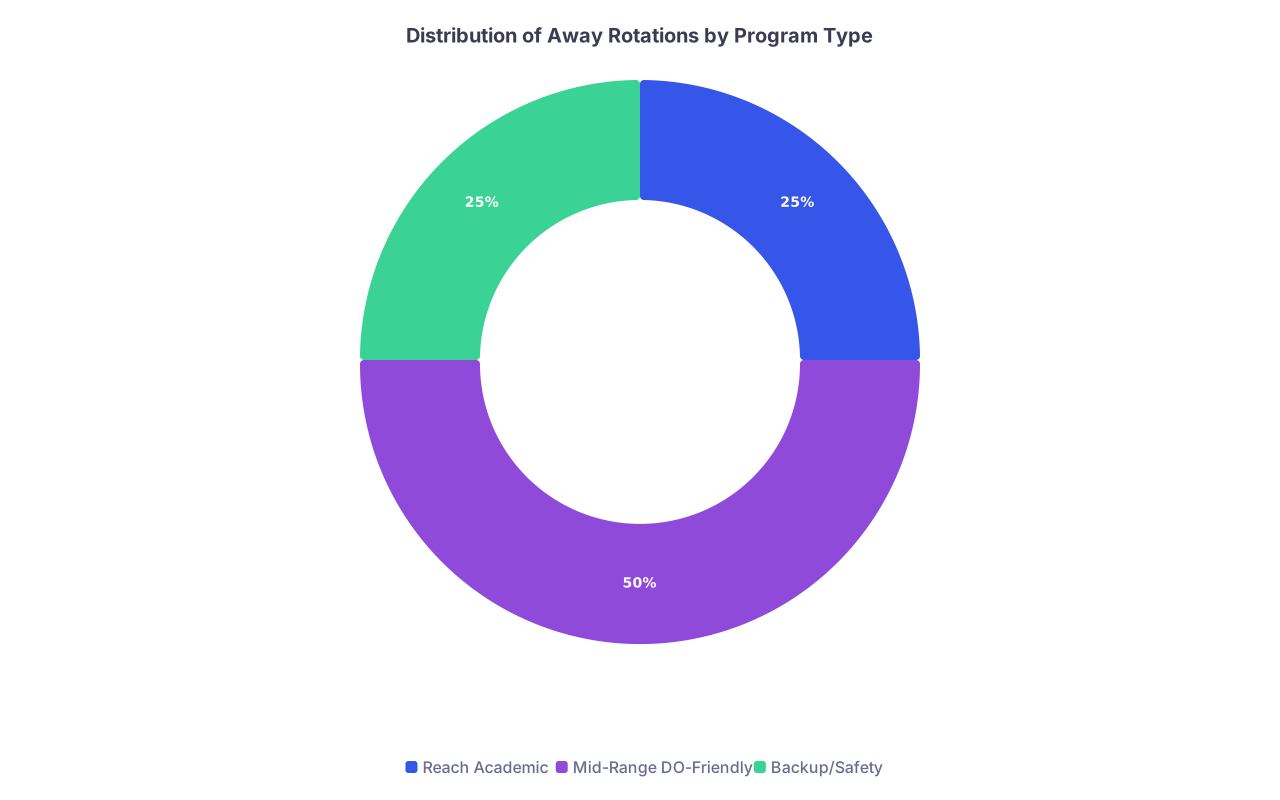
| Category | Value |
|---|---|
| Reach Academic | 25 |
| Mid-Range DO-Friendly | 50 |
| Backup/Safety | 25 |
If your school forces you into a couple of home‑system rotations that are useless for your target specialty, fine. Don’t fight battles you can’t win. Just make sure every elective block you can control is doing work for you.
Step 7: Know the Specialty-Specific Realities
Some specialties are brutal without strong affiliations. Some are much more forgiving.
Very rough realities:
- Hard bordering on masochistic without affiliations: Dermatology, Ortho, ENT, Plastics, Neurosurgery, Ophtho, competitive IR tracks.
- Still competitive but survivable with smart away strategy: EM (varies), Anesthesia, Radiology, General Surgery, OB/GYN.
- More flexible: IM (especially community programs), FM, Psych, Peds, PM&R, Neurology (depending on region).
If you’re going for a “brutal” specialty from a DO school with no ACGME ties and no USMLE, you’re trying to win on hard mode. People do it, sure. But you cannot skip:
- USMLE Step 1 and very likely Step 2.
- Multiple high‑quality away rotations.
- Networking and strong home letters.
For more flexible specialties, one or two solid ACGME rotations plus strong performance at your existing sites can be enough. But you still need the exposure.
Step 8: Use Alumni and Residents Like Actual Humans, Not Abstract “Networking”
Mass‑emailing “Dear Doctor” to thirty random attendings on Doximity is useless. But one well‑targeted message to an alumnus at a program you want? That can unlock a rotation.
How you do it:
Get names:
- Your school’s alumni office.
- Department websites (look for “Medical school: [Your DO school]”).
- Older classmates who matched in your specialty.
Send short, specific outreach:
“Hi Dr. [Name], I’m a third-year at [Your DO school]. I saw you trained at [Your DO school] and are now at [Program]. I’m interested in [Specialty] and hoping to do a visiting rotation at your institution. My school doesn’t have a formal relationship with [Program], but I’m working on arranging one.
Would you be open to a brief call or email to advise me on the best way to set this up, and whether your department takes visiting DO students? I’d really appreciate any guidance you have.”
Do not ask them to “get you in.” Ask them how the system works. If they like you and it’s realistic, they’ll often volunteer to pull you in or at least vouch for you with their coordinator.
Step 9: Handle the Logistics Like a Pro
Most students underestimate how much friction there is just moving paperwork around.
Have these ready, updated, and easy to send:
- PDF CV (1–2 pages, clean, current).
- COMLEX/USMLE score reports.
- Immunization record & TB/flu/COVID documentation.
- Background check / drug screen proof if your school handles that.
- BLS/ACLS cards if required.
- Malpractice coverage letter from your school (they should provide this).
Create a dedicated folder on your computer / cloud drive with everything saved as clear filenames:
Lastname_CV.pdfLastname_COMLEX1.pdfLastname_Immunizations.pdf
You don’t want to be hunting down your hepatitis titer at 1 a.m. the night before a deadline.
Step 10: Once You Get the Rotation, Make It Count (Twice)
Landing the rotation is step one. Making that rotation produce an interview is step two.
At a program with no prior relationship to your school, you’re not just “a student.” You’re a test case. If you perform well, they’re more likely to take DOs from your school again. If you flame out, you close that door for others.
On site, your priorities:
- Show up early, consistently. Nobody cares what your school’s typical hours were.
- Know the basics cold. Common presentations, bread‑and‑butter management.
- Ask for feedback in week one, not week four. “Is there anything I should be doing differently to be more helpful to the team?”
- Make your interest in their residency explicit—but not desperate.
Somewhere mid‑rotation you say to your PD or APD:
“I’ve really enjoyed working with your team and I can see myself fitting in here for residency. I’ll be applying this cycle—do you have any advice on how I can be a stronger applicant for your program?”
You’re telling them: I want to be here, and I’m serious. That puts you on their radar when applications roll in.
Step 11: Cover Yourself With Backup Plans
If your school doesn’t have built‑in ACGME affiliations, you are more fragile to:
- Late VSLO acceptances.
- Canceled rotations.
- Last‑minute policy changes (“We decided not to take DOs this year”).
So you maintain a live backup list at all times. Programs that:
- Take visiting students late in the season.
- Accept off‑cycle months.
- Are DO‑heavy and used to last‑minute schedulers.
You also keep at least one “meh but safe” rotation offer in your back pocket for each major block, as long as it doesn’t block you from a much better one.
This is where many people mess up: they put all their hope into four shiny big‑name applications and end up with nothing, then scramble into random electives that don’t help them match.
Don’t do that.
Step 12: Be Honest About When You Need to Adjust Specialty or Strategy
Sometimes the answer, if your DO school has zero ACGME ties and you’re already late in the game, is that you need to adjust.
Signs you need a course correction:
You’re late MS3 with:
- No USMLE,
- No secured ACGME rotations,
- And aiming for a hyper‑competitive specialty.
Every program you contact directly either ignores you or says “we only take students from our partner schools,” and you’re already inside the normal away rotation window.
In that scenario, you have three realistic moves:
- Pivot to a more DO‑friendly specialty where you can still create meaningful rotations late.
- Take an extra year to build research, take USMLE, and secure better rotations.
- Accept that your first job may not be your dream specialty, but you match into something solid and build from there.
I’ve seen people stubbornly push for a specialty they had no realistic path into from their setup and end up scrambling unmatched into something they liked even less. You don’t need to be that person.
Step 13: Documentation for the Match – Show the Story
When it’s time to apply, your ERAS needs to make sense of your patchwork electives.
You’re not just “randomly rotating all over the country.” There should be a clear narrative:
- Regional focus: “I did rotations in the Midwest because my partner/family is there and I want to train there.”
- Specialty focus: “My electives reflect a strong commitment to [Specialty] with exposure at both academic and community programs.”
- Relationship to programs: “I sought out these institutions specifically because of X, Y, Z.”
Your personal statement and interview answers should make your away rotation choices look intentional, not desperate.
Step 14: One Harsh Truth You Need to Accept
No one is coming to rescue you from the fact that your DO school doesn’t have strong ACGME affiliations.
Some schools are incredible at advocating for their students. Some aren’t. You may have deans who treat “ACGME” like a dirty word. You can waste energy being angry about it, or you can treat this like what it is: a project with a deadline.
The students who do well from schools like yours are the ones who:
- Start early.
- Keep meticulous records of contacts and applications.
- Follow up politely but persistently.
- Aren’t afraid to ask for things that aren’t pre‑built.
You do not need permission to take ownership of your clinical education.

| Step | Description |
|---|---|
| Step 1 | Choose target specialty |
| Step 2 | Build program spreadsheet |
| Step 3 | Research DO-friendly programs |
| Step 4 | Identify rotation channels (VSLO, direct) |
| Step 5 | Email coordinators/alumni |
| Step 6 | Secure rotation offers |
| Step 7 | Coordinate school affiliation/paperwork |
| Step 8 | Complete rotation and seek letter |
| Step 9 | Apply to programs where you rotated |
Your Move Today
Do this right now: open a blank spreadsheet and list 10 ACGME programs in your target specialty that:
- Have at least one DO resident currently.
- Publicly list visiting student info (VSLO or otherwise).
Fill in whatever columns you can find in 45 minutes. No perfection. Just data.
That sheet is the backbone of you creating your own rotations. Without it, you’re just “hoping” your school’s lack of affiliations magically stops mattering.
Hope is not a strategy. A good spreadsheet and a few well‑written emails? That’s a strategy. Start it today.


