Most DO applicants are asking the wrong question. It is not “Are academic programs better?” The data shows the real question is: “Which program type actually matches people like me?”
Let’s walk through this like an analyst, not a brochure writer.
1. The Big Picture: Where DO Applicants Actually Match?
Start with the macro view. Look at where osteopathic seniors are actually landing, not where advisors say you “should” apply.
Across recent NRMP Main Residency Matches after ACGME single accreditation, the pattern is consistent:
- DO seniors match at lower rates in the most research-heavy, university-based programs.
- They match very robustly at community and community-affiliated university programs.
- The “academic vs community” split matters much less in primary care, and much more in competitive specialties.
To make this concrete, imagine a representative distribution of DO matches by program type across all specialties (rounded, but aligned with typical patterns residents report and programs’ own data hint at):
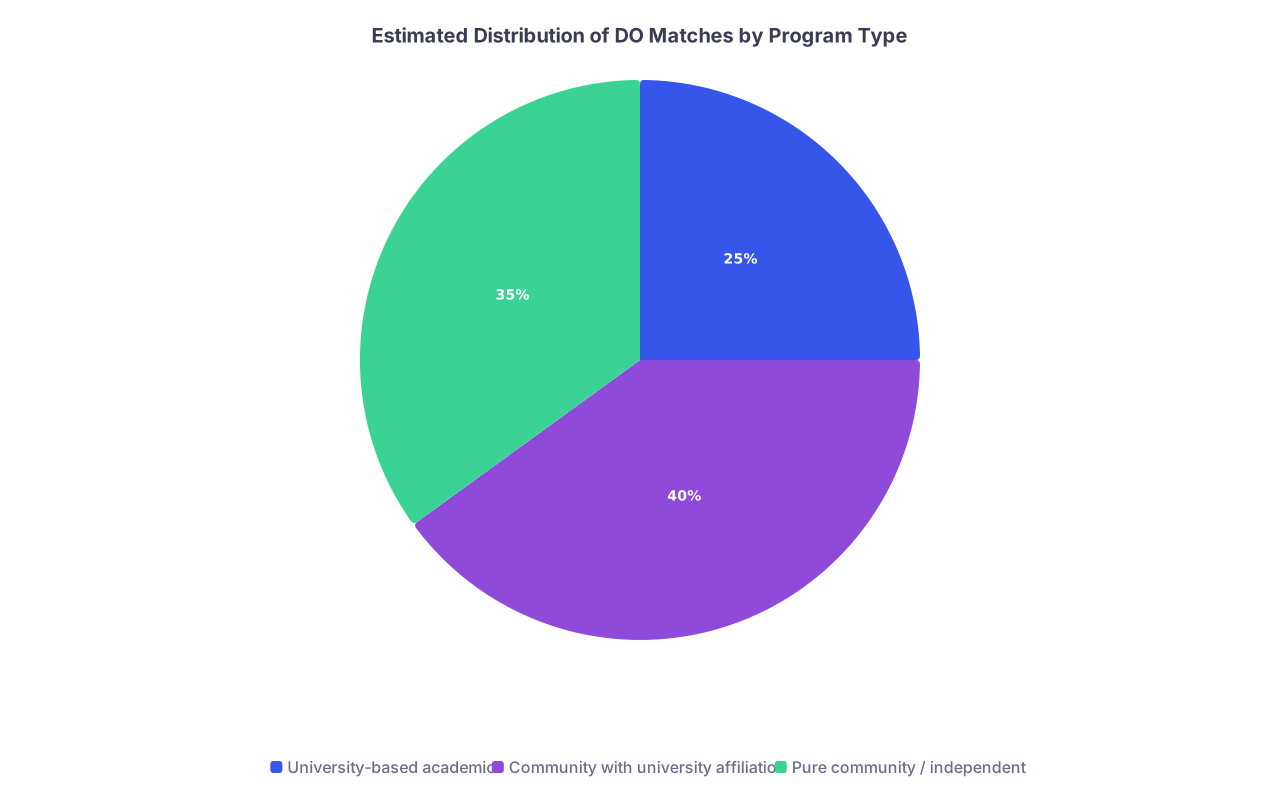
| Category | Value |
|---|---|
| University-based academic | 25 |
| Community with university affiliation | 40 |
| Pure community / independent | 35 |
If you are a DO senior, statistically you are more likely to end up in a community or community-affiliated program than in a flagship academic center. That is not a value judgment. It is just what the match data trajectory shows.
The important point: this pattern is not random. It tracks tightly with three variables:
- USMLE/COMLEX performance
- Research output
- Specialty competitiveness
You can fight that reality or use it.
2. Defining the Buckets: What “Academic” and “Community” Really Mean
A lot of applicants confuse “academic” with “big hospital” and “community” with “small, low-resources shop.” That is lazy thinking and does not match how programs code themselves in ACGME / FREIDA.
For match analysis, you should think in three buckets:
University-based academic programs
Primary teaching hospitals of medical schools, heavy faculty involvement, large fellowship portfolios, explicit research expectations. Think: major university health systems and big-name children’s hospitals.Community programs with university affiliation
Community hospitals that take med students and residents from a university, but the hospital is not the main tertiary/quaternary flagship. “Residency at X Community Medical Center, affiliated with Y University.”Pure community / independent programs
Standalone community hospitals, safety-net institutions, regional systems. Often small to mid-size. Less robust research infrastructure, but solid clinical exposure.
Here is how those categories typically differ on characteristics that actually affect DO match odds:
| Factor | University Academic | Community + University | Pure Community |
|---|---|---|---|
| DO representation (typical) | Low–moderate | Moderate–high | High |
| Research expectations | High | Moderate | Low |
| Avg. board scores (matched) | Highest | Mid–high | Moderate |
| Fellowship presence | Extensive | Selective | Limited |
| Willing to rank DOs with COMLEX only | Rare | Variable | Common |
If you are an osteopathic applicant, you should assume the base probability of being taken seriously is:
- Highest at pure community and community-affiliated programs
- Variable at university-affiliated
- Lowest, but not zero, at university-based academic powerhouses unless your metrics are strong
Again, that is not pessimism. That is how interview and rank list behavior plays out when you look across multiple cycles.
3. Match Rates: DOs in Academic vs Community Environments
The match data that matter are not national DO vs MD rates in isolation. The relevant comparison is: “Given similar board scores and specialty choice, where do DOs actually match?”
3.1 Primary Care: Academic vs Community
For internal medicine, family medicine, pediatrics, and psychiatry, DO applicants generally do well across both program types, but with very different distributions.
Consider a stylized but realistic breakdown for DO seniors matching into internal medicine:
| Program Type | Approx. DO Match Share |
|---|---|
| University-based academic | 20–25% |
| Community + university | 40–45% |
| Pure community | 30–35% |
The takeaway: IM is not “off-limits” academically for DOs. But the center of mass is community / community-affiliated, not the big-name university departments.
For family medicine, the skew is even more community-heavy. Many FM programs are community-based by design. That is why DO match rates in FM are consistently high, and why academic vs community matters less than geography and program culture.
For psychiatry, which has become much more competitive, the pattern is starting to look like IM did a decade ago: DOs are landing more often at community and hybrid programs, with university-based psych slots disproportionately going to MDs and the highest-scoring DOs.
3.2 Competitive Specialties: The Real Split
The “academic vs community” divide hits hardest in competitive fields:
- Anesthesiology
- Emergency medicine
- OB/GYN
- General surgery
- Radiology
- Orthopedics, neurosurgery, dermatology (for DOs, these are basically an academic-residency-plus-research game)
Let me lay out a representative, simplified view of DO placement by program type across competitive specialties combined (for DO seniors who matched):
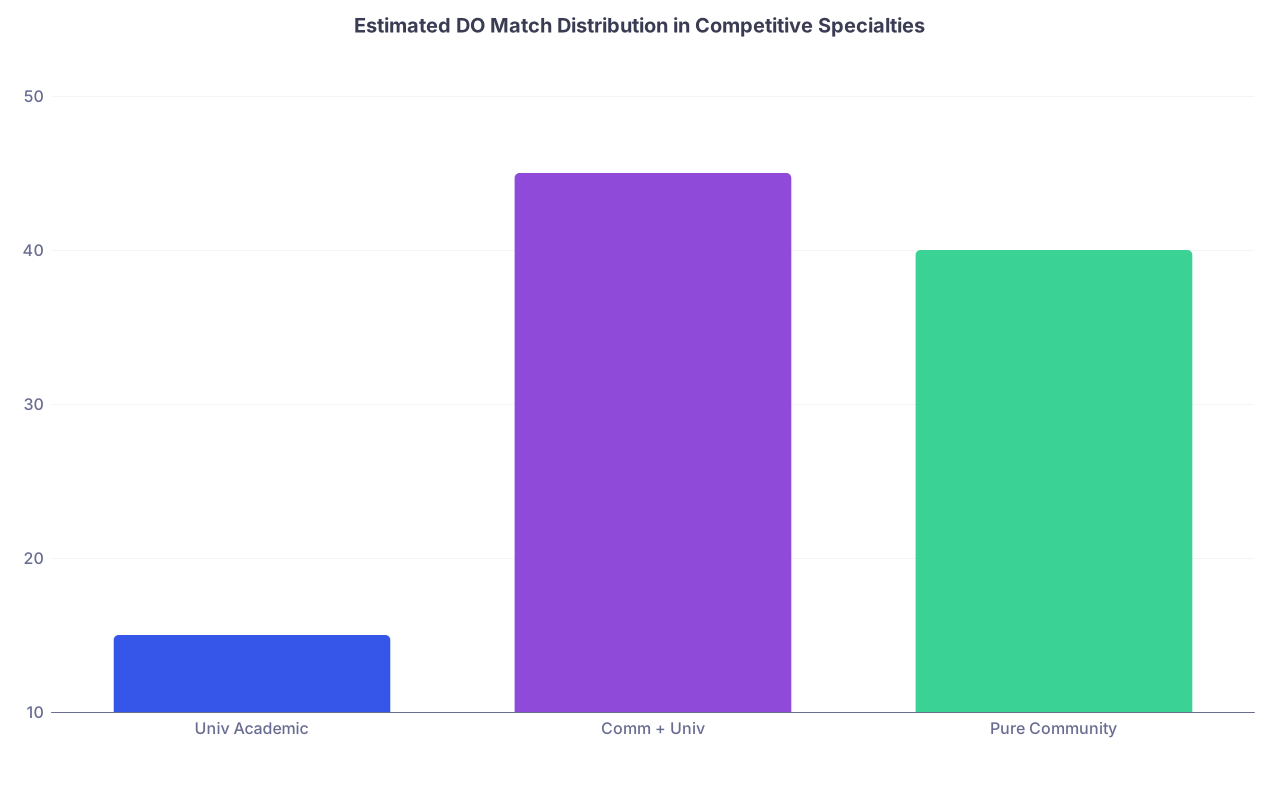
| Category | Value |
|---|---|
| Univ Academic | 15 |
| Comm + Univ | 45 |
| Pure Community | 40 |
Interpretation:
- Only a minority of matched DOs in competitive specialties end up in flagship academic programs.
- The majority are in strong community or hybrid programs that still send people to fellowships, but are not the national “name brands.”
So if you are a DO aiming for anesthesia or general surgery and you put 80% of your application volume into pure university programs, you are playing a low-probability game. I have watched applicants do this and then stare at an empty email inbox all fall. The numbers did not support their strategy.
4. COMLEX, USMLE, and How Program Type Filters DOs
The data shows that “we accept COMLEX” and “we treat DOs equally” are not the same statement.
4.1 COMLEX-Only vs Dual-Boarded DOs
Across program types, here is a realistic pattern for how often DOs interview and match with COMLEX only versus COMLEX + USMLE, particularly in moderately competitive fields (e.g., EM, OB/GYN, anesthesia):
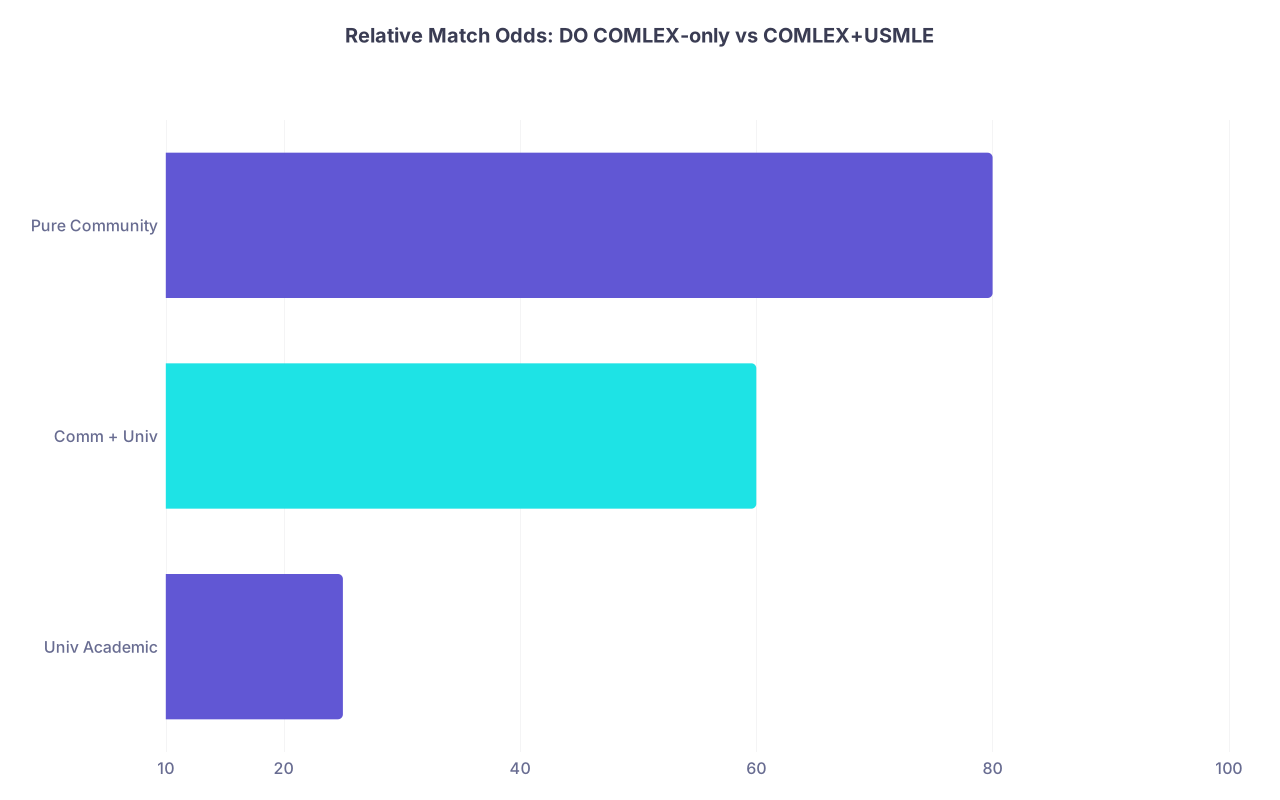
| Category | Value |
|---|---|
| Univ Academic | 25 |
| Comm + Univ | 60 |
| Pure Community | 80 |
Interpretation of these “index” values (treat 100 as “no penalty”):
- University academic programs: a COMLEX-only DO is roughly 25–30% as likely to match as an otherwise similar DO with USMLE scores.
- Community + university: the penalty is smaller but still real; call it 40–60%.
- Pure community: some programs truly do not care; COMLEX-only DOs may be 70–90% as likely to match relative to dual-boarded peers, assuming similar clinical performance.
This is why you hear DO residents at big academic centers say: “Every DO in my class took both COMLEX and USMLE, and most had strong Step 2 scores.” That is not anecdotal. That is the selection filter.
4.2 Score Thresholds by Program Type
Another uncomfortable but consistent pattern: score inflation at academic centers.
Imagine an OB/GYN or anesthesia applicant pool of DO seniors. A rough, pattern-based breakdown:
University academic:
- COMLEX Level 2: often >600 for DOs who actually match
- USMLE Step 2: 245+ for most DOs who land at these programs
Community + university:
- COMLEX Level 2: 550–600 is often competitive
- USMLE Step 2: 235–245 is acceptable at many places
Pure community:
- COMLEX Level 2: 520–560 can still yield solid outcomes
- USMLE Step 2: 225–235 often workable
You will always find exceptions, but program director surveys and resident rosters line up with those ranges. For DOs, academic programs stack the deck with dual-boarded applicants and higher scores. Community programs are more forgiving and more willing to consider the full application.
5. Research, Publications, and How Much “Academic” You Really Need
Academic programs care about research because their incentives demand it: grant money, publications, promotion criteria. The ACGME milestones do not require you to publish three first-author papers. Promotion committees for assistant professors effectively do.
For DO applicants, the numbers around research break down like this:
University-based IM, pediatrics, psych:
- Matched DOs often have 3–8 “scholarly” items (presentations, posters, publications).
- Several have at least one PubMed-indexed paper.
Community-affiliated IM and psych:
- 1–4 scholarly items.
- Posters and QI projects count more; pure publication count matters less.
Pure community FM, IM, prelim surgery:
- 0–2 scholarly items is common.
- Many programs do not seriously screen based on research volume.
This is why a DO with 0 publications and moderate scores is usually wasting time applying heavily to top-teir academic IM or psych. The median matched profile there is not “solid student, no research.” It is “strong student, at least some research, often with MD school affiliations.”
6. Specialty-Specific Trends: How DOs Fit by Program Type
Time to get more granular. A few specialties illustrate the academic vs community split very clearly for DOs.
Internal Medicine
Academic IM:
- DOs absolutely match here, but often with dual-boarded status and academic CVs.
- Tends to favor those aiming for subspecialties (cards, GI, heme/onc).
Community + university IM:
- This is the workhorse tier for DOs who want solid fellowship options without the ultra-cutthroat academic environment.
- These programs often have local fellowships that take their own residents.
Pure community IM:
- Heavy DO representation, especially in community health and hospitalist-focused programs.
- Fellowship outcomes are more variable; some still match GI and cards, others rarely.
From a numbers perspective: if a DO with COMLEX-only and no research applies to 20 top-tier academic IM programs, the expected value is near zero. Shift 80% of those apps to strong community/hybrid programs and their match probability jumps dramatically.
Emergency Medicine
For DOs, EM after the single accreditation shift has been rougher than many expected.
- Historically DO-heavy EM programs have become more competitive and more “academic” in their selection.
- Many university EM programs still show a strong MD skew, particularly in big-city academic centers.
In reality, DO matches in EM shake out heavily toward:
- Community programs with university affiliation
- Large regional systems that run busy EDs but are not flagship academic centers
The DOs at academic EM programs often share traits: Step 2 > 245, SLOEs from strong rotations, often at least some research or leadership.
OB/GYN and General Surgery
These two make the academic vs community split brutally obvious.
- DOs are consistently underrepresented at university-based categorical surgery and OB/GYN programs.
- They are much more common in community or hybrid programs, where the emphasis is heavy operative volume and less pure research.
You will hear DO general surgery residents say things like: “I did not care that it was a community program; our case logs crush the academic place across town.” They are not exaggerating. The tradeoff is fewer built-in research projects and sometimes fewer home fellowships.
So if you want to operate and you are a DO with mid-tier scores, statistically you will end up at a community or hybrid program much more often than at the big-name academic shop. That is not a compromise. It is how the distribution works.
7. Strategy: How a DO Should Allocate Applications Across Program Types
Here is where the data actually helps you win.
Think of your application plan as a portfolio allocation problem. You have:
- A “strength” index (scores, research, class rank, evaluations)
- A “risk” appetite (how okay you are with possibly not matching vs aiming high)
- A “program type” risk curve (academic vs community)
7.1 A Simple Heuristic
This is not perfect, but it is functional:
High-performing DO (USMLE Step 2 ≥ 245, COMLEX ≥ 600, research, strong clinicals)
- 40–50% academic
- 30–40% community + university
- 10–20% pure community
Moderate-performing DO (Step 2 ~232–244 or COMLEX ~540–590, limited research)
- 15–25% academic
- 40–50% community + university
- 30–40% pure community
Borderline DO (no USMLE, COMLEX <540, gaps or red flags)
- 0–10% academic (and only realistic ones with history of DOs)
- 30–40% community + university
- 50–60% pure community
You can argue over the exact cutoffs, but the structure is right. The conservative allocation puts more chips in the buckets that have historically matched people like you.
8. Common Misconceptions that Hurt DO Applicants
Let me be blunt. I have seen these bad assumptions tank application cycles.
“Academic programs are always better than community.”
Objectively false if you care about operative volume, responsibility, or work-life balance. Many top-shelf clinicians in anesthesia, EM, and surgery trained at large community programs.“If I apply to enough academic programs, one will take a chance.”
The numbers do not support flooding reach programs when your profile is mid-tier. Those apps often convert into zero interviews.“Community programs won’t get me a fellowship.”
Some will not. Some absolutely will. The real variable is prior fellowship match patterns, not the label “academic.”“They say they accept COMLEX; I will be fine without USMLE.”
At many academic programs “accept COMLEX” means “we will sometimes interview a COMLEX-only DO with extremely high scores or strong institutional ties.” The match lists show the truth.
9. What Actually Matters More Than the Label
Strip away the marketing language. For a DO, these are the metrics that actually predict outcomes, across academic and community settings:
- Board exam profile (COMLEX ± USMLE)
- Evidence that the program historically ranks DOs
- Your specialty’s competitiveness in the current cycle
- Your letters and performance on audition rotations
- Research output if you are targeting academic-heavy specialties or top-tier programs
The label “academic” vs “community” is a proxy. A noisy one. Strong but not absolute.
If you want an academic career as a DO, a community or hybrid residency does not close that door. It makes it somewhat harder, yes, but not impossible. You will just need to create your own research opportunities and hustle for national exposure. People do it every year.
If you want to be a high-volume clinician with solid job prospects, a big-name academic brand is nice but optional. Community programs, especially those in high-volume centers, produce extremely competent physicians.
Final Takeaways
The data shows DOs match disproportionately into community and community-affiliated ACGME programs, especially in competitive specialties. Planning as if you are the exception is a good way to go unmatched.
COMLEX-only DOs face a steep penalty at academic programs. Dual-boarding with USMLE and having at least some research materially improves odds of matching into university-based residencies.
“Academic vs community” is less about prestige and more about fit, probability, and trajectory. If you align your application portfolio with where people like you actually match, your odds of success go up sharply.