The way rank committees talk about candidates with multiple exam failures is harsher and more blunt than anyone tells you publicly. You will not hear this in a dean’s meeting or from your school’s “wellness-friendly” advisor. But you need to know it if you’re applying with more than one failed Step or COMLEX attempt.
Let me walk you into that room and show you what actually gets said.
What “Multiple Exam Failures” Signals Before Anyone Reads Your File
By the time your name comes up in the rank meeting, the story has already been half-written in most people’s heads. Multiple exam failures are not just “a score issue.” They are a shortcut label.
The unspoken translation at many programs is: risk.
Not “bad person.” Not “bad doctor.” Just: this applicant is a risk to:
- The program’s board pass rate
- Service coverage when remediation time kicks in
- Faculty time and emotional bandwidth
- The program’s reputation with the GMEC and the sponsoring hospital
And that risk signal fires before anyone reads your personal statement, your “I grew a lot from this experience” paragraph, or your letters.
I’ve watched this happen over and over. The coordinator projects the spreadsheet, and there’s a small notation in one column: “S1 fail x2” or “S1+S2 fails.” The PD squints and says what they always say: “Remind me, is this first-attempt pass rate or any pass?” Then someone clarifies, “No, this is 2 fails before passing.” The room’s posture literally changes.
Your file is now in the “prove it to me” category instead of the “probably fine unless something weird shows up” category.
The First Filter: How Bad Is “Multiple”?
There’s a hierarchy of how ugly multiple failures look. People pretend there isn’t. There is.
| Pattern | Typical Initial Committee Reaction |
|---|---|
| Single Step 1 fail, passed on 2nd, all others first attempt | Wary but open to redemption |
| Step 1 fail + Step 2 fail, both later passed | Serious concern, “systemic issue?” |
| Step 1 fail x2, passed on 3rd attempt | Near-automatic no at competitive programs |
| COMLEX fail x2 but no USMLE taken | Very program-dependent, often skeptical |
| Mix of preclinical/remediation + board fails | “Chronic academic struggle” narrative |
Let me decode the gut reaction at most mid-to-high tier university programs:
- One failure: “Explain it and show me a strong upward trajectory. I’ll listen.”
- Two separate exam failures (different times, different exams): “This is not a fluke. This is a pattern.”
- Two failures on the same exam: “They either cannot test at this level reliably or cannot adapt. High risk.”
- Three or more total fails: “We’d be taking this on eyes wide open, and we probably do not need to.”
Community programs and less competitive specialties sometimes soften those lines, but they don’t erase them. The idea that “community programs don’t care about scores” is a myth spread by people who have never sat in a rank meeting. They care. They’re just more willing to do case-by-case rescue if other parts of the file are stellar and their applicant pool is thinner.
Behind Closed Doors: The Language People Actually Use
I’ve heard these exact phrases in rank rooms over the years. Variations of them show up everywhere.
“Do we want to be the program that takes this on?”
“We’re already on thin ice with our board pass rate. I’m not getting called back into that meeting again.”
“I like her, but three attempts? If she struggles again, this is an avoidable headache.”
“If we have five applicants without any fails who are almost as good, why are we doing this to ourselves?”
Notice the pattern. This is not about your ethics, your empathy, or whether patients will love you. Many of them assume you will be a good clinician. They are still reluctant.
What they’re really doing is risk triage. They’re allocating limited “bandwidth for problems.”
Every class has a certain number of “known projects”: a resident with family chaos, one with borderline professionalism, one with chronic health needs, one with borderline clinical skills who will need close oversight. When your file reads like another category of “high maintenance,” you get slotted into that mental bucket before you ever show up.
Not fair. Also not changing anytime soon.
How Program Type Changes the Conversation
The tone of that discussion depends heavily on the program’s context. You have to understand the ecology you’re walking into.
1. Highly Competitive University Programs
Think: academic IM at UCSF, anesthesia at Duke, ortho at Mayo, derm basically anywhere.
Multiple board failures almost never survive first-pass screening. If your file makes it to the table, it’s because:
- You have a heavy-hitting connection (chair call, inside advocate).
- You bring something rare (PhD with major publications, elite athletics, unique skill set the department wants).
In the room, the discussion is clinical and ruthless. The PD will ask: “Is there any reason to take this risk when we have 60 people above our cut who don’t have this issue?”
If nobody puts their neck out explicitly—“I worked with them, they’re outstanding, I’ll own it”—you’re done.
2. Mid-Tier University or Strong Community Programs
Here, the conversation is more nuanced. They still care deeply about board pass rates and service coverage, but their applicant pool may not be as absurdly overstuffed.
I’ve seen this exact pattern:
- Someone likes you from interview day.
- They say, “Yes, two fails, but did you meet them? They were one of the best interviews we had.”
- Another faculty member says, “Show me the trajectory.”
Now some actual analysis happens: did the scores climb? Did Step 2 jump? Did later COMLEX levels normalize? Did you crush away rotations?
If there’s a slope that points clearly upward, this room may fight over your rank position rather than instantly dumping you. But you’ll still be a “discussion candidate,” not a consensus one.
3. Smaller Community Programs / Newer Programs
This is where the stories of “I matched with two fails” almost always come from.
They may have:
- Fewer total applicants
- More IMG-heavy pools
- Institutional pressure to fill all spots, every year
- Chairs who value work ethic and grit more than metrics because they’re on the wards with you daily
The conversation turns more practical. Someone might say: “Look, the scores are bad, but they did three rotations with us and everyone loved them. They’re already basically one of us. I’d take them over a stranger with a 250.”
That’s your opportunity zone. But it doesn’t mean no one is nervous. It just means emotional connection and performance can override numerical fear.
What Committees Scrutinize Once You’re Flagged
Once the “multiple failures” label is on the table, the committee goes hunting for either reassurance or reasons to cut you.
They usually go in this order:
1. Timing and Context of the Fails
Early vs late matters more than most applicants realize.
Early Step 1/Level 1 fail followed by a strong Step 2/Level 2: The narrative can be “immature student who figured it out.”
Later failure (Step 2 or Level 2) after a clean history: That spooks people more. It suggests plateauing or burnout right before residency.
Fail during major life events: If clearly documented (serious illness, family death), some committees genuinely do give grace. But they want to see that once that storm passed, your trajectory normalized and stayed stable.
A private truth: if your explanation sounds like a vague mix of “stress, anxiety, depression, COVID, pandemic, burnout,” and there’s no crystallized change-point with sustained improvement, most attendings quietly lump it into “chronic fragility.” They won’t say this to your face. They will think it.
2. The Shape of Your Score Trajectory
People don’t just look at pass/fail; they look at trend.
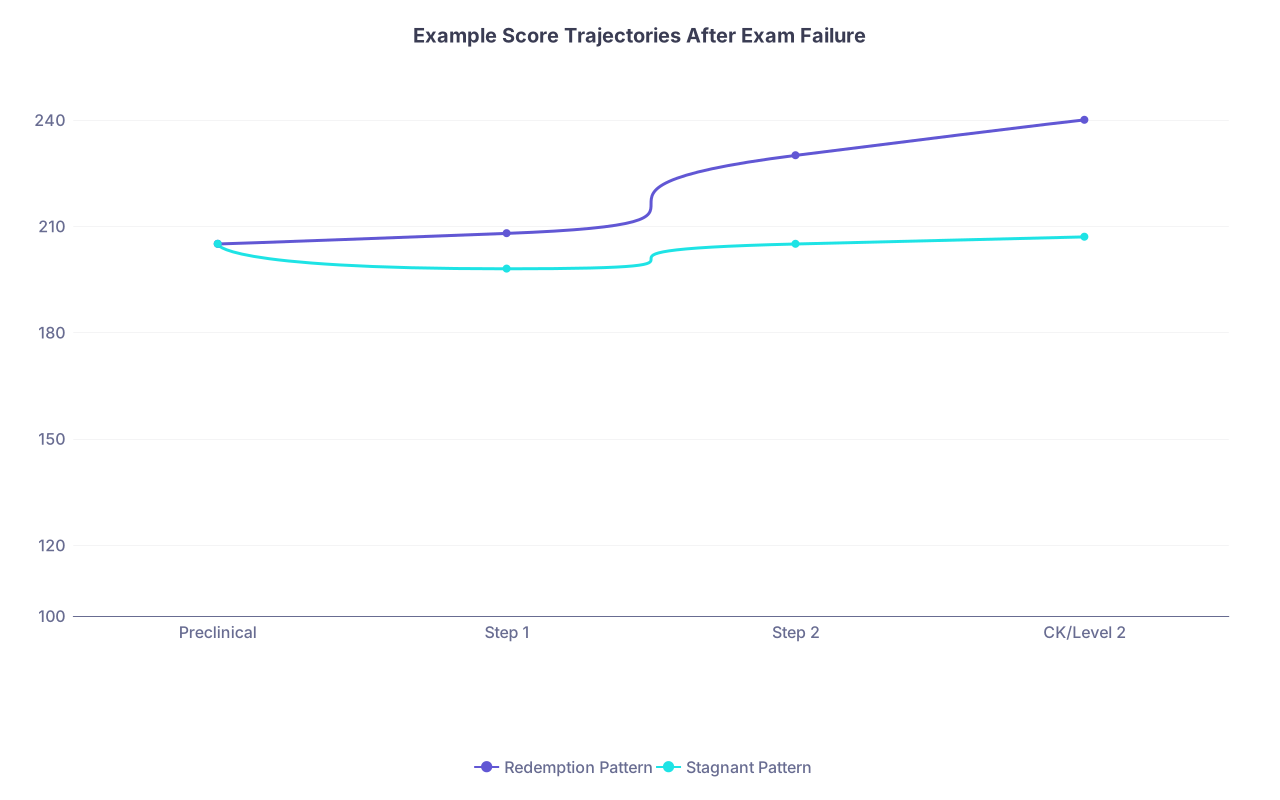
| Category | Redemption Pattern | Stagnant Pattern |
|---|---|---|
| Preclinical | 205 | 205 |
| Step 1 | 208 | 198 |
| Step 2 | 230 | 205 |
| CK/Level 2 | 240 | 207 |
Here’s how these patterns are talked about:
Clear rebound (failed Step 1 at 195, then Step 2 at 240): “OK, something clicked. They can perform at the level we need.”
Barely passing after multiple attempts (multiple 200–210 scores): “Chronic borderline test taker. What happens when they hit in-service and boards?”
Long gaps between attempts: “Were they needing massive remediation? Remediating a chronic issue or just dragging their feet?”
Programs with institutional board pass problems pay especially close attention to this. If their last ACGME site visit dinged them for low pass rates, your trajectory had better look like a bullet train upward, not a flatline.
3. Clinical Evaluations and Narrative Comments
Everyone says “letters matter.” On applicants with multiple failures, narrative comments become either your salvation or your obituary.
What rank committees look for are phrases like:
- “Top 5% of students I’ve worked with in the last decade.”
- “Functions at or above intern level already.”
- “I would be delighted to recruit them to our own program.”
Versus:
- “Will be a solid resident with appropriate support.”
- “Shows improvement with feedback.”
- “Pleasant to work with.”
Those cautious, hedged compliments? Death by faint praise when stacked next to academic risk.
If you have multiple fails, you cannot afford lukewarm clinical commentary. Especially not from your home institution. When your own school or your own program can’t bring themselves to rave about you, committees assume that what they’re seeing on paper is the tip of the iceberg.
4. Away Rotations: Asset or Liability
This is where a lot of multi-fail applicants either rescue themselves or quietly destroy their chances.
The rank room question is simple: “We had them on our service—what did we see?”
Best-case scenario: the attending who worked with you says, “If I could clone this student for all four of our spots, I would. They outworked my own residents.” Now your failures are a storyline, not a verdict. People will take leaps for you.
Worst case: “Nice person, but a little slow, needed a lot of hand-holding.” That single sentence detonates any lingering argument that your test issues are just about exams.
I’ve seen PDs take a chance on a 3-time taker because they trusted their own eyes for four weeks. I’ve also seen PDs drop a 250+ scorer down the rank list because an away rotation exposed major issues. The more baggage your scores bring, the more you live or die by what you did in person.
How Mitigation Stories Land (And When They Don’t)
You’ve been told to “address your failures head-on.” Half-right answer.
Here’s how those explanations play in the room:
What Actually Helps
Specific, finite problem with clear resolution.
Example: “I was caring for a terminally ill parent during second year, my time management collapsed, I failed Step 1. After their passing I took a leave, got therapy, completed a structured test-prep program, and scored 240 on Step 2.”That gives people something concrete: a storm, a pause, a fix, and then clean sailing.
Demonstrated pattern of high performance afterwards.
Not just “I changed,” but “I changed and here’s two full years of clean evals, strong in-training exam, research productivity, leadership, etc.”Insight matched to behavior.
Saying, “I realized I needed to ask for help earlier,” and then having a mentor write, “She proactively sought feedback and implemented it rapidly” makes your story believable.
What Backfires
Vague psychological hand-waving.
“I struggled with stress/anxiety/depression during this time” without clear boundaries and recovery looks to attendings like “I may crash again exactly when your program needs me most.”Blaming the exam or process.
Any hint of “the test is unfair,” “they changed the scoring,” or “I’m just not a good standardized test taker but I’m great clinically” reads like rationalization. Fair or not, this sinks you at many programs.Explanations that require faith.
If your story boils down to “Trust that I’m different now,” and you don’t have a mountain of recent hard data, they won’t.
The Real Role of In-Person Interview Day
Here’s the part almost nobody tells you: once you’ve reached interview day with multiple failures, your ceiling is often higher than you think—but your floor is much lower.
You’ve already beaten the odds by getting invited. That means somebody on the selection side pre-advocated for you or they’re genuinely open-minded. They’re taking a shot.
On interview day, committees are asking themselves one simple question:
“Does my direct experience with this person override my preconceptions enough that I’m willing to fight for them in the meeting?”
You can’t have an average day. You have to be:
- Noticeably better prepared than your peers
- Sharper on your clinical reasoning conversations
- More aligned with the program’s mission
- More useful in the eyes of faculty (“This is someone I’d love to have on my team at 2 a.m.”)
If you come off slightly awkward, slightly underconfident, or slightly generic, the file reverts to what it looked like on paper: risky, with no emotional counterweight.
I’ve watched this psychological flip countless times:
Before interview: “Two fails, I’m not sure.”
After a stellar day: “Honestly, I liked them more than 80% of our no-fail candidates. Put them in the middle third.”
That’s how multi-fail applicants quietly match at places people think they had no shot.
Where the Hard Line Really Is: Multiple Fails and Specialty Choice
Let’s be blunt.
If you have multiple exam failures and you are still aiming at:
- Dermatology
- Plastic surgery
- Neurosurgery
- Orthopedics
- ENT
- Radiation oncology
You are living in fantasy land unless you bring something else so extraordinary that department heads personally lobby for you. And even then, you’re playing a game with a <5% personal match probability.
The rank room in those specialties is viciously numbers-aware and PR-sensitive. They do not need to take chances. They already reject plenty of perfect-paper applicants.
On the other hand, in fields like:
- Family medicine
- Psychiatry
- Pediatrics (community-heavy)
- Internal medicine (outside top universities)
- Transitional/Prelim programs in smaller systems
The conversation changes from “why would we” to “can we justify not taking them if they were great on rotation or interview?”
Targeting the right tier and type of program becomes the difference between “no one will rank you” and “5–10 places might put you in the middle of their list.”
The One Thing That Overrules Everything
There is one trump card that, when present, changes the entire conversation: a respected insider who is willing to stake their reputation on you.
Not an email. Not “happy to be listed as a reference.” I mean a PD, chair, or senior faculty member telling another PD: “Listen, I know their exam history. I’ve worked with them. If you take them, you won’t regret it. I would take them myself.”
That kind of advocacy turns the rank meeting into a different discussion:
Instead of: “Why are we even talking about this candidate with two fails?”
You get: “Dr. X speaks very highly of them. Can we list them in the second half and see how our list shakes out?”
I’ve seen directors soften their board paranoia on the spot when the recommender was someone they trusted deeply. That’s how this game actually works behind the scenes.
How to Position Yourself If You Have Multiple Failures
If you’re reading this as the person with two or three red marks on your transcript, you don’t need sugarcoating. You need a playbook.
You win in four ways:
You pick the right battlefields. That means specialties and programs where your clinical value and persistence can actually compete with your risk profile.
You build a post-failure record so strong that the committee can visibly see a new version of you: upward scores, exceptional clinical comments, meaningful responsibilities.
You get at least one faculty member with real influence to know you well enough that they’re emotionally invested in your success.
You show up to every rotation and interview like you are already a member of the team, not an anxious applicant begging for forgiveness.
Does that guarantee anything? No. Some programs will never touch you. Some will say nice words and rank you so low that you effectively don’t exist. That’s the reality.
But the quiet truth in those rank rooms is this: when someone with multiple failures has clearly rebuilt themselves and proved it over and over, there’s always at least one person at the table saying, “I like them. I’d be proud to train them.”
Your job is to give that person enough ammunition that they can win that argument.
If you remember nothing else
Multiple exam failures do not end your career, but they absolutely change who has to fight for you and how hard. Committees see you first as a risk; your trajectory, performance, and advocates have to flip that script.
Programs do not make these decisions based on your personal statement. They make them based on patterns: score trends, clinical narratives, away rotations, and who’s willing to go to bat for you.
The more brutally honest you are about where you’re competitive—and the more time you spend becoming so strong after those failures that people forget them on interview day—the more likely it is that, when your name comes up in that closed room, the conversation ends with: “Let’s take the chance.”