
Last cycle, I watched a very solid applicant get absolutely grilled in our selection committee meeting over one line in their MSPE: “Required to repeat Internal Medicine clerkship to achieve passing performance.” No failures on Step 2. Strong letters. Good research. But that single sentence changed the entire tone of the conversation in the room. And how the applicant handled it in their application and interview is what saved them.
Let me walk you through how this really works, because most students either overestimate or wildly underestimate how bad a remediated rotation looks.
First: What “Remediated Rotation” Signals To Program Directors
When a program director sees “remediated,” they don’t immediately think, “This person is unsafe” or “automatic rejection.” That’s not how it works.
The words that actually pop into people’s heads behind closed doors are:
- “Why?”
- “Pattern or one-off?”
- “Professionalism? Clinical skills? Attitude?”
- “How did they respond afterward?”
We are not just looking at the event. We’re reading it as a proxy: decision-making, resilience, coachability, and risk.
Here’s the uncomfortable truth: a remediated core rotation is a yellow flag that can become red or almost green depending on how the rest of your file looks and how you explain it. It’s not neutral. It demands an explanation, even if nobody says that to your face.
The exception: a remediated sub-internship or AI (acting internship) in the SAME specialty you’re applying to. That’s not a yellow flag. That’s almost red bordering on “we need a damn good reason.”
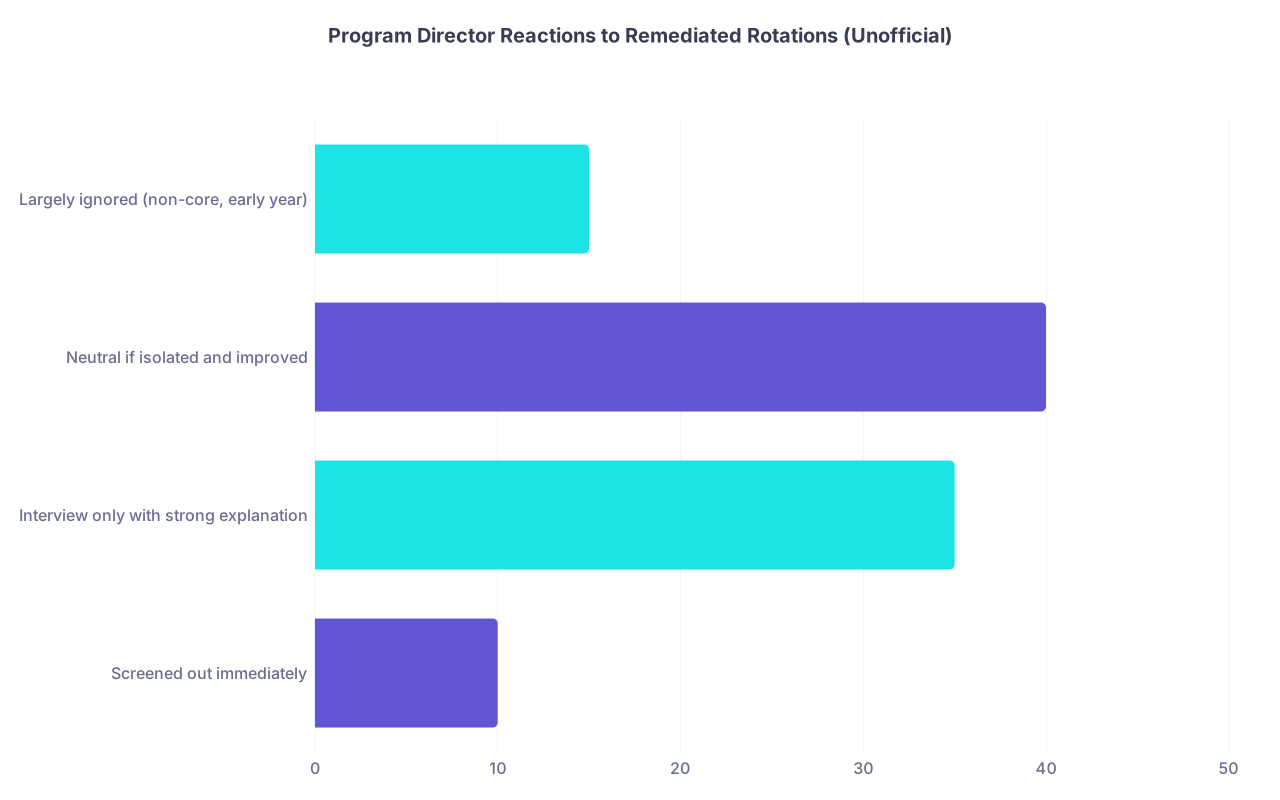
How Often Does a Remediated Rotation Kill an Application?
| Category | Value |
|---|---|
| Screened out immediately | 10 |
| Interview only with strong explanation | 35 |
| Neutral if isolated and improved | 40 |
| Largely ignored (non-core, early year) | 15 |
These numbers are from off-the-record conversations I’ve had sitting in PD offices, not some glossy NRMP survey write-up.
What you need to understand:
- Around 10% of programs, especially in competitive specialties, will quietly hard-screen you out if they see “repeat clerkship” or “required remediation,” no matter what the context is. They will never tell you that. You just will not hear from them.
- A large chunk—about a third—will still interview you, but they expect a tight, credible, mature explanation. If that’s missing or weak, you die in committee.
- Another group, often in less competitive or more holistic programs, will see it as a data point but not a deal-breaker, if your trajectory afterward is clearly upward.
- And yes, some genuinely do not care much if it’s a minor, early rotation, especially pre-clinical era or in something unrelated to your specialty.
The mistake students make is thinking this is binary: “I had a remediation, so I’m done” versus “My school said it’s fine, so nobody will care.” Both are wrong. They care, but differently.
What Type of Rotation You Remediated Matters A Lot
Let me be blunt: not all remediations are created equal. Faculty rank them mentally.
| Rotation Type | Typical Concern Level | PD Gut Reaction |
|---|---|---|
| Core IM/Surgery/Peds/OB/Psych | High | “Why did they struggle with basics?” |
| Core FM/Neuro/Emergency (varies) | Moderate | “Is this weakness in bread-and-butter?” |
| Sub-I / Acting Internship (any) | Very High | “Struggled at near-intern level?” |
| Elective in unrelated field | Low–Moderate | “What actually happened here?” |
| Early pre-clinical remediation only | Low (for some fields) | “Did they mature and recover?” |
If you:
- Remediated a core rotation (IM, surgery, OB, Peds, Psych), eyes will narrow. These are the bread and butter of clinical medicine. The assumption is: something about your baseline performance or professionalism was off.
- Remediated a sub-I/AI, especially in the field you’re applying into: this is bad. A sub-I is as close to intern-level functioning as medical school gets. If an attending said, “Not safe / not ready,” that’s hard to ignore.
- Remediated an elective that had unusual expectations, terrible structure, or a malignant attending: people give this the most benefit of the doubt, if the rest of your record is clean.
- Only had pre-clinical remediation (like repeating a course, needing summer remediation): for many PDs, if your clinical years and Step 2 look strong, this is a footnote, not a headline.
Programs aren’t stupid. They know some attendings fail people for nonsense reasons. They also know students love to blame that.
That’s why the story around the remediation—the narrative and the documented change—is more important than the raw fact that it happened.
What Programs Really Want To Know About Your Remediated Rotation
Here’s what we’re actually trying to extract when we see “remediated” anywhere in your file:
Was it performance or professionalism?
If it was professionalism (no-shows, lying, disrespect, big conflict with staff), that’s more dangerous than just being shaky at H&P’s as a new clerk. Performance issues can be trained. Character problems are harder.Was this a repeated pattern?
One remediated rotation, then straight honors and solid Step 2? That reads as a stumble.
Two remediated rotations. Or one remediation, one barely-passed with comments like “often unprepared,” “difficulty accepting feedback”? That starts to look like who you are.Did you actually get better?
We look at the remediated evaluation or later rotations. If you repeated Medicine and your repeat eval still has phrases like “requires close supervision” or “just meets expectations,” we worry.Did you take responsibility or blame everyone else?
In your personal statement, interviews, or any explanation letter, if your story is 80% “this attending was unfair” and 20% “here’s what I did differently,” you’re in trouble.
Here’s the unofficial translation PDs do in their heads when they read vague language:
- “Struggled with time management” → late on notes, maybe slow, easily overwhelmed.
- “Needed closer supervision than peers” → unsafe at some point, or made errors that scared people.
- “Difficulty accepting feedback” → argued, defensive, or rolled their eyes when corrected.
- “Professionalism concern addressed via remediation” → there was an incident significant enough to document and escalate.
If your school gave you a nicely sanitized MSPE but word gets around that you had major professionalism issues? Trust me, PDs talk. Especially within a region.
The MSPE: Where Your Remediation Quietly Lives or Gets Buried
You will not get a straight answer from your dean’s office about this, so I’ll give you the unvarnished version.
The MSPE (Dean’s Letter) is where most programs first see your remediation. It usually shows up as:
- A line in the “Academic History” section:
“Student required to repeat the Internal Medicine clerkship to achieve a passing grade.” - A comment in the narrative of that specific rotation:
“After initial difficulties, the student successfully remediated the clerkship.” - Or, in some “protective” schools: an almost hidden footnote in an appendix.
Do not kid yourself: PDs who care about this stuff read those lines carefully. Some will literally search the word “repeat” or “remediate” in your PDF.
If your school gives you a chance to review the MSPE for factual accuracy, you are not rewriting history—but you can push for clarity. For example:
- “Failed Internal Medicine due to unprofessional behavior”
vs
“Initially struggled with organization and timely documentation; after remediation and additional supervision, demonstrated improvement sufficient for a passing evaluation.”
Those two versions land very differently in a committee room, even if they describe similar events.
How Much Different Specialties Care
Some students think: “It’s fine, I’m going into [insert supposedly less competitive field]. They won’t care.”
That’s naive.
Do different specialties weigh this differently? Yes. But not always the way you think.
| Category | Value |
|---|---|
| Derm/Ortho/Plastics | 9 |
| EM/Anesthesia/Rads | 7 |
| IM/Gen Surg | 7 |
| FM/Peds/Psych | 6 |
| Path/PM&R/Neuro | 5 |
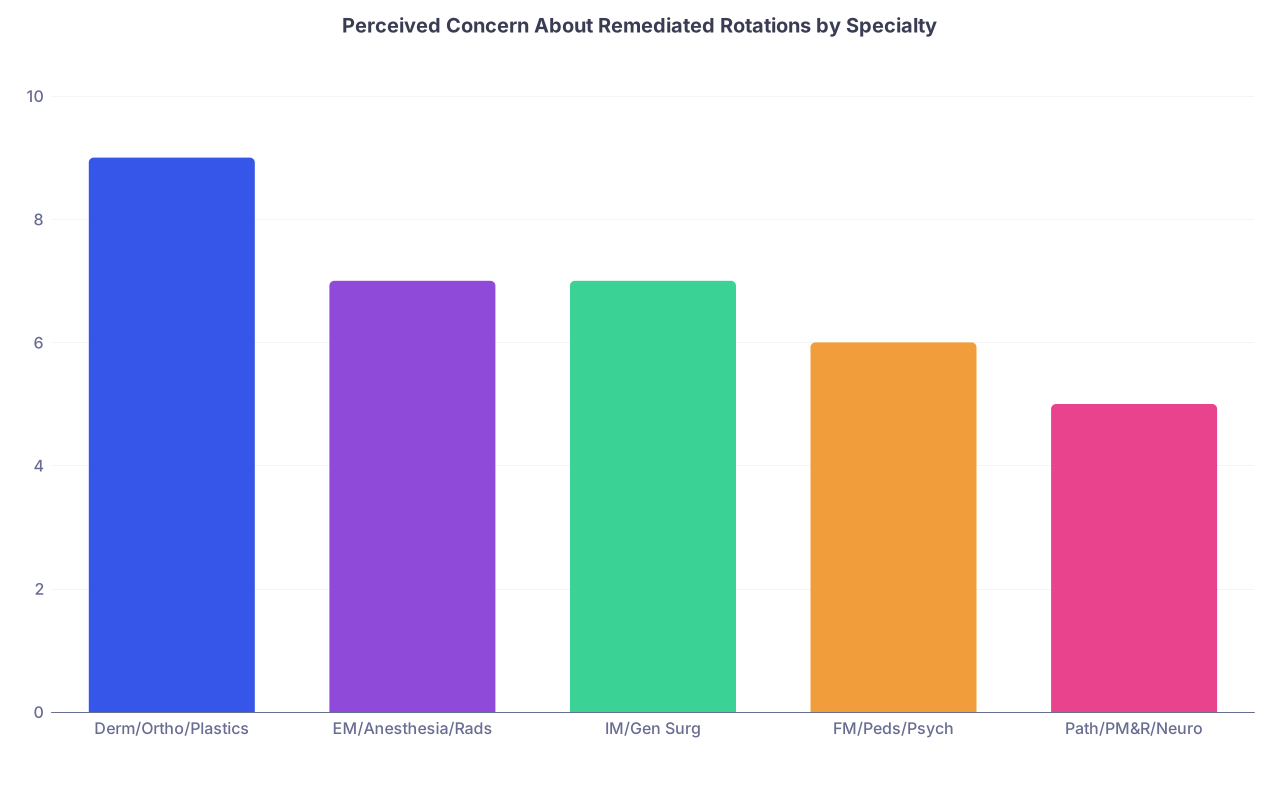
Scale here is 1–10 for “how much PDs I’ve talked to actively worry about remediations.”
- Highly competitive fields (derm, ortho, plastics): many can auto-screen you out because they have ridiculous applicant volumes. A remediation is an easy excuse to toss your file.
- EM, anesthesia, rads: they care about reliability and clinical judgment. A remediated core or sub-I gets discussed.
- IM and general surgery: often pragmatic. One remediated rotation with a strong story and improved performance? They’ll still consider you. But surgery especially will be brutal over remediated surgery or sub-I’s.
- FM, peds, psych: more holistic, but they won’t ignore it. If the remediation ties into concerns about communication, empathy, or professionalism, that matters a lot.
- Path, PM&R, neuro: varied. Many PDs in these fields are quite thoughtful and will look at the whole story rather than automatically punishing you. They also see a lot of “career transition” applicants.
The pattern: the more applicants a program has per seat, the more any red or yellow flag gets weaponized as a filter.
How To Frame a Remediated Rotation Without Digging a Deeper Hole
This is where you either recover or sink. I’ve watched both happen.
You need three things to make this survivable:
- A clear, brief, specific explanation
- Documented improvement afterward
- Consistent messaging across your application, MSPE, and interviews
How to Talk About It (Without Sounding Defensive)
The best explanations I’ve heard from applicants usually follow this rough pattern:
State the fact plainly.
“During my third year, I was required to remediate my Internal Medicine clerkship.”Give a concise root cause that does not sound like finger-pointing.
“I struggled to manage the pace of inpatient medicine at the start of clerkships and did not ask for help early enough.”Describe concretely what you changed.
“Afterward, I worked with our learning specialist, started pre-charting methodically, and asked residents to observe my presentations and give real-time feedback.”Point to objective improvement.
“On the remediated rotation and in subsequent clerkships, my evaluations highlighted more organized notes, improved presentations, and stronger team communication. My sub-I in medicine was rated ‘outstanding’ with comments about reliability and growth.”
That’s it. You don’t need a three-minute monologue. You need 20–30 seconds of clean, adult accountability.
What you must avoid:
- Over-explaining the politics of that team.
- Trashing the attending (“everyone failed that year” or “they just didn’t like me”).
- Vague nonsense like “It just wasn’t my best performance, but I learned a lot.”
If I ask, “What changed specifically?” and you cannot answer in concrete behavioral terms, I assume nothing really changed.
What Matters More Than the Remediation Itself
Here’s the part students almost never hear clearly: once you have a remediated rotation, you cannot erase it. The only game now is “overwhelm it with better data.”
Faculty look for certain counterweights:
- A strong Step 2 score (for better or worse, this reassures a lot of people about baseline knowledge).
- Later rotations in similar settings rated strongly, ideally honors or “exceeds expectations.”
- Letters of recommendation that implicitly address prior concerns without naming them:
- “X is highly receptive to feedback and quickly incorporates suggestions.”
- “They functioned at or above the level expected of an incoming intern.”
- A sub-I in the same area with comments about reliability, ownership, and clinical judgment.
If you remediated Internal Medicine and then your Medicine sub-I letter says: “Shows excellent ownership of patients, anticipates tasks, and is a pleasure to work with,” that neutralizes a lot of worry in the room.
On the other hand, if everything after the remediation is just “average,” no honors, no strong language in letters, then the committee starts wondering if the remediation was the symptom, not the cause.
What Actually Happens in the Committee Room
Let me paint the scene you’ll never see.
We’re in a room, stacks of applications or a giant digital board. Your name comes up. Someone—PD, APD, or core faculty—has your file open.
They say something like:
“USMD, Step 1 pass, Step 2 237, mostly passes and a few high passes. Research okay. Oh, there’s a remediated Surgery clerkship.”
Then one of three things happens, depending on the vibe in the room and the field:
You’re already borderline→ this tips you into the ‘no’ pile.
No drama. No debate. Just, “We have plenty of applicants without that.”You’re strong otherwise→ someone says, “Can we look at the repeat eval?”
If your repeat rotation and later evals are strong, the tone becomes, “Alright, they improved; let’s still consider.” If they’re mediocre, the room gets quiet and you slide down the rank list.You’re exceptional otherwise→ it becomes a curiosity, not a deal-breaker.
“Interesting that they remediated early on, but look at this sub-I and their letters.” That’s where the narrative of growth carries you.
The critical thing: virtually nobody in that room cares what your school told you about how “this won’t affect your residency chances.” We care what’s in your record and whether we think you’ll be safe, teachable, and not a headache.
If You Haven’t Applied Yet: Damage Control Strategy
If you’re still in medical school and you’ve just been told you need to remediate a rotation, the way you handle the next 6–12 months is what will decide how much this hurts you.
Here’s what I’d tell you if you were sitting in my office:
Stop arguing the grade. Start fixing the behavior.
Fight it if it’s truly factually wrong or defamatory, sure. But 95% of the time, endless appeals just brand you as “difficult.”Ask for specific, brutal feedback in writing.
“What concretely did I do or fail to do that would make an attending say ‘not ready to pass’?” Then address those items one by one.Be strategic about later rotations.
If you remediated Medicine, you should absolutely try to crush a Medicine sub-I at a place that will write a detailed letter. Same for surgery, psych, etc.Set up one attending or clerkship director as your “rehabilitation witness.”
Someone senior who can say, “Yes, I know about their earlier issues. What I saw on my team was a different, improved version of this student.”
If you’re already in the application cycle, you don’t have the luxury of time. Your main tools are: the explanation, the rest of your record, and your interviews.
FAQ: Remediated Rotations and Residency Applications
1. Should I explicitly mention my remediated rotation in my personal statement?
Only if it was truly pivotal to your growth and you can describe that growth concretely. Do not open your personal statement with it. A brief, focused paragraph in the middle or later is enough. If the MSPE already documents it neutrally and you have strong upward trajectory, you can also save it for the “Tell me about a challenge” interview question.
2. Will community programs care less about remediated rotations than academic programs?
Often, yes—but “less” doesn’t mean “not at all.” Community PDs are very practical. They care about whether you’ll function independently, not melt down on nights, and not trigger HR headaches. If your remediation involved professionalism, they’ll be just as cautious as academic programs. If it was early performance and you’ve clearly matured, many community programs will move on quickly.
3. Is it better or worse if my school doesn’t explicitly label the rotation as ‘remediated’ but just shows two attempts?
Everyone in residency selection has seen this trick. Two Medicine clerkships, two sets of evals, only the second one with a grade? We know what that is. If the MSPE is vague, PDs may feel more suspicious, not less. You’re usually better off being ready with a clean, direct explanation than hoping no one notices.
4. I remediated a rotation but then honored my sub-I in the same field. Can I still match that specialty?
Yes, absolutely. I’ve watched it happen repeatedly. In that case, your sub-I performance and letter become your primary evidence of who you are now. You’ll still need to explain the remediation, but if your story aligns with “I was inexperienced, I adapted, and here’s proof I can perform at an intern level,” many programs will accept that and move forward with you.
Key points: a remediated rotation is a real yellow flag, not a death sentence. Programs care less about the event itself and more about what it reveals—or fails to reveal—about your judgment, professionalism, and trajectory. If you own it, fix the underlying issues, and stack your file with evidence of growth, you can compete and you can match.