
The fastest way to turn a borderline concern into a “Do not rank” is with a careless interview answer.
You think you are reassuring them. You are actually confirming their worst fears.
Residency interviewers are not neutral observers. They walk into that room with a short list of questions in their heads:
- Will this person be safe with patients?
- Will they show up, do the work, and not melt down at 3 a.m.?
- Will they poison the team?
- Will they embarrass us with the CCC, the PD, or the ACGME?
If your application has any small red flag—average Step 2, a leave of absence, mediocre clinical comments, one failed shelf, a late switch in specialty—your answers can either shrink that flag… or turn it into a flashing siren.
I have watched people talk themselves out of a rank position in under ten minutes. Not with scandals. With “normal” answers that seemed honest but were poorly framed, defensive, or oblivious.
Let’s walk through the most common traps and what to say instead—so you do not make the same mistakes.
1. The “Weakness” Answer That Sounds Like a Liability
You will get some version of: “Tell me about a weakness,” or “What is an area for growth?”
This question is dangerous when your answer matches a concern already in your file.
Mistake: Confirming the exact fear they already have
Examples I have actually heard:
- With low clinical comments: “My weakness is time management. I tend to fall behind on notes and tasks.”
- With a failed Step: “I have always struggled with standardized tests. I get anxious and freeze.”
- With professionalism comments: “I sometimes speak my mind too directly and it can rub people the wrong way.”
On paper, they saw:
- Slightly below-average evaluations
- Marginal Step 2 score
- A “needs reminders” comment about documentation or punctuality
Then you tell them: “Yes, that worry you had? It is real, and I do not really have a plan for it.” You have just upgraded a small question mark into a big one.
Better approach: Choose something adjacent, show insight, show specific change
You need a weakness that is:
- Real, but not core to patient safety or reliability
- Framed with self-awareness and maturity
- Actively being addressed with specific, concrete steps
Do not pick:
- “I am a perfectionist” (transparent and annoying)
- “I care too much” (you sound unserious)
- Anything that reinforces a documented problem in your file
Instead, if you struggled with time management on third year, you might say:
“Earlier in clinical rotations I tended to over-document and spent too long perfecting notes. It slowed me down and occasionally made me less efficient for the team. Midway through third year, my senior pointed it out. Since then I have started using templates, setting time limits for each note, and prioritizing active patient issues first. On my last two rotations, my seniors commented that my documentation was timely and much more focused.”
You did three things:
- Admitted something real without sounding dangerous.
- Demonstrated you respond to feedback without getting defensive.
- Showed evidence of improvement, not just “I am working on it.”
Do not say you are “still working on it” without a single concrete adjustment. That sounds like “This is just how I am.”
2. Explaining a Step Failure or Low Score by Throwing Yourself Under the Bus
A Step failure or low score is not a death sentence. Your explanation can be.
Mistake: Oversharing, catastrophizing, or sounding unstable
Problem answers I have heard:
- “I just completely fell apart that year. I was really depressed and unmotivated, and honestly I still struggle with that.”
- “I have never been good at test-taking. I get so anxious that sometimes I blank out. It might happen again, but I am trying.”
- “I had a lot going on with my relationship and family at the time. It was really overwhelming.”
You think you are being raw and vulnerable. What they hear:
- Unstable.
- Might not pass boards during residency.
- Life stress easily derails performance.
Residency programs cannot risk chronic board problems. The Clinical Competency Committee does not want to fight with the board pass rate report every year.
Better approach: Contain the problem and emphasize the trajectory
Your answer should do four things:
- Define the problem narrowly and in the past.
- Take ownership without self-immolation.
- Show specific changes in study strategy or support.
- Point to subsequent success as proof of function.
For example, if you failed Step 1:
“I underestimated Step 1. I treated it more like another exam instead of respecting its scope. My content review was scattered and I did not do nearly enough question blocks under timed conditions. After I failed, I met with our learning specialist, built a structured schedule centered on UWorld and NBME self-assessments, and treated each week like a dress rehearsal. I passed comfortably on my second attempt and used the same approach for Step 2, where I scored a 236. I learned very quickly that I cannot wing high-stakes exams.”
Notice what you did not say:
- You did not frame yourself as a chronically “bad test taker.”
- You did not blame vague “anxiety” without a solution.
- You did not sound like you are still in crisis.
Do not turn a solvable academic hiccup into a question about long-term stability.
3. Talking About a Leave of Absence or Personal Hardship like it is Ongoing
Leaves of absence, illness, family crises—they happen. Programs can be compassionate. But not if you convince them the crisis is still active.
Mistake: Making your current stability ambiguous
Dangerous phrasing:
- “I took time off for mental health reasons and I am still figuring things out.”
- “There are still some ongoing family issues, but I am hoping it will calm down.”
- “I stepped away because it was all too much. I am back now, but I sometimes still get overwhelmed.”
Those sentences are death in a risk-averse selection meeting.
If your application already shows a leave of absence, poor attendance one semester, or delayed graduation, they are asking one thing: “Will this repeat under residency stress?”
Better approach: Clear resolution, clear support, clear performance since
You need to be brief, factual, and forward-looking.
For a mental health leave:
“I took a leave of absence during second year for depression and anxiety that had built up over several months. I saw a psychiatrist, started therapy, and adjusted my medications. I returned to school the next semester and have completed all rotations on time since then, with no further interruptions. I continue regular follow-up and have built better routines for sleep and stress management. I am in a much more stable place now than when I initially struggled.”
Key points:
- Defined cause and timeline.
- Clearly treated.
- Clear, sustained function since then.
- Continuing support, not white-knuckling.
For a family crisis:
“I took one semester off to help manage a sudden family health crisis. During that time, I worked with the dean’s office to plan my return. The situation has since stabilized and other family members are now the primary caregivers. Since returning I have finished all remaining clinical requirements on schedule.”
Do not leave them guessing: “Is this student going to disappear mid-PGY1 if something happens again?”
4. “Why This Specialty?” That Sounds Like You Chose It Yesterday
If your file shows a late specialty change, scattered experiences, or weak letters in the new field, your “why this specialty” answer is under a microscope.
Mistake: Vague, cliché, or obviously recycled answers
Red-flag classics:
- “I like working with my hands but also using my brain.”
- “I love the mix of continuity and acute care.”
- “I just really enjoyed my rotation.”
This is filler. It tells me nothing about your commitment, and it screams “backup choice” if your CV is light in the field.
If your application already suggests you flirted with multiple specialties, a vague answer confirms you are still not sure. Programs do not want to be your experiment.
Better approach: A clear story arc, anchored in your actual behavior
You need to connect:
- Early exposure or assumptions
- A turning point or key rotation
- Deliberate follow-up actions (electives, research, shadowing)
- What you understand about the lifestyle and training
For a late switch from surgery to anesthesia:
“I entered medical school convinced I would be a surgeon and structured my early electives accordingly. During my surgery rotation, I realized that what I enjoyed most was the physiology and intraoperative management. I found myself asking the anesthesiologist more questions than the surgeons. After that, I did an anesthesia elective and a month in the ICU. I liked thinking in real time about hemodynamics, ventilator management, and pain control. I also spent time talking with anesthesiology residents about call schedules and career paths to make sure I understood the lifestyle. Since then, I have completed two additional anesthesia electives and joined an outcomes project with the anesthesia department. This is not a tentative decision; it is where my skills and interests line up.”
You point to specific actions that cost you time and effort. That reads as commitment, not desperation.
Do not claim deep passion if you have no electives, no projects, and one lukewarm letter in the specialty. They see your ERAS.
5. Blaming Others When Asked About Conflicts or Professionalism Issues
If there is anything in your MSPE or letters hinting at “difficult interactions,” “communication issues,” or “needed reminders about professionalism,” the conflict question is not casual. It is a probe.
Mistake: Sounding defensive or self-righteous
Danger signs:
- “The attending just did not like me.”
- “I think my eval was unfair. I actually did what I was told.”
- “The nurse overreacted and made a big deal out of nothing.”
- “Honestly, it was more of a personality clash than a real issue.”
As soon as you say this, I picture you arguing with seniors and nursing staff at 2 a.m.
Better approach: Show capacity to self-reflect and adjust
Pick an example where:
- You had some responsibility.
- You changed something about how you communicate.
- The result improved.
For instance:
“On my medicine rotation, a senior resident mentioned that my sign-outs were too detailed and sometimes buried the key issues. At first I felt defensive because I did not want to leave anything out. After reflecting, I realized I was making it harder for the night team to quickly identify what mattered. I asked that senior for examples of concise sign-outs he liked and started following that structure. By the end of the month he commented that my sign-outs were much more focused and usable. That experience made me more open to feedback, especially around communication.”
If you truly had a significant professionalism incident (e.g., formal remediation), your answer must:
- Acknowledge it without minimizing.
- State what you learned.
- Emphasize clean record afterward.
Do not say: “But everyone did it” or “It was not that serious.” Programs see that as a future headache.
6. “Why This Program?” That Accidentally Admits You Know Nothing
Programs smell generic answers instantly. If your filters (low Step, IMG, couple’s match, late application) already suggest you are casting a wide net, you must not sound like you copy-pasted.
Mistake: Saying the same three phrases at every interview
Common lazy responses:
- “I like the strong clinical training and diverse patient population.”
- “I have heard great things about your program’s collegial culture.”
- “I am excited about the research and teaching opportunities here.”
Every program says those words about themselves. When you repeat them back, you tell them exactly nothing.
If they already suspect they are a “safety” on your list, a generic answer drops you down or off their rank list.
Better approach: Three specific anchors that only apply there
You should be able to name:
- One or two concrete program features (tracks, rotations, schedules).
- One or two people or initiatives you actually know about.
- How that aligns with your demonstrated interests.
For example:
“There are three things that stand out to me about your program. First, the four-week block in the addiction consult service is unique; I have been involved in a buprenorphine clinic at my home institution and want more formal training in that area. Second, I am drawn to your clinician-educator track. I have done small-group teaching for MS1s and would like structured mentorship in developing as an educator. Finally, on my interview day, both Dr. Lee and the PGY-3s mentioned how the program leadership protected didactic time. That tells me education is more than a slogan here.”
You just showed:
- You did your homework.
- You know yourself.
- You are not treating them as interchangeable.
Do not tell a community program you are “excited about NIH-funded basic science research” if you have never done any and they do not offer it.
7. Trying to “Be Honest” about Burnout and Work-Life Balance—The Wrong Way
You should not lie. But some truths need framing. Programs take burnout very seriously now. They also cannot rank someone who sounds like they are already at the edge.
Mistake: Sounding like you are one rough rotation away from quitting
Risky answers:
- “I worry a lot about burnout; I saw residents who were miserable.”
- “I really value work-life balance and I do not want residency to take over my life.”
- “I am not sure how I will handle the hours. I know I struggle when I do not get enough sleep.”
Fair feelings. Bad interview phrasing.
When your MSPE already hints you “needed reminders about attendance” or had difficulty with “consistent engagement,” talking about how much you hate long hours is gasoline on that fire.
Better approach: Acknowledge reality, emphasize coping strategies and prior evidence
For example:
“I am realistic that residency will be demanding. On surgery and medicine sub-I, I experienced 70–80 hour weeks and frequent late nights. What helped me was being very intentional about small routines—short workouts, packing food, and using my commute to decompress instead of ruminating. I have also learned that I need to speak up early if I am falling behind rather than trying to tough it out alone. I am not expecting residency to be easy, but I know what I look like under heavy workload and how to keep myself functional.”
You are not pretending to love 28-hour calls. You are showing:
- You have done something hard.
- You remained functional.
- You have a plan for sustaining yourself.
Do not use the interview to vent about how “toxic” med school was. Fair or not, they will assume you will say that about them next.
8. Answering “Any Questions for Us?” with Red-Flag Questions
The last five minutes of an interview can undo the previous twenty-five.
Mistake: Asking questions that scream “What can I get away with?”
Examples that raise eyebrows:
- “How strict are you about duty hours really?”
- “How much call can residents usually switch or get out of?”
- “How often are people able to moonlight or take time off for side projects?”
- “Do you monitor how often people call in sick?”
These read as: unreliable, disengaged, or already planning your exit.
You can and should care about workload, wellness, and fairness. But the wording matters.
Better approach: Ask about support, not escape routes
Better questions:
- “How does the program respond when a resident is struggling academically or personally?”
- “How does leadership solicit and respond to resident feedback about workload?”
- “Can you tell me about any recent changes you have made based on resident input?”
These show you care about the environment and communication, not gaming the system.
An easy rule: If your question could be paraphrased as “How little can I work and still be here?”—do not ask it.
9. The “Tell Me About Yourself” Monologue That Exposes Poor Judgment
This open-ended classic seems benign. It is not. It is an x-ray of your priorities and judgment.
Mistake: Leading with irrelevant, risky, or polarizing details
Actual answers I have seen:
- Starting with, “Well, I am really into cryptocurrency and day trading. That is my main passion outside medicine…”
- Spending two minutes on a contentious political advocacy group before mentioning any clinical interests.
- Diving deep into a niche hobby that reads as extreme (e.g., high-risk sports) when you already have health or leave-of-absence concerns on file.
If there are already small concerns about professionalism, impulsivity, or stability, leading with high-risk hobbies or controversial themes just amplifies them.
Better approach: A tight, professional arc that frames your story the way you want to be remembered
You control the first impression. Use it.
Structure it:
- Very brief background (1–2 sentences).
- Key medical school themes (what you leaned into—teaching, QI, underserved care, etc.).
- One or two personal interests that humanize you, not dominate you.
For instance:
“I grew up in a small town and was the first in my family to go into medicine. In medical school I found myself consistently drawn to acute care settings and longitudinal follow-up, which led me to internal medicine and additional time in the ICU and cardiology clinics. I have enjoyed working with first- and second-year students as a peer tutor and would like teaching to be a part of my career long term. Outside the hospital, I run regularly and play in a community orchestra—it has been a good counterbalance during busy rotations.”
That answer does not trigger new concerns. It reinforces that you are:
- Grounded.
- Focused.
- Likely to fit on a team.
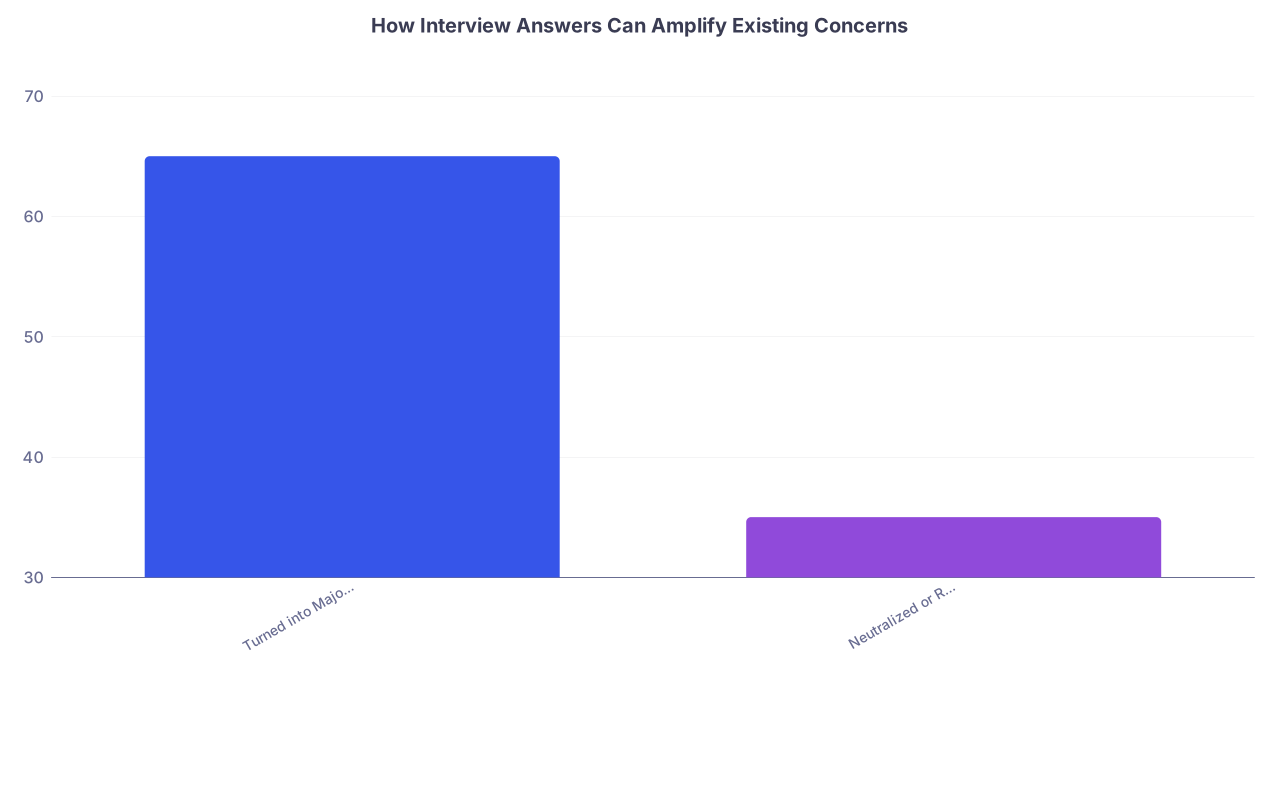
| Category | Value |
|---|---|
| Turned into Major Concern | 65 |
| Neutralized or Reassured | 35 |

| Step | Description |
|---|---|
| Step 1 | Minor Concern in Application |
| Step 2 | Concern Escalates |
| Step 3 | Concern Reduced |
| Step 4 | Lower on Rank List |
| Step 5 | Maintained or Improved Standing |
| Step 6 | Interview Question Probes It |

| Question Topic | Bad Answer Snippet | Better Answer Snippet |
|---|---|---|
| Step failure | "I'm just a bad test taker." | "I underestimated it, changed my approach, and..." |
| Weakness | "Time management has always been a problem." | "I used to over-document; now I use templates and..." |
| Leave of absence | "I'm still figuring things out." | "I received treatment, returned, and completed..." |
| Why this program | "Great clinical training and diverse patients." | "Your addiction rotation and educator track fit..." |
| Conflict with staff | "The nurse overreacted." | "I realized my communication wasn't clear, so I..." |

Your Next Step: Script, Then Stress-Test Your Answers
Do not walk into an interview and “wing it,” especially if you know you have any yellow flags in your file.
Here is what you should do today:
Open a document and write out exact answers to these five questions, tailored to your situation:
- “Tell me about yourself.”
- “Why this specialty?”
- “Tell me about a weakness.”
- “Can you explain [your Step score / leave of absence / gap / grade issue]?”
- “Describe a conflict or difficult feedback you received and how you handled it.”
Then—this is the part almost nobody does—show those answers to someone who is willing to be blunt: a resident you trust, a faculty advisor, or a former chief.
Ask them one specific thing:
“Does anything I just said make you more worried about me than before you heard it?”
If the answer is yes, fix it now, not after your interview day autopsy.