
It is March 5th. You just got your Step 2 CK score… and it is not what you wanted. Or you had to extend a leave of absence. Or you failed a shelf. Either way, your original “take exams on time, do core rotations, apply in September” fantasy timeline is dead.
This is where sequencing matters. The order of your recovery steps can either blunt the red flag or spotlight it.
I am going to walk you from “delay or red flag identified” all the way through Match Week. Month by month, then zooming into key weeks. At each point: what you should prioritize, what can wait, and what you absolutely should not do.
Step 0: Diagnose Your Specific Red Flag (Week 1–2)
You are here: something went wrong. Before you build a timeline, you need to define the problem.
Common red flags that force timeline shifts:
- Failed Step 1 or Step 2 CK
- Step 2 CK taken very late (after rank list deadline or right before)
- Leave of absence (medical, personal, academic)
- Failed core clerkship or multiple low pass grades
- Extended graduation date (5th year, remediation)
In the first 1–2 weeks, you should:
- Get the facts in writing
- Exact score(s) and dates
- Official documentation for leave of absence, remediation, or extended time
- Your school’s policies on:
- Graduation requirements
- How delays affect MSPE and transcripts
- Maximum allowed time to graduate
2. Meet these three people in this order
- 1. Academic / student affairs dean
- Ask: “What are my realistic graduation dates from here?”
- Ask: “How will this appear in my MSPE?”
- 2. Specialty advisor or career dean
- Ask: “Given [Step score / LOA / fail], which specialties are realistic, and which year should I target?”
- 3. Someone who matched recently in your interested specialty
- Ask frankly: “If you saw my application, what would you assume? What would you do to fix it?”
3. Decide your target application year
- This is the first big fork:
- Option A: Stay with your original cycle (more risk, less time to repair)
- Option B: Push to the next cycle (less risk, costs you a year)
If you do not make this decision early, everything else becomes muddy. Your exam dates, away rotations, and letters all hinge on which ERAS cycle you are aiming for.
Big-Picture Timeline Options (Year 0 vs Year +1)
Let us put some structure on the calendar. Assume ERAS opens in June and applications can be submitted mid–September of the application year.
| Path | When You Apply | Who This Fits Best |
|---|---|---|
| Stay Same Cycle | This upcoming September | Mild red flag, manageable delay |
| Delay 1 Cycle | September next year | Step failure, long LOA, weak portfolio |
How to choose, bluntly
Stay in same cycle if:
- You have one moderate red flag (e.g., Step 1 fail but strong Step 2 CK likely)
- You can realistically be fully ready by July–August (exams done, letters coming)
- You are willing to apply more broadly and aim for less competitive programs
Delay a full cycle if:
- You failed Step 2 CK or both Steps
- You have an extended LOA and minimal clinical time recently
- You are switching specialties late with minimal relevant exposure
- You want anything competitive (derm, ortho, plastics, ENT, rad onc, etc.) with a red flag — you need time to build an undeniable file
Once you choose a path, the sequencing of exams, rotations, and applications gets clearer.
If You’re Staying in the Same Cycle (Month‑by‑Month)
Let us say it is spring and you still want to apply this September.
March–April: Stabilize Exams and Schedule Rotations
At this point you should:
- Lock in exam retake / Step 2 CK date
- Target: no later than early July
- That gives you:
- Time to get your score back before ERAS submission
- Time to pivot if the second score is still marginal
- Sequence rotations around your exam
- The month immediately before your high‑stakes exam: schedule a lighter rotation or dedicated study month
- Avoid:
- ICU, surgery with 5 am rounds, or heavy call right before Step retake
- Prioritize these rotation types first:
- Home rotation in your target specialty (to secure at least one strong letter)
- High‑impact sub‑I (medicine, surgery, or specialty‑specific)
- One strong “character” rotation (where attendings actually know you)
You are not trying to do everything. You are trying to do the most interpretable rotations first, so your letters and grades show a clear rebound.
May–June: Build Your “Recovery Narrative”
At this point you should be:
- Deep in exam prep
- On a rotation that allows you to:
- Be on time
- Show reliability
- Work with attendings long enough to get a letter
Your goals for these 2 months:
Secure at least 2 letter writers who have seen the rebound
- Tell them directly:
- “I had a setback with [Step / LOA]. I am working hard to show improvement. I would value an honest, supportive letter that speaks to my current performance.”
- People write stronger letters when they know what they are backing you up against.
- Tell them directly:
Get documentation ready
- If the red flag was:
- Health issue: ensure there is a clean, concise way to describe resolution and current stability
- Academic issue: gather evidence of improved performance (shelf jump, honors on recent rotations, etc.)
- If the red flag was:
Finalize Step 2 / retake prep schedule
- The 4 weeks before the exam:
- Cap clinical hours if you can
- Hit consistent Qbank and practice exams
- Do not schedule important away rotations during the 4 weeks before your exam. That is how you get two mediocre results instead of one strong one.
- The 4 weeks before the exam:
July: Exam + Prime Rotation
Timeline this month should look almost choreographed.
- Week 1–2: Final study push + lighter clinical load
- Week 2–3: Step 2 CK / retake
- Week 3–4: High‑impact rotation start
- Ideal: home sub‑I or your strongest potential letter writer
Your aim:
- Score arrives late July / early August
- Strong rotation comments start populating your dean’s ears around the same time
If your new score is clearly better, it reframes the narrative:
- “Had a bump, then crushed Step 2” beats “still pending” every time.
August: Lock In Your File
By August you should:
Have:
- Final Step scores in
- At least 2 letters uploaded or firmly promised with dates
- Personal statement draft that addresses (not hides) your red flag if needed
Spend this month:
- Finalizing specialty choice (if still waffling, that is a red flag by itself)
- Targeting programs where your profile fits reality
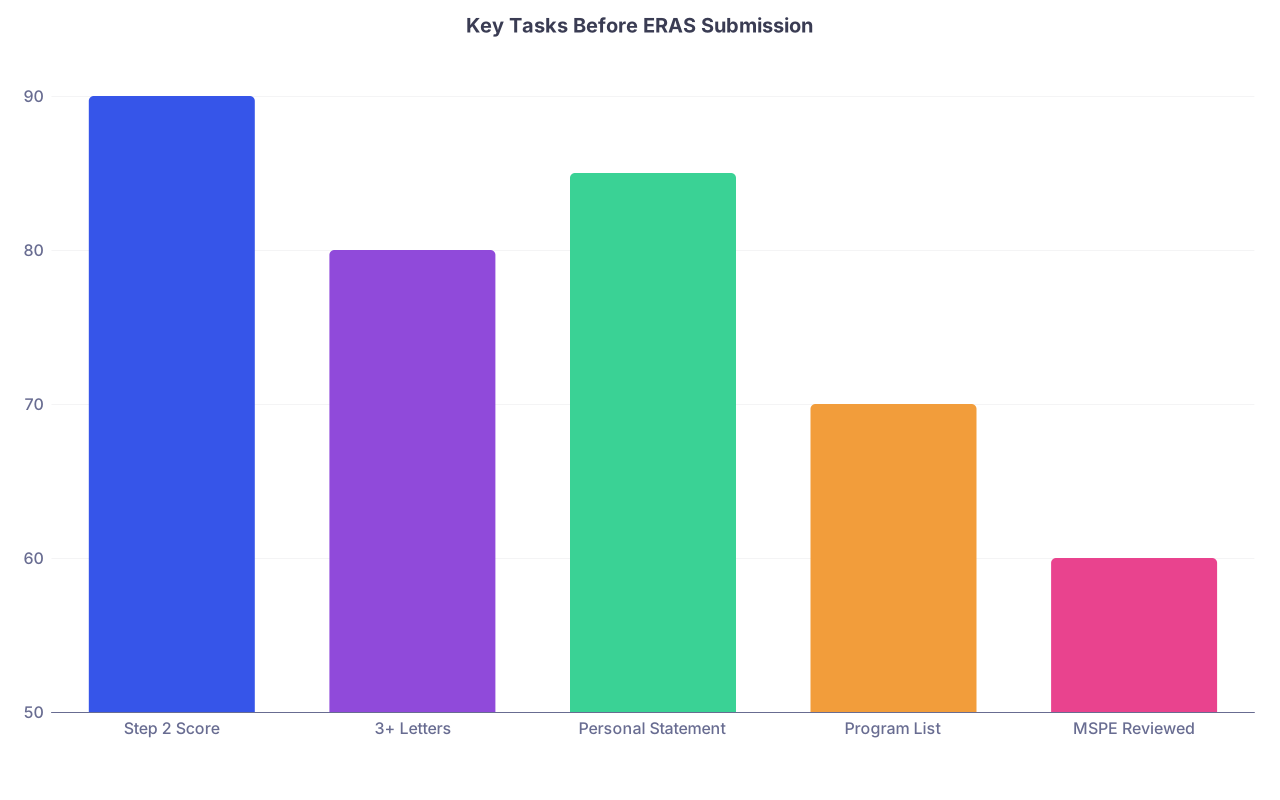
| Category | Value |
|---|---|
| Step 2 Score | 90 |
| 3+ Letters | 80 |
| Personal Statement | 85 |
| Program List | 70 |
| MSPE Reviewed | 60 |
Numbers are “percent of applicants without delays who usually have this done by Sept 1.” You are catching up to that baseline with a handicap. Act like it.
September–October: Apply and Select Rotations Strategically
Once ERAS opens:
- Submit early (mid‑September). With a red flag, you cannot afford to be late.
- Rotations during interview season:
- Do not stack brutal services Oct–Jan. You will need flexibility for interviews.
- Good choices:
- Electives with controllable hours
- Outpatient blocks
- Research time if it keeps you clinically engaged
If you are doing away rotations:
- Aim for:
- One or two max if you have a red flag. Overexposure can hurt if you are not consistently on your game.
- Early in the season (July–September), so letters can arrive in time.
If You’re Delaying a Full Cycle (Year‑Long Plan)
Now the other path. Let us say you failed Step 2 or had a long LOA and decided, correctly, to push your application one full year. This can turn a disastrous cycle into a surprisingly strong one, if you use the time deliberately.
Year −1: Anchor Dates First
At this point you should:
- Decide:
- Your graduation month/year
- Your ERAS application year (e.g., graduate May 2026, apply September 2026)
- Fix on calendar:
- Step 2 CK date (if not passed yet)
- Step 3 (for some IM/FM/psych, having Step 3 before interview can help with red flags, but do not over-prioritize it if Step 2 is weak)
- At least 2–3 core high‑impact rotations in the 6–9 months before ERAS
Months 1–3: Clean Up Exams
Sequence here is non‑negotiable:
Stabilize and pass all required board exams
- Your priority is to show:
- No repeat failures
- Clear improvement
- If you failed Step 1:
- Pass Step 2 with a clearly higher percentile
- If you failed Step 2:
- Retake with ruthless preparation, even if that means a lighter rotation load.
- Your priority is to show:
Choose rotations accordingly
- During the remediation / intense study window:
- Lighter clinical obligations
- Shorter commute if possible
- After passing:
- Gradually increase responsibility: sub‑I, ICU, specialty electives
- During the remediation / intense study window:
You are building a “post‑failure performance block” that programs can easily see and interpret: “After this date, everything is stable and strong.”
Months 4–6: Build a Post‑Red‑Flag Track Record
These are your money months.
At this point you should:
Schedule:
- 1–2 sub‑Is in your target specialty or core field (medicine, surgery, etc.)
- 1–2 rotations with known good letter writers
On these rotations:
- Be boringly reliable. Zero late arrivals, zero missed notes.
- Volunteer for cases, but do not be chaotic. Attendings remember the student who quietly handled the difficult family meeting more than the one who begged to scrub every case.
Parallel track:
- Start small scholarly work if feasible:
- Case report with attending
- Poster with department
- This is not about building a research empire. It is about showing engagement and maturity post‑setback.
- Start small scholarly work if feasible:
Months 7–9: Prepare Application Materials Early
Since you bought yourself a year, stop acting like a last‑minute applicant.
By this phase you should:
- Have your Step exams fully done
- Have 2 letters already written or committed
- Draft your personal statement that honestly frames your red flag
Key move here: timing the story.
- You want enough distance between the red flag and your application that:
- The “recent you” looks obviously different.
- Your letters can say: “In the time I have known them after [event], they have consistently performed at the level of our strongest students.”
If your LOA or failure just happened 3 months before applying, that narrative is weak. Twelve months later, with clean performance, the story becomes believable.
Months 10–12: Launch a Clean, Structured Application
Final pre‑ERAS quarter:
Polish:
- CV (clearly separate pre‑ and post‑event periods)
- Personal statement
- Program list (aimed realistically at places with a track record of taking “non‑traditional” or reapplicant candidates)
Consider:
- Step 3 (mainly if:
- You are going for IM/FM/psych and
- Your earlier Steps were marginal and
- You can score clearly higher without compromising rotations)
- Step 3 (mainly if:
Plan rotations during interview season:
- Prefer flexible schedules
- Try to keep at least 1 day per week that can be moved or swapped
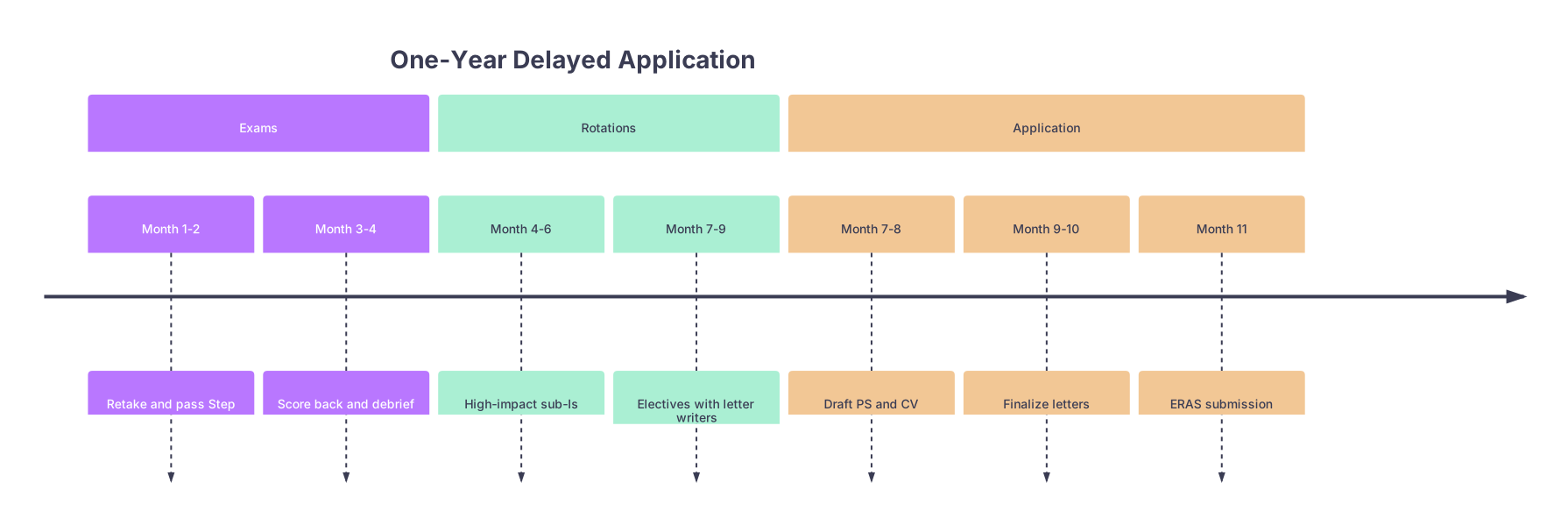
| Period | Event |
|---|---|
| Exams - Month 1-2 | Retake and pass Step |
| Exams - Month 3-4 | Score back and debrief |
| Rotations - Month 4-6 | High-impact sub-Is |
| Rotations - Month 7-9 | Electives with letter writers |
| Application - Month 7-8 | Draft PS and CV |
| Application - Month 9-10 | Finalize letters |
| Application - Month 11 | ERAS submission |
How to Sequence Rotations When You Have a Red Flag
Whether you stay on-cycle or delay, rotation order matters a lot more for you than for the student with straight honors and 250+ scores.
General priority order
- Rotations that generate strong letters
- Rotations in your target specialty / core discipline
- Rotations that show reliability and maturity post‑event
- Everything else (interesting electives, “fun” blocks)
Practical sequencing rules:
Do not:
- Put a brutal, high‑stakes rotation immediately before a major exam retake.
- Stack multiple “letter‑critical” rotations back‑to‑back if you are not fully recovered emotionally or academically.
Do:
- Front‑load at least one strong home rotation after your performance has stabilized.
- Space out high‑stakes blocks by at least 1 month of lighter work or outpatient time.
An example layout for someone applying this coming September after a Step 1 failure in February:
- March–April: Dedicated study + light elective
- Late April: Step 1 retake
- May–June: Medicine sub‑I (letter #1)
- July: Target specialty elective (letter #2)
- August: Outpatient elective + ERAS prep
- September–October: Flexible electives / research (interviews begin)
Instead of trying to prove yourself while still panicked and mid‑remediation, you build a clear “recovery phase” first.
How To Address the Red Flag in Your Application (Timing Matters)
Sequencing is not just calendars. It is when and where you explain what happened.
At this point — once your timeline is set and exams/rotations slotted — you should:
Decide where to explain
- Personal statement
- Secondary / supplemental questions
- Dean’s letter only
- Rarely: during interviews only (this is usually too late)
Align your explanation with your chronology
- If your failure or LOA is recent and there is minimal evidence of recovery:
- Keep the explanation brief and factual.
- Focus heavily on what you are doing now to mitigate it.
- If you have 6–12+ months of improved performance:
- You can frame the event as a pivot point.
- Then let your recent rotations, scores, and letters carry the argument.
- If your failure or LOA is recent and there is minimal evidence of recovery:
Programs do not just read your explanation. They cross‑check it against your sequence:
- You said you learned to manage time better?
- Does your record show missed exams or late rotations after that?
- You said health issues are resolved?
- Are there new gaps or erratic performance in the last 6 months?
Your sequencing must make the story believable.
During Application Season: Weekly Priorities
Once you have actually submitted ERAS:
Week 1–2 after submission
At this point you should:
- Confirm:
- All exam scores uploaded
- All letters received or pending with clear dates
- Send:
- Targeted emails to key programs only if:
- You have a genuine connection (home program, regional tie)
- You can succinctly contextualize your red flag and recent upgrades
- Targeted emails to key programs only if:
Interview months (October–January)
Each week:
Maintain:
- Acceptable performance on your current rotation
- Reliable appearance at interviews (no rescheduling chaos)
Prepare:
- A clean, 60–90 second explanation of:
- What happened
- What you changed
- What your last year looks like now
- A clean, 60–90 second explanation of:
Do not overconfess. Do not under-explain. Calm, factual, and aligned with your transcript.
FAQ (Exactly 2 Questions)
1. If I failed Step 1, should I delay until I have my Step 2 CK score before applying?
If Step 1 is your only red flag and you can realistically take Step 2 CK by early July with several weeks of real preparation, I recommend you wait for the Step 2 score before applying. Programs are far more forgiving of a Step 1 fail followed by a strong Step 2 than of a pending Step 2 with a failure on record. What you must not do is rush Step 2 just to get it on the transcript; a second mediocre score is worse than a later, clearly improved one.
2. Is taking a leave of absence always a red flag that requires delaying my application a full year?
No. Short, well‑explained LOAs with solid performance before and after do not automatically demand a full‑year delay. The LOAs that push you into “delay the cycle” territory are: multiple leaves, vague or poorly documented reasons, or leaves immediately followed by exam failures or weak clinical performance. If you can show 6–12 months of strong, uninterrupted work post‑LOA before your ERAS submission, you can usually stay on‑cycle. If not, the extra year gives you the chance to build that clean post‑LOA track record.
Key points to leave with:
- Decide early whether you are staying in the same cycle or delaying a year. Everything else depends on that call.
- Sequence exams first, then high‑impact rotations, then everything else. Do not cram big exams and big rotations together.
- Your “recovery phase” must be clearly visible on your timeline. Programs believe stories when the calendar backs them up.