
LOA Decision Point: Timing Your Leave to Minimize Match Impact
It is late February of your third year. You are exhausted, your evaluations are slipping from “excellent” to “meets expectations,” and your PCP just used the words “major depressive episode.”
You are also staring at the ERAS timeline in your email:
- June: ERAS opens
- September: Programs get applications
- October–January: Interviews
And now you are asking the right question: If I take a leave of absence (LOA), when do I do it so it does not torch my Match chances?
Let us walk this out chronologically. Because with LOAs, timing is not a detail. It is the entire game.
Big Picture: How Programs Actually See an LOA
At this point, you need to understand how your LOA will show up on paper.
Programs will see an LOA in three main places:
- Your MSPE (Dean’s Letter) – explicit statement of leave dates and sometimes reason category
- Your transcript – gap in course/rotation dates
- Your ERAS experiences / personal statement – if you choose to explain it
What they care about:
- Timing: Did you vanish during core clerkships? In the middle of interview season?
- Duration: A 4-week medical LOA reads very differently than an 18-month “career exploration” pause.
- Trajectory: Did you come back and crush things, or limp to the finish line?
So your goal: Time your leave so that (1) your story is coherent, (2) your performance after return is strong, and (3) you avoid disappearing in the middle of the application cycle.
Now the timeline.
18–12 Months Before Match: Early Third Year – Highest Flexibility
You are early MS3, just starting or midway through core clerkships. The Match you care about is next academic year.
At this point, you have the maximum freedom to take a leave with minimal Match damage if handled correctly.
If You Are 18–15 Months Pre‑Match (Early MS3)
This is the safest “red flag” window.
If you need an LOA now for:
- Medical illness (physical or mental)
- Major family crisis
- Pregnancy / postpartum recovery
- Burnout that is clearly impairing performance
At this point, you should:
Pause before the collapse.
Do not wait until you fail a shelf or get written up. A clean record + early LOA looks smart and proactive. A pattern of marginal performance + late LOA looks like avoidance.Talk to three people in this order in the same week:
- Your physician / therapist – to define what you actually need
- Student affairs / Dean of Students – to understand official LOA options and transcript impact
- A trusted advisor in your intended specialty – to sanity-check timing
Decide the LOA type and duration as cleanly as possible.
Vague, open-ended LOAs look worse than a clear 3–6 month medical leave with a documented return.Aim to finish core clerkships on either side of the LOA, not split them awkwardly.
Example:- Bad: Start Internal Medicine, take LOA 2 weeks in, return 4 months later mid-rotation.
- Better: Complete IM. Then take LOA before starting Surgery.
From a program’s perspective:
- Early MS3 LOA + solid comeback performance = usually not a dealbreaker.
- If the reason is medical and the narrative is “I was sick, I got treated, I returned, I excelled,” most PDs shrug and move on.
12–9 Months Before Match: Late Third Year – Start Thinking Strategy
You are now late MS3. You are:
- Finishing core clerkships
- Thinking about specialty choice
- Staring at Step 2 / CK timing
- About a year out from Match
Here, timing gets sharper.
If You Need an LOA at This Point
Ask yourself one blunt question:
“Is this LOA going to meaningfully fix my problem before applications go in?”
If yes, you protect your Match by NOT dragging the decision into the application year.
At this point, you should:
Take the leave before you start audition/sub‑internships.
You do not want to show up half-functional on your key letters-of-rec rotations.Plan backward from ERAS opening (June) and application release (September).
You need:- Enough time after LOA to complete at least 1–2 strong sub‑Is
- A good Step 2 score (if you are using it to “rescue” a weak Step 1 or borderline transcript)
- At least 2–3 solid specialty letters
If you are thinking about a 3–4 month LOA, the sweet spot here is:
- Finish key cores by March/April
- LOA: April–July, for example
- Return: July/August for sub‑Is, Step 2, and only then apply in the following cycle
Notice that last part.
Often the smartest move is to push your Match by a year rather than try to squeeze an LOA and a full-speed application into the same 9–12 months.
9–6 Months Before Match: Early Application Year – High-Risk Window
You are now entering or in early MS4:
- ERAS opens in June
- You plan to apply this fall
- You are scheduling sub‑Is, Step 2, and maybe away rotations
This is the most dangerous time to ignore serious issues and “push through.” This is how red flags multiply:
- Poor sub‑I evaluations
- Failed Step 2 or bad Step 2 score
- Unexplained gap in rotations right before applications
If you need an LOA now, you are at a decision fork:
Option A: Short, tightly timed LOA, still apply same year
Option B: Full pause and delay your Match by one cycle
Let me be direct:
For anything beyond a 4–6 week medical LOA with a clear resolution, Option B is usually safer.
If You Try to Apply in the Same Year
At this point, you should:
Avoid vanishing during June–September if you can.
That 3-month block is when:- Programs receive applications
- MSPE is being finalized
- You are supposed to be doing sub‑Is and generating letters
If you must take a short LOA (4–6 weeks), anchor it clearly:
- Finish a strong sub‑I first
- Get at least 1–2 letters in-hand
- Take leave with a documented return date
- Come back before applications actually hit programs (mid-September)
Coordinate your MSPE narrative.
Work with your Dean’s office so your LOA is described factually, briefly, and with an arc of recovery:- “The student took a medical leave from May–July 2025 and returned to full-time clinical duties in August 2025. Subsequent performance has been strong, with honors in sub-internship rotations.”
Protect Step 2.
If you are not in good shape to take Step 2, do not force it into this window. A failed or mediocre score is a far louder red flag than a well-explained brief LOA.
When this works:
- LOA: tightly bounded, clearly for treatment / defined issue
- You return, crush a sub‑I, and your letters say “reliable, improved, excellent team member”
- Your story in interviews: concise, confident, not defensive
When this blows up:
- You try to “tough it out,” tank evals and Step 2, and then take a panicked LOA in September with no return date.
6–3 Months Before Match: Interview Season – Do Not Disappear Lightly
We are in October–December now.
ERAS is out. Invitations are coming (or not). You are rotating, traveling, and barely sleeping.
This is where bad timing turns one LOA into three red flags:
- Mid-interview‑season absence
- Cancelled interviews
- Incomplete rotations and awkward transcript gaps
If you hit a breaking point here, things are already serious. But you still have options.
If You Need an LOA During Interview Season
At this point, you should:
Separate two decisions:
- Your personal health / safety (non-negotiable)
- Whether to continue in this Match cycle
If you are hospitalized, suicidal, or medically unstable:
- Step out. Immediately.
- Ask student affairs to help you:
- Notify programs you are withdrawing from the Match this year
- Coordinate a formal LOA
- Protect your future application (this is salvageable if handled cleanly)
If your situation is serious but potentially manageable: You still need to be ruthless about risk.
Ask:
- “Can I show up as a functional, professional version of myself to interviews?”
- “Will continuing rotations harm my performance and evaluations?”
If the honest answer is no, pausing the cycle is usually less damaging than:
- Showing up disheveled and disengaged to half your interviews
- Collecting mid or negative evaluations on late sub‑Is
If you insist on trying to finish the cycle:
- Narrow interviews to a realistic list you can handle
- Prioritize programs you’d seriously rank
- Consider converting some interviews to virtual if offered
- Be ready to address any gaps or cancelled rotations succinctly later
But let me be blunt: a chaotic, half-completed interview season is a bigger red flag than an intentional step back and reapplication next year with a stable story.
3–0 Months Before Match: Post-Interview to Match Day – Do Not Panic‑Pull
You are between January and March. Interviews are mostly done. Rank lists are coming up.
At this stage, an LOA does not affect your current application much, because:
- Programs have already met you
- Your file is essentially complete
However, it does affect:
- Your performance if you match
- How programs view you if you end up reapplying next year
If You Are Falling Apart After Interviews
At this point, you should:
Avoid impulsively withdrawing from the Match unless safety demands it.
If you can safely complete the year and start residency, there is value in not adding a pre‑residency LOA to your story.If you are borderline functional:
- Talk now with student affairs and your clinician
- You can:
- Finish out the year
- Start residency
- Arrange early support and, if needed, a residency LOA with your future program
- This often reads cleaner than “pulled out of Match in February, re-applied a year later.”
If you absolutely cannot continue:
- You can withdraw from the Match and extend your LOA through graduation timing
- Expect to explain in your next cycle:
- Why you withdrew
- How you are now stable and ready
- What you did in that extra year
How Different LOA Timings Look to Programs
Here’s how the same 4–6 month LOA reads, depending on when it lands.
| LOA Timing | Typical Program Reaction |
|---|---|
| Early MS3, clear medical/family reason, strong return | Mild concern, often neutral if performance post‑LOA is strong |
| Late MS3, then delayed graduation by 1 year with solid post‑LOA work | Noticeable but acceptable, especially with strong Step 2 and sub‑Is |
| Early MS4 with attempt to apply same year, limited recovery time | Higher concern, questions about stability and readiness |
| Mid-interview season with cancelled interviews and scattered communication | Major concern; seen as instability or poor professionalism unless extremely well explained |
| Post-interview, pre-Match LOA with clear medical crisis and documented care | Mixed; more acceptable if subsequent trajectory is stable and strong |
Year‑Long Strategy: If You Already Know You Need an LOA
Sometimes you are not at a single decision point. You already know things are off, and you want to plan the next 12–18 months to both get help and keep your Match viable.
Here is how that can look in a clean, realistic timeline.
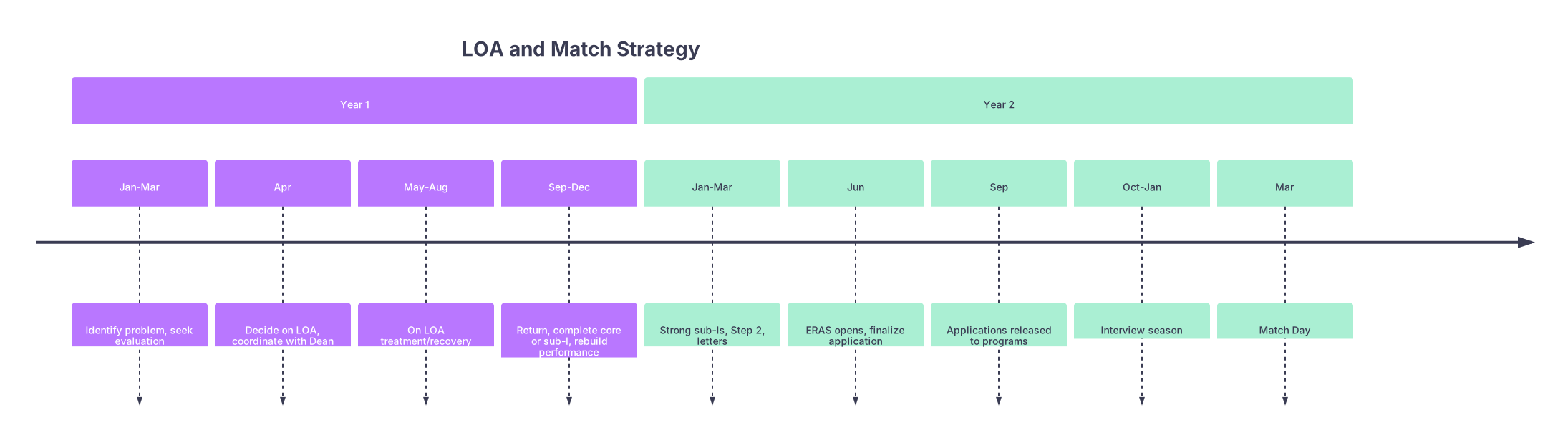
| Period | Event |
|---|---|
| Year 1 - Jan-Mar | Identify problem, seek evaluation |
| Year 1 - Apr | Decide on LOA, coordinate with Dean |
| Year 1 - May-Aug | On LOA treatment/recovery |
| Year 1 - Sep-Dec | Return, complete core or sub-I, rebuild performance |
| Year 2 - Jan-Mar | Strong sub-Is, Step 2, letters |
| Year 2 - Jun | ERAS opens, finalize application |
| Year 2 - Sep | Applications released to programs |
| Year 2 - Oct-Jan | Interview season |
| Year 2 - Mar | Match Day |
At each point in that 2-year arc, your focus shifts:
Month 0–1 (Decision):
Get a diagnosis, choose LOA vs “push through.” Do not stall for 6 months.Months 1–4 (On LOA):
Actually treat the problem. Your future PD can tell when someone took “vacation” vs did real work on their health.Months 4–9 (Return period):
Load up on:- High-quality rotations
- Faculty who can advocate for your comeback
- Objective data (honors, improved comments, good Step 2)
Application Year:
Present the LOA as:- Time-limited
- Addressed
- Followed by sustained strong performance
Common Bad Timelines – And How to Avoid Them
You are trying to avoid patterns I have seen more times than I like.
Pattern 1: The “Slow Slide Then Panic LOA”
- Fall MS3: Struggling quietly, evaluations slide
- Spring MS3: Fails a shelf, still avoids help
- Summer MS4: Starts sub‑I, performs poorly
- August: Panics, takes LOA after bad feedback
- September: No letters, incomplete rotations, unclear return date
This is catastrophic for a competitive Match year.
Fix: Move the LOA up to early MS3 once the slide starts and return with a clean slate.
Pattern 2: The “Apply Anyway” Year
- Needs a 3–4 month LOA early MS4
- Insists on applying the same cycle
- Ends up with:
- Hastily done ERAS
- Weak or missing letters
- Few interviews
- Exhaustion on the trail
Result: No match and now a failed cycle plus an LOA to explain.
Fix: Take the LOA, skip that application year, return with a complete, strong application the following cycle.
How to Talk About Your LOA (Once You Have Timed It)
Timing is half the battle. The other half is the story.
At any point after the LOA, you should be able to explain it in 3 parts, in about 60–90 seconds:
What happened – in broad, honest but non-graphic terms.
- “I developed a significant depressive episode”
- “I had a major orthopedic injury requiring surgery and rehab”
- “A close family member’s terminal illness required my presence”
What you did.
- “I stepped away on a formal leave for X months”
- “I received treatment and ongoing follow-up”
- “I worked with the school and my physician to plan a safe return”
How you are functioning now.
- “Since returning, I have completed all rotations without issues”
- “I honored X and Y sub‑Is and performed well under increased responsibility”
- “I have been stable on treatment and have a plan in place for residency”
You do not need to overshare. But you do need to show that the LOA fits into an arc of maturity and stability, not chronic chaos.
Inline Visual: When LOA Timing Hurts Most
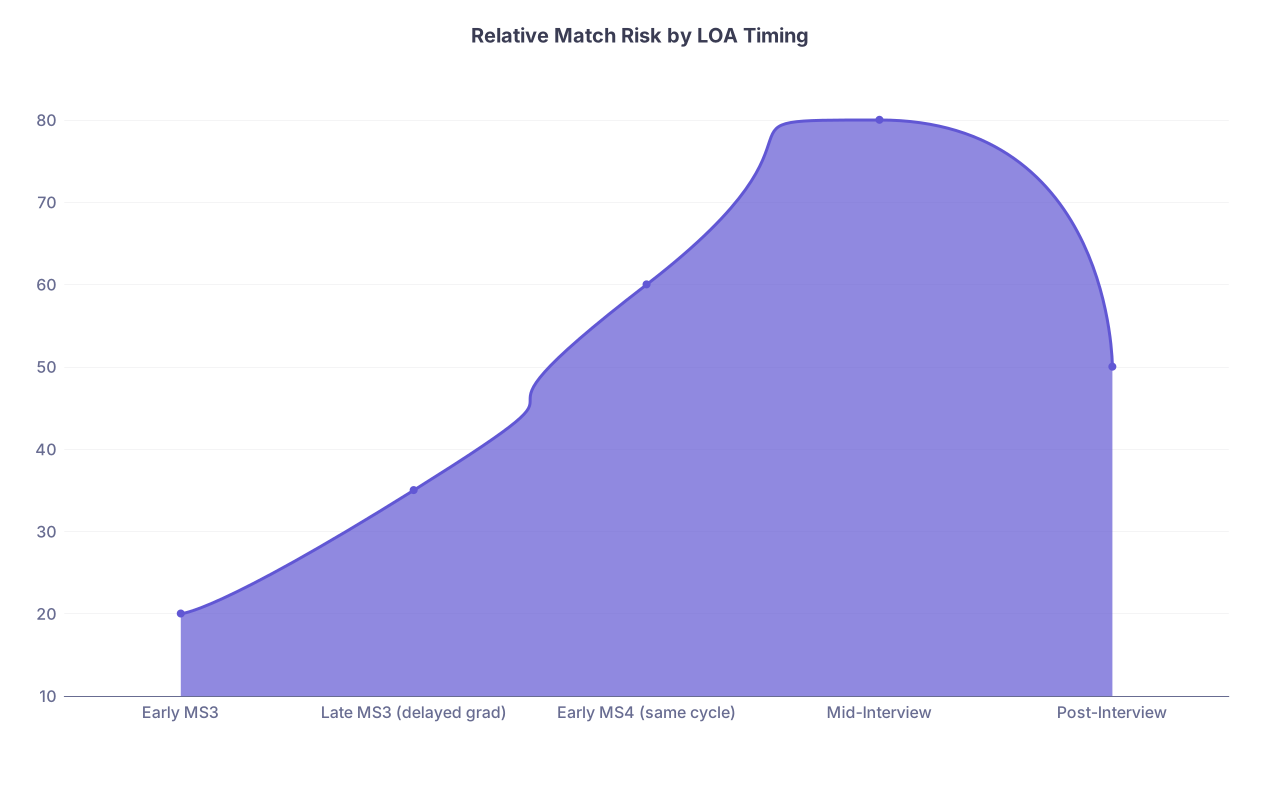
| Category | Value |
|---|---|
| Early MS3 | 20 |
| Late MS3 (delayed grad) | 35 |
| Early MS4 (same cycle) | 60 |
| Mid-Interview | 80 |
| Post-Interview | 50 |
Interpretation:
- Early MS3: lowest relative risk when managed well
- Early MS4 same-cycle LOA and mid-interview LOA: highest perceived risk
- Post-interview LOA: moderate but still significant, depends heavily on subsequent trajectory
Final Takeaways
Three points to leave you with:
Earlier is almost always better. A well-timed LOA in early MS3 with a strong comeback beats a late, panicked withdrawal in MS4 every single time.
Do not stack red flags. If you need an LOA, protect evaluations and board scores. One contained red flag is survivable. Three overlapping ones are not.
Own the narrative. Whatever you do, plan your LOA and your Match as a single, coherent timeline. Your goal is simple: by the time programs see your file, your leave looks like a solved chapter, not an ongoing crisis.