
The worst mistake reapplicants make is drifting. One day it’s March, you “might reapply.” You blink, it’s September, ERAS is due, and nothing actually changed.
This roadmap exists to prevent that.
You’re not starting from zero. You have data: scores, feedback, your interview list (or lack of one). Now you need a relentless, month‑by‑month plan from this March to next February so you do not end up in the exact same spot.
I’ll walk it straight: by each month, what you should be doing, fixing, and finishing.
Big Picture: Your Reapplicant Year At a Glance
At this point you should zoom out and see the whole year before you zoom in.
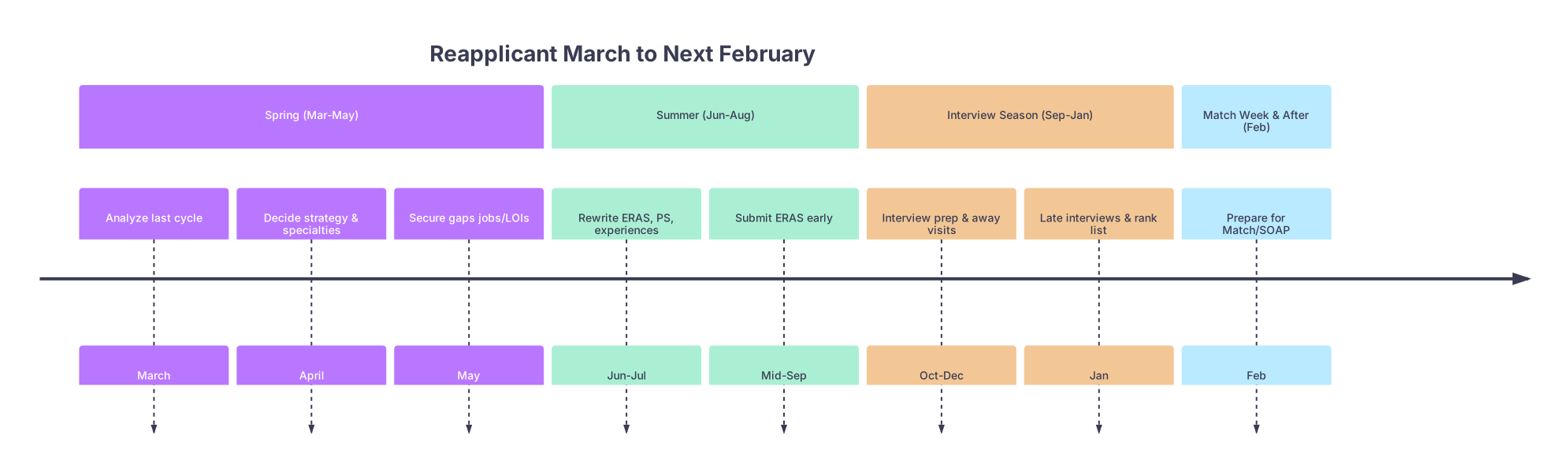
| Period | Event |
|---|---|
| Spring (Mar-May) - Analyze last cycle | March |
| Spring (Mar-May) - Decide strategy & specialties | April |
| Spring (Mar-May) - Secure gaps jobs/LOIs | May |
| Summer (Jun-Aug) - Rewrite ERAS, PS, experiences | Jun-Jul |
| Summer (Jun-Aug) - Submit ERAS early | Mid-Sep |
| Interview Season (Sep-Jan) - Interview prep & away visits | Oct-Dec |
| Interview Season (Sep-Jan) - Late interviews & rank list | Jan |
| Match Week & After (Feb) - Prepare for Match/SOAP | Feb |
You’re working toward three outcomes:
- Fix red flags (failed exams, no interviews, poor letters, unprofessional behavior).
- Show clear improvement (scores, clinical activity, professionalism).
- Make programs trust you can start PGY‑1 tomorrow without being a problem.
Now let’s walk it, month by month.
March: Post‑Match Autopsy and Hard Decisions
At this point you should be brutally honest.
Week 1–2: Do a structured post‑mortem
Sit down with:
- Your ERAS application from last cycle
- Program list (where you applied, where you interviewed)
- Exam history (Step/COMLEX, attempts, dates)
- Any feedback from PDs, advisors, deans
Then classify your situation:
| Profile | Typical Issues |
|---|---|
| Strong on paper, few interviews | Poor personal statement, weak letters, bad program list |
| Multiple exam failures | Hard red flag, needs time and strong narrative |
| IMG with late graduation | Needs fresh US clinical experience, strong advocacy |
| Unmatched with interviews | Interview performance, red flag behavior, weak signals |
| Career switch / gap years | Narrative confusion, lack of current clinical work |
If you’re not sure, ask three people who know residency selection:
- Your home PD or APD
- A trusted faculty mentor
- Dean’s office / student affairs
Do not ask only friends. They’ll be too nice.
Week 3–4: Decide if you should reapply this cycle
At this point you should answer:
- Will I have all exams done (including Step 3 if that’s part of my fix) by September?
- Can I realistically improve my application in the next 6 months?
- Do I need a dedicated year (research, prelim, MPH, etc.) before reapplying?
Red flag reality check:
- Multiple failures, professionalism issues, or very low Step 2 → often better to take a true rebuild year and apply the following cycle.
- No interviews despite decent stats → you probably had strategy and application quality problems. You can fix those by this September if you start now.
If you choose to not apply this coming cycle, still follow this roadmap, but stretch timelines and focus heavier on long-term repair (research year, Step 3, formal remediation).
April: Strategy, Specialty, and Red Flag Plan
At this point you should have decided: yes, I’m reapplying this coming ERAS. Now you design your plan.
Weeks 1–2: Choose or confirm specialty strategy
Ask yourself:
- Am I staying in my original specialty?
- Do I need to pivot to something less competitive?
- Do I need a transitional/prelim year strategy?
Common honest pivots:
- From surgical subspecialty → categorical general surgery / prelim surgery / IM
- From derm/rads/ortho → IM / family / prelim + research
- From EM → IM/FM or transitional year
Do not just “spray and pray” across 5 specialties. That reads desperate.
Weeks 3–4: Build a concrete red‑flag repair plan
Write this out in a document titled “Reapplicant Plan – [Your Name]”. Sections:
- Exam deficits
- Step 1 fail → Plan to take Step 2 early with strong score; possibly Step 3 pre‑ERAS if feasible.
- Low Step 2 → Dedicated study schedule with goal score; consider UWorld reset, NBME benchmarks.
- Clinical gaps
- Schedule USCE (observerships, hands‑on electives, sub‑Is, hospitalist scribe roles).
- Professionalism / communication concerns
- Ask specific faculty for feedback on your behavior, email tone, interview style.
- Consider mock interviews with brutal feedback.
- Letters of recommendation
- Identify 3–4 potential letter writers who’ve actually worked with you recently.
By the end of April you should:
- Know your primary specialty (and any backup).
- Have a written red‑flag repair plan.
- Have started outreach emails for positions (research, clinical jobs, observerships).
May: Secure Positions and Lock in Your Year Structure
At this point you should be locking in where you’ll physically be and what you’ll be doing from June–February.
Weeks 1–2: Lock down your main activity
You want one of these (ordered from best to least ideal for most reapplicants):
- Full‑time clinical job in a teaching hospital
- Research coordinator on an inpatient service
- Hospitalist extender / scribe / clinical associate
- NP/PA support roles where you’re embedded with attendings and residents
- Formal research position with strong PD/PI
- Especially if you’re going for competitive fields or need academic credibility.
- US clinical observership / externship blocks
- For IMGs or graduates with older YOG, you need fresh USCE.
If you already have a prelim year or a non‑categorial PGY‑1: your job is to crush it and collect glowing letters and a PD recommendation.
Weeks 3–4: Confirm letter writers and timelines
By end of May you should have:
- Verbally confirmed at least 2 strong letter writers (“I’d be happy to write you a strong letter.” Anything weaker, be cautious.)
- A plan to earn 1–2 more letters over the summer/fall from current mentors/attendings.
- A draft email ready for July/August requesting letters through ERAS.
Also: clean up your online presence. If any of your red flags were professionalism‑related, PDs do Google. Remove dumb posts.
June: Rewrite Your Application From Scratch
At this point you should be erasing the idea that you’re “tweaking” last year. You’re not. You’re rewriting.
Week 1: Inventory last year’s ERAS
Mark up a printed copy:
- Circle anything generic or cliché in your personal statement.
- Highlight any activity description that doesn’t show impact or maturation.
- Note inconsistencies, typos, or awkward phrasing.
Week 2–3: Draft a new personal statement
You need a reapplicant narrative, not a pity story. Structure:
- Very brief origin of interest in the specialty.
- Concrete examples from your recent experiences (this year, or late med school) showing growth.
- Address red flags directly but concisely if they’re serious (exam fail, leave of absence).
- One tight paragraph: what happened, what you learned, what changed.
- Forward‑looking close: the trainee you are now and the kind of program where you’ll thrive.
Bad: “I didn’t match because the process is competitive.”
Better: “I applied broadly but my application didn’t reflect who I’d become clinically. Over the past year, I’ve…”
Week 4: Rebuild your experiences section
For each significant entry:
- Start with what you actually did, not fluff titles.
- Include numbers and specifics: “Followed 10–15 inpatients daily, pre‑rounded and presented to hospitalist team.”
- Explicitly show growth since last cycle: new responsibilities, leadership, or projects.
By the end of June you should have:
- Full new draft of your personal statement.
- Rewritten experiences with updated roles and responsibilities.
- A clean list of programs you’re considering (initial draft).
July: Scores, MSPE, and Final Polishing
At this point you should be tightening what PDs see first: scores, transcript, and core narrative.
Week 1–2: Exams and transcripts
- If you’re retaking Step 2 or taking Step 3: target score release before mid‑September. Back‑calculate your test date.
- Confirm your school or ECFMG timeline for MSPE and transcript uploads.
- If there was an academic leave / remediation, ensure the language is accurate and you understand how it reads.
Week 3: Final personal statement and activity edits
Send your drafts to:
- One trusted attending in your specialty
- One peer who matched successfully
- Possibly a dean/advisor who has read hundreds of PSs
Incorporate only the feedback that strengthens clarity and authenticity. Do not let 10 people rewrite your voice into generic mush.
Week 4: Program list version 1.0
Use a simple tiering:
- Tier 1: realistic core programs where your stats and profile are solidly in range.
- Tier 2: reach programs, but connected (research ties, geographic link, mentor advocacy).
- Tier 3: safety/backup, including community programs, prelim/TY if part of your plan.
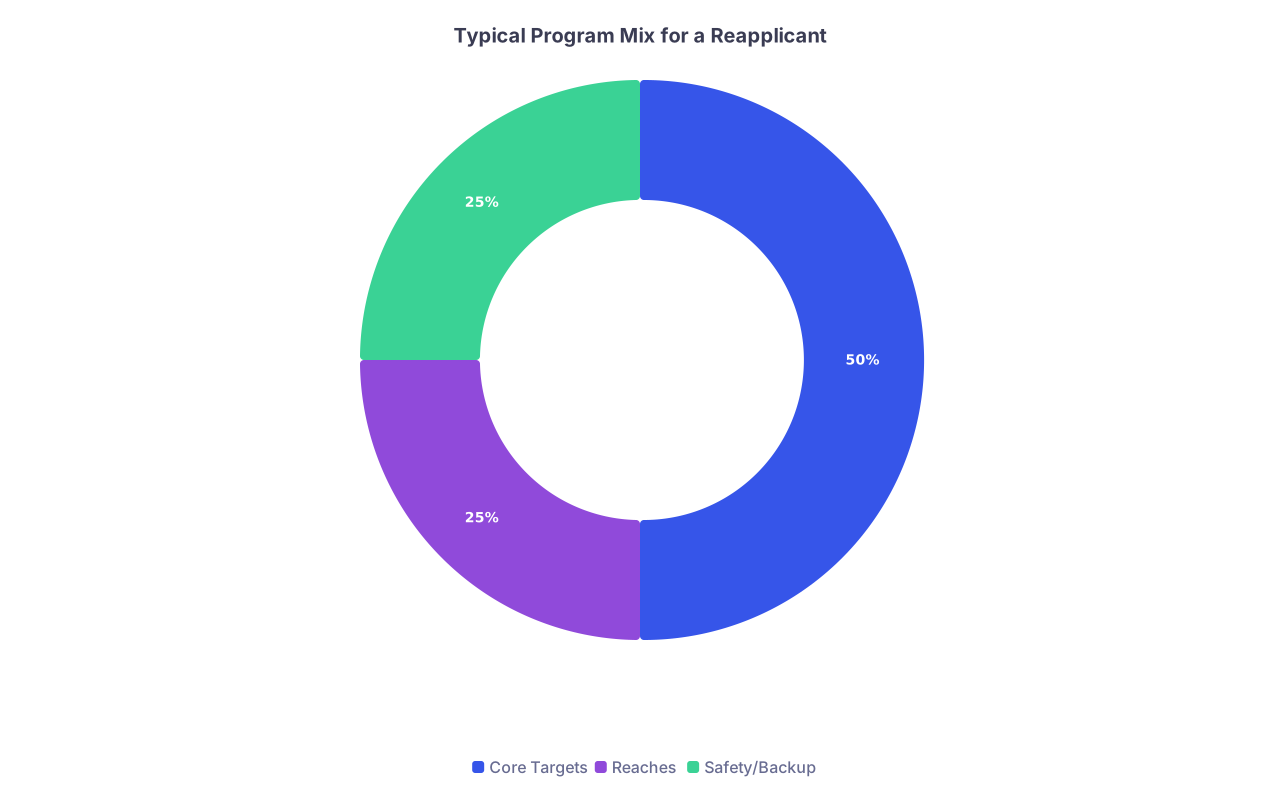
| Category | Value |
|---|---|
| Core Targets | 50 |
| Reaches | 25 |
| Safety/Backup | 25 |
By end of July you should:
- Have no major unanswered questions about your red flags.
- Know your exact exam schedule and score‑release dates.
- Have near‑final personal statement and ERAS content.
August: Letters, ERAS Finalization, and Logistics
At this point you should be in execution mode.
Week 1: Lock in letters
- Remind each letter writer with:
- Your CV
- Draft personal statement
- Last cycle’s summary (what happened, what’s improved)
- Clear instructions and deadline (aim for early September)
You want 3 letters minimum, 4 ideal, and at least 2 specialty‑specific.
Week 2–3: ERAS proofread and red‑flag messaging
- Double‑check:
- Dates align with CV and MSPE
- No unexplained gaps
- “Interrupted medical education” or “leaves” sections are accurate and concise
- For major issues (e.g., prior professionalism concerns), prepare a short supplemental explanation if needed, but do not volunteer drama in every field.
Week 4: Technical and life logistics
- Update email, phone, voicemail greeting (professional, short).
- Set up a simple tracking spreadsheet for:
- Programs applied
- Dates of communication
- Interview offers, rejections
- Arrange flexibility at your job so you can attend interviews (remote or in‑person).
By the last week of August, your ERAS should be ready to submit minus last‑minute tweaks.
September: Submit Smart and Early
At this point you should execute, not still “thinking about it.”
Early September (ERAS opening):
- Submit on or near opening day with:
- Completed experiences
- Final personal statement
- Most letters uploaded (you can add late ones, but don’t wait forever)
- Pay attention to program‑specific requirements (Supplemental ERAS, PS length, specific questions).
Red flags for reapplicants here:
- Waiting weeks after the opening to submit “until everything is perfect.”
- Applying to 100+ random programs with no logic.
Mid–Late September: Targeted outreach
Careful, not spammy.
You might email:
- Programs where you did rotations / observerships
- Programs where your current mentor has a connection
Short email template:
- Who you are, where you trained
- That you’re a reapplicant with clear improvements (1–2 concrete examples)
- Your current role (clinical/research)
- Brief expression of interest with one specific reason for that program
No attachments unless they request. No life story. They don’t have time.
October–November: Interview Season and Damage Control
At this point you should be in interview + continuous improvement mode.
Ongoing: Monitor invites and adjust
- Track where invitations are coming from.
- If you see a complete drought by early November:
- Re‑examine your program list.
- Ask a trusted mentor to review your ERAS and PS again.
- Consider a modest second wave of applications to additional realistic programs.
Interview prep (week by week)
- Do mock interviews focusing on:
- Red‑flag questions: “Tell me about your failed exam,” “Why didn’t you match?”
- Communication and professionalism: do you sound bitter, evasive, or defensive?
- Build tight, rehearsed narratives:
- 60–90 second “tell me about yourself”
- Clear, non‑dramatic summary of why you’re a reapplicant and what’s changed
If you had prior feedback about being awkward, arrogant, or too quiet, this is where you fix it. I’ve seen applications rescued solely by a dramatic improvement in interview presence.
December: Late Interviews and Future‑Proofing
At this point you should be doing two things in parallel: finishing interviews and preparing in case you under‑match or don’t match.
Early December: Finish strong on interviews
- Do not relax your prep just because you’ve already had several.
- Send short, specific thank‑you emails within 24–48 hours if appropriate in your specialty.
Mid–Late December: Contingency planning
Quietly, in the background:
- Update a SOAP‑ready CV and short personal statement variant.
- Keep your clinical or research supervisors aware that:
- You may need rapid letters or updated notes in February.
- You may need to extend your current position if you don’t match.
You’re not assuming failure. You’re preventing panic.
January: Rank List Strategy and Final Signals
At this point you should be converting interviews into a sane rank list.
Week 1–2: Build your preliminary rank list
Core principles for reapplicants:
- Rank every program where you’d be willing to train. Strategic under‑ranking is how people go unmatched with 10+ interviews.
- Do not try to “game” the algorithm with weird ordering based on who seems most interested.
- Give extra weight to:
- Places where you felt comfortable and supported.
- Programs where PDs addressed your red flags with understanding and a plan.
Week 3–4: Final communication
If your specialty tolerates it (varies a lot):
- You may send a single, clear “top choice” note to one program.
- Any additional updates should be:
- Concrete (new manuscript accepted, new leadership role, improved exam result)
- Brief and respectful
Do not pester programs with multiple “You’re in my top three” emails. That looks non‑trustworthy.
February: Match Week Readiness and Next Steps
By this point you should be emotionally and logistically ready for both outcomes: matching and not matching.
Early February: SOAP and backup plan dialed in
Prepare:
- A SOAP‑formatted personal statement (shorter, very direct).
- Updated CV with all recent months of work.
- Contact information for letter writers who can respond quickly.
If your red flags are serious, SOAP might actually be where a program willing to take a chance on you appears. But you need to be ready, not scrambling.
Match Week (mid‑March, but prep starts now)
Even though it’s slightly beyond February, you need February to:
- Understand SOAP rules and timelines for your specialty and status (US grad vs IMG).
- Coordinate with your current employer for potential sudden schedule changes (starting residency vs extending job).
Key Milestones to Remember
- March–May is your rebuild design window. You identify what went wrong, choose your specialty path, and secure the clinical or research role that will define your year.
- June–September is your execution core. Rewrite ERAS from scratch, address red flags directly but briefly, and submit early with a smart, realistic list.
- October–February is about conversion and contingency. Improve your interviewing, build a rational rank list, and quietly prepare a safety plan in case you do not match again.
Follow the timeline, month by month, and you stop drifting. You start showing programs exactly what they want from a reapplicant: growth, insight, and proof you’re ready right now.