
It's the last week of March. Your phone just buzzed with friends posting Match Day photos in short white coats and blowing confetti cannons. You’re staring at an email that says “We are sorry to inform you…” or “You did not match.”
You feel sick. Then numb. Then the thought hits: now what?
This guide is for the next 12 months. How to turn a match failure into a productive gap year instead of a slow-motion train wreck. Month-by-month. With specific “at this point you should…” checkpoints so you are not drifting.
Big Picture: What This Year Actually Needs To Do
Before we zoom into months, set the mission. This gap year has 4 jobs:
- Fix or offset red flags
- Make you clinically relevant, not rusty
- Generate strong, recent, specific letters
- Rebuild your story so PDs believe you belong in residency
Most people screw this up by doing “a little of everything” and nothing well. You can’t afford that. You need a focused plan.
Here’s the arc we’ll follow:
- March–April: Triage, reality check, alternate plans
- May–June: Lock in your main gap year role(s)
- July–September: Execute, build capital (LORs, projects, skills)
- October–December: Application, interviews, adjust strategy
- January–Match Week: Close-out, back-up plans, mental prep
You can shift a month or two based on your calendar, but the sequence should stay.
March–April: Triage and Brutal Honesty
You’ve just failed to match (or SOAP didn’t work). This is the shock phase. You don’t get to stay here long.
Week 1–2: Get Your Data, Not Just Feelings
At this point you should:
Pull your full application:
- ERAS PDF
- Personal statement
- LOR list and who wrote what
- Score report(s) and transcript
- Programs you applied to
Identify obvious red flags (be ruthless):
- Any USMLE/COMLEX fail or low score
- Extended time to graduate
- LOA, professionalism issues, remediation
- Very weak or generic letters (you often know)
- Extremely late Step 2, or no Step 2 when specialty expects it
- Low interview-to-application ratio (e.g., 80 apps → 2 interviews)
You’re not guessing here. You’re building a problem list like you would for a patient.
| Red Flag | Gap Year Focus |
|---|---|
| USMLE/COMLEX fail | Strong retake + explanation |
| Few or no interviews | Broaden specialty/programs |
| Weak/old letters | New letters from this year |
| Minimal clinical in target | Sub-I/observership/research |
| Communication/professionalism | Direct mentorship + feedback |
Week 2–3: Get External Eyes
At this point you should:
- Set up 2–3 real feedback sessions:
- Your dean or student affairs
- A faculty member in your target specialty
- If possible, a program director (even a community PD)
Ask them explicit questions:
- “If you had this application in your pile, why would you not interview this person?”
- “If I have one year, what would move the needle the most?”
- “Would you reapply in the same specialty if you were me?”
If you come out of these meetings with only vague advice (“just keep trying”), you didn’t push hard enough.
Week 3–4: Decide on Specialty Strategy
Now you need to commit to a direction. Waffling here wastes months.
At this point you should:
- Decide which of these you are:
- Reapply same specialty, same level of competitiveness
- Reapply same specialty, but much broader programs (community, new programs, different states)
- Switch to a less competitive specialty
- Switch completely and aim for prelim/TY spot plus long-term pivot
If you had:
- Zero interviews
- Big score issues
- Or a specialty like ortho/derm/ENT with mediocre stats
…you probably need option 3 or 4. Not always, but usually.
May–June: Lock In Your Gap Year Structure
By now, the shock is over. This is planning and job-hunting season.
Your goals for this period:
- Anchor yourself in 1–2 primary roles
- Start addressing red flags in a tangible way
- Stay clinically adjacent
What Your Gap Year Needs On Your CV
At this point you should be aiming to lock down at least one of these (two is ideal, if they fit):
Clinical role (strongest)
- Research fellow with clinic time
- Clinical instructor / junior faculty (some IMGs)
- Full-time clinical assistant/scribe with one supervising attending
- Postgraduate year as a non-resident (“house officer”, “junior doctor” role in some systems)
Research role in your specialty (or new specialty)
- 1-year research fellowship tied to an academic department
- Paid research coordinator job with consistent attending interaction
Teaching/education role
- Anatomy/clinical skills instructor
- Small-group facilitator
- OSCE/standardized patient program support
Pure online course work and random part-time jobs do not fix red flags. They’re fillers at best.
How to Actually Get These Roles (Fast)
At this point you should:
Email specific attendings/PDs, not generic HR:
- Subject: “Unmatched 2026 graduate seeking gap-year role in [Specialty]”
- Attach CV + brief 1-paragraph summary of your situation and what you’re looking for
- Offer value: “Available full-time, willing to take call, data-savvy, can manage REDCap, etc.”
Ask:
- “Do you have room for a research assistant/fellow, even if funding is limited?”
- “Is there a need for a full-time scribe/clinical assistant in your clinic?”
- “Could I help with med student teaching, OSCEs, or curriculum projects?”
Send a lot of these. 20–30+ is not crazy. The bottleneck is usually not your talent; it’s bandwidth and money on their side.
July–September: Execution Phase – Building Real Capital
By now you should be starting your gap-year roles. This is the phase where people either build a killer narrative or just “stay busy.” Your choice.
Month 1 in New Role (July-ish): Make Yourself Unavoidable
At this point you should:
Meet your direct supervisors and ask 3 questions:
- “What are the department’s top 2–3 priorities right now?”
- “How can someone in my position be most helpful?”
- “If things go well, would you be comfortable writing a strong letter by October?”
Get on:
- One longitudinal project (paper, QI, curriculum, etc.)
- One fast-win project (abstract, case report, poster, workflow improvement)
Track your work in a simple log:
- Dates, tasks, outcomes
- Names of faculty you work closely with
- Any measurable impact (RVUs, time savings, fewer errors, etc.)
You’re not just punching a clock. You’re building the bullet points that will go into your next ERAS.
August: Plug the Specific Red Flags
Now you’re in rhythm. This is where you target your main issues.
At this point you should:
If exams were your red flag:
- Register and schedule USMLE/COMLEX retake if applicable and allowed
- Set a 3–4 month study plan that coexists with your job
- Use NBME/UWSA exams and track progress objectively
If lack of clinical exposure was the issue:
- Push for more clinic time, more responsibility, more patient contact
- Ask to:
- Pre-round with residents
- Help with documentation
- Present literature in rounds or teaching conferences
If professionalism/communication was questioned:
- Ask a trusted attending to observe and give direct feedback
- Document improvements and request that they mention it in your letter
September: Start Rebuilding Your Application Spine
You can’t wait until ERAS opens to start thinking about your story.
At this point you should:
Draft a new personal statement with a different spine:
- Acknowledge the gap year directly
- Briefly, factually address any failure (Exam fail, no match) without self-pity
- Emphasize what you did about it: “I spent this year in X role, where I…”
Update CV with:
- Official titles, start dates
- Clear descriptions that highlight:
- Patient care
- Responsibility
- Initiative
Identify your 3–4 target letter writers:
- Aim for at least 2 letters from this gap year
- Each should be able to say: “I supervised them consistently over months.”
Drop a reminder: “I’ll likely ask for a letter in October; is that something you’d feel comfortable doing if things continue as they are?”
October–December: Application, Interviews, and Live Adjustments
This is where everything comes together. Or falls apart. Depends on how intentional you’ve been.
October: ERAS and LORs
At this point you should:
Have ERAS basically ready to submit:
- Updated experiences with strong, specific bullet points
- New personal statement tailored to:
- Specialty A
- Or Specialty A and B if dual-applying (each with its own PS)
Secure letters:
- Politely remind letter writers with:
- Your updated CV
- Personal statement
- A short summary of key things you hope they can highlight
- Politely remind letter writers with:
Explicitly address red flags in:
- MSPE addendum (if school will support)
- Personal statement paragraph
- Or in an “additional information” box if available
Be direct, short, and accountable: “I failed Step 1 on my first attempt due to poor study strategy and overcommitment. Since then, I passed Step 1 and Step 2 on first attempt, scored X on my retake, completed Y hours in [role], and received strong evaluations from [faculty].”
November–December: Interview Season (If They Come)
If interviews roll in, your job changes slightly.
At this point you should:
Prepare a tight 60–90 second story for:
- “So, you didn’t match. Tell me what happened.”
- Structure:
- What happened (brief, factual)
- What you did about it (actions, not feelings)
- Why you’re stronger now (specific examples)
Keep working your gap-year job hard:
- Programs sometimes call your current supervisors
- You’ll need updated anecdotes: “Just this month I was involved in…”
If interviews are not coming by mid-December, don’t just watch the calendar.
At this point you should also:
Email programs where you have a real connection:
- Prior rotation, same medical school, same research network
- Brief email: updated CV, 1–2 line summary of your gap year, sincere interest
Talk to your faculty:
- “Are there programs you’d feel comfortable contacting on my behalf?”
January–Match Week: Contingencies and Mental Game
Last stretch. A lot is out of your control now, but not everything.
January–February: Keep Your Foot on the Gas
At this point you should:
Maintain performance in your role:
- Don’t emotionally check out “because interview season is over”
- Keep adding tangible outcomes:
- Submissions
- Teaching evaluations
- QI project milestones
Prepare for both outcomes:
- If I match: how do I transition smoothly?
- If I do not match again: what’s my next pivot?
Around early February, have a brutally honest check-in with:
- Yourself
- A trusted mentor or PD
- Possibly your dean
Ask: “If I don’t match this cycle, should I reapply again or change direction?” Better to face this early than spiral in March.
Match Week: If You Don’t Match (Again)
You’re not planning for this, but you should be ready.
At this point you should:
- Engage fully with SOAP (if eligible)
- Keep your current supervisors in the loop:
- They may know unadvertised prelim or off-cycle positions
If you remain unmatched after SOAP:
- Decide:
- Do I extend current role?
- Add more clinical (e.g., move from research-heavy to clinic-heavy)?
- Reconsider specialty or even alternative career paths?
I’ve seen people match on the second or even third try. It’s not fun. But it’s possible if each year looks different and stronger, not like a stuck record.
Visual Timeline: One-Year Gap Plan
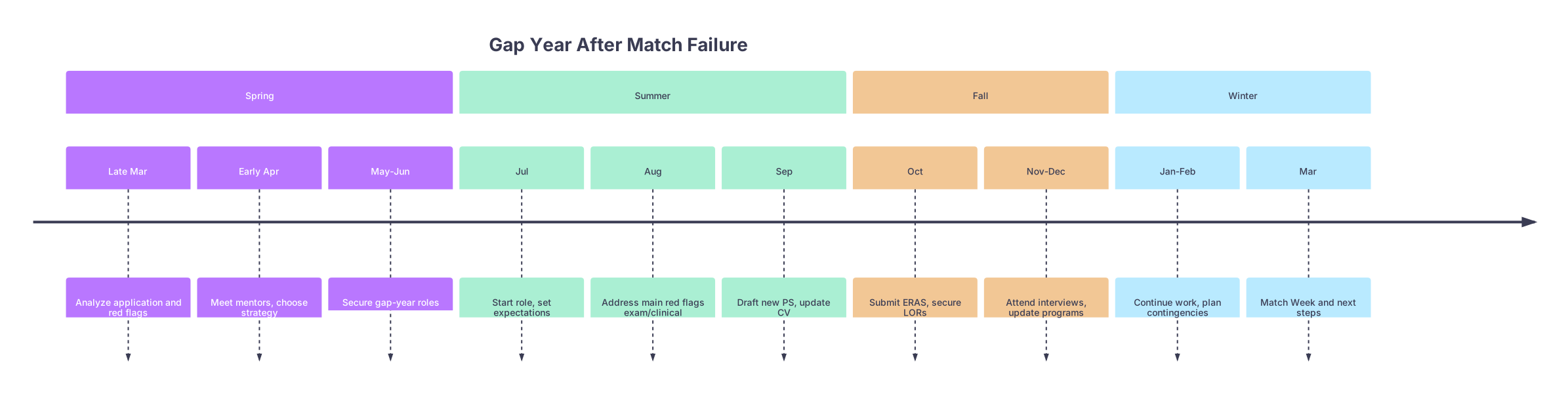
| Period | Event |
|---|---|
| Spring - Late Mar | Analyze application and red flags |
| Spring - Early Apr | Meet mentors, choose strategy |
| Spring - May-Jun | Secure gap-year roles |
| Summer - Jul | Start role, set expectations |
| Summer - Aug | Address main red flags exam/clinical |
| Summer - Sep | Draft new PS, update CV |
| Fall - Oct | Submit ERAS, secure LORs |
| Fall - Nov-Dec | Attend interviews, update programs |
| Winter - Jan-Feb | Continue work, plan contingencies |
| Winter - Mar | Match Week and next steps |
Example Weekly Structure (Execution Phase)
During your core gap-year months (July–December), your weeks should not be a blur. Here’s a simple structure.
| Day | Focus Area |
|---|---|
| Mon–Thu | Primary role (clinic/research/teaching) |
| Fri AM | Project time (QI, manuscript, PS edits) |
| Fri PM | Study (if exam retake) |
| Sat (half) | Study or scholarly work |
| Sun | Rest + 1–2 hours planning |
Quick Chart: Where Your Time Should Go
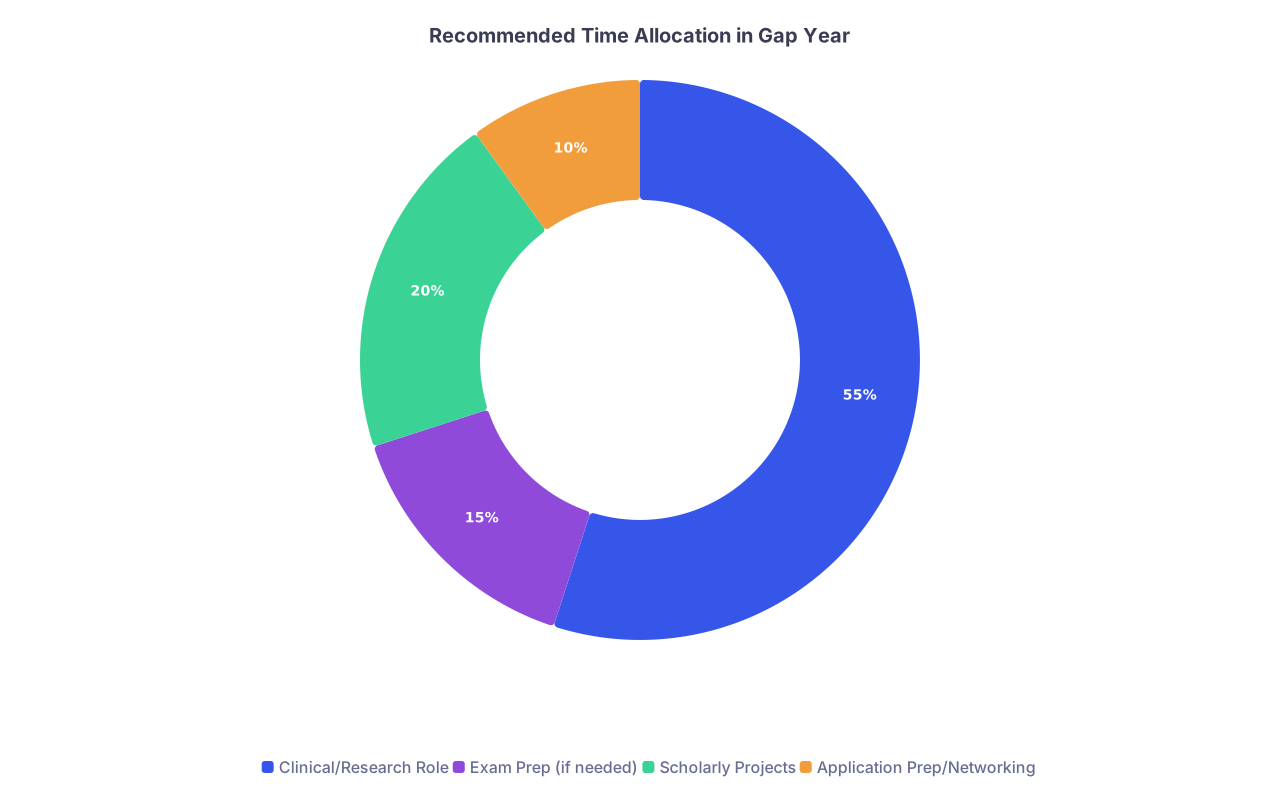
| Category | Value |
|---|---|
| Clinical/Research Role | 55 |
| Exam Prep (if needed) | 15 |
| Scholarly Projects | 20 |
| Application Prep/Networking | 10 |
FAQ (Exactly 4 Questions)
1. Should I tell programs directly that I failed to match?
Yes. They will see your history anyway. You look worse if you try to hide it. Briefly acknowledge the non-match or exam failure, then spend most of your time on what you learned and what you did to improve. One paragraph in the personal statement and a confident, concise answer in interviews are enough.
2. Is pure research (no clinic) a good gap-year option after a non-match?
It depends on your red flags. If your main issue was lack of research or academic engagement in a competitive specialty, it can help. But if programs were worried about clinical readiness or you’ve already been away from patient care for a while, then a pure desk-research job just makes you look more distant from the bedside. In that case, fight for at least some clinical exposure.
3. How many times is it reasonable to reapply after not matching?
Twice is common; beyond that, you need a very compelling story and major changes each cycle. If you’ve applied 3 times in the same specialty with minimal movement, that’s usually a signal to pivot—either to a less competitive specialty, a different type of program (e.g., prelim, community), or a non-residency career path. Don’t treat infinite reapplication as a strategy.
4. Does a gap year automatically look bad on my residency application?
No. A blank gap year looks bad. A productive, clearly structured year with strong letters, concrete outcomes, and a believable growth story can actually make you more attractive than some straight-through applicants. I’ve seen unmatched graduates come back with a focused, high-yield gap year and match into solid programs. The key is intentionality, not just time.
Key Takeaways
- Treat your non-match like a clinical case: define the problem list, target the biggest issues, and measure progress.
- Structure the year around real roles—clinical, research, teaching—that generate new, strong letters and a clear growth story.
- Every few months, ask: “Would this version of me be an obvious upgrade over my last application?” If the answer is no, adjust now—not next March.