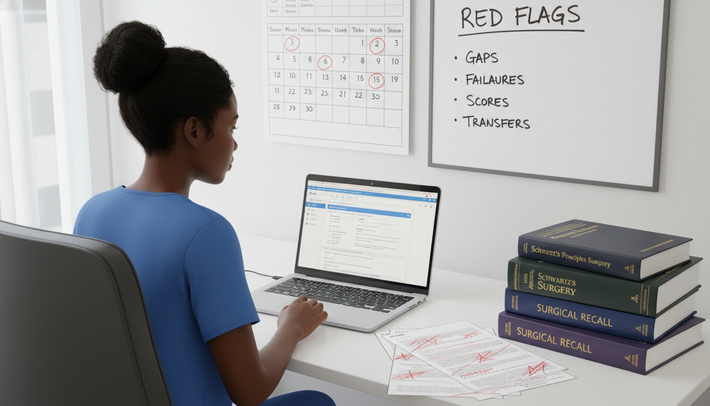
Program directors don’t trust you.
They verify you.
You’d be shocked how much of your “story” gets quietly checked behind the scenes. The coordinator who “just wanted to confirm your Step date.” The faculty member who “happened” to know someone at your school. The PD who calls a colleague at 6:45 a.m. on the drive in: “Hey, what’s the real deal with this applicant?”
Let me walk you through how it actually works when there’s a red flag on your residency application—and how PDs quietly backchannel to verify it.
The Trigger: What Actually Makes PDs Start Digging
PDs don’t have time to investigate every file. They dig when something smells off. And they’re very good at noticing when something doesn’t line up.
The usual triggers:
- Failed or multiple attempts on Step 1/2
- Long unexplained gaps in training
- Transfers between med schools or between residency programs
- “Extended” graduation with fuzzy explanations
- MSPR/Dean’s Letter language that’s clearly sanitized
- Unusual professionalism comments on evaluations
- Massive discrepancy between your personal statement and your letters
- A letter from someone “important” that feels oddly generic or faint-praise
Most of the time they don’t say, “We think you’re lying.” They say, “Let’s get more context.” But everyone in that room knows what’s going on.
There’s one phrase I’ve heard from multiple PDs:
“If I have to wonder what’s missing, I’ll find out.”
And they usually do.
The First Line of Defense: Internal Pattern Recognition
Before anyone picks up a phone, PDs and coordinators use pattern recognition and internal chatter. It’s more primitive than you’d expect, but very effective.
The “Does This Add Up?” Scan
On a first pass, PDs do a mental consistency check:
- Do the dates line up? Grad dates, leave of absence, rotations, exams
- Do the scores match the narrative? “Test anxiety” but perfect Step 3
- Do the comments in the MSPE tone-match the glowing LORs?
- Does the personal statement sound like the same person described by letters?
If something doesn’t match, it goes into a mental “look deeper” bucket. Not necessarily reject; just “not straightforward.”
I’ve sat in rank meetings where a PD lines up three applications and says:
“These two have clear stories. This one has a story. And then some missing pages.”
“Missing pages” is their internal shorthand for red-flag territory.
Internal Gossip: Residents and Rotators
Second layer: internal gossip. PDs won’t call it that, but that’s what it is.
They’ll ask:
- “Did anyone here work with this student on their sub-I?”
- “Did this person rotate here as a visiting student?”
- “Weren’t they at our hospital two summers ago?”
If anyone remembers you—and not in a good way—that will color how much digging they do. A single bad whisper (unreliable, arrogant, unprofessional) pushes you into the extra-verification pile.
The Quiet Phone Call: The Most Powerful Backchannel Tool
Here’s the part applicants consistently underestimate: PDs have each other on speed dial. And they absolutely use it.

| Step | Description |
|---|---|
| Step 1 | Spot Red Flag |
| Step 2 | Proceed With Caution |
| Step 3 | Check MSPE & Notes |
| Step 4 | Call Trusted Colleague |
| Step 5 | Document Informally |
| Step 6 | Adjust Interview / Rank Decision |
| Step 7 | Need More Info? |
| Step 8 | Still Concerned? |
PD-to-PD Calls
This is the single most common backchannel move. It’s done quietly, outside ERAS, often outside email.
Examples I’ve seen or heard firsthand:
- “You had this student on a sub-I last year—was there anything… concerning?”
- “I see they transferred to your school after M2. Why?”
- “This resident left your program PGY-1 and is applying here as a PGY-2. What’s the real story?”
- “Your department chair wrote a very… cautious letter. Am I missing something big?”
The wording is always polite. The meaning is not.
The question behind all of these is:
“Am I about to inherit a mess?”
If the colleague trusts the caller, the answer is blunt. Nobody puts it in writing. And no, you’ll never know the conversation happened.
Faculty-to-Faculty Backchannels
Not all queries go PD-to-PD. A lot of the real gossip moves faculty-to-faculty.
You mention in your personal statement that you did research with Dr. X at Big Name Institution? If someone on our faculty did fellowship there:
“Hey, did Dr. X ever mention this student? I’ve got them applying here and something in the MSPE feels odd.”
Or your letter writer is famous but your letter is cold and generic?
“Do you actually know this person? This letter doesn’t sound like your style.”
If the answer is, “Honestly, I barely remember them,” that’s code for “This was a favor, not an endorsement.”
The Program Coordinator: The Silent Investigator
Coordinators are the quiet intelligence network of every program. You’re underestimating them if you think they’re just doing scheduling.

The “Clarification” Email
You’ll get an email like:
- “Hi, we’re confirming your Step 2 CK test date and whether you’ve released your score to us.”
- “We’re missing documentation for your leave of absence; can you provide details?”
- “Can you send your most recent transcript/MSPE/updated CV?”
On the surface: administrative.
Reality: they’ve seen something that doesn’t match, and the PD wants the paper trail.
I’ve watched coordinators quietly check:
- Dates of graduation vs. dates listed in ERAS
- Whether your “planned Step 2” date mysteriously kept getting pushed
- If your transcript actually matches the “I just needed extra research time” story
- Whether your “decided late” on the specialty aligns with your rotation order
Coordinator-to-Coordinator Backchannel
This is massively underappreciated. Coordinators talk. They all go to the same conferences. They’re in the same listservs and WhatsApp groups.
Typical question I’ve heard:
- “Did this applicant ever cancel an interview with you last-minute, or no-show?”
- “Did you guys have professionalism issues with this resident before they transferred?”
- “Your PD mentioned some concerns last year about a student with this name… is this the same one?”
And unlike PDs, coordinators have long memories for behavior.
You ghosted an interview two cycles ago? That can still follow you.
MSPE and Transcript: How They Read Between the Lines
The MSPE (Dean’s Letter) is supposed to be neutral. It’s not. Everyone in academic medicine knows the code language.
| MSPE Phrase | What PDs Actually Hear |
|---|---|
| "Completed requirements with support" | Academic or professionalism concerns |
| "Required additional time" | Remediation, LOA, or failure |
| "Improved over time" | Was weak, barely reached acceptable |
| "Responded to feedback" | Had behavioral or attitude issues |
| "Nontraditional path" | Something interrupted training |
I’ve been in the room while a PD says:
“Go to the MSPE comments. I don’t care about the summary paragraph; that’s all politics.”
They zoom in on:
- Clinical rotation narratives: any mention of “professionalism,” “timeliness,” “communication issues,” “took feedback”
- Breaks in training: “during this period the student…” followed by vague language
- Grade distributions: “school does not rank” but somehow your grades show a pattern
If there’s a gap or a euphemism, that’s when the backchannel starts.
“Call their dean’s office. Off the record.”
And yes, deans or student affairs officers will often give non-documentable answers: “We had some professionalism concerns but they completed all requirements.” That’s enough to make a PD cautious.
Verifying Failed Exams, Leaves, and “Health Issues”
PDs are not heartless about red flags. They just don’t like being surprised. The big three they backchannel hard on: exam failures, leaves of absence, and professionalism.
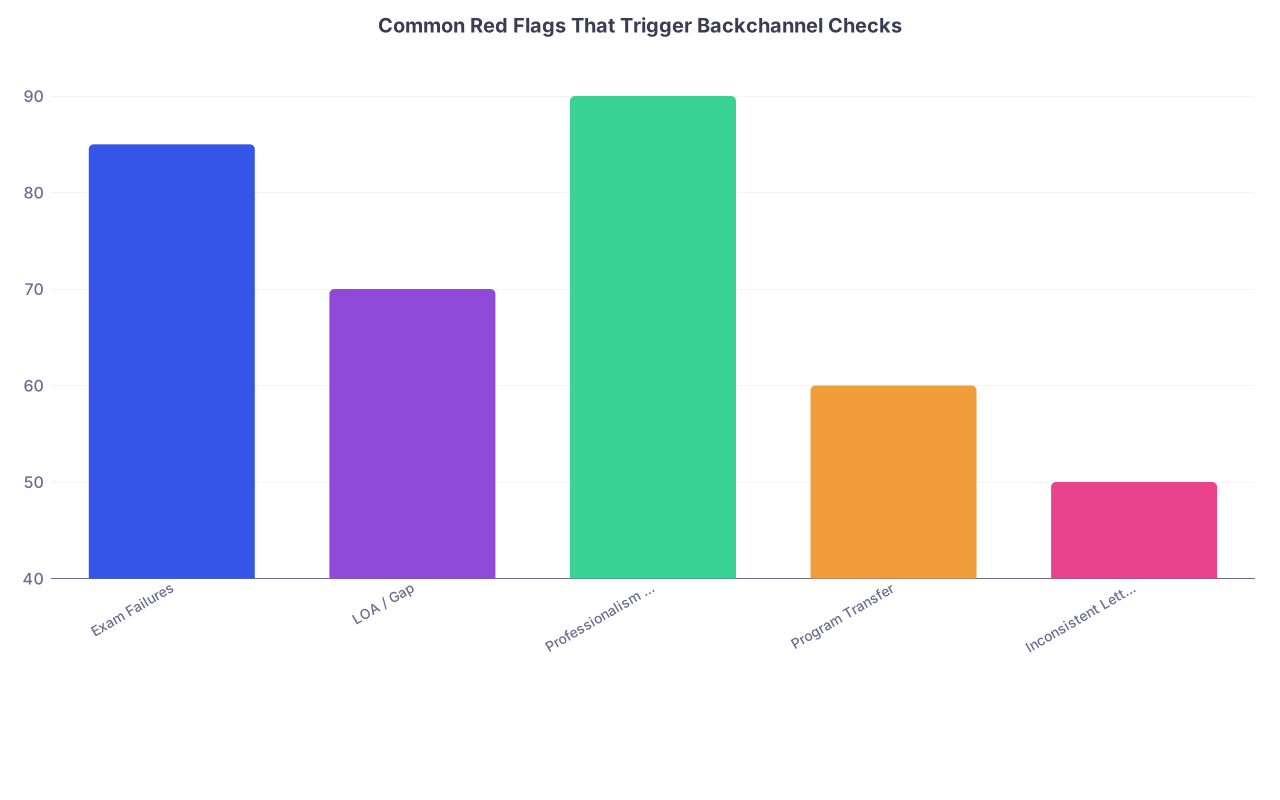
| Category | Value |
|---|---|
| Exam Failures | 85 |
| LOA / Gap | 70 |
| Professionalism Note | 90 |
| Program Transfer | 60 |
| Inconsistent Letters | 50 |
Exam Failures and Multiple Attempts
They see “Step 1: Pass (second attempt)” and your explanation: “Personal circumstances, now resolved.”
Do they believe you? Sometimes. Often they check.
How they verify:
- Compare timing of your exam attempt with known personal events (e.g., your LOA)
- If you took the exam late, did you rotate late as well? Was there a ripple effect?
- Ask your school directly if there were any academic actions beyond what’s in the MSPE
Pro tip: if your story is “I had health issues” and your timeline suggests you were also doing research, traveling, or doing electives during that same period, PDs notice the inconsistency. That’s when the phone calls happen.
Leave of Absence: Health vs. Disciplinary
Everyone says “health reasons” or “family reasons.” PDs have heard that line a thousand times.
What they actually want to know is: Was this disciplinary?
Backchannel routes:
- Quiet call to the Dean of Student Affairs: “Was this LOA strictly health-related?”
- Asking someone they know on your faculty: “Would you re-train this person again?”
- Looking for pattern: LOA + delayed exams + borderline comments on rotations
I’ve seen PDs be extremely forgiving about genuine health issues, especially when the narrative is consistent and verifiable. But if they sense it was actually professionalism or academic dishonesty packaged as “health,” they lose trust fast.
The Resident Transfer: Maximum Backchannel Mode
If you’re applying as a transfer resident, understand this: PDs will absolutely call your current or prior PD. No question. That’s standard, not exceptional.

Typical questions asked PD-to-PD:
- “Was this a voluntary or encouraged departure?”
- “Would you keep them if you had a spot?”
- “Any concerns I should know about before I bring them into my program?”
- “How are they with professionalism? Patient care? Interactions with staff?”
If your story is “I want to be closer to family” but your current PD says, “We had multiple formal professionalism remediation plans,” guess whose version is believed.
I’ve seen transfer applicants sink themselves by trying to spin too hard. PDs swap notes. They compare what you said with what your old PD said. If those don’t match, you’re done.
Letters of Recommendation: Backchannel Decoding
You think of letters as static documents. PDs treat them like signals—especially when something doesn’t fit.
Red flag scenarios they chase:
- Letter from a big-name person that’s unusually short or lukewarm
- Letter that reads generic while your personal statement claims “close mentorship”
- Mismatch: your CV lists a “major role” in a project; letter barely mentions you
Faculty backchannel looks like this:
“You wrote a letter for this applicant—did you have any reservations? Because your letter feels… cautious.”
If the response is, “I didn’t feel comfortable being too strong,” that translates to: “I don’t fully trust this person.”
PDs may never see that email or call. But the faculty who reviews applicants and advises the PD will. And they will absolutely say in committee, “I spoke with Dr. X; they weren’t enthusiastic.”
Social Media and Reputation: The Informal Backchannel
No, most PDs are not stalking your TikTok. But don’t be naïve. Residents are online. Medical Twitter, Reddit, SDN, specialty group chats—your name can circulate.
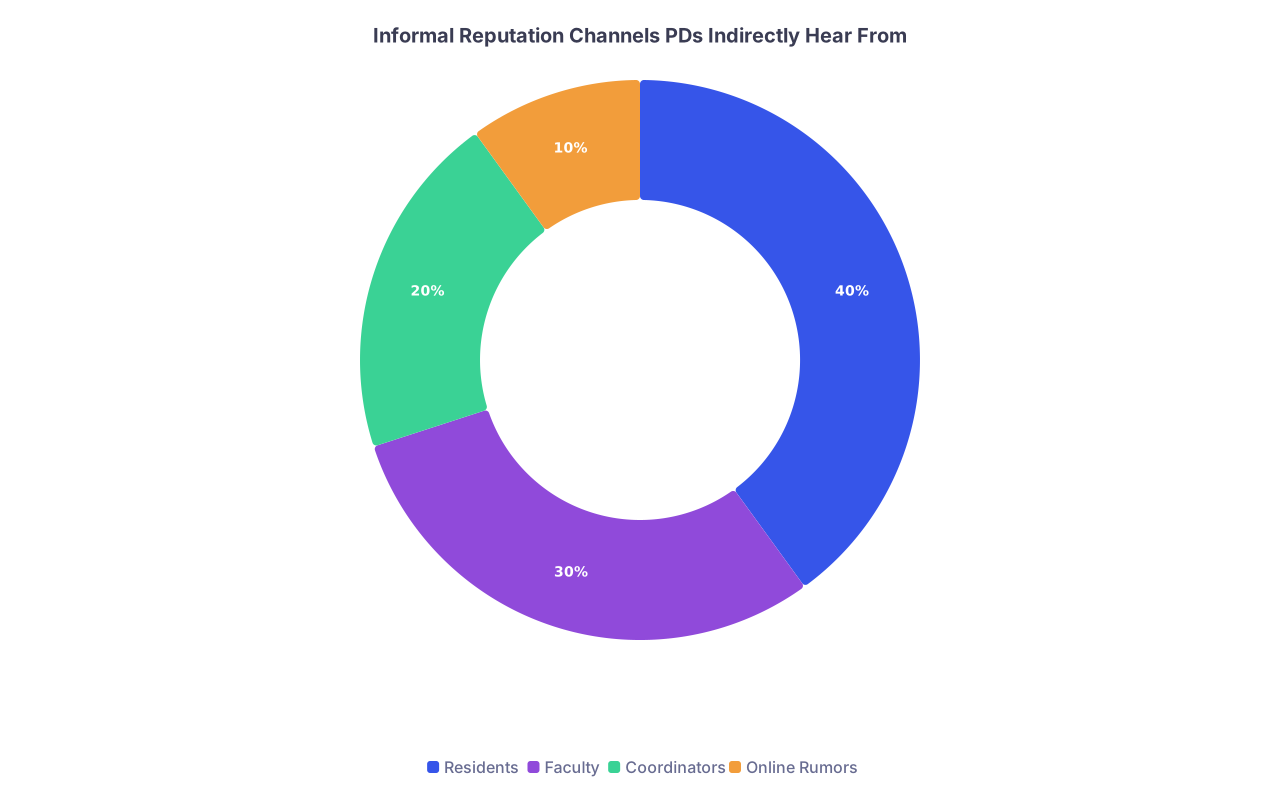
| Category | Value |
|---|---|
| Residents | 40 |
| Faculty | 30 |
| Coordinators | 20 |
| Online Rumors | 10 |
Common pattern:
- A resident on the selection committee recognizes your name from online drama
- A faculty member hears from a colleague: “Oh, that’s the student who…”
- A coordinator remembers an unprofessional email or rude interaction last cycle
No one says, “We rejected them because of Reddit.”
They say, “We have some concerns about professionalism” and move on.
How PDs Document (Or Don’t) What They Find
Important truth: much of what PDs learn never touches your official file. It stays in their head, in brief notes, or discussed verbally in meetings.
What actually gets written:
- “Significant academic difficulty early; has improved.”
- “LOA – circumstances discussed in interview.”
- “Concerns re: professionalism – discussed with faculty X.”
- “Spoke with prior PD; would accept again / would not accept again.”
What stays verbal:
- “Dean told me there were unreported professionalism issues.”
- “Old PD basically said, ‘You don’t want this problem.’”
- “Faculty at their home institution warned me they’re difficult.”
So when you ask later, “Why didn’t I match there?” you’ll never see the real reason in any document. But it was there, behind closed doors.
What This Means For You: Red Flags and Damage Control
You can’t stop PDs from backchanneling. You can control what happens when they do.
Here’s the unvarnished truth:
If you lie or heavily spin, you will get caught.
The backchannel exists precisely to check your story. When what you say and what your school/PD says don’t match, programs assume you’re the unreliable narrator.If your story is consistent and honest, many PDs will give you a chance.
I’ve seen applicants with Step failures, serious health leaves, even prior remediation, match solidly because their narrative was clear, consistent, and verified.Silence is suspicious.
“I just needed time off” with no real explanation triggers more backchannel than “I had depression, got treatment, returned and passed everything on the first try after that.”Your behavior outside the application matters.
How you treat coordinators, how you email, how you handle scheduling—those little things spread quietly. You’re building or destroying your reputation long before rank list day.
FAQs
1. If I have a red flag, should I bring it up in my personal statement or wait for them to ask?
Address it briefly and clearly in your application somewhere (personal statement, ERAS section, or supplemental). If you leave a big blank, PDs assume you’re hiding something and will start digging. Give a concise, honest explanation, emphasize what changed, and stop. You don’t need a full confession novel, but you do need to show you own it.
2. Can I ask my dean or PD not to share certain details if another program calls?
You can ask, but there are limits. Many schools and PDs have policies about what they will or won’t disclose, especially for legal reasons. But here’s the reality: the more you try to “control the narrative” behind the scenes, the more suspicious it looks when your version doesn’t align. You’re better off making sure your story is accurate and consistent rather than trying to muzzle people.
3. Do programs really check every LOA or exam failure?
No, not every single one. But any LOA or failure that isn’t clearly explained, or where the surrounding timeline looks odd, is very likely to get extra scrutiny. The more competitive the specialty or program, the more they check. In a tight year or small program, they’ll scrutinize nearly every red flag because one bad match hurts them a lot.
4. If my prior PD hates me, am I completely doomed for a transfer or reapplication?
Not automatically, but it’s rough. You need two things: other credible faculty who strongly vouch for you, and a story that acknowledges the conflict rather than pretending it never happened. Some PDs will write you off based on a bad prior PD report. Others will look for consistency across multiple sources. If everyone except your prior PD describes you positively and your behavior since then backs that up, you still have a shot—just know you’re in uphill territory.
Key points: PDs do backchannel; they don’t rely solely on what you upload. Red flags aren’t automatic death sentences, but inconsistency and spin usually are. If your record has scars, your only real play is honest, aligned, and verifiable—because the quiet phone calls will happen whether you like it or not.