
What if the letter of recommendation you never see is quietly killing your entire residency application?
You worry about Step scores. You obsess over your personal statement. But one bad letter of recommendation (LOR) from the wrong person can quietly sink you at every single program, and you will never know exactly why.
I’ve seen it happen. Strong Step 2 score. Solid clerkship evals. Interview numbers oddly low. Then someone on a committee mentions it: “That letter from Dr. X was… concerning.”
You cannot afford that.
Let’s walk through the landmines people step on every year with residency letters—and how you avoid being the applicant whose own referee ruins the application.
Mistake #1: Choosing “Big Name” Over “Knows You”
This is the classic, career-damaging mistake.
You chase the most famous name on the faculty list instead of the person who can actually write a strong, specific letter about you.
Here’s how it plays out:
- You shadowed the department chair for 2 mornings.
- You barely interacted beyond “Good morning.”
- At the end of the rotation, you ask for a letter because “They’re the chair. It will look great.”
- They say yes out of politeness.
- They write something bland like, “I had limited interaction with the applicant, but they appeared professional.”
Translation for programs: No one with real insight is willing to go to bat for this person.
A mediocre letter from a big name is worse than a strong letter from a mid-level faculty who knows you well.
Major red flags in these “big name” letters:
- Phrases like:
- “In my limited interactions…”
- “Based on brief exposure…”
- “I did not directly supervise…”
- No specific anecdotes or clinical examples
- Generic praise that could apply to anyone: “hard-working,” “pleasant,” “professional”
- Obvious template language that sounds copied and pasted
These are not neutral. Program directors read “limited interaction” as: no one closer to this student wanted to write a letter.
Avoid this mistake:
- Prioritize:
- People who supervised you directly
- Faculty you worked with for at least several weeks
- Attendings who gave you feedback—and saw you improve
- Only add a “big name” if:
- They truly know you (mentorship, research, repeated contact)
- They can describe you in detail, not just your CV
If, in your gut, you know someone doesn’t really know you, don’t ask them for a letter just because their title is impressive. That’s how you get a pretty letterhead and a silent torpedo.
Mistake #2: Ignoring the Lukewarm or Hesitant Response
You ask: “Would you be willing to write me a strong letter of recommendation?”
They respond: “Sure, I can write you a letter.”
Notice what’s missing? The word strong.
That gap is where careers go to die.
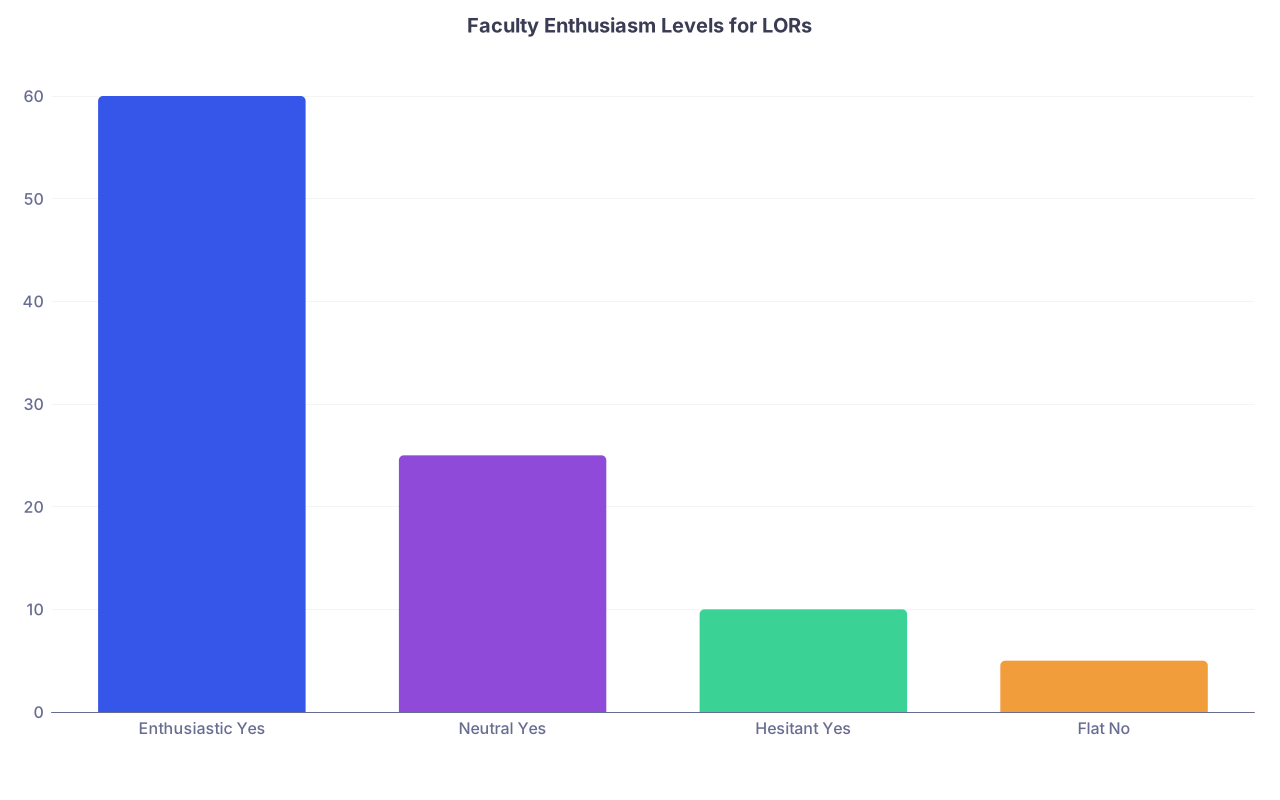
| Category | Value |
|---|---|
| Enthusiastic Yes | 60 |
| Neutral Yes | 25 |
| Hesitant Yes | 10 |
| Flat No | 5 |
I’ve watched students ignore obvious hesitation because they’re uncomfortable backing out. Here’s what they overlook:
Subtle danger phrases from faculty:
- “I can write you a letter if you need one.”
- “I’m happy to write something for your file.”
- “I didn’t work with you that closely, but I can put something together.”
- “I can comment on your time on the service.”
None of those mean “I am excited to support your application.” They mean: I’m not going to tank you, but I’m not doing you any favors either.
The nasty part? A “neutral” letter is not neutral in a competitive pool. When other applicants have glowing, detailed letters, your bland one becomes a negative by comparison.
What you should do instead:
Ask clearly and directly
“Would you feel comfortable writing a strong letter of recommendation for my residency applications?”Listen to the exact wording of the response
If you hear anything less than clear enthusiasm, back away:You: “No worries if not—if you don’t feel you can write a strong letter, I completely understand. I want to make sure my letters reflect people who know me well.”
Have backup options ready
Don’t corner yourself with only one attending from each rotation who could possibly write for you.
If you sense hesitation and proceed anyway, do not be surprised when that letter becomes the soft underbelly of your application.
Mistake #3: Asking the Wrong Type of Writer for the Wrong Specialty
You’re applying to orthopedic surgery, but your best letter is from a psychiatry attending who loves you. You’re convinced that because it’s glowing, it will carry weight everywhere.
Reality: It won’t.
Programs judge not just what is said, but who is saying it and whether they understand the specialty’s standards.
Here’s how that mismatch looks on the program side:
- Ortho applicant with:
- 1 ortho letter (generic)
- 1 IM letter
- 1 psychiatry letter (effusive)
- PD reaction: “Why do we not have multiple strong letters from surgeons who worked closely with this applicant? Why is the best letter from psych?”
Red flag: “No strong advocates in the target field.”
| Letter Mix | Program Director Impression |
|---|---|
| 2–3 strong in-specialty letters | Serious, well-known in the field |
| 1 in-specialty, 2 generic others | Borderline, maybe weak support |
| 0 in-specialty letters | Major red flag, likely no interest |
| Best letter from non-core field | Concerning, misaligned mentorship |
Avoid this mistake:
- For competitive and surgical specialties:
- Aim for at least two letters in the specialty.
- For less competitive or broad fields (FM, IM, peds):
- Still get at least one strong specialty letter, ideally two.
- Use out-of-specialty letters to:
- Highlight a different dimension (teaching, research, leadership)
- Complement, not replace, the core clinical letters
If the only people who will rave about you are outside your chosen field, you have a bigger problem than letters. And program directors will pick up on it immediately.
Mistake #4: Letting a Poor Clinical Evaluation Turn Into a Quietly Damaging Letter
You know the rotation I’m talking about.
- You were late a couple times.
- You had that one bad call night.
- The attending seemed… unimpressed.
- The eval came back “Meets expectations” with a few lukewarm comments.
Yet you still ask that same attending for a letter, because:
- “I need a letter from this specialty.”
- “They’re the main faculty in that clinic.”
- “They know me best from that block.”
Bad logic. Dangerous logic.
Here’s what often happens in those letters:
- They avoid strong language.
- They damningly praise you with faint words:
- “On par with peers.”
- “Performed at expected level.”
- “Required moderate supervision.”
- They highlight one concern:
- “At times needed reminders about timeliness.”
- “Occasionally struggled with prioritization.”
- “Will benefit from continued development of independence.”
Program directors read hundreds of letters a year. They know exactly what those phrases mean: There were problems. I’m subtly warning you.
How to not walk into this trap:
Know your evaluations
If the formal eval was average or had critical comments, do not assume the letter will magically be better.Ask for honest feedback before asking for a letter
“Do you feel I performed at a level you’d be comfortable strongly supporting in a letter? If not, I’d rather you be honest and I’ll ask someone else.”Do not “rescue” a weak specialty experience with a letter from that same weak experience
That just duplicates the problem in a more permanent format.
If a rotation was shaky, let it stay as a mediocre eval in the internal system. Do not immortalize it as a letter that goes to every residency director.
Mistake #5: Letting the Wrong Person “Help” Write or Edit Your Letter
This one’s subtle but ugly.
Some institutions allow you to see or even draft your own letters. Others funnel everything through a Dean’s office or a centralized system.
The mistakes:
- You “help” by writing a self-congratulatory letter full of clichés:
- “One of the top students I have ever worked with”
- “Truly exceptional in every dimension”
- You give that draft to an attending who barely edits it and signs.
- On the program side, it reads artificial and generic. Program directors have seen that exact wording dozens of times.
Or worse:
- You let a peer or relative “polish” your letter drafts if you’re allowed to contribute.
- They overdo it—excessive superlatives, unnatural phrasing, weird formality.
- It no longer sounds like any real clinician’s voice.
Residency committees can smell an inauthentic or applicant-written letter immediately. It cheapens the whole packet.
Safer approach:
If an attending asks you for a “letter template” or bullet points:
- Give them:
- A brief summary of cases you worked on
- Specific traits you hope they’ll comment on (reliability, ownership of tasks, teamwork)
- Concrete examples: “I followed X patient through admission to discharge and adjusted the plan after new labs.”
- Do not write full glowing paragraphs for them.
- Give them:
Never pressure an attending to sign your exact wording.
Never edit their letter unless they explicitly request factual corrections (dates, projects, roles).
You want letters that sound like the actual physician writing them. Not something that reads like ChatGPT drank three cups of coffee and a thesaurus.
Mistake #6: Using a Non-Physician or Weak Professional as a Core Letter Writer
Look, I get it. Sometimes your strongest supporter is:
- A PhD research mentor
- A nurse practitioner who worked with you for months
- A nurse manager
- A premed advisor from undergrad
All valuable humans. Often more invested in your success than some attendings.
But using them as core clinical letter writers for residency? That’s a problem.
Programs expect your main letters to come from physicians who supervised you clinically in a setting similar to residency.
Red flags when non-physicians are used badly:
- Best letter in the file is from a non-MD/DO
- No strong clinical physician letters to balance it out
- The NP/PA/PhD comments glowingly on professionalism, but not on residency-level skills or readiness
Does that mean you can’t ever use them? Not exactly. You just have to be smart:
- Non-physician letters are:
- Fine as an additional letter.
- Dangerous as a replacement for physician clinical letters.
If the person who knows you best clinically is not a physician, use their letter as a bonus, not as the cornerstone of your application.
Mistake #7: Timing Letters So They Arrive Late or Out of Sync
Program directors expect serious applicants to have their materials ready early in the season. Chronically late letters raise eyebrows.
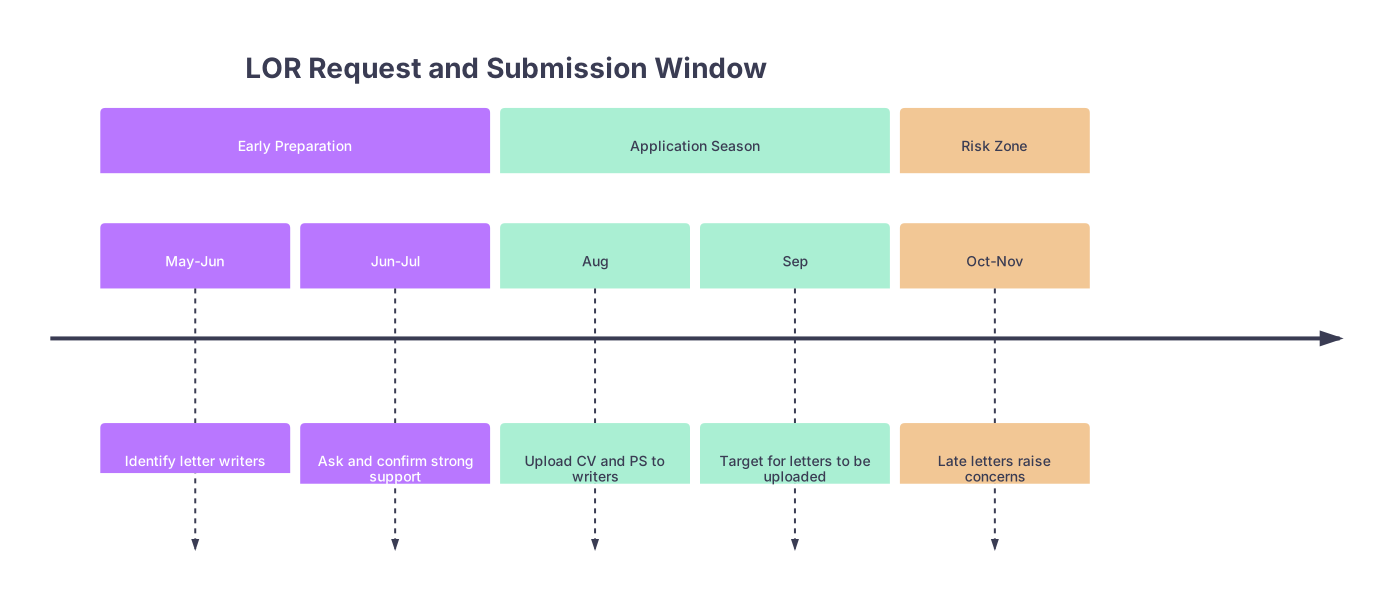
| Period | Event |
|---|---|
| Early Preparation - May-Jun | Identify letter writers |
| Early Preparation - Jun-Jul | Ask and confirm strong support |
| Application Season - Aug | Upload CV and PS to writers |
| Application Season - Sep | Target for letters to be uploaded |
| Risk Zone - Oct-Nov | Late letters raise concerns |
Here’s the red flag scenario:
- You submit your ERAS application in September.
- Programs see your file marked as “incomplete” because letters are missing.
- Your best letter arrives in November.
- Many interview offers have already gone out.
To a program, that can read like:
- Poor planning.
- Weak relationships with faculty (they didn’t prioritize you).
- Disorganization—bad sign for residency.
Avoid this trap:
- Ask early—3–4 months before application opening is standard.
- Gently follow up:
- 4–6 weeks after first request
- Again 2–3 weeks before your target submission date
- Give your writers:
- Your updated CV
- Personal statement draft
- List of programs/specialty and why you’re pursuing it
If the attending consistently delays or seems unreliable, swap them out. Do not let your whole season hinge on one chronically late letter writer.
Mistake #8: Red-Flag Content You’ll Never See (But Should Anticipate)
The scariest part of LORs: You usually will not see what’s written. Especially in systems that require waiving your right to view letters.
So you need to think like a program director and avoid the types of writers most likely to include subtle (or not subtle) red flags.
Common quiet red flags in letters:
- “May struggle in a fast-paced environment.”
- “Will need close supervision in the early stages of training.”
- “Has overcome some challenges with professionalism.”
- “At times, appeared less engaged than peers.”
Those are soft bombs. They don’t scream “do not rank,” but in a competitive pool, they absolutely push you down the list.
You’re at highest risk for this kind of language when you:
- Ask someone who gave you mixed or negative feedback.
- Ask someone you clashed with on rounds.
- Ask someone who clearly favored other students over you.
- Ask someone who questioned your professionalism—even once.
Better strategy:
- Get informal read-outs before asking:
- “How did I do on this rotation compared to other students?”
- “Would you place me in the top, middle, or lower group of students you’ve worked with this year?”
- If the answer is not “top” or close to it, do not hand them your future.
Mistake #9: Mismanaging How Many Letters You Send and to Whom
Programs differ in how many letters they accept and what they expect. Sloppy letter management makes you look… sloppy.
| Specialty | Common LOR Count | In-Specialty Expected? |
|---|---|---|
| Internal Med | 3–4 | 1–2 IM |
| Surgery | 3–4 | 2+ Surgery |
| Pediatrics | 3–4 | 1–2 Peds |
| Psych | 3–4 | 1 Psych |
| FM | 3–4 | 1–2 FM |
Red flag moves:
- Sending only 2 letters when they say “3–4 recommended”
- Having zero letters from your target specialty
- Sending too many letters (6–7) so programs assume you lack judgment and force them to sift through noise
- Mixing up specialty-specific letters:
- Using a “To the Internal Medicine Selection Committee” letter for EM programs
- Or worse, having the wrong specialty name in the letter body (it happens)
Clean approach:
- Aim for 3–4 total letters for most specialties.
- Of those:
- 2 should be strong core clinical letters in the specialty or close to it.
- 1 can be from a different clinical area that knows you well.
- 1 optional from research/leadership if it’s genuinely strong.
If you’re applying to two different specialties, be ruthless about which letter combinations go to which programs. Don’t make them guess which version of you they’re supposed to care about.
Mistake #10: Not Protecting Yourself With Early, Honest Conversations
The biggest underlying mistake? Treating letters like a formality instead of a high-risk, high-impact piece of your application.
You protect yourself by being proactive and slightly blunt earlier than feels comfortable.
Conversations you should actually have:
With a potential writer after a strong rotation:
“I’ve really appreciated working with you. Do you feel you know me well enough and feel comfortable writing a strong, supportive letter for my residency applications?”With someone you’re unsure about:
“I respect your honesty—if you feel my performance was not at a level you’d strongly endorse in a letter, I’d rather know that and not put you in that position.”With yourself:
“If this attending were sitting on a program’s selection committee, would I bet my entire application on how they’d talk about me?”
If the answer is no, move on.

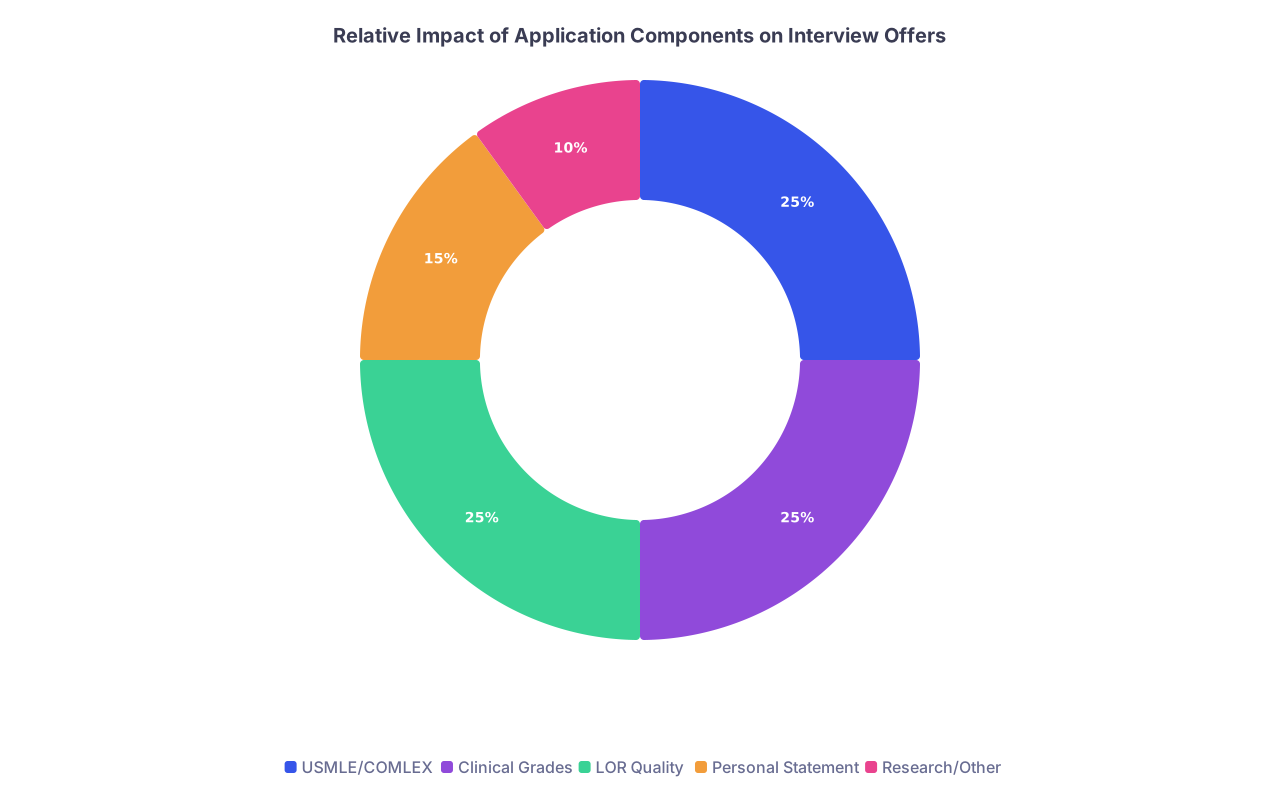
| Category | Value |
|---|---|
| USMLE/COMLEX | 25 |
| Clinical Grades | 25 |
| LOR Quality | 25 |
| Personal Statement | 15 |
| Research/Other | 10 |


| Step | Description |
|---|---|
| Step 1 | Identify Potential Writers |
| Step 2 | Review Rotation Feedback |
| Step 3 | Ask Directly for Strong Letter |
| Step 4 | Choose Different Writer |
| Step 5 | Provide CV & PS |
| Step 6 | Set Clear Deadline |
| Step 7 | Confirm Submission |
| Step 8 | Feedback Strong? |

The 3 Things You Cannot Afford to Get Wrong
Who you choose
Don’t chase titles. Choose people who truly know your work, like you, and will back you enthusiastically—especially in your chosen specialty.How honest you are about performance
Avoid writers tied to weak rotations, lukewarm evals, or professionalism concerns. Those concerns will leak into the letter.How early and clearly you manage the process
Ask early, ask explicitly for a strong letter, and switch course if you sense hesitation or unreliability.
Protect your application from the reference who quietly ruins it. Because once that letter is uploaded, you won’t be in the room to defend yourself—your choice of writer is your only defense.