What do you think happens to your application the moment a program director screenshots your email and sends it to the entire selection committee with, “We’re passing on this one – concerning judgment”?
If you think that’s dramatic, you’re underestimating how fast unprofessional emails travel through residency programs. I’ve watched it happen. People remember names. And they absolutely remember red-flag emails.
This isn’t about being “perfectly polished.” It’s about not torching your reputation in 3 sentences and a subject line.
Let’s walk through the email behaviors that quietly – and sometimes loudly – amplify professionalism concerns in the residency application process. And how to stop doing them before they cost you interviews or a rank spot.
1. The Entitled, Demanding, or “Pushy” Email
This is the number one category that gets people labeled as a “professionalism risk.”
I’ve seen these come into program inboxes:
- “I would like an update on my application status ASAP.”
- “I interviewed over a week ago. When will decisions be released?”
- “Given my qualifications, I’m surprised I haven’t heard back.”
Here’s what programs read between the lines:
This person will be difficult when they don’t get what they want.
Red flags in this category:
- Impatient follow-ups: Emailing 3–4 days after an interview asking for decisions.
- Entitlement language: “Deserve,” “should be,” “expected to get,” “I know I’m a strong candidate so…”
- Implied pressure: Hinting that you’ll rank them higher if they respond or give some kind of assurance.
- Boundary crossing: Messaging multiple people in the same program to “check on status.”
How to avoid looking entitled:
- Give programs time. For anything status-related, think in weeks, not days.
- Use neutral, non-demanding phrases:
- “I wanted to briefly express my continued interest in your program.”
- “I recognize how busy this season is and appreciate your time.”
- Never suggest what they should do (“You should strongly consider…” is a terrible sentence to write).
Mental rule:
If your email is mainly about what you want from them, pause. Reframe it around appreciation and brief clarification, not demands.
2. Over-Familiar, Casual, or “Buddy-Buddy” Tone
You’re not texting your co-intern. You’re writing to people who will decide your future and then potentially evaluate your professionalism every day for 3+ years.
The email style that gets mocked in resident rooms:
- Subject: “Hey!”
- Greeting: “Hi guys,” “Hey there,” “Yo Dr. K”
- Closing: “Cheers,” “Best, [First name only, nickname]” to a PD you’ve never met
- Emojis, “LOL,” “haha,” or texting abbreviations
This doesn’t make you “friendly.” It makes you look like you don’t understand professional distance.
Red flags for programs:
- Poor boundaries
- Possible difficulty with hierarchy
- Immaturity under stress
Better patterns to use:
- Subject line: “Thank you for the interview – [Your Name]” or “Question regarding [Program Name] rotation requirement”
- Greeting:
- “Dear Dr. [Last Name],”
- “Dear Program Director [Last Name],” if you really don’t know
- Tone: Polite, direct, short sentences. No jokes, sarcasm, or inside humor.
You don’t need to sound like a robot, but if your email reads like something you’d send to a friend, it’s wrong for residency.
3. Sloppy, Error-Filled, or Obviously Copy-Pasted Emails
You know what gets everyone’s attention instantly?
“Dear Dr. Smith,
Thank you again for the opportunity to interview at [Wrong Program Name].”
Or:
“I really enjoyed speaking with residents at [Other City] and I’m excited about the research opportunities at [Completely Different Institution].”
That’s not just a typo. That’s a judgment problem. Programs worry you’ll do the same type of careless work with orders, notes, or prescriptions.
Common sloppiness red flags:
- Misspelling the program name or PD’s name
- Referring to the wrong specialty (e.g., “your internal medicine program” when emailing a prelim surgery program)
- Wrong institution in the body text
- Switching pronouns/names in template paragraphs
- Multiple grammatical mistakes in a short email
Do programs actually care about grammar? Yes. Not because they’re grading you like an English professor, but because your attention to detail is on display.
How to avoid this:
- Never mass-send emails without customizing and re-reading each one.
- Always check:
- Program name
- Institution name
- PD’s name and title
- Any references to location, tracks, or subfields
- Read the email out loud once before sending. You’ll catch awkwardness and errors.
If you’re too “busy” to proofread a 5-line email, what does that say about your future sign-outs?
4. The “Love Letter” or Over-The-Top Flattery Email
Programs don’t like being love-bombed. They like being respected.
Here’s where you go wrong:
- “Your program is my absolute dream and I can’t imagine training anywhere else on earth.”
- “After learning more, I know this is my perfect fit and no other program compares.”
- A page-long email about how meaningful the day was and how you admire every single faculty member personally.
You think you’re expressing interest. They read clinginess, poor judgment, and possibly dishonesty (especially when 15 other applicants send the same energy).
Red flags to them:
- Unstable or overly emotional responses to routine situations
- Potential boundary issues with patients or colleagues
- Questionable sincerity
What they actually want in a “continued interest” email:
- Brief. 5–8 sentences maximum.
- Specific. Mention 1–2 real program features that matter to you.
- Grounded. No “only place I’ll be happy” dramatics.
Better pattern:
- “I remain very interested in your program, particularly because of X and Y.”
- “After visiting, I’d be excited to train in a program with your strengths in Z.”
- If you truly intend to rank them highly and it’s allowed in your specialty/region:
“I anticipate ranking your program very highly” (not “number 1” unless you mean it and know the rules).
Over-declaring or sending “You’re my #1” to multiple programs? That’s how you earn a reputation as untrustworthy. And yes, PDs do talk.
5. Inappropriate CC/BCC and Group Emails
One of the fastest ways to raise professionalism concerns is misusing the To/CC/BCC lines.
Common mistakes:
- CC’ing the entire program (multiple attendings, chiefs, coordinators) for a minor question that belongs only to the coordinator.
- Replying-all to group messages with personal comments.
- BCC’ing other programs when sending a “personal” thank you email (this is career suicide-level dumb).
- Looping random faculty into an issue to “get more eyes on it” – looks like you escalate instead of communicate directly.
How this lands:
- You don’t understand communication chains.
- You might expose protected or sensitive information to the wrong people.
- You’ll create drama on services by escalating anything that frustrates you.
Good rules:
- Most program-related questions = sent only to the program coordinator.
- Thank-you notes = usually director + specific interviewers, not every attending you saw in a conference room.
- If you’re not sure who to include, start small. Let the recipient loop in others if needed.
And never, absolutely never, send one email to multiple programs with all of them visible. That’s a neon sign saying, “I don’t understand professional discretion.”
6. Inappropriate Timing and Frequency of Emails
You may think “it’s just an email” and they’ll get to it when they can. That’s not quite how they read it.
Problem behaviors:
- Multiple emails in a short time window:
You email Monday. Follow up Wednesday. Follow up Saturday. They’re now worried about your ability to tolerate uncertainty. - Late-night messages with urgent tone about non-urgent topics.
- Emailing during holidays demanding responses (“I understand it’s Thanksgiving week but I was hoping for an update.”).
- Sending long, reflective, semi-emotional emails after every interview.
Here’s what makes sense:
- After an interview: Optional, short thank you within 24–72 hours. Then stop.
- If truly necessary follow-up (e.g., you have a major update like a new Step score, publication, or couples match info): 1 email. Not a chain.
- If you haven’t heard back about an interview invite? Often you do not need to email at all. If there’s a real reason (e.g., a major geographic tie you didn’t get to explain in ERAS), 1 short, non-pressuring email is reasonable.
If your name keeps popping up in their inbox, they will remember you. Just not how you’re hoping.
7. Sharing Too Much Personal Information or Emotion
Some of you turn emails into therapy sessions. Do not.
Red-flag overshares:
- Trauma disclosures not directly and clearly relevant to your application and not requested by them.
- Emotional content: “I cried after the interview because I felt so connected to your program.”
- Telling them how stressed, burned out, or depressed you are right now.
- Over-explaining personal hardship before they even ask.
Programs are wary of anything that suggests you may have difficulty with emotional regulation under stress. Residency is pressure by default. They don’t want to worry if you’ll fall apart or need significant accommodations they can’t provide.
Yes, hardships matter. Yes, context can be important. But:
- That belongs in your personal statement, not a follow-up email explosion.
- If you must explain something (e.g., a failed exam because of a specific acute illness), do it once, briefly, and in professional language.
Example of better style:
- “You may notice a Step 1 failure earlier in my training. At that time, I experienced [very brief, neutral description]. I’ve since addressed this and performed well on [later metric]. I’m happy to discuss further if helpful.”
If you’re typing with tears in your eyes or shaking hands, you probably shouldn’t be sending that email.
8. Anger, Sarcasm, or “Calling Them Out”
This one ends careers before they even start.
Maybe you feel:
- A program treated you rudely.
- An interviewer seemed discriminatory.
- Your interview was canceled last-minute with no apology.
- You didn’t get an interview where you “should have.”
Your impulse might be to “give feedback” or “let them know how this looked.”
Don’t. Not right now. Not during the same season they’re still deciding on your file.
Red-flag behaviors here:
- Sarcastic comments: “I’m sure your program is just too busy to respond.”
- Calling them unprofessional or unfair.
- Saying you’ll be warning other applicants or your school about them.
- Threatening legal action in an email to the program (go to counsel, not the PD’s inbox).
How this is perceived:
- High risk for conflict
- Poor impulse control
- Difficult to remediate if issues arise during residency
If something truly problematic happened?
- Document it privately.
- Talk to your dean’s office or trusted advisor.
- Consider formal channels later, once your match is secured, if appropriate.
Do not dump your anger into an email during application season. They will protect themselves, not you.
9. Unprofessional Email Address, Signature, or Attachments
Yes, your email handle matters. Yes, your signature can be a problem too.
Red flags:
- Email address like: partydoc94@..., shots4days@..., drsexy@..., meme-based handles, gamer tags, etc.
- Signatures that include:
- Quotes with aggressive or controversial content
- Religious or political slogans
- Memes, emojis, GIFs, or images
- Sending attachments they did not ask for (full CVs, research posters, PDFs of your publications) in cold emails.
Programs are not impressed by your “personality” if it’s welded into every email. They want predictable, low-risk professionalism.
Fix it:
- Use a clean address: first.last@, last.first@, or something boring and neutral.
- Signature:
Name
Medical school
Preferred contact info
That’s it. No quote from Marcus Aurelius. No Bible verse. No rainbow gradient.
Think: If your email was printed and placed in your HR file, would you be fine with every word and image being reviewed during a professionalism committee meeting? If the answer is no, change it now.
10. Being Vague, Confusing, or Needing Multiple Clarifications
Great way to look disorganized: send an email that requires three extra emails to figure out what you’re asking.
Common issues:
- “I had some questions about your program” with no specifics.
- Run-on paragraphs with 6 different topics.
- No clear ask, so no one knows whether to respond or forward.
- Asking about information that’s clearly on their website.
This doesn’t seem “unprofessional” at first glance, but under the surface, it signals:
- Possible difficulty with communication
- Inefficient time use
- Poor preparation
Better approach:
- Read the website first.
- Write a short, focused email with 1–2 specific questions max.
- Example structure:
- Greeting
- One sentence of context (who you are)
- 1–2 questions, numbered if needed
- Thank you
If a coordinator has to decode your message, they won’t appreciate it. And yes, they talk to PDs about “high-maintenance applicants.”
Quick Comparison: Low-Risk vs High-Risk Email Patterns
| Situation | Low-Risk Email Behavior | High-Risk Email Behavior |
|---|---|---|
| Post-interview | One short thank-you, specific, polite | Multiple long emails, emotional content |
| Asking status | Often no email; or one neutral, brief inquiry | Repeated “any updates?” messages |
| Tone | Formal but warm, clear boundaries | Casual, jokey, or confrontational |
| Content | Focused, relevant, error-free | Copy-paste errors, oversharing, drama |
| Recipients | Coordinator or PD only when appropriate | Massive CC chains, reply-all misuse |
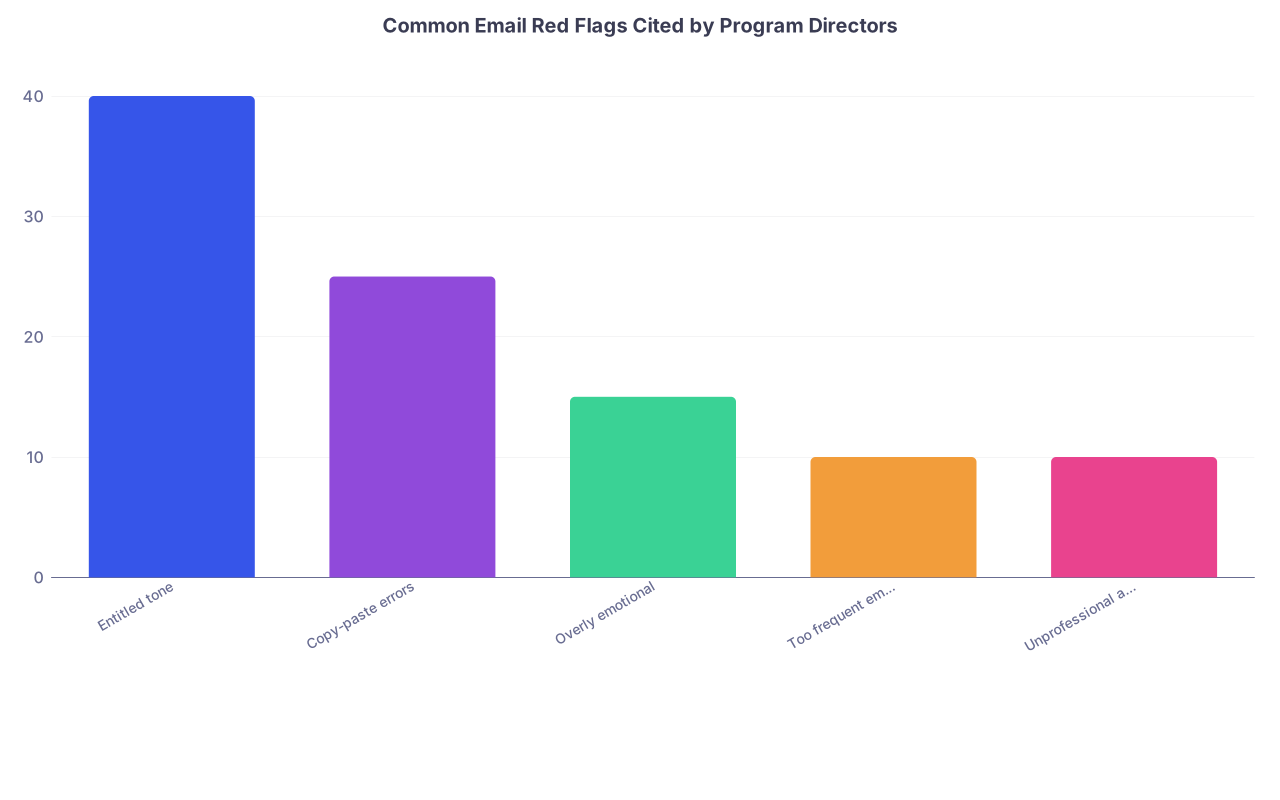
| Category | Value |
|---|---|
| Entitled tone | 40 |
| Copy-paste errors | 25 |
| Overly emotional | 15 |
| Too frequent emails | 10 |
| Unprofessional address | 10 |
A Simple Email Safety Checklist
Before you hit send, ask yourself:
- Would I be comfortable with this email being read aloud in a resident conference with my name attached?
- Am I asking for something reasonable, in a reasonable way, at a reasonable time?
- Could any of this be misread as entitled, angry, needy, or careless?
- Have I double-checked names, program, and any specific details?
- Does this need to be an email at all?
If any answer makes you hesitate, fix it. Or don’t send it.

| Step | Description |
|---|---|
| Step 1 | Want to email program |
| Step 2 | Do not email |
| Step 3 | Draft short, formal email |
| Step 4 | Check names & details |
| Step 5 | Remove or rewrite |
| Step 6 | Send once and wait |
| Step 7 | Is this on website already? |
| Step 8 | Is it time-sensitive and reasonable? |
| Step 9 | Any emotion or pressure? |

FAQ: Email Red Flags in Residency Applications
1. Is it actually necessary to send thank-you emails after interviews?
No, it’s not strictly necessary for most programs. Thank-you emails rarely rescue a weak application, but a bad one can hurt you. If you send one, keep it short (5–8 sentences), specific, and error-free. If you’re the type who over-explains or gushes, you’re safer skipping it entirely.
2. Can I tell a program they’re my number one choice?
You can, but only if all three are true:
- They actually are your clear #1,
- You understand your specialty’s rules and NRMP communication guidelines, and
- You say it once, clearly, without pressuring them.
Never tell multiple programs they’re your top choice. That backfires fast.
3. What if I realize I sent an email with the wrong program name?
Do not send three follow-ups apologizing. One short correction is enough:
“Dear Dr. X, My apologies – in my previous email I mistakenly wrote [wrong name]. I very much meant to refer to [correct program]. Thank you again for the opportunity to interview.”
Then stop. They’ll notice the initial mistake, but they’ll also notice how you handled it.
4. Is it okay to email a program if I haven’t received an interview invite yet?
Sometimes. Good reasons: major update (new score, significant publication, couples match info, strong geographic/family tie), and you haven’t heard from them at all. Bad reasons: “I think I deserve an interview,” “just checking,” or sending generic interest blasts. One focused, respectful email can be fine. Multiple “just checking if you saw my application” messages are not.
5. Can I talk about mental health struggles or personal hardship by email if it affected my performance?
You can, but you should be very careful and very concise. Long, emotional disclosures in email often raise more concerns than they address. If context is genuinely important, a brief, neutral explanation linked to objective improvement is safest. For anything complex, it’s better handled in a personal statement, official dean’s letter, or in conversation if they ask directly—not in an unsolicited, highly emotional email.
Key things to remember:
- Your emails are part of your professionalism file whether you like it or not.
- Most damage comes not from silence, but from emotional, sloppy, or entitled messages.
- If you’re unsure, make the email shorter, calmer, and less frequent—or don’t send it at all.