
The quiet line in your Dean’s Letter will hurt you more than a mediocre Step score.
How Unprofessionalism Notes Actually Work Against You
Let me be blunt. Program directors fear unprofessionalism more than low test scores, average schools, or lack of research. They’ll take a 220 with a solid reputation over a 255 with a pattern of being “difficult,” “unreliable,” or “concerning” any day.
And the catch is this: the nastiest landmines in your application are usually buried in the MSPE and narrative evaluations. Not on your CV. Not in your personal statement. In the bland, bureaucratic language that faculty and deans think you won’t understand.
You know what PDs do when they see a whiff of unprofessionalism? They do not argue. They do not give you the benefit of the doubt. They quietly move on to the next application. There are too many safe choices.
I’ve sat in rooms where someone says, “There’s a professionalism note in the MSPE” — and that’s it. No debate. No rescue. No “but they have great research.” Just: “Next.”
Let me walk you through how this really plays out behind closed doors.
The Code Words: How Deans Say “Do Not Trust This Person”
Deans and clerkship directors almost never write “This student is unprofessional and you should not rank them.” They use sanitized language that sounds reasonable. But PDs have learned the code.
Here’s how the translation actually works in committee.
The Obvious Red Flags
These are phrases that stop your file dead:
- “Required professionalism remediation”
- “Placed on professionalism probation”
- “Formal professionalism concern was filed”
- “Remediated a lapse in professionalism during clerkship year”
- “Recurrent issues with timeliness and communication”
Those are nuclear. These notes are remembered, quoted, and often copied into PD spreadsheets. Once you’re in the “professionalism concern” bucket, you’re competing only against other risky applicants. That’s a tiny and brutal pool.
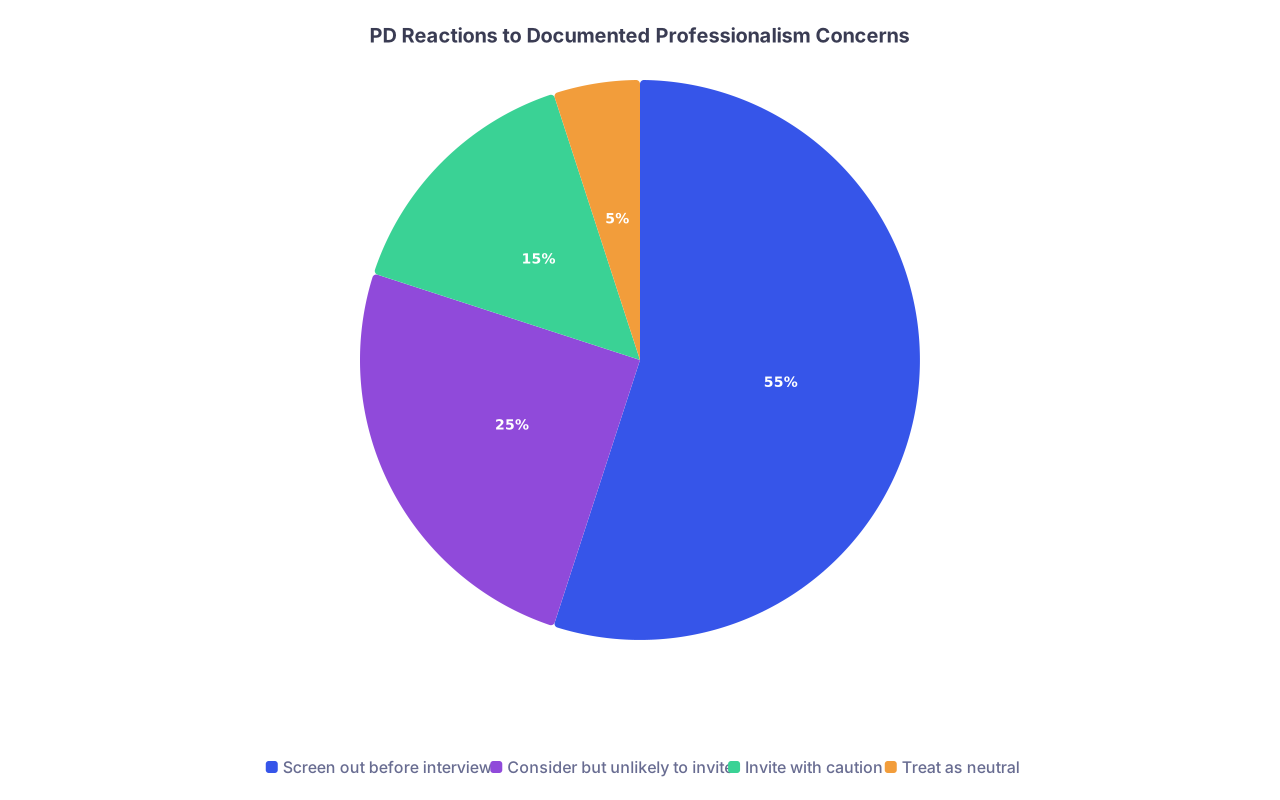
| Category | Value |
|---|---|
| Screen out before interview | 55 |
| Consider but unlikely to invite | 25 |
| Invite with caution | 15 |
| Treat as neutral | 5 |
Those numbers aren’t from a journal article. They’re from real hallway conversations and rank meetings: roughly half of programs will toss you outright; another quarter will only consider you if desperate.
The Soft-Language Landmines
The more dangerous lines are the “mild” ones, because students underestimate them. Program directors do not.
Here’s what I’ve heard in actual meetings:
MSPE line: “Can be perceived as defensive when given feedback.”
PD translation: “We’re going to be arguing with this person all residency.”MSPE line: “Needed occasional reminders regarding punctuality.”
PD translation: “Chronic late. Not worth it.”MSPE line: “Improved communication with staff over the course of the rotation.”
PD translation: “Had problems with staff. Staff do not complain lightly.”MSPE line: “Benefited from close supervision during team-based activities.”
PD translation: “Do not leave this person alone with anyone.”MSPE line: “At times, interpersonal interactions were less effective, but improved with feedback.”
PD translation: “Had at least one serious interpersonal issue.”
And the truly poisonous one:
- “There was a professionalism concern addressed at the clerkship level; the student responded appropriately and completed the required remediation.”
You see “responded appropriately” and think it sounds positive. A PD sees it and thinks: “Somebody escalated this. Enough that they documented it. Hard pass unless we’re desperate.”
Where These Notes Really Come From (Not Just “Bad Luck”)
Unprofessionalism notes in the Dean’s Letter almost never come out of nowhere. They’re usually the end of a paper trail.
Here’s what I’ve seen over and over on the back end:
Staff complaints — not attendings — start the fire.
A nurse, clerk, MA, or tech writes: “Student was rude / dismissive / refused to help / disappeared.” Faculty may like you. Staff do not file formal complaints lightly. When they do, schools take it very seriously because hospitals remember.Repeated “minor” issues add up.
A few “late to rounds,” “didn’t follow through on task,” “missed didactics” notes. One alone might vanish. Three in different rotations? Pattern. That’s how “recurrent issues” language appears.Arguing about grades backfires. Hard.
Students think they’re “advocating for themselves.” Faculty hear: “entitled, lacks insight.” The worst is when a student escalates to the clerkship director or dean over an evaluation. Those grievances often end up referenced, directly or indirectly, as “difficulty accepting feedback” or “challenging interactions around evaluation.”Social media and outside-the-hospital behavior sometimes leaks in.
Is it common? No. Does it happen? Yes. Especially if it spills into the clinical environment: screenshots shared with residents, patients seeing posts, professionalism committee involvement.
By the time something hits your MSPE, multiple people have discussed it. There’s usually a email chain. And here’s the less-public truth: once there’s a documented professionalism issue, the school is going to cover itself. That means putting something into the official record. Which becomes your problem later.
How Program Directors Actually Read the MSPE
Most students think PDs skim the MSPE for honors and shelf scores. That’s naive. The first scan, in many competitive programs, is for one thing: “Is there anything in here that can blow up in our faces?”
They read differently than you think.
The Steps They Take Behind Closed Doors
The unfiltered version, from sitting in those rank meetings and file review sessions:
Filter 1: Any formal professionalism language?
One director I know has an actual note on his ERAS review template: “P flag?” That’s it. If yes, he either screens out or flags for “only if low applicant pool this year.”Filter 2: Any coded behavioral concerns in clerkship narratives?
PDs zoom in on phrases about teamwork, communication, response to feedback, dependability. They skim right past “strong fund of knowledge” because everyone has that. They stop on “occasionally dismissive” and “needs reminders.”Filter 3: Does this match what LORs say?
When the MSPE says “needed feedback about communication” and one letter says “great team member” but another is oddly generic and short, PDs assume the generic writer didn’t want to put a negative but also wouldn’t endorse strongly. That soft negativity is enough to drop you below the cut line.Filter 4: Any pattern across rotations?
One bad eval on surgery? Could be a malignant service. But when medicine, OB, and EM all mention some version of “timeliness,” “professionalism,” or “communication challenges”? That’s game over in many places.
I’ve watched committees go from “solid Step, good school, decent research” to “we’re not touching this” in under 30 seconds because of a single professionalism line in the MSPE.
The Silent Killer: “Unprofessionalism” vs “Not A Team Player”
You think unprofessionalism is cheating, screaming at nurses, or showing up drunk. That’s the extreme end. The stuff that quietly kills your rank list spot is much softer: the perception that you’re not someone people want to work with at 3 a.m.
There are two themes that terrify PDs:
Reliability concerns
Anything suggesting late, disorganized, disappears, doesn’t follow through.
They see:- “Occasionally needed reminders to complete documentation.”
- “Sometimes required follow-up to complete assigned tasks.”
They read: “This person will miss pages and leave patients hanging.”
Interpersonal friction
Anything that suggests conflict with staff, residents, or peers.
They see:- “Had difficulty integrating feedback about communication style.”
- “Perceived by some team members as abrupt, though always respectful with patients.”
They read: “We’re going to get emails about this person from nurses and co-residents all year.”
And here’s the blunt reality: PDs care more about this than your academic strength. They can remediate knowledge gaps. They cannot fix personality issues that have been reinforced for 20+ years.
Specialties That Are Ruthless vs. Forgiving About Professionalism Notes
All programs care. But not all programs care equally.
| Specialty | Typical Reaction to Formal Pro Note | Chance of Interview (if otherwise strong) |
|---|---|---|
| Dermatology | Automatic screen-out at many places | Very low |
| Orthopedics | Almost always removed from list | Very low |
| Plastic Surgery | Treated as fatal flaw | Near zero |
| Internal Med | Some will consider with caution | Low–moderate |
| Family Med | Most will at least review context | Moderate |
| Psychiatry | Extremely wary of interpersonal flags | Low–moderate |
Competitive surgical subspecialties? A clear professionalism note is a death sentence almost everywhere. There are too many clean files to choose from.
Family medicine or community internal medicine programs? They may glance at context and see if it’s a one-off issue versus a pattern. But even there, if they have enough applicants, they’ll often silently pass.
Psychiatry is a funny one. Students think it’s non-judgmental. PDs in psych are actually hyper-attentive to interpersonal functioning and stability. A flagged professionalism issue in psych is interpreted as: “Even in med school, something was off.”
How a Single Line Can Tank You: Realistic Scenarios
Let me show you how this plays out in practice.
Scenario 1: The Grade Challenger
You finish surgery, get a High Pass instead of Honors. You’re furious. You email the attending. Then the clerkship director. You escalate. You bring in the dean.
Months later, your MSPE says:
“Advocates strongly for self; at times, interactions around evaluations became challenging but ultimately constructive.”
I have seen that exact type of line sink otherwise stellar applicants. PDs hear: “Will fight us on every eval, every schedule, every call assignment. Hard pass.”
Scenario 2: The “Just 10 Minutes Late” Student
You’re “only” 5–10 minutes late to sign-out. A few times. Once to clinic. Residents roll their eyes but don’t scream at you. One preceptor marks: “occasionally late.” Another: “needed reminders to arrive on time.”
In the MSPE summary:
“Had some issues with punctuality early in the clerkship year, but improved with feedback from the team.”
You think: “They said I improved. That’s good.”
Committee reads: “This was a big enough, frequent enough problem that multiple people noticed and it got escalated to the MSPE summary. Not worth the risk.”
Scenario 3: The Staff Complaint
You’re tired. A nurse asks you to help with something you think isn’t your job. You respond curtly. She documents: “Student dismissive, refused to assist patient transfer.”
School convenes a professionalism meeting. You attend. You apologize. You do the reflection. You think it’s over.
Your MSPE:
“During third year, there was a professionalism concern regarding communication with nursing staff. The student completed a professionalism curriculum and responded appropriately. There have been no subsequent concerns.”
You may be genuinely changed. PDs don’t care. They care that it got far enough to hit that letter. That means risk.
What You Can Do If You Already Have a Professionalism Note
This is the part everyone really wants: “Can I fix this?” The honest answer: you can’t erase it. But you can control how it’s perceived and how much it damages you.
1. Contain the Damage With Time and Clean Rotations
The most powerful antidote is a long stretch of completely clean, glowing evaluations after the incident.
Program directors look at timing. If the issue was in early third year and everything after is “excellent team player, reliable, great communicator,” that does soften the hit. It becomes: “Maybe they were immature and grew up.”
If the incident was M4, close to application time? Much harder. There’s no trail of redemption.
2. Get Letters That Explicitly Talk About Teamwork and Reliability
You need at least one or two letters that are clearly written by people who worked closely with you and who say things like:
- “Incredibly reliable; always early to rounds and thorough in follow-up.”
- “Excellent relationships with nursing staff and ancillary team.”
- “Receives and integrates feedback well.”
You don’t ask them to reference your professionalism incident explicitly. But you absolutely tell them, privately, “I had a professionalism concern earlier in training and I’ve been working hard on communication and teamwork. If you’ve seen growth or strengths there, it would really help me if you could mention it.”
That’s not manipulative. That’s called damage control.
3. Decide Carefully Whether to Address It in Your Personal Statement
This is delicate. If your MSPE has a clear, formal line about professionalism, some PDs expect you to show self-awareness. Others will never read your statement carefully enough to care.
General rule from what I’ve seen:
- If the incident is serious and explicitly named (probation, remediation, formal committee), a short, direct paragraph in your personal statement can help show ownership and growth.
- If it’s a vague “communication” or “feedback” line and not the dominant theme of your file, sometimes drawing more attention to it hurts you.
If you address it, you do not whine. You do not litigate the fairness. You say, in essence:
“I had a professionalism lapse involving communication with staff during my third-year clerkships. It was painful to confront, but it forced me to examine how I came across under stress. I received clear feedback, completed the remediation process, and have focused since then on being consistently reliable, respectful, and collaborative. The evaluations that followed reflect that growth, and this is now a core part of how I show up on teams.”
Short. Direct. Ownership. Evidence of change.
4. Apply Tactically, Not Aspirationally
This is where most students blow it. They act like nothing happened and apply like a clean-file applicant. That is fantasy.
If you have a documented professionalism flag:
- You must apply to more programs than your advisors tell a “typical” applicant with your scores and school would need.
- You should bias toward community programs and slightly less competitive regions.
- You should not bank on home and dream programs saving you. They might. They might also quietly screen you out.
I’ve watched students with mild-to-moderate professional flags match well because they accepted reality early and built an application strategy that assumed many PDs would silently discard them.
How to Avoid Ever Getting That Line in the First Place
This should be obvious, but let me say it like I’d say it to a student I actually care about: you do not have as much slack as you think.
The fastest ways I’ve watched good people earn professionalism scars:
- Emailing or talking to attendings in a way that sounds like you’re owed something.
- Being late and treating it like no big deal.
- Venting frustration in front of staff, or worse, about staff.
- Disappearing during a shift: “I was just studying / on my phone / in the call room.”
- Reacting defensively the first time someone gives you negative feedback.
One more behind-the-scenes truth: residents have far more power to sink you than you realize. The MSPE might not quote them by name, but their group narrative comments often trigger those “communication” and “reliability” lines.
You do not need to be loved. You just need to be impossible to complain about.
A Quiet Reality: Some Schools Protect, Some Schools Expose
Not all deans write the MSPE the same way.
Some institutions, frankly, are protective to the point of being opaque. They bury minor professionalism issues. They soften everything. Their students benefit in the match, and the problems appear later in residency.
Other schools are aggressively transparent. They document every remediation, every committee appearance, every formal concern. Their theory is “honesty with GME partners.” Their students pay the price.
If you’re at the second kind of school, you have to be even more careful. I’ve seen students stunned at how brutally honest their MSPE is. But the dean’s office wasn’t being cruel; they were following their standard.
You cannot change your school. You can avoid ever testing how honest they feel compelled to be.
Final Thought
The match isn’t just a test of how smart you are or how high you can score on standardized exams. It’s a test of whether enough people, reading between the lines, believe you’re safe to hand a pager to at 2 a.m. and walk away.
Years from now, you won’t remember the exact wording of your MSPE. But you will remember how you carried yourself when no one seemed to be watching—and how that, quietly, decided which doors stayed open.