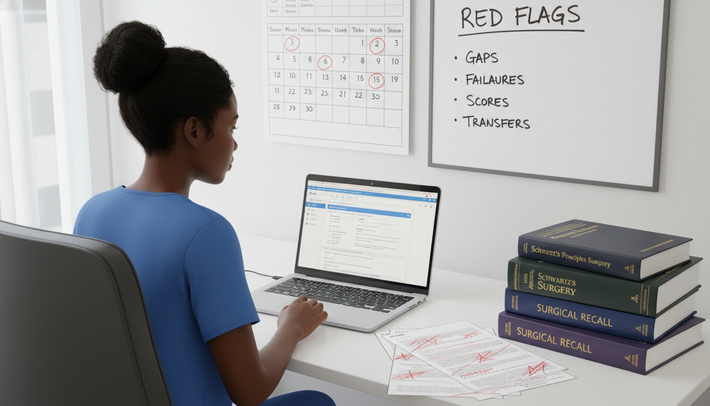
You are on call, sitting in the residents’ workroom as an MS4 on an away rotation. The senior is finishing a note. Your patient is finally stable. You pull out your phone, open Instagram, and fire off a story about “another dumpster-fire night in this hellhole” with a blurry shot of the ED board in the background.
You hit post.
What you do not notice: one of the names on that board is legible. The hospital logo is obvious. And the chief resident who just wrote you a glowing feedback email? She follows you. So does the PD’s administrative assistant.
This is how people get quietly blacklisted before anyone reads their personal statement.
Let me be blunt: social media will not match you. But it can absolutely sink you. Fast. Before you ever get an interview.
Program directors are not running formal CSI investigations on you, but they do live in the same online world you do. A co-resident screenshots something. A faculty member recognizes themselves in a tweet. An applicant tags the program in a half-drunk TikTok. I have watched interviews disappear within 24 hours.
You are in the most background-checked phase of your life. Treat your online presence like part of your application, because for many programs, it already is.
The First Reality Check: Yes, They Look
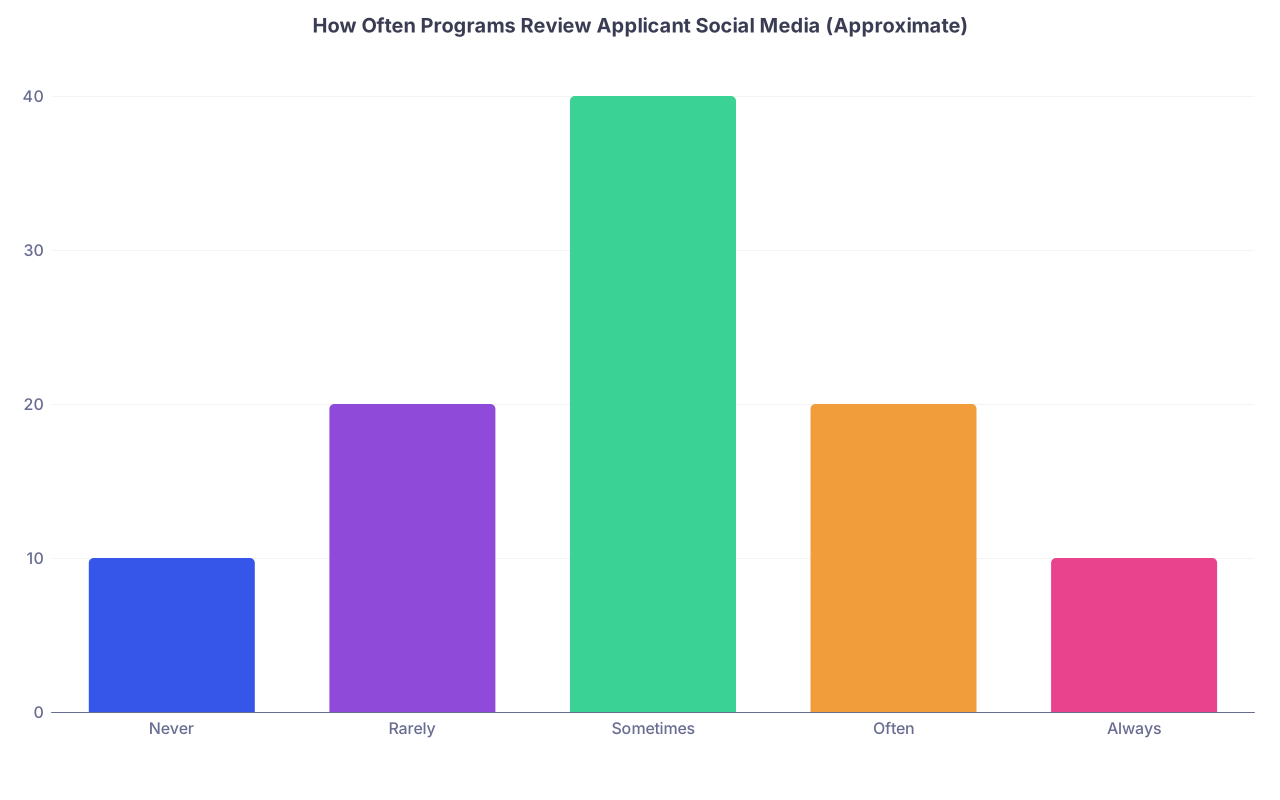
| Category | Value |
|---|---|
| Never | 10 |
| Rarely | 20 |
| Sometimes | 40 |
| Often | 20 |
| Always | 10 |
Do all PDs stalk your Instagram? No.
Do enough of them (or their residents, or coordinators) see what you post that it matters? Yes.
The common mistakes students make here:
- Assuming “private account” means “safe”
- Assuming “they are too busy to care”
- Assuming “that tweet I deleted is gone”
- Assuming “everyone complains, it is normal”
Every cycle, someone finds out the hard way that one bad screenshot beats 10 stellar LORs.
The people most likely to see your content are not PDs sitting on their couch scrolling. It is:
- Residents who just met you on rotation
- Co-students you annoyed on rounds
- Friends from med school who did not match well and are bitter
- Random followers who love drama
They screenshot. They share. Sometimes with your name and ERAS AAMC ID.
You cannot control what other people do. You can control what you give them to work with.
Red Flag #1: Clinical Content That Violates Trust
This is the fastest way to go from “competitive applicant” to “we cannot trust this person in our hospital.”
Concrete missteps I have seen:
- Posting “funny cases” with cropped but still recognizable CT images
- Posting ED/OR pictures where monitors, wristbands, or room numbers are visible
- “De-identified” stories where the details are so specific that any staff member could identify the patient
- Posting selfies with unconscious or vulnerable patients in the background
Does HIPAA technically apply to your vague “42-year-old male with a history of…” story? Maybe not.
Do programs care about technicalities when the core issue is your judgment? Not really.
The mistake is thinking, “I didn’t put any names, so it’s fine.”
The standard PDs use is closer to: “Would I be comfortable if this applicant posted about my family member like this?”
If the answer is no, you are done.
How to avoid this:
- No photos in clinical areas. None. Not the “empty hallway,” not the “just me and this sterile field,” not the “patient’s cool tattoo” with their face cropped out.
- No case details online while you are a trainee. If you have an urge to tell a story, save it for a de-identified, vetted teaching platform or later in your career when you understand the risk better.
- No “look how ridiculous this consult was” tweets. You are mocking real people. Someone will recognize it.
If talking about a case is even a borderline call, treat it as off-limits. You are not a med Twitter influencer. You are an applicant.
Red Flag #2: Trash-Talking Programs, Specialties, or Colleagues
It is July 2nd. Interns are drowning. You tweet: “Some of these IM residents are straight-up incompetent. How did they match here?”
You feel better for 30 seconds. Then someone screenshots. A friend from another institution sends it to their chief. The chief knows your med school. They text your PD: “Is this your student?”
This is how people lose letters.
The common flavors of this mistake:
- Calling a specific program “toxic,” “abusive,” or “garbage” by name in public posts
- Mocking another specialty as “not real doctors” or “failed surgeons”
- Complaining about attendings or residents with identifying details (“that neurosurgery attending at [Hospital X] is a psychopath”)
- Live-posting program gossip from away rotations
You absolutely can have serious concerns about training environments. You can and should talk about them. Just not in public feeds that can be traced back to you during match season.
Programs watch for this because it is predictive. If you are already blasting your colleagues as an MS4, they assume you will be worse as a stressed PGY-2.
Here is what PDs think when they see this pattern: This person will be a cancer to team culture.
They do not care that “you were just venting.” Everyone vents. Mature people do it in private, to trusted peers, not to a hundred random followers.
Red Flag #3: Partying, Substance Use, and “Bad Judgment” Posts
You are allowed to have a social life. Nobody expects you to become a monk.
But there is a line between “normal young adult” and “risk to patient safety,” and social media can make that line very visible.
Examples that have directly cost people interviews:
- Photos of obvious heavy intoxication with captions like “Round 4 of shots, who needs a liver anyway”
- Videos of you clearly drunk or high in what appears to be a clinical setting (yes, people post this)
- Jokes about prescribing yourself or others controlled substances “for fun”
- Posts glorifying driving under the influence or avoiding DUIs
Is one picture of you holding a beer a disaster? No. PDs drink wine too.
The mistake is patterns and tone. Accounts that look like:
- Constant blackout-drunk stories
- “Work hard, party harder” as a lifestyle brand
- Memes about working hungover or still high
No one will email you saying, “We did not invite you because your TikTok looked unprofessional.” They will just quietly move to the next application.
If you are wondering whether something looks bad: it does.
Red Flag #4: Unprofessional Humor and Dark “Med Twitter” Energy
Medicine has dark humor. Gallows humor is real. People decompress that way privately all the time.
Where people get burned is broadcasting that humor where patients, families, and PDs can see it completely out of context.
The big offenders:
- “Body count” jokes about number of patient deaths
- Memes joking about enjoying codes, traumas, or bad outcomes
- Making fun of patient demographics (obesity, mental illness, substance use, language barriers)
- Sexist, racist, or ableist jokes, even if you think they are “obviously ironic”
You might think your followers “get it.” The internet does not. Neither do hospital lawyers.
Once you put that on a public or semi-public account with your face, real name, and school attached, you stop being “stressed student” and become “professional risk.”
Residents will sometimes share screenshots in group chats. “Is this the same [Name] interviewing here next week?” That is the conversation you want to avoid at all costs.
Red Flag #5: Aggressive or Toxic Online Arguments
Another pattern PDs hate: the applicant who lives in the comments, fighting.
Typical red flags here:
- Long, hostile threads arguing with strangers about politics, religion, gender issues, or controversial medical topics
- Ad hominem attacks (“you’re an idiot,” “you should kill yourself,” “people like you shouldn’t reproduce”)
- Screenshots of DMs where you harass or insult someone
- Public feuds with classmates, co-residents, or attendings
It is not that PDs expect you to have no opinions. Many have very strong personal politics themselves.
The problem is conflict style. They are asking: What happens when this person disagrees with a nurse? With a co-resident? With a patient’s family?
If your online record shows you escalate, insult, and refuse to back down, they will move on. There are plenty of applicants who do not look like a lawsuit waiting to happen.
If you are someone who gets pulled into fights easily, the safest move in application season is simple: stop posting. At least stop posting anything remotely controversial.
You do not need to “win” Twitter. You do need to match.
Red Flag #6: Oversharing Political or Polarizing Content (With Identity Attached)
Let me be clear: having political beliefs is not the problem. Advocacy is not the problem. Many PDs respect it.
The risk is how you combine:
- Highly polarizing content
- Extreme language (“anyone who believes X is evil,” “I will never work with people who…”)
- And clear real-life identity (full name, med school, face, location)
You can absolutely be an activist and still match. People do it every year.
Where they get into trouble:
- Calling out specific hospitals or faculty by name as racist / sexist / corrupt in public threads
- Making statements that sound like you would not treat certain patient groups fairly
- Posting highly aggressive “us vs them” rhetoric attached to your professional persona
Even PDs who agree with you politically may be scared off by the intensity and tone. Because their job is to run a residency, not a movement.
If advocacy is a major part of who you are, put it in your ERAS under experiences and talk about it maturely in interviews. Do not let your most unfiltered, angry midnight posts be the main evidence of your values.
Red Flag #7: Inconsistent Professional Identity Across Platforms
One of the more subtle mistakes: your ERAS application presents you as “future serious academic physician.” Your social media presents you as… something else.
Common mismatches:
- Your CV says “dedicated to professionalism” but your Twitter bio is full of crude jokes
- You emphasize interest in pediatrics but your public TikTok is full of explicit sexual content and nothing medical at all
- You describe yourself as “committed to wellness and burnout prevention” while publicly mocking colleagues who ask for help or accommodations
PDs are very sensitive to inconsistency. It reads as lack of self-awareness at best, dishonesty at worst.
You do not need to be “on brand” like a corporation. You do need to avoid having your public persona directly contradict the values you claim in your personal statement.
If someone skimmed your last 50 posts, would they see a person they would be comfortable handing a pager to? Or would they be confused how this is the same person who wrote that polished, earnest ERAS essay?
What PDs Actually Do When They See a Red Flag

There is no universal policy, but there are recognizable patterns.
Depending on severity, a PD or selection committee member might:
- Quietly drop you from the interview list. No explanation. Just fewer invites.
- Ask someone at your school about “professionalism concerns”
- Flag your name mentally as a risk, making every small error in interview season count more
- If truly egregious (HIPAA breach, explicit threats, clear hate speech), report to your school
The part you will feel: the silence. Or the “we regret to inform you” emails.
You will not usually get feedback that social media hurt you. So you will blame scores, school prestige, research. You will not fix the actual leak.
Damage Control: What To Do Right Now
If you are in the application or pre-application phase, your move is not “panic.” It is “audit.”
Step 1: Search yourself like a PD would

| Step | Description |
|---|---|
| Step 1 | Start |
| Step 2 | Google your name |
| Step 3 | Check images & first 2 pages |
| Step 4 | Search name + med school/hospital |
| Step 5 | Review all public profiles |
| Step 6 | Remove or lock risky content |
| Step 7 | Ask trusted friend to re-check |
| Step 8 | Ongoing caution during season |
Use:
- Google your full name, plus your med school, city, and common nicknames
- Look at Google Images too
- See what comes up on Facebook, Instagram, TikTok, Twitter/X, LinkedIn
Then log into every account you own. Yes, even the one from M1 that you “never use anymore.”
Step 2: Lock down or clean up
You have three main strategies:
| Strategy | Visibility | Risk Level | Effort to Maintain |
|---|---|---|---|
| Delete content | None | Lowest | Medium (one-time) |
| Make private | Limited | Medium | Low |
| Stay public | High | Highest | High (ongoing) |
Honestly, for most people, the safest choice during match season is:
- Set personal accounts to private
- Remove your full name and med school from bios
- Delete obviously problematic or borderline posts, not just hide them
- Untag yourself from questionable photos friends posted
If you want a public professional account (some people do):
- Use your real name and school
- Treat it like a LinkedIn with occasional human moments
- Zero clinical details, zero drama, zero rage-posting
Step 3: Change habits, not just history
The dumbest move is doing one giant delete, then continuing to post the same stuff thinking “this time it is fine.”
During ERAS and interview season:
- Do not post when you are angry, tired, drunk, or on call
- Do not live-comment interviews, ranking decisions, or impressions of programs
- Do not subtweet about “a certain program” you just interviewed with
- Do not share screenshots of program emails or Zoom interviews
If you are bored between cases, open Anki. Not Twitter.
Special Trap: “Anonymous” or Pseudonymous Accounts
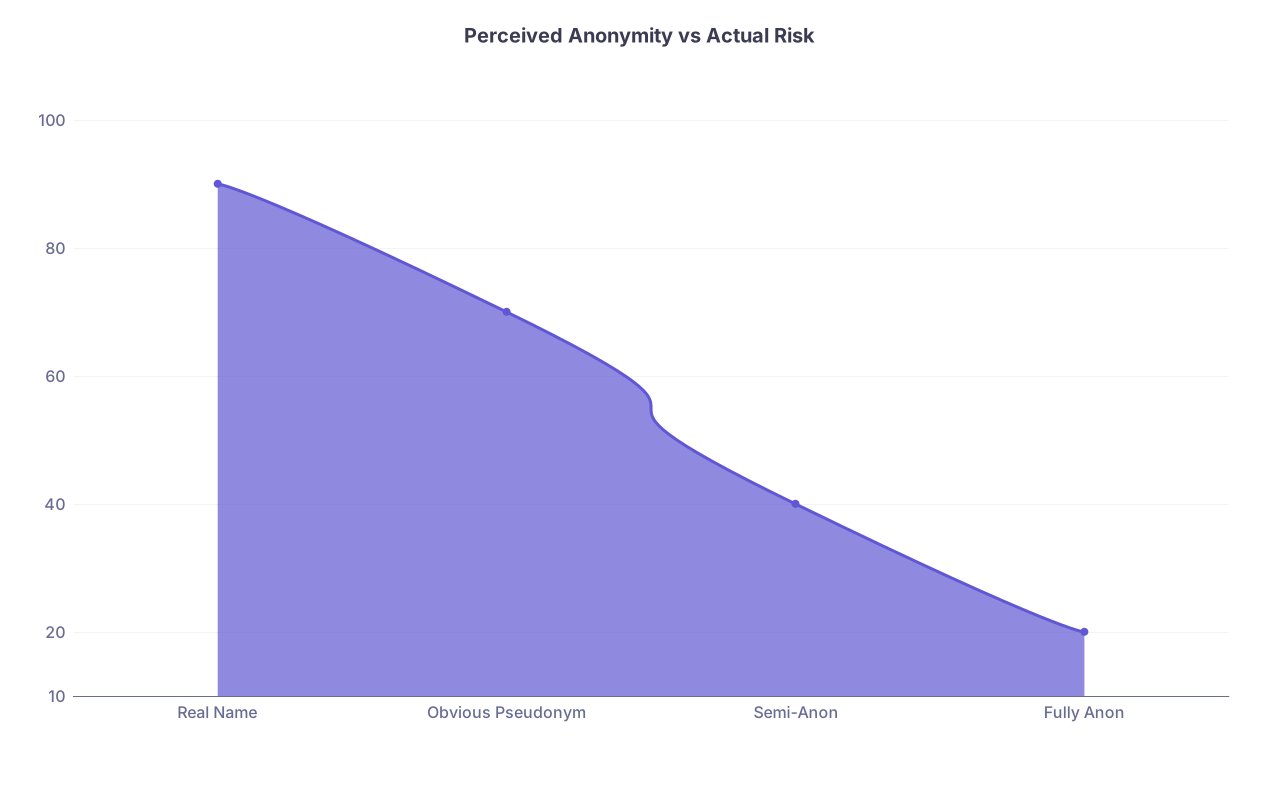
| Category | Value |
|---|---|
| Real Name | 90 |
| Obvious Pseudonym | 70 |
| Semi-Anon | 40 |
| Fully Anon | 20 |
Every cycle, there is at least one “anonymous” med account that gets unmasked. Friends talk. People slip up. They post a call schedule, a rotation photo, a unique story that someone recognizes.
If your “anon” account includes:
- Your real photos
- References to your specific med school or hospital
- Details of rare cases or unique events
- Same writing style as your personal account
Then it is not anonymous. It is just delayed-identifiable.
If that account is full of complaining, mocking, dark humor, or borderline HIPAA violations, you are playing roulette with your match.
If you absolutely cannot resist having an anonymous account, at least:
- Never mention your real name, school, city, or hospital
- Never post patient details or workplace photos
- Assume it could be linked back to you tomorrow and ask: would that be survivable?
Again: the safest move is to stop. Temporarily. This phase of your career is too high-stakes.
What “Professional But Human” Actually Looks Like Online

You do not need to scrub all signs of personality to match. In fact, some programs like seeing that you are a real person with hobbies.
What does a safe, healthy online footprint look like?
- Occasional photos with family, friends, or pets (nothing wild)
- Posts about hobbies: running, music, cooking, travel (non-obnoxious)
- The occasional neutral comment about med school life (“long day, grateful for my team”)
- Maybe some carefully framed advocacy or academic posts if that is your lane
What it does not include:
- Complaints about specific people or institutions
- Anything you would not say in front of a patient’s parent sitting at the bedside
- Any content you would be embarrassed to see on a projector at noon conference with your name on it
That test is crude but effective: Would I be ok if this post was printed and handed to my PD during my interview?
If no, do not post.
Do Not Outsource Your Judgment
One last trap: “My friend said it’s fine,” “my chief thought it was funny,” “people liked it so it must be ok.”
Most people have terrible instincts about long-term reputation risk. They focus on immediate feedback: likes, laughs, comments.
Program directors do not care how many likes your meme got. They care whether, if something goes wrong on night float, they would be comfortable standing next to you in court.
Your job is not to become paranoid and plastic. Your job is to respect the difference between private conversations and permanent public record.
Because that is what social media is for you right now: a searchable, screenshot-able, non-expiring supplement to your application.

Final Takeaways
- Social media will almost never help you match, but one reckless post can absolutely hurt you. Your judgment online is part of how programs assess whether to trust you.
- Anything involving patients, workplace complaints, heavy substance use, or aggressive conflict is radioactive during match season. Delete it, lock it down, or do not post it.
- Do a real audit now, then change your habits. Assume every post could be screenshotted with your name next to it and shown to a PD. If that thought makes you uneasy, you already know what to do.