
Failing Step 1 right before MS3 is a crisis—but it’s also a scheduling problem you can solve.
I’m going to talk to you like someone who just opened their score report, felt their stomach drop, and now has an MS3 schedule starting in 2–4 weeks. You’re not looking for inspirational posters. You need: What do I do with my rotations? How do I avoid torpedoing residency?
Let’s rebuild your third year so this becomes a recoverable red flag instead of a career-ending one.
1. First 48 Hours: Do Not Pretend This Didn’t Happen
Step 1 failure before rotations is not a “maybe I’ll just study nights and weekends and squeeze in a retake” situation. That is how people fail twice.
Here’s what you do in the first 48 hours:
- Pull your actual score report.
- Take screenshots or print it.
- Email or message to set up meetings with:
- Your dean of student affairs or academic support dean
- Your school’s Step advisor (if they have one)
- The registrar / scheduling coordinator (for rotations)
You say something like:
“I just received my Step 1 result and did not pass. My MS3 schedule starts on [date]. I want to proactively adjust my third-year plan to maximize chances of passing on the next attempt and protecting my residency prospects. Can we meet this week?”
Then you clear your next 7–10 days as much as possible: no huge obligations, no extra shifts, no big travel.
Because you’re about to make one big decision: Do you start rotations on schedule, or do you pause to fix Step 1 first?
2. The Core Decision: Rotations Now vs. Delaying MS3
Here’s the fork in the road. And yes, this matters a lot.
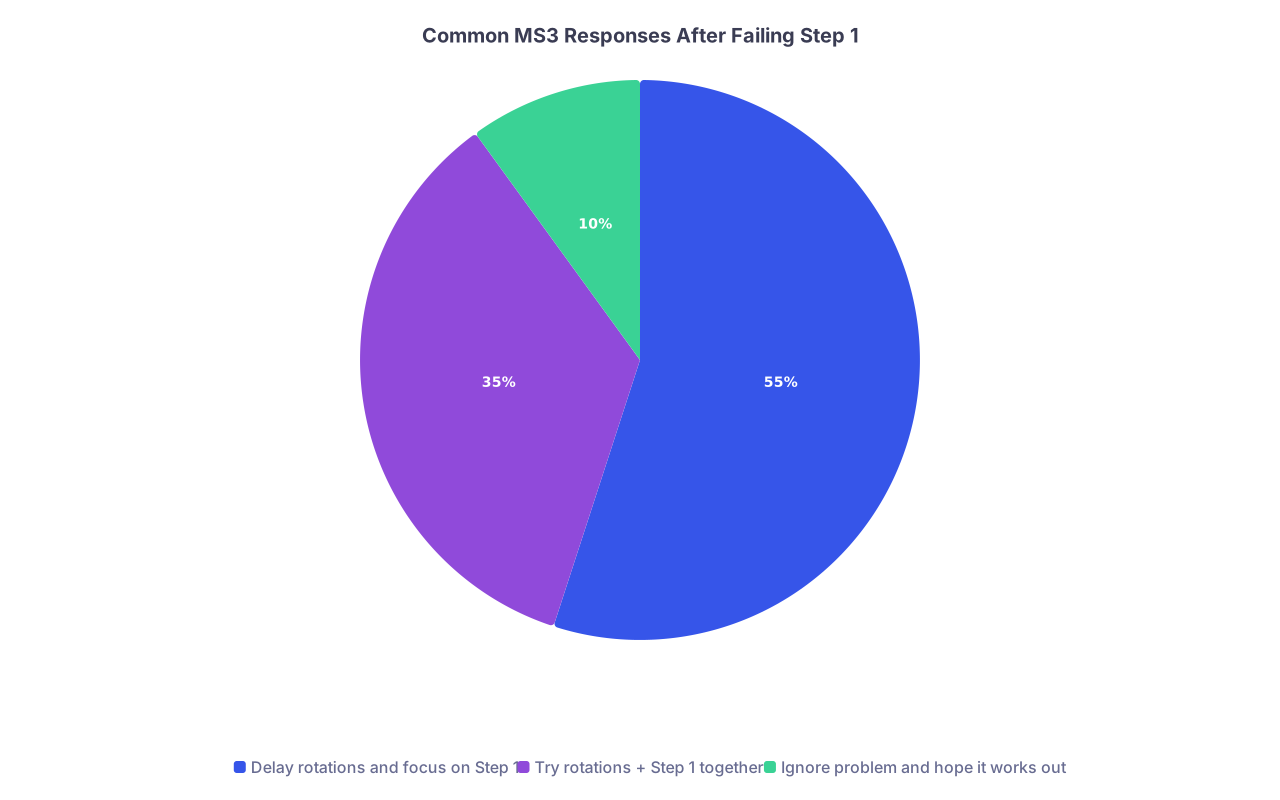
| Category | Value |
|---|---|
| Delay rotations and focus on Step 1 | 55 |
| Try rotations + Step 1 together | 35 |
| Ignore problem and hope it works out | 10 |
I’ve watched all three. Only one consistently ends well.
Option A: Delay Rotations, Fix Step 1 First
This is usually the smart move—even if it feels like social death when your classmates move on without you.
You:
- Take a formal leave or “Step remediation” block
- Treat Step 1 like a full-time job for 6–10 weeks
- Do not start clinicals until you have:
- A passing score
- A realistic plan for Step 2, knowing you’ve already shown vulnerability
This option is better when:
- Your score was well below passing (e.g., not a 1–2 point miss, but a clear gap)
- Your UWorld percentages were low, not just a bad test day
- You struggled on basic science exams in pre-clinicals
- You’re the kind of student who needs focused time, not multitasking chaos
What programs will think later:
- You had a failure, you addressed it head-on, came back with a pass (ideally strong)
- You showed judgment and maturity in not trying to “wing it” during clinicals
Option B: Start Rotations and “Squeeze In” a Retake
I only endorse this in very specific cases, and even then I grit my teeth.
Maybe:
- You missed the pass by a hair
- Your practice tests were consistently passing before the real exam
- Your school has hard rules about not delaying rotations
- You have strong evidence it was a fluke (illness, test center disaster, etc.)
If you choose this, you must restructure MS3 ruthlessly. No magical thinking.
Option C: Denial / Minimal Change
“I’ll just work harder and figure it out.”
This is how you end up with:
- One failed Step 1
- Marginal clinical performance because you’re half-studying, half-drowning
- A delayed Step 2
- Then a weak application explaining a pattern of underperformance
Do not choose this path. Programs can smell it in your file.
3. How to Restructure Your MS3 Schedule (Scenario-Based)
Let’s get into actual scheduling. I’ll break it into two main scenarios.
Scenario 1: You Delay Rotations to Focus on Step 1
This is the more controlled, cleaner option. Here’s how to build it.
Step 1: Quantify the Damage
Sit with your score report and answer:
- How far below passing were you?
- Which content areas were weakest? (Look for 2–3 clearly low bars)
- What was your UWorld performance?
- How many NBME practice exams did you take, and what were your scores?
Write this out for your advisor. Not vibes. Data.
Step 2: Map a Dedicated Study Block
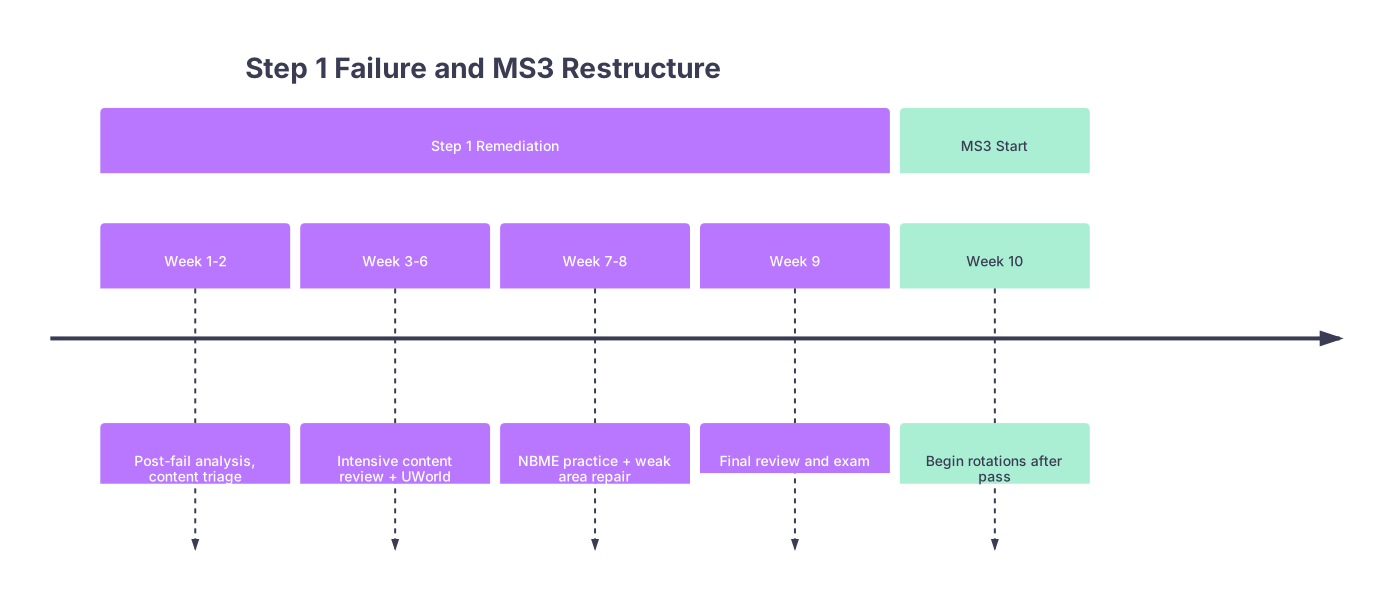
You want 6–10 weeks of full-time Step 1 prep. Example:
| Period | Event |
|---|---|
| Step 1 Remediation - Week 1-2 | Post-fail analysis, content triage |
| Step 1 Remediation - Week 3-6 | Intensive content review + UWorld |
| Step 1 Remediation - Week 7-8 | NBME practice + weak area repair |
| Step 1 Remediation - Week 9 | Final review and exam |
| MS3 Start - Week 10 | Begin rotations after pass |
During this block:
- No rotations
- No research ramp-up
- Minimal nonessential commitments
Your daily schedule looks more like:
- 6–8 hours of structured study
- 40–60 UWorld questions/day with full review
- Scheduled NBME exams every 1.5–2 weeks once you stabilize
Step 3: Adjust the Rest of MS3
Once you’ve passed and are cleared to start rotations, your third year might now be 2–3 months “shifted.”
Common downstream changes:
- Some core rotations move into what would’ve been early MS4
- You might graduate later than your original class (sometimes; not always)
- Your Step 2 timeline moves too—often into late MS3 / early MS4
You want your schedule to protect three things:
- Protected time before Step 2 CK
- Time for at least one or two “audition” rotations in your target specialty
- Space to recover from the emotional drain of the fail + retake
If the school offers flexibility, a restructured year might look like:
| Block | Months | Plan |
|---|---|---|
| 1–2 | Jul–Aug | Step 1 remediation + retake |
| 3–4 | Sep–Oct | Internal Medicine (core) |
| 5 | Nov | Psychiatry (core) |
| 6 | Dec | Family Med (core) |
| 7–8 | Jan–Feb | Surgery (core) |
| 9 | Mar | Step 2 CK dedicated study |
| 10 | Apr | Step 2 CK exam + short elective |
Specifics will vary, but the logic is stable: big exam → core rotation → protected study → next exam.
Scenario 2: You Start Rotations and Prepare for a Retake
If you and your dean decide you’re going to push forward with rotations while fixing Step 1, you cannot just “see how it goes.”
You need structure and brutal honesty.
Step 1: Front-load Lighter Rotations
You do not start with Surgery 8 weeks + 6 AM rounds if you’re also trying to fix Step 1. That’s a setup for burnout and mediocrity.
You instead push for:
- Family Medicine
- Psychiatry
- Outpatient-heavy IM subsites
- Any rotation at your school known for predictable hours and minimal call
Then you build in:
- A dedicated 4-week study block after 1–2 light rotations for the retake
- No big exams or oral presentations during that block
Step 2: Pre-commit a Drop-Dead Plan
You tell yourself and your dean:
“If I cannot consistently hit [passing + 10–15 points] on NBME practice exams by [date], I will pause rotations and switch to full-time Step 1 prep.”
Because what you cannot do is:
- Continue rotating while sitting on a failing-level performance
- Roll into a second fail because you were too proud to pause
You must treat the second attempt as non-negotiable pass territory. A second failure is one of the hardest red flags to overcome in residency applications.
4. How This Affects Your Residency Application Strategy
Failing Step 1 isn’t the end. But it changes the rules.
Programs don’t just ask: “Did they fail?”
They ask: “What happened next?”
Here’s what good “next” looks like:
- Step 1: Fail → retake → solid pass
- Step 2 CK: Strong score (often more important now that Step 1 is Pass/Fail at many schools, but failures still matter)
- MS3: Mostly honors/high pass or at least clear upward trend
- Narrative: You explain the failure cleanly, take responsibility, and show that every datapoint after that moves in the right direction
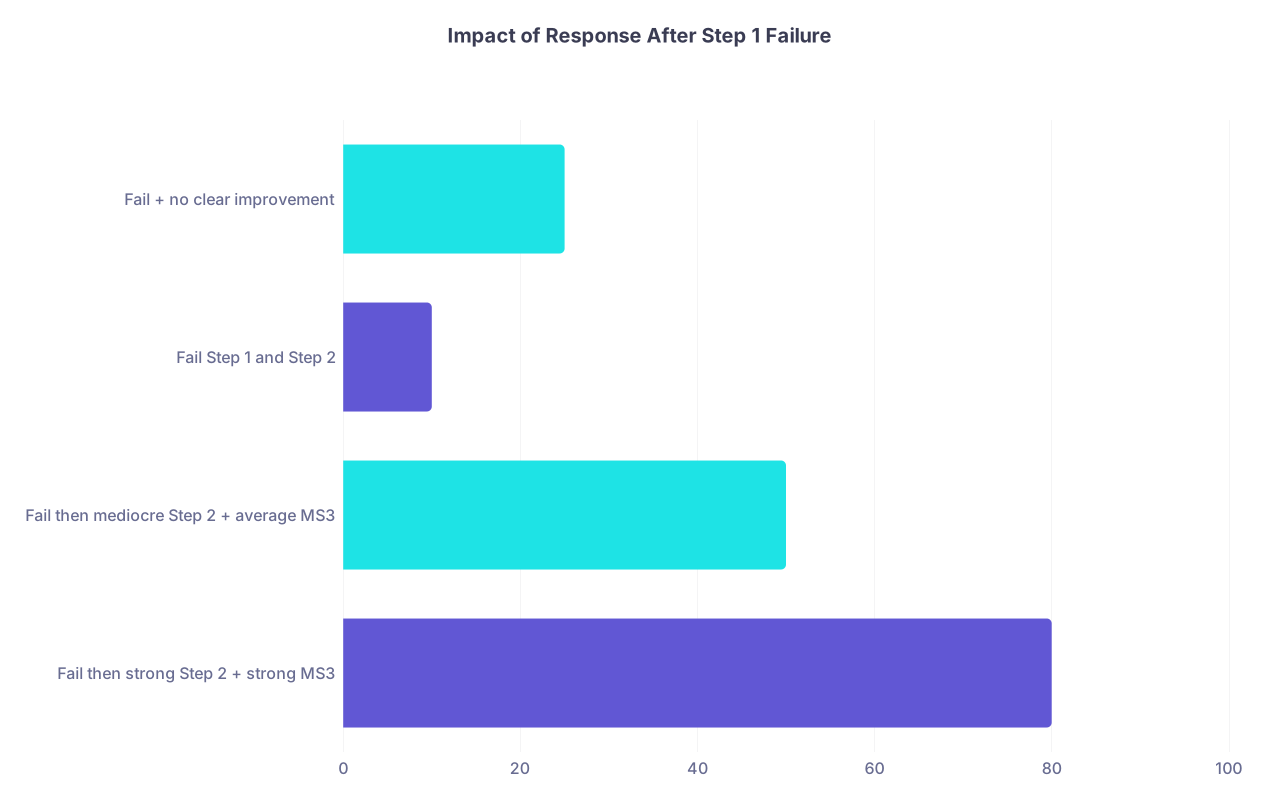
| Category | Value |
|---|---|
| Fail then strong Step 2 + strong MS3 | 80 |
| Fail then mediocre Step 2 + average MS3 | 50 |
| Fail Step 1 and Step 2 | 10 |
| Fail + no clear improvement | 25 |
(Values here roughly reflect how “viable” each profile is in the Match, not exact percentages.)
How to Rebuild Your Narrative During MS3
While you’re fixing your schedule, you’re also constructing your future personal statement and interview answers.
You want to be able to say:
- “I struggled with Step 1 because [specific, honest reason—poor strategy, personal crisis, etc.].”
- “I changed my approach by [concrete changes: daily schedule, resources, support, therapy, time management].”
- “Since then, I’ve [passed on first retake, did well on Step 2, performed strongly in clinical rotations, earned strong comments].”
You do not want:
- Excuses with no ownership
- Vague claims of “I just had a bad day” with no subsequent improvement
- Continuing academic issues that suggest the fail was just the first crack in a pattern
5. Rotations to Prioritize and How to Stack Them
Your failed Step 1 changes which rotations matter most and how you schedule them.
Priorities Now:
Internal Medicine
- Heavy on knowledge, rounding, notes, presentations
- IM grade + comments will be scrutinized by basically every specialty
Core Surgery / OB / Peds
- Not because you’ll necessarily go into them, but because these are high-stress, high-visibility blocks
- A strong performance here says: “Under pressure, I do not crack”
Your Intended Specialty
- If you know your target, protect time to do at least one rotation at a place you might apply to residency
What That Means for Scheduling
If you delayed for Step 1:
- Do NOT pile all your most demanding rotations back-to-back
- You just went through a failure + remediation + retake; you’re at risk for burnout
- Alternate heavier and lighter blocks when possible
Example pattern:
- IM (heavy) → Psych (lighter) → Surgery (heavy) → Outpatient FM (lighter) → OB (heavy)
If you are still worried about your test-taking ability, try to avoid:
- Having Step 2 prep overlap with the heaviest rotation
- Leaving Step 2 until the last possible moment (programs like seeing it early if you have a prior failure)
6. Protecting Step 2 CK After a Step 1 Fail
Here’s the silent rule: once you’ve failed Step 1, Step 2 becomes your redemption exam. You cannot treat it casually.
You want at least:
- 4 dedicated weeks (6 is better if your school allows)
- Minimal clinical duties during that time
- A tested, fixed daily routine, not improvisation
Given that you’re restructuring MS3 anyway, you should:
- Identify a 4–6 week window now—before you start anything else
- Block it on your calendar as “non-negotiable Step 2 time”
- Tell your dean and rotation coordinator that all scheduling must work around this
When programs see:
- Step 1 fail
- Step 2 strong score (or at least clear pass well above minimum)
- Upward trend in performance
They mentally move you from “maybe risky” to “had a stumble, recovered.”
7. Emotional and Practical Landmines To Avoid
I’ve watched people in your exact spot self-sabotage with the same 5 mistakes.
Here they are so you can side-step them.
Hiding the failure from everyone at school.
You need institutional support. Scheduling power. Documentation. Letters that explain your growth. Not telling anyone is how you get stuck with a schedule that makes passing nearly impossible.Keeping the same study methods and just “working harder.”
If the method gave you a fail, it’s broken. Change resources, structure, question habits, everything. Do an autopsy on your old approach.Trying to maintain pre-fail extracurriculars at full volume.
Cut back. Research, leadership, extra clinics—keep only what is essential or deeply restorative. Your main job now: fix Step 1, protect Step 2, perform on rotations.Refusing to consider graduation delay as an option.
Is it ideal? No. But “graduated a year later with strong scores and solid clinical performance” beats “on-time grad with multiple board red flags and burned-out evaluations.”Letting shame run the schedule.
You’ll be tempted to make decisions based on “I don’t want people to think I’m behind” instead of “What will give me the best shot at a good residency?” You must fight that instinct.
8. How to Talk About This Later (Without Sounding Defensive)
You’re restructuring MS3 not just to survive, but to give Future You a clean story to tell in ERAS, personal statements, and interviews.
Your ideal future explanation hits these beats:
Brief context, no excuses.
“I failed Step 1 during a period when I’d underestimated how much structure I needed in my studying and over-relied on passive review.”Clear action.
“I worked with my dean to adjust my third-year schedule, took a dedicated remediation period, switched to an active QBANK-based strategy, and treated my retake like a full-time job.”Concrete result.
“I passed Step 1 on my next attempt and then prioritized Step 2, scoring [X]. I also maintained strong performance in my core rotations, which I’m proud of given that period.”Lesson learned that ties into residency.
“That experience forced me to get honest about my weaknesses early, ask for help, and build systems. Those are the same habits that now help me on busy call nights and complex patients.”
Everything you’re doing now with your schedule is so that this future story writes itself.
FAQ (Exactly 3 Questions)
1. Is failing Step 1 before rotations an automatic deal-breaker for competitive specialties (derm, ortho, plastics, ENT)?
It’s not an absolute deal-breaker, but it makes an already brutal path steeper. To stay in contention for the most competitive fields, you’d need:
- A clear pass with a buffer on the Step 1 retake
- A very strong Step 2 CK (often well above the average for that specialty)
- Outstanding clinical performance, research, and letters
- A realistic mix of programs on your list (including less-name-brand places)
You should have a blunt conversation with a specialty advisor in that field after your retake and at least one strong core rotation. Some students pivot specialties after a fail; others stay the course but build a far more risk-conscious application list.
2. If I delay rotations and end up graduating later, will residency programs care about the extra year?
Programs care far more about why you took extra time and what your performance looked like afterward than the mere fact that your graduation year shifted. A narrative like, “I took an additional year to remediate a failed Step 1, passed on the next attempt, scored well on Step 2, and used the time to solidify my clinical skills,” is infinitely better than, “I rushed to stay on time and racked up more red flags.”
A single extra year with a clean upward trajectory is usually manageable. Multiple extended leaves with ongoing problems? That’s when it becomes a major concern.
3. Should I tell my attendings during MS3 that I failed Step 1?
Generally, no. Your day-to-day clinical evaluation should be based on how you show up on the wards, not your exam history. The people who absolutely should know:
- Your dean / student affairs officers
- Any formal academic support staff
- Possibly your core clerkship directors if schedule changes are needed
You might selectively share the story with a mentor after you’ve passed the retake and they already know you as a strong worker; sometimes that context helps them write a more powerful letter. But you do not need to open with, “Hi, I’m the student who failed Step 1.” Let your work on rotation define you first.
Open your MS3 schedule right now and mark three things in red: your potential Step 1 remediation window, your future Step 2 dedicated block, and your heaviest rotations—then email your dean today to start reshaping that map before it reshapes your career for you.