Program directors do not automatically reject you because of a leave of absence. But they absolutely notice it, they absolutely talk about it, and they absolutely judge how you handled it.
Let me tell you what actually happens in the committee room when that “Leave of Absence” line shows up on your transcript or MSPE.
Not the sanitized version you get from student affairs. The real version.
How PDs Actually Encounter Your Leave of Absence
Every PD I know scans applications in roughly the same order: board scores (if available), school, class ranking/MSPE language, and then that medical school transcript. The transcript is where the leave of absence lives.
Here’s what really happens.
They scroll. They skim course blocks. Then the PD hits:
“Leave of Absence – Academic Year 2022–2023”
Or worse:
“Leave of Absence – Spring 2022 (Academic Difficulty)”
That’s the moment you become a topic of conversation instead of just a file.
They do not care about the exact date. They care about three things:
- Why did you leave?
- How clean is the story?
- What happened when you came back?
The truth: they’re not scared of the leave. They’re scared of future problems on their service. Nobody wants a resident who disappears in January of intern year, or melts down halfway through a night float month, or needs months of remediation when everyone else is drowning.
So the leave of absence becomes a proxy: risk signal or maturity signal. And you get sorted quickly into one of those buckets.
The First Split: “Innocent” vs “Concerning” Leaves
PDs mentally bucket leaves of absence into two broad stacks: understandable and potentially dangerous. They won’t say that out loud to you, but they absolutely say it to each other.
Bucket 1: The “Understandable” Leaves
These are the ones that, behind closed doors, PDs shrug at and move on.
Common examples:
- Medical illness, surgery, or serious health event
- Pregnancy / maternity or paternity leave with a clear timeline
- Major family crisis (parent with cancer, sibling ICU situation, etc.)
- Military deployment / required service
- Structured research year that’s clearly intentional and productive
These aren’t really “red flags” if:
- The timeline makes sense
- There’s a clear, finite reason
- You came back and performed solidly or better
In discussions, it sounds like this:
“She took a semester off for surgery, came back, passed everything, solid Step 2, strong letters.”
“Okay, that’s fine. Move on.”
There might be a follow-up in the interview: “I see you had a health-related leave — how are you doing now?” But that’s to confirm stability, not to grill you.
Bucket 2: The “Concerning” Leaves
This is where PDs start leaning back in their chairs and asking more questions.
These usually include:
- Academic difficulty / remediation leave
- Unspecified “personal reasons” with no real explanation
- Mental health/failure crisis with poor subsequent performance
- Behavioral / professionalism issues that triggered a leave
- Repeated or multiple leaves
When the transcript says “personal reasons” and the MSPE says nothing or is vague? PD radar goes up. PDs have seen too many messy stories hidden under “personal reasons.”
In the committee room, it sounds like:
“Why did he leave?”
“MSPE says ‘personal reasons,’ no detail.”
“What happened when he came back?”
“He failed Medicine, had to repeat the clerkship, Step 2 is 213.”
“…Okay. That’s a problem.”
Nobody is obligated to give you the benefit of the doubt. And most will not if the pattern after the leave looks unstable.
How the Type of Leave Changes the Reaction
Let’s break down what’s actually going through a PD’s head depending on the reason for the leave.

Medical or Surgical Leave
This is the simplest category.
What PDs think:
- “Is this a chronic, ongoing issue that will affect residency performance?”
- “Did they fully recover and come back strong?”
- “Did they own the story, or are they dodgy about it?”
If the leave was for something like an ACL reconstruction, cancer treatment, a complicated pregnancy, etc., and your post-leave performance is solid, most PDs move on. They see that as part of life, not a character flaw.
The only time they hesitate is if:
- There are multiple, scattered absences
- You seem fragile in your interview discussion
- Your clinical performance and Step 2 lag compared to peers after returning
They’re imagining 28-hour calls. Winter viruses. Service backups. They want to know you can physically withstand the job. If your narrative reassures them, the leave becomes background noise.
Mental Health Leave
Here’s the part nobody says out loud in public meetings: mental health leaves still make many PDs nervous. Not because they don’t believe in mental health. They do. But because they’ve been burned.
Everyone has a story of the intern who:
- Was amazing on paper
- Had a history of a prolonged mental health leave in med school
- And then collapsed under residency stress, needed extended leave, disrupted schedules, and forced coworkers to pick up slack
So when they see:
“Leave of Absence – Spring 2021 (Personal / Mental Health Reasons)”
They ask:
- “How severe was this?”
- “How stable are they now?”
- “Do we see resilience in their subsequent years?”
- “Is this well-managed or still fragile?”
They’re not supposed to ask all of that. But they do. Quietly.
If you came back and:
- Passed everything on time
- Performed strongly clinically
- Have solid, specific letters describing your reliability and work ethic
- Have a calm, grounded, matter-of-fact way of describing what happened
Then a lot of PDs will mark it as “addressed” in their minds and move on.
If your story is vague, emotional, or defensive, that’s when doubts fester.
Academic / Remediation Leave
Academic leaves are different. These are bona fide red flags for many programs.
This can look like:
- Failed multiple preclinical courses leading to a leave
- Failed a core clerkship and stepped away
- Significant board delay tied to poor performance
What PDs think:
- “How hard did the school try before they pulled the plug and gave a leave?”
- “Is this someone who was chronically behind?”
- “Did they need extra hand-holding to get through?”
- “What changed after the leave?”
The worst version is an academic leave followed by:
- More failures
- Bare-minimum clinical grades
- Low Step 2
That screams ongoing risk.
The best version is:
- Academic leave early in med school
- Clear, concrete explanation of what went wrong and what you changed
- Strong upward trend: better grades, strong Step 2, excellent clinical evaluations
In other words: was this a one-time stumble early in the course, or a fundamental capacity issue?
“Personal Reasons” With No Detail
This is the one that really irritates PDs.
When they see “Leave of Absence – Personal Reasons” with zero elaboration in the MSPE or personal statement, it does not make them think: “Ah yes, privacy.” It makes them think: “What is being hidden from me?”
They assume the worst. Substance use. Legal issues. Disciplinary actions. Major instability. Because that’s what has been hidden before under “personal reasons.”
If you go this route — leaving it vague with no explanation anywhere — understand the tradeoff. You’re giving up control of the story and leaving PDs to fill in the blanks with their own past experiences. That rarely benefits you.
What Matters More Than the Leave Itself: The Pattern After
Here’s the secret: the leave is the hook. The story after the leave is what really decides whether you sink or swim.
PDs are pattern-readers. They care less about “you needed six months off in 2021” and much more about what your trajectory did from 2022 onward.
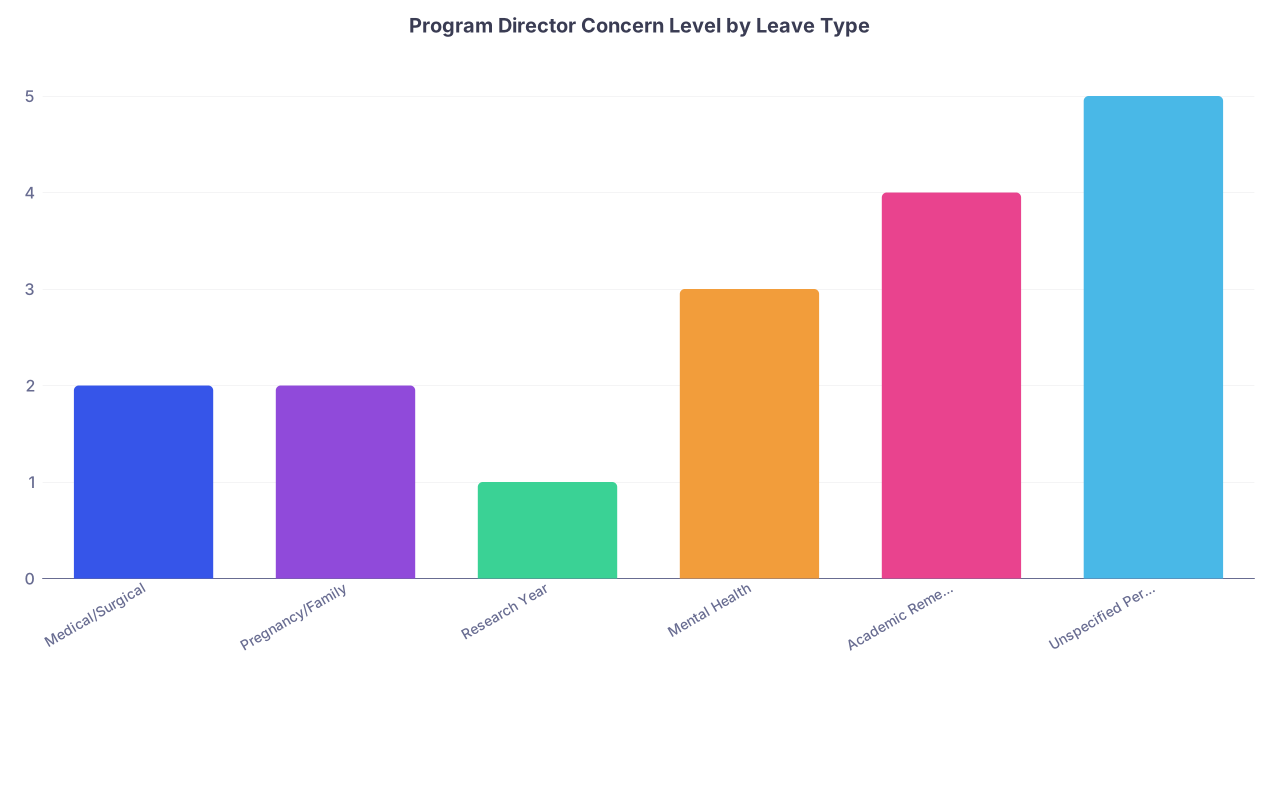
| Category | Value |
|---|---|
| Medical/Surgical | 2 |
| Pregnancy/Family | 2 |
| Research Year | 1 |
| Mental Health | 3 |
| Academic Remediation | 4 |
| Unspecified Personal | 5 |
(Scale: 1 = low concern, 5 = high concern. This is roughly how PDs behave, whether or not they say it out loud.)
If your pattern is:
- Pre-leave: Mixed performance
- Leave
- Post-leave: Strong grades, good Step 2, no further gaps, excellent letters
Then in PD brain, the narrative becomes:
“They had something happen, dealt with it, and came back stronger. Okay.”
If your pattern is:
- Pre-leave: Struggles / failures
- Leave
- Post-leave: Marginal, more red flags, weak letters
Then the narrative becomes:
“This person has a chronic performance problem and took a leave in the middle of it.”
The PD does not want to be the next person who has to grant another leave or put you on remediation again, this time as an intern.
How Your School’s MSPE and Deans Play Into This
There’s another layer most students underestimate. The MSPE and the quiet backchannel communication between deans and PDs.
Some schools are extremely protective. They reduce everything to “personal reasons” and redact all context. Others are blunt:
“The student took an academic leave following multiple course failures in the second year.”
PDs know which schools sugarcoat and which schools are direct. They age-adjust what they read.
I’ve sat in meetings where a PD said:
“This is School X. If they’re willing to call it an academic leave, it was bad.”
I’ve also heard:
“This is School Y. ‘Personal reasons’ might be anything from a broken engagement to rehab. We need to ask directly in the interview.”
Sometimes PDs email or call the dean or clerkship director about borderline applicants. That’s when your narrative had better match what your school has been saying.
If you claim “I took time for family reasons” and the dean hints strongly at an academic or professionalism issue? You’re done. Integrity question. That kills applications faster than the leave itself.
How to Frame a Leave of Absence So PDs Don’t Torpedo You
You cannot erase the leave. You can control how it lands. And some of you are doing this badly.

| Step | Description |
|---|---|
| Step 1 | See Leave on Transcript |
| Step 2 | Check Performance After Leave |
| Step 3 | Look for Explanation in MSPE/PS |
| Step 4 | Assume Higher Risk |
| Step 5 | Consider Low/Moderate Risk |
| Step 6 | Flag as High Risk |
| Step 7 | Reason clear? |
| Step 8 | Still vague? |
| Step 9 | Upward Trend? |
1. You Need One Clean, Consistent Story
PDs hate ambiguity more than they hate leaves. You need a single, coherent narrative that:
- Matches what’s in your MSPE
- Matches what any dean or advisor might say if asked
- Is the same in your personal statement, supplemental essay, and interview
You do not need every gritty detail. You do need clarity.
Something like:
“During my second year, I took a one-semester leave of absence due to a significant family health crisis. During that time, I was the primary support for a close relative. Once the situation stabilized, I returned to school, completed the remaining coursework and clerkships on time, and have since been able to fully focus on my training.”
Or, for mental health:
“In my second year, I took a medically-approved leave to address depression and anxiety that had built up during training. I used that time to engage in treatment, develop stable coping strategies, and return with a sustainable approach to medicine. Since returning, I completed all clinical rotations on schedule and have maintained strong evaluations.”
Short. Direct. Past tense. Stable.
What PDs listen for in your wording:
- Do you sound like someone in ongoing crisis?
- Or someone who had a hard season, got help, and is now steady?
2. Show, Don’t Just Tell, That You’re Stable
Every PD has heard: “I’m fine now.” They do not believe words by default. They believe patterns.
Evidence that calms PDs down:
- Solid Step 2 CK score after the leave
- Continuous enrollment with no further leaves
- Strong clerkship performance, especially in Medicine, Surgery, and your specialty
- Letters that explicitly talk about reliability, composure under stress, work ethic
If you had a mental health leave and your psychiatry attending writes:
“They were consistently on time, handled challenging cases effectively, and sought feedback maturely.”
That matters a lot more than your own claim of resilience.
If you had an academic leave and your Medicine letter says:
“They functioned at the level of a sub-intern, took ownership of patient care, and required minimal supervision.”
That reassures them this isn’t a chronic cognitive problem.
3. Don’t Overshare. Don’t Undershare.
There’s a line.
Oversharing looks like:
- Going deep into trauma details in your personal statement
- Crying in the interview while recounting the leave
- Making the leave the emotional center of your entire application
PDs will tag you as emotionally volatile or still in process. That’s not the reaction you want.
Undersharing looks like:
- Refusing to give any reason
- Saying “personal reasons” and clamming up
- Acting defensive or annoyed when asked
That triggers suspicion and makes the leave a bigger deal than it has to be.
The sweet spot: brief, factual, past tense, with clear evidence you’re functioning well now.
How Different Specialties React to Leaves of Absence
Not all PDs view leaves the same way. Some fields are harsher than others.
| Specialty | Typical Strictness | Comments |
|---|---|---|
| Dermatology | Very High | Any red flag hurts a lot |
| Plastic Surgery | Very High | Tiny applicant pool, intense scrutiny |
| Orthopedic Surgery | High | Academic/mental health leaves hurt |
| EM / Anesthesia | Moderate-High | Stability and performance are key |
| Internal Medicine | Moderate | Context and trend matter a lot |
| Pediatrics | Moderate | More open to well-explained leaves |
Competitive surgical subspecialties: one unexplained or academic leave can quietly move you into the “nice but no” pile, unless there’s an exceptional recovery and strong advocacy from faculty.
IM, peds, family med, psych: far more context-sensitive. They see more students with non-traditional paths and are used to real life intruding on training.
Psychiatry is interesting. They’re more philosophically sympathetic to mental health leaves. But they’ve also seen residents with poorly controlled illness implode dramatically. So they’re supportive but still cautious.
Bottom line: the more competitive the specialty and the fewer spots, the less tolerance there is for any perceived instability unless your “after” story is phenomenal.
What You Should Fix Now If You Already Have a Leave
You can’t undo the leave. You can absolutely alter the narrative PDs will attach to it.

Here’s what I’d tell you sitting in my office, door closed.
Lock in your performance from here on out.
No more fails. No more borderline clerkship feedback. No more “tired of trying” attitude. If you already have a leave, every misstep after it counts double.Get at least one strong letter that indirectly addresses your reliability.
You don’t need a letter that says “despite a leave of absence…” In fact, avoid that. You want language like “consistently dependable,” “handles high workload well,” “emotionally mature.”Work with your dean’s office on consistent language.
Don’t let the MSPE say one thing while you say another. Ask them exactly how they’ll phrase the leave. Craft your personal statement and interview answer around the same skeleton.Practice a 30–60 second explanation out loud.
With someone who will stop you if you sound defensive or overly raw. You want it to sound like you’re describing something that happened five years ago, even if it was last year.Strategically choose your programs.
If you’ve got a serious academic or mental health leave with ongoing weakness in your file, gunning only for ultra-competitive academic programs is delusional. Community, mid-tier, and places with a history of taking non-traditional applicants will be far more realistic.
Frequently Asked Questions
1. Should I explicitly mention my leave of absence in my personal statement?
If the leave is visible on your transcript or MSPE, yes — in most cases you should briefly address it somewhere, especially if it was for academic or mental health reasons. One tight paragraph is enough. Ignoring it and hoping no one notices is fantasy; they will see it. The key is not to let it dominate the entire statement.
2. Will a mental health leave automatically ruin my chances of matching?
No. I’ve seen students with well-managed depression or anxiety who took a leave, came back strong, and matched into solid programs, even in moderately competitive specialties. What ruins chances is a mental health leave followed by continued inconsistent performance, vague explanations, or signs that you’re still barely holding it together.
3. Is a research year considered a leave of absence?
Sometimes yes, sometimes no. Many schools list it as an “enrichment year” or “research year” rather than a formal LOA, and PDs don’t consider that a red flag if it’s clearly structured and productive. If your transcript literally says “leave of absence” and calls it research, you need to make sure the output (publications, presentations, clear mentorship) supports that.
4. How bad is an academic leave for a competitive specialty?
Brutally honest: for things like derm, plastics, neurosurgery, ENT — an academic remediation leave is often a near-fatal hit unless your post-leave performance is stellar, your Step 2 is strong, and you have powerful advocates making personal calls. Even then, your realistic options may shift from top-tier academic places to smaller or more forgiving programs. It’s not impossible, but the margin is razor thin.
5. What if I truly don’t want to share the details of my leave?
You can keep some details private, but total opacity is a mistake. PDs are not owed your trauma narrative, but they do need enough information to judge your future reliability. You can say, for example, “I took a one-semester leave to address a serious but time-limited personal and medical situation, which has since fully resolved.” That protects your privacy while preventing them from imagining something far worse.
Key takeaways: PDs don’t automatically reject you for a leave of absence; they judge the reason, your honesty about it, and the pattern that follows. A clean, consistent story plus strong post-leave performance turns a red flag into a yellow one. And the less you let the leave define you — in your record and in how you talk about it — the less power it has over your match.