
One exam failure does not automatically doom your match. The myth that “one fail = career over” is exaggerated, outdated, and flat‑out wrong in many cases.
Is it a problem? Yes. Is it a permanent scarlet letter? No—unless you handle it badly, or you pick targets that ignore the data and live in fantasy-land about how “holistic” they are.
Let’s cut through the folklore and look at what actually happens to people with a Step or COMLEX failure.
The Myth vs. Reality: What Program Directors Actually Do
Here’s the myth that gets repeated on forums and whispered in study rooms: “If you fail Step 1 or Step 2 even once, no one will touch your application.”
That’s not what program directors report. And not how the Match data looks.
Every few years, the NRMP and specialty organizations survey program directors and publish match statistics. Buried in those PDFs is the truth:
- Some specialties treat any exam failure as almost disqualifying.
- Some care but will look past it with strong counterbalancing strengths.
- Many community and mid-tier programs match applicants with failures every year.
The key word is context.
Programs rarely look at a fail in isolation. They look at:
- Which exam you failed (Step 1 vs Step 2 vs COMLEX Level 1/2)
- How many times
- How early or late in training
- What you did afterward (remediation, high retake score, pattern change)
- Your specialty choice and overall application
Let me give you the punchline early:
If you have:
- A single Step 1 or Level 1 failure
- Passed on the second attempt with a clear margin
- Then scored solidly on Step 2/Level 2 and avoided further academic issues
…you are not “done.” You are just not a luxury pick for hyper-competitive programs anymore.
You are in the rehab-your-narrative, choose-realistic-targets, and do-not-make-another-mistake zone.
What the Match Data Actually Shows About Exam Failures
Let’s put numbers where anxiety usually lives.
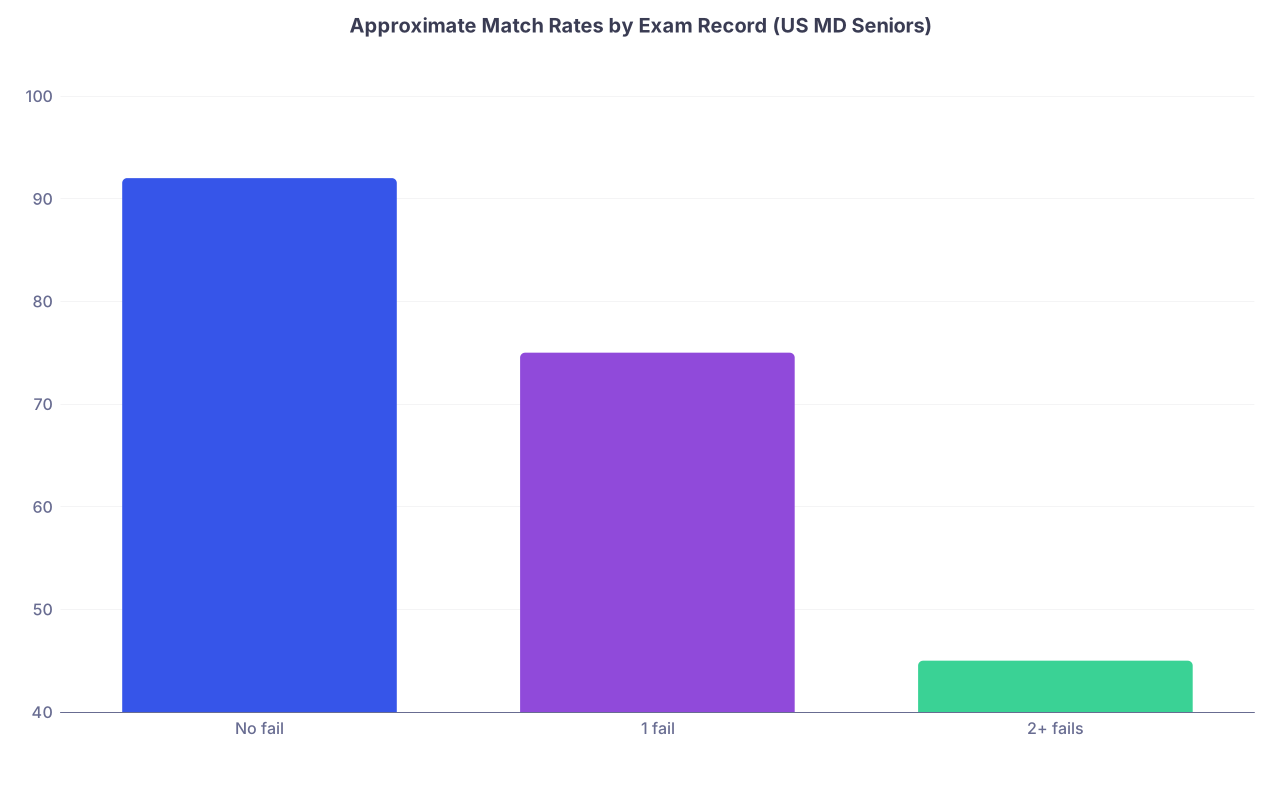
US MD seniors with exam failures still match—just at lower rates and in different kinds of programs than their never-failed classmates.
The exact numbers move a bit year to year, but the pattern is stable: a single failure drops your odds, sometimes sharply, but doesn’t send them to zero.
| Category | Value |
|---|---|
| No fail | 92 |
| 1 fail | 75 |
| 2+ fails | 45 |
You can argue whether those percentages shift a few points, but the pattern holds:
- No failures: high probability of matching
- One failure: still more likely to match than not
- Multiple failures: big problem, but not always automatic game over
Now, does this look the same in neurosurgery and family medicine? Of course not.
Here’s a simplified reality snapshot:
| Specialty Type | One Fail Impact | Multiple Fails Impact |
|---|---|---|
| Ultra-competitive (Derm, Ortho) | Usually fatal | Essentially disqualifying |
| Competitive (EM, Anes, Rads) | Significant barrier | Almost always disqualifying |
| Mid-competitive (IM, Gen Surg) | Hurts but sometimes OK | Very limited openings |
| Less-competitive (FM, Psych, Peds) | Often survivable | Hard but occasionally salvageable |
Let me be blunt:
If you failed Step 1 and still think you’re going to waltz into dermatology at a top-20 program without some miracle-level compensatory profile, you’re not dealing with reality.
On the other hand, I’ve personally seen:
- A US MD who failed Step 1, retook and passed comfortably, then scored >250 on Step 2 and matched categorical internal medicine at a solid university program.
- A DO who failed COMLEX Level 1, then passed Level 1 and Level 2 on first retake, did a dedicated research year, and matched categorical general surgery at a community program with decent fellowship placements.
- An IMG with a Step 1 fail and decent Step 2 who matched psychiatry after aggressively targeting community programs and selling a mature, honest story in interviews.
The common denominator?
They didn’t pretend the fail didn’t matter. They rebuilt the narrative around it.
Step 1 vs Step 2 vs COMLEX: All “Fails” Are Not Equal
You’ll hear attendings say “a fail is a fail.” That’s not how it plays out in selection meetings.
Admissions committees absolutely distinguish between:
- Failing Step 1/Level 1 early in med school vs.
- Failing Step 2/Level 2 right before residency vs.
- Failing an in-training exam vs.
- Failing Step 3/Level 3 after starting residency
Early Basic Science Exam Failure (Step 1 / Level 1)
This is the most common scenario and the one people obsess over.
How programs often interpret it:
- Could be adjustment issues, poor test strategy, or underestimating the exam
- If the retake is a solid pass and all later exams are clean, many PDs see it as less concerning over time
- With pass/fail Step 1 at many schools, the emphasis has shifted to Step 2/Level 2 anyway
However, some specialties and programs still use any Step 1/Level 1 fail as a hard filter. They get 1,000+ apps; they need a quick cut. You lost access to some of those, yes.
Clinical Knowledge Exam Failure (Step 2 / Level 2)
More dangerous.
Failing a clinical exam raises questions about:
- Clinical reasoning
- Reliability in real patient care settings
- Judgment under pressure
I’ve sat in meetings where a PD said, almost verbatim:
“I can rationalize a Step 1 fail. Step 2 is harder to ignore because now you’re in the hospital and should’ve figured your learning style out.”
Is it still survivable with a strong retake and no other red flags? Yes. But the bar is higher, and more competitive specialties will be much less forgiving.
Step 3 or Level 3 Failure
Ironically, this is often less damaging for the Match, because many applicants have not taken Step 3 yet when applying. But failing Step 3 as a resident raises separate questions about promotion and board eligibility.
For residency applications, if you’re an IMG who took Step 3 early and failed, some US programs will quietly move your application into the no pile. Others will shrug if your later score is strong and everything else is clean.
One Fail vs Pattern of Failures: Programs Care About Trajectory
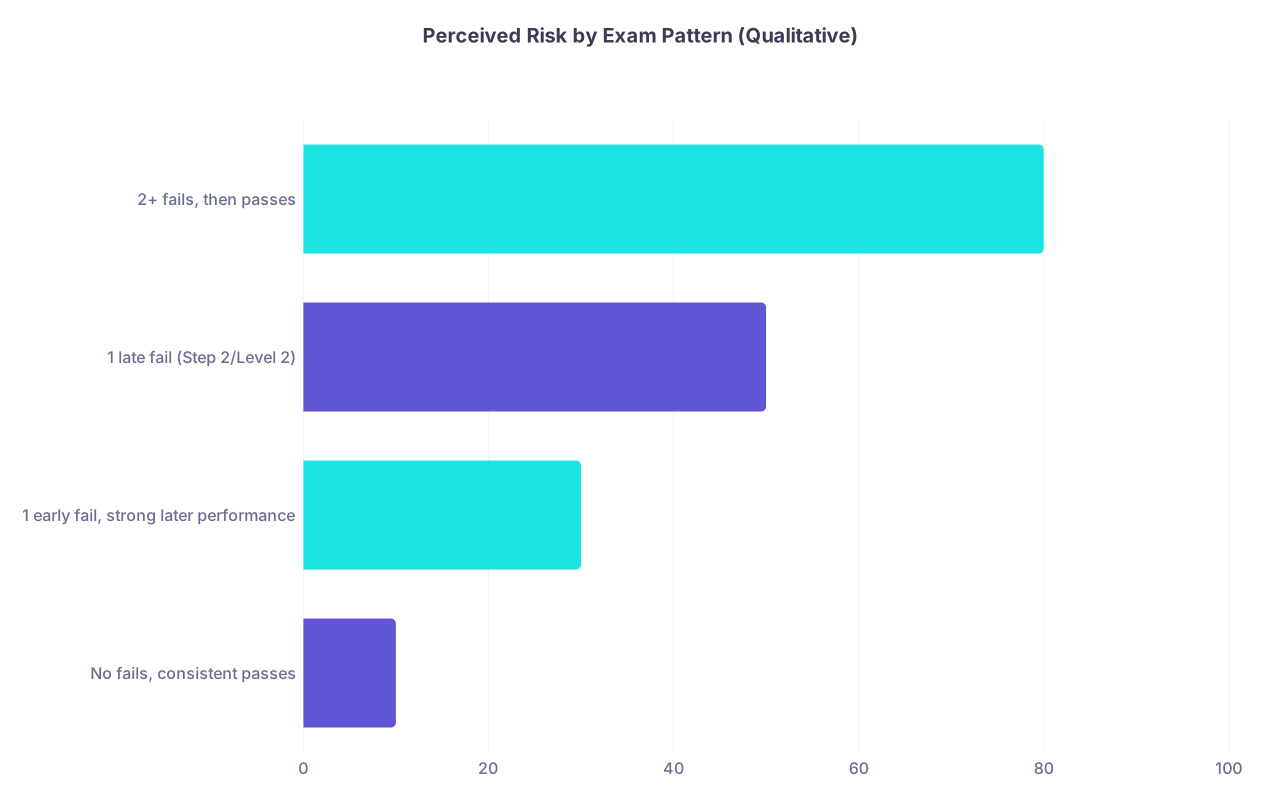
Program directors obsess over patterns more than single data points.
One fail with a clean record afterwards says:
- You hit a wall once
- You adapted and corrected
- You’re unlikely to implode mid-residency
Multiple fails say:
- Either you do not adapt
- Or your baseline ability to handle high-stakes exams is questionable
- Or there are underlying issues (health, mental, life chaos) that may keep recurring
| Category | Value |
|---|---|
| No fails, consistent passes | 10 |
| 1 early fail, strong later performance | 30 |
| 1 late fail (Step 2/Level 2) | 50 |
| 2+ fails, then passes | 80 |
Programs won’t say it in marketing materials, but internally they think in terms of risk management:
- Who is likely to pass their boards on schedule?
- Who won’t need remediation time and extra faculty bandwidth?
- Who isn’t going to be a constant source of meetings and paperwork?
A single fail with a clear upward trend is a medium risk. A history of repeated failures is a high risk. They only take high-risk applicants when they’re desperate or when you bring something extremely rare (niche research, unique skills, strong connection).
The Specialty Reality Check: Where One Fail Hurts vs. Kills
Here’s where most students fool themselves. They hear “a fail doesn’t automatically doom you” and interpret that as “I can still apply anywhere I want if I explain it well.”
No. The explanation helps where you are already under consideration. It does not magically reopen doors that a program’s filters slammed shut.
| Specialty Tier | One Fail Practical Effect |
|---|---|
| Hyper-competitive (Derm, Plastics, Ortho, ENT) | Nearly fatal at most programs |
| Competitive (Anesthesia, EM, Rads, Uro) | Major handicap; only some programs open |
| Core (IM, Gen Surg, OB-GYN) | Requires strategy; many programs still open |
| Less-competitive (FM, Psych, Peds, Neuro) | Often manageable with good Step 2 and story |
Can you find exceptions? Sure. A PD who values your PhD, your unique background, your home connection. But you do not build a career plan on edge-case anecdotes.
If you have a single fail and you:
- Apply to 35 dermatology programs with no backup
- Or 40 categorical surgery spots and no prelims
- Or only top-20 name-brand academic programs
…you’ll probably be another “the system is broken” post-match sob story on Reddit.
On the other hand:
- A single Step 1 failure + strong Step 2 + realistic specialty choice + smart program list
= a very reasonable chance to match.
What Actually Helps You Overcome One Failure (And What’s Just Noise)
People panic after a failure and try everything. Most of it is inefficient at best.
Things That Actually Move the Needle
A clearly stronger subsequent exam record
- Step 2 CK / COMLEX Level 2 score that’s comfortably above the passing line and ideally near or above the median for your target specialty
- No further failures. This is non-negotiable.
Transparent, calm explanation in your application and interviews
The worst thing you can do is:- Make excuses
- Blame the exam, the school, or some vague “bad day” without showing what changed
The best pattern:
- Briefly describe the factors (too many responsibilities, poor test strategy, health issue)
- Show concrete, observable changes: dedicated study plan, practice tests, tutoring, changed schedule
- Point to proof: stronger later scores, improved clerkship performance
Letters that explicitly vouch for your reliability and clinical competence
Strong letters that say:- “This resident/student is exceptionally prepared, diligent, and clinically sound.” Matter more if there’s a question mark in your exam history. I’ve heard PDs say, “The exams worry me, but this chair is basically guaranteeing he’ll be fine.”
Strategic program selection
- Heavy emphasis on community programs, newer programs, and less competitive geographies
- Apply more broadly than your classmates
- Use data (past residents, program websites, published board pass rates) to infer how rigid they are
Things That Mostly Don’t Save You (On Their Own)
- A random master’s degree nobody asked for
- One or two poster presentations thrown together post-hoc
- Volunteering “to show commitment” with no clear link to your story
- A long, emotional personal statement that spends three paragraphs rehashing the failure
None of that is bad. It’s just not the lever you think it is. The biggest lever is what you did on the next high-stakes exam and how you function clinically.
How to Frame a Single Exam Failure Without Sinking Yourself
Programs are not looking for melodrama. They are looking for evidence you are:
- Self-aware
- Trainable
- Stable now
Here’s the rough structure that tends to work:
Short acknowledgment
“During my second year, I failed Step 1 on my first attempt.”Concise explanation, no self-pity
“I underestimated the exam and tried to balance full-time research with my preparation, which fragmented my studying.”Concrete change in behavior
“I worked with my academic dean to design a focused remediation plan, devoted 8 weeks exclusively to preparation, and incorporated weekly NBME practice tests and dedicated tutoring.”Proof of improvement
“On my second attempt, I passed comfortably. I then scored [X] on Step 2 CK and have passed all subsequent shelf exams and OSCEs on the first attempt.”Bridge to present competence
“This experience forced me to change how I approach large, high-stakes projects. I now front-load preparation, seek feedback earlier, and build structured plans—which translated directly into stronger performance on my clinical rotations and Step 2.”
That’s it. No three-paragraph apology tour. No “I’ve always wanted to be a doctor since I was five” speech bolted to the end.
Long-Term Career Impact: Are You Branded Forever?
The fear is that one exam failure will lurk in every hallway conversation forever. That’s not how this works.
Here’s what actually happens over time:
- During residency selection: It matters a lot. It changes which doors open.
- During residency training: Your current performance and whether you pass specialty boards on time matters more.
- When applying for fellowship: Most academic fellowships care more about your residency performance, research, letters, and board status than an old Step 1 wound—unless you’ve repeated the pattern.
- 5–10 years out in practice: Patients don’t know. Employers are usually more focused on board certification, references, and your track record than a single ancient failure.
Where it can come back to bite you:
- If your specialty board has strict policies about multiple failures or extensions
- If you maintain a pattern of barely passing or failing exams repeatedly
But if your trajectory is:
- Early stumble
- Then consistent passes, good clinical reviews, and on-time board certification
…you’re not going to be known as “the one who failed Step 1 once.”
You’re going to be known as “the attending who actually teaches well” or “the surgeon who doesn’t panic at 3am.”
At that point, nobody cares about the NBME PDF from a decade ago.
The Bottom Line: What the Data Actually Says About One Exam Failure
Strip away the drama and here’s where the evidence and real-world experience land:
One exam failure is a serious disadvantage, not a death sentence. It reduces options and match probability, especially in competitive specialties, but plenty of applicants with a single failure match every year—often into solid programs.
Trajectory matters more than the isolated event. A clean record and strong performance after the failure (especially on Step 2/Level 2) do far more to rehabilitate you than any amount of hand-wringing or generic “resilience” language.
Your outcome depends less on the failure itself and more on your response and strategy. Own it briefly, demonstrate concrete change, pick a realistic specialty, target the right programs, and do not fail again. That’s how one bad exam becomes a plot point—not your whole story.