
Most residency interviewers do not carefully read your red flag addendum. And the ones who do are usually looking for something very specific—clarity, accountability, and risk—rather than your beautifully worded narrative.
That’s the uncomfortable truth underneath all the “just be honest and reflective” advice you see on Reddit and from well-meaning deans.
Let’s pull this apart.
What Interviewers Actually Look At (Versus What You Think)
Everyone imagines a calm, thoughtful faculty member sitting at their desk, reading every line of every ERAS entry, personal statement, and red flag addendum like it’s literature.
Reality is closer to this: it’s 7:10 a.m., pre-clinic, they have 12 notes unfinished, and they’re skimming your file in under three minutes.
Most interviewers in competitive programs don’t start with your carefully crafted explanation. They start with three things:
- Board scores / fails
- Class rank / MSPE summary language
- Obvious problem areas: failure, LOA, professionalism notes, big gaps
Only once a trigger is hit do they look for context. That’s where your red flag addendum lives: as supporting documentation for an already-identified concern, not as star of the show.
I’ve seen faculty at big-name IM and EM programs scroll like this on ERAS:
- Scores
- MSPE notables
- Education history (LOA? Remediation?)
- Then—maybe—“Applicant Explanation Statement” or the related section
If your file is clean, most will never open that addendum section because it doesn’t exist. If your file has a known issue, they’ll scan it quickly for three questions:
- What actually happened?
- Is this likely to happen again?
- How much hassle/risk are we taking on if we rank this person high?
Your beautifully emotional paragraph about personal growth? That’s optional garnish.
Who Reads Your Addendum—and When
Let me be specific, because “programs” don’t read your stuff. Individual humans with varying levels of attention do.
| Role | Likelihood of Careful Read | When They Read It |
|---|---|---|
| Program Director | High | Before offering interview, rank |
| APD/Core Faculty | Medium | Skim before/during interview |
| Chief Resident | Low–Medium | If on committee, before meeting |
| Regular Faculty | Low | Sometimes mid-interview on iPad |
| Coordinator | High (for logistics) | During screening/flagging stage |
Program directors and coordinators are the only people you can almost guarantee have looked at your explanation. They’re the gatekeepers.
The typical sequence in many programs goes something like this:

| Step | Description |
|---|---|
| Step 1 | ERAS File Submitted |
| Step 2 | Standard Screen |
| Step 3 | Coordinator/PD Review |
| Step 4 | Auto Screen Out or Low Priority |
| Step 5 | Invite to Interview Pool |
| Step 6 | Faculty Skim File Before Interview |
| Step 7 | Ask Targeted Questions |
| Step 8 | Move On |
| Step 9 | Red Flag Present? |
| Step 10 | Enough Context & Low Risk? |
| Step 11 | Concern Still Active? |
Notice something: your addendum is a filtering tool early on and a talking point later. It’s not your salvation. It either keeps you from being binned or gives the interviewer a script to probe.
The Harsh Truth About “Redemption Narratives”
There’s a popular myth: “If you just own your mistake and show growth, programs will look past anything.”
That’s not how this works.
Certain red flags are structurally different in how they’re read:
| Red Flag Type | Salvageable With Good Addendum? | Primary Concern |
|---|---|---|
| Single Step/COMLEX fail | Sometimes | Test-taking consistency |
| LOA for medical issue | Usually | Stability, recurrence risk |
| LOA for non-medical/personal | Depends | Judgment, chaos risk |
| Professionalism violation | Rarely fully erased | Reliability, culture fit |
| Criminal record (recent) | Very limited | Liability, patient safety |
A beautifully written addendum does not erase the structural concern. A PD might say in committee, “Yes, they’ve got great insight now, but this was a professionalism lapse in third year. We have 800 other applicants who did not have this issue.”
That’s the competition you’re up against. Not your past self. The people with no red flags at all.
The addendum’s job isn’t to make you “inspiring.” It’s to make you “low enough risk to consider.”
How Much Do They Actually Read?
Let’s put some numbers to this so we’re not just hand-waving.
When faculty skim a file, they’re typically giving you a total of 3–8 minutes. Some less. Very few more unless you’re stellar or very concerning.
The addendum lives as one section among many. It might be 150–300 words. That’s 20–45 seconds of reading if they commit.
In practice, here’s what I’ve watched faculty do:
- Read the first 2–3 sentences
- Look for concrete info: dates, what, resolution
- Skip long emotional digressions
- Stop as soon as they feel they understand the risk category: “Acute depression, treated, stable on meds, no recurrence” versus “Chronic chaos, ongoing therapy, still figuring it out”
So yes, they “read” it. But not like you think. They’re scanning for data points and stability, not literary merit.
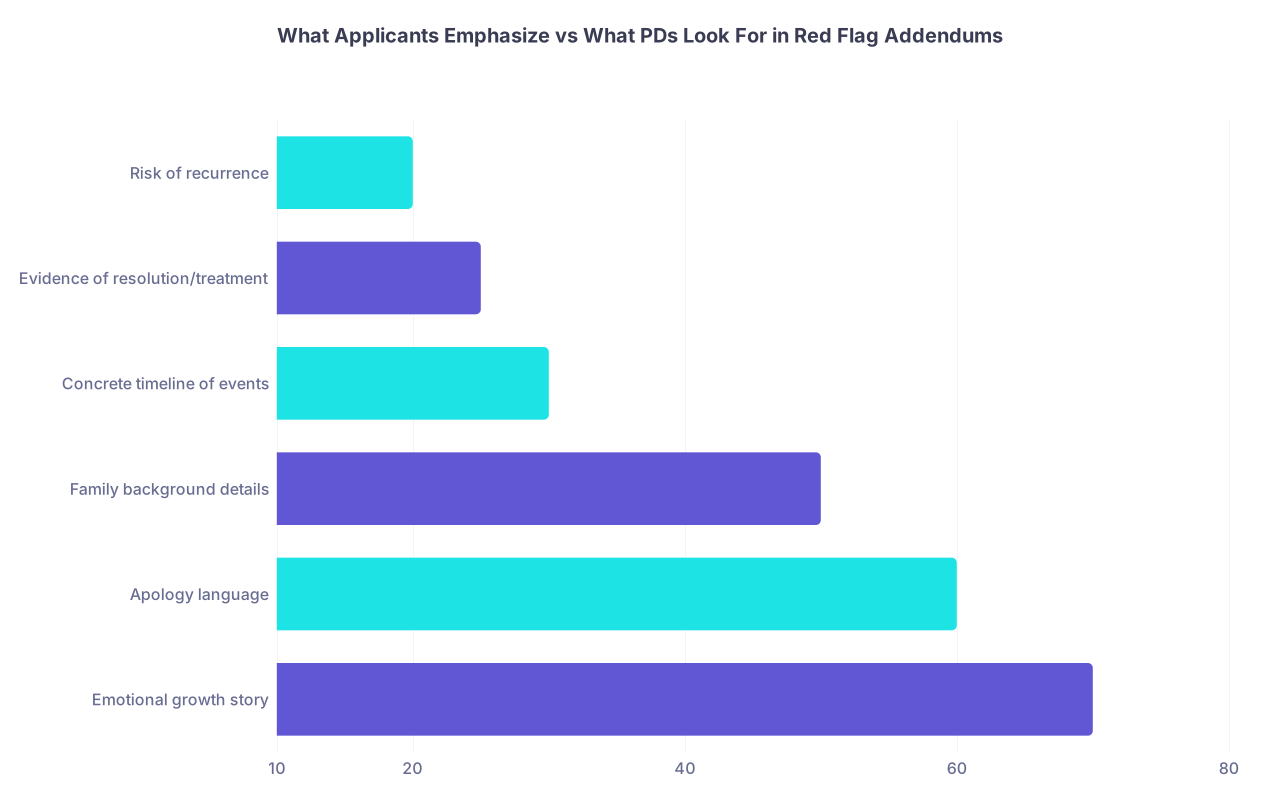
Here’s what that mismatch looks like visually:
| Category | Value |
|---|---|
| Emotional growth story | 70 |
| Apology language | 60 |
| Family background details | 50 |
| Concrete timeline of events | 30 |
| Evidence of resolution/treatment | 25 |
| Risk of recurrence | 20 |
Applicants overspend words on the top three. PDs care most about the bottom three.
The Fantasy of “If I Explain It Well Enough, It Won’t Matter”
This is the dangerous lie: “If I just write the perfect addendum, my red flag won’t affect me.”
Every PD I’ve heard talk about this in real life says some version of: “An explanation helps me sort ‘automatic no’ into ‘maybe,’ but it doesn’t erase the underlying issue.”
A Step 1 fail that you “explain well” becomes: a Step 1 fail with less unknown risk. Not “no big deal.”
A professionalism lapse explained with insight becomes: a professionalism lapse with a slightly better chance it won’t repeat. Not “clean record.”
And programs are ruthlessly utilitarian about it. When you have 60 interview slots and 1,000+ applicants, “slightly better chance” may still not beat “no concerns on record.”
That said, a strong addendum absolutely makes the difference between:
- Auto-screened out
vs - Interviewed and ranked in the mid-lower part of the list
I’ve seen applicants with a failed course or a LOA land solid IM or FM positions because their explanation was tight, honest, and boringly reassuring.
Boring is the goal. Not cinematic redemption.
What a “Readable” Addendum Looks Like to an Interviewer
Let me show you the difference using the lens interviewers actually use.
Most addendums I see from applicants make three classic mistakes:
- Too long. 400–600 words of narrative. No PD has time for that.
- Vague. “I was going through a lot” with no concrete structure.
- Over-focused on feelings, under-focused on logistics and outcomes.
Interviewers are reading for four quick hits:
- What exactly happened?
- When did it happen?
- What has been done to fix / treat / change it?
- What’s the current status and risk going forward?
So they love sentences that sound like:
- “In March 2022 I failed Step 1 on my first attempt, scoring 192.”
- “I took a medical LOA from June 2021 to February 2022 for treatment of major depressive disorder.”
- “Since resuming school, I have passed all clerkships on first attempt, and passed Step 2CK with a 241.”
- “I continue regular follow-up with my psychiatrist, and my symptoms have been stable for over two years.”
Those are the markers that your situation is contained.
Your long description of childhood, relationships, or how ashamed you felt? That’s mostly for you, not them.
Do Interviewers Use Your Addendum During the Interview?
Yes—but often in a way that surprises applicants.
There are three main patterns:
The “I Read It, And We’re Done” Interviewer
They say, “I saw you addressed your Step 1 fail in your application, and it seems you’ve bounced back with strong clerkship performance. I don’t have any further concerns.”
Translation: addendum did its job, they’re moving on. Good.The “Help Me Understand This” Interviewer
They quote a line from your addendum: “You mentioned a leave for ‘personal reasons.’ Can you clarify what that involved?”
If your addendum was vague, you’ll get more probing. If it was clear, this is usually a quick confirmation.The “Why Should We Trust You?” Interviewer
Less common, but these are the ones that feel like cross-examination. They’ll say something like, “So why should I believe this won’t happen again when you’re on a busy ICU month?”
This is where your written explanation and your verbal story better match. If you sound rehearsed but evasive, they’ll smell it.
Notice the pattern: they use your addendum as a starting point for their internal risk calculation. Not as your emotional confessional.
Programs That Do Read Carefully vs Those That Don’t
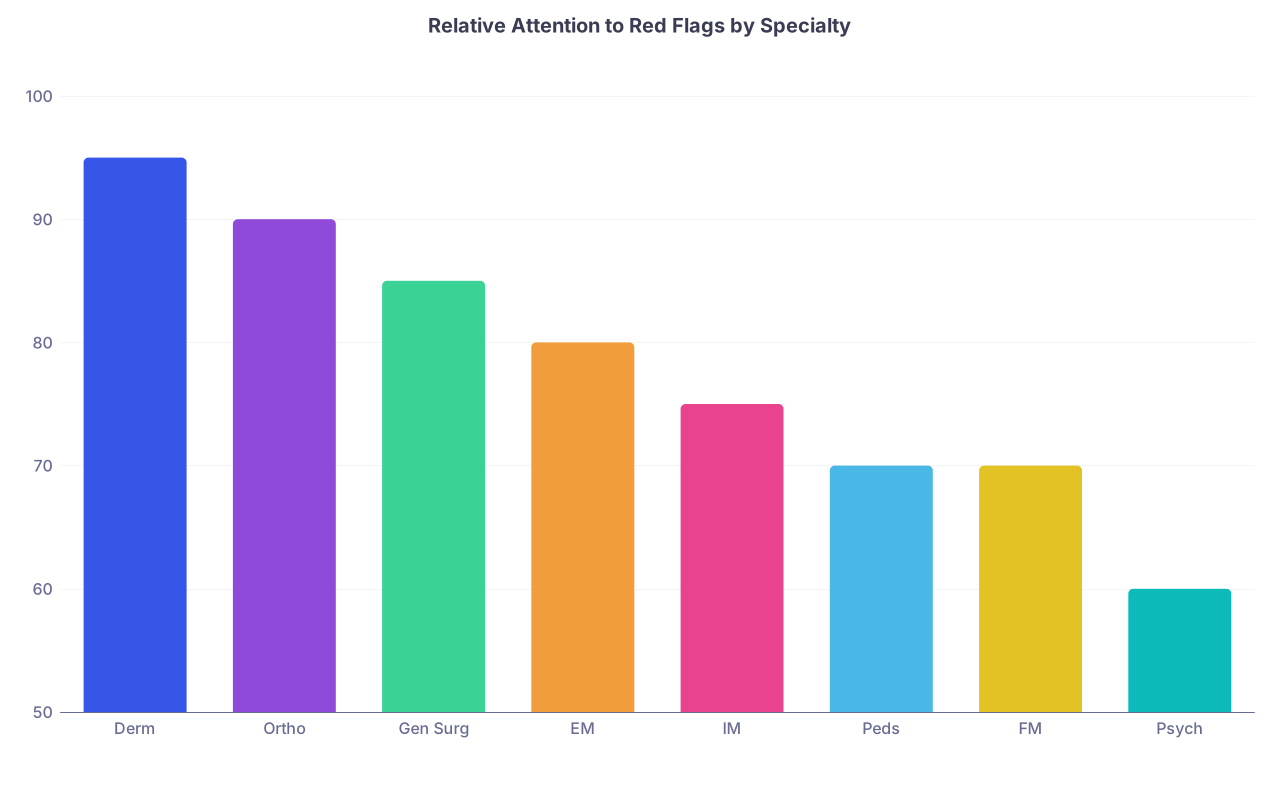
Not every specialty and not every program treats red flags the same way.
| Category | Value |
|---|---|
| Derm | 95 |
| Ortho | 90 |
| Gen Surg | 85 |
| EM | 80 |
| IM | 75 |
| Peds | 70 |
| FM | 70 |
| Psych | 60 |
Roughly speaking:
- Highly competitive, small programs (Derm, Ortho, some ENT, RAD Onc) often treat any red flag as disqualifying unless there’s a strong insider advocacy. They might read your addendum out of curiosity more than true openness.
- Mid-competitive but high-volume fields (IM, EM, Gen Surg) will actually use your explanation to distinguish between “we can manage this” and “we don’t need this trouble.”
- Primary care and psych are paradoxical. They see more LOAs, mental health breaks, nontraditional paths. They can be more flexible, but they’re also very attuned to patterns of chaos.
And then there’s the culture factor. Some places have a strong “second chance” ethos. Others are quietly allergic to drama.
You can’t fully control those variables. But you can make sure that for the people who are open to being convinced, your addendum is written so they can absorb the essentials in under 30 seconds.
So What Should You Actually Do?
If you strip away the myths, your strategy becomes much simpler—and much less romantic.
You’re not writing a redemption essay. You’re writing a professional incident report with a human voice.
Aim for:
- 150–250 words
- Chronological clarity: what, when, outcome
- Direct responsibility where appropriate: “I underestimated…”, “I did not seek help early…”
- Concrete steps taken and current stability
- Zero melodrama, zero self-pity, minimal adjectives
You’re optimizing for a PD skimming your file at 6:45 a.m. and deciding, “This seems under control. Let’s offer them an interview.”
Not for someone printing it out and annotating your character arc with a highlighter.
And once you’re in the interview, the real test isn’t whether they read every word of your addendum. It’s whether your in-person explanation matches the tone and facts of what you wrote—calm, consistent, and grounded.
Years from now, you won’t remember the exact sentences you craft in that little text box. You’ll remember whether you treated your red flag as a shameful secret or as one more problem you took ownership of and managed like a physician.