
A 260+ on Step 2 will not magically delete your academic red flags. It can blunt them. It can reframe them. But erase? No.
Most med students I’ve worked with who are in trouble cling to one fantasy: “If I just crush Step 2, programs will forget everything else.” That belief is pushed by classmates, Reddit, and sometimes even well-meaning faculty who haven’t actually sat in on a rank meeting in years.
Here’s what the data and real selection behavior actually show: programs do not look at any single metric in isolation. A monster Step 2 score is a powerful counter-signal, but it does not reset your transcript, remove failures, or hide LOAs. The question is not “Will they forget?” but “What story does this let you tell, and which programs will buy it?”
Let’s break that down without the usual hand-holding optimism.
What Programs Actually Use Step 2 For (Now That Step 1 Is Pass/Fail)
Once Step 1 went pass/fail, Step 2 CK quietly became the new sorting weapon. Not officially, of course. But watch what programs do, not what they say.
Here’s the reality from PD surveys and match data:
- For many competitive specialties (ortho, derm, plastics, neurosurgery, rad onc), Step 2 is now the primary numeric filter.
- For internal medicine, EM, anesthesia, gen surg, neuro, psych – it’s heavily weighted but not alone.
- Failures and repeats on any USMLE/COMLEX stay visible no matter how high your later score is.
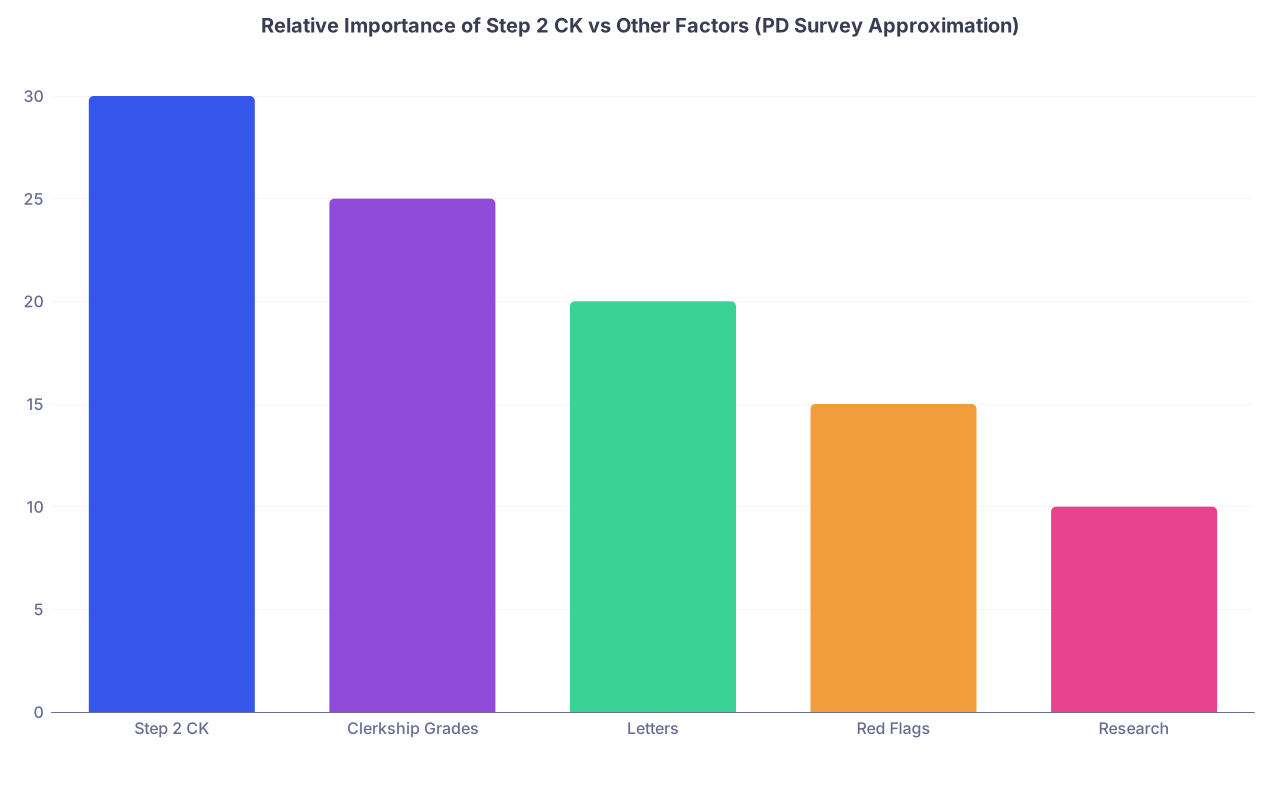
| Category | Value |
|---|---|
| Step 2 CK | 30 |
| Clerkship Grades | 25 |
| Letters | 20 |
| Red Flags | 15 |
| Research | 10 |
Those numbers aren’t literal, but the pattern is. Step 2 is a big chunk of the pie, but not the whole thing. So a stellar Step 2:
- Gets you through more initial filters.
- Buys you a second look despite earlier issues.
- Signals “this person can handle board-level material now.”
What it does not do: make your F in M1 anatomy vanish, turn a leave of absence into a non-event, or rewrite a professionalism note in your dean’s letter.
Programs see all of it side-by-side.
What Counts as “Early Academic Trouble” — And How Bad Is It Really?
People use “academic trouble” as a vague catch-all. Residency programs don’t. They differentiate. Sharply.
Common categories:
- Single early pre-clinical failure (M1/M2), remediated, passed
- Multiple pre-clinical failures or repeats
- USMLE/COMLEX failure(s)
- LOA for academic reasons
- Chronic barely-passing performance + weak clerkship grades
These are not equal sins.
| Red Flag Type | Typical PD Reaction Severity |
|---|---|
| Single remediated M1/M2 course failure | Low–Moderate |
| Multiple pre-clinical failures | Moderate–High |
| Step 1 or Step 2 failure | High |
| LOA for academic reasons | High |
| Chronic low clerkship performance | Moderate–High |
Now, here’s where your big Step 2 score actually matters:
- For single early failure: a high Step 2 often mostly neutralizes it for many programs, especially if your clinical years are strong.
- For multiple failures or an LOA: a high Step 2 helps, but the red flag remains a major discussion point.
- For a USMLE failure: a later high Step 2 proves improvement, but the original fail is not erased. Some programs auto-screen out anyone with any failure, period.
So when someone says, “A 260 Step 2 makes everything else irrelevant,” they either have not looked at real screening practices—or they matched in a non-competitive specialty and think everyone else’s life looks like theirs.
When a High Step 2 Really Changes the Game
Let me give you the cases where a stellar Step 2 actually moves the needle in a serious way.
1. The Early Course Failure Story
Scenario: M1 physiology fail during a rough personal semester. Remediated. Since then: clean transcript, solid clerkship grades (mostly honors/high pass), no professionalism issues. Step 2: 255.
What PDs see:
- Yes, there’s a blemish.
- But all recent data (clerkships, Step 2) screams “competent and reliable now.”
- Your high Step 2 validates that your improvement isn’t just luck or grade inflation.
In this case, that Step 2 score doesn’t “erase” the failure, but it downgrades it from a red flag to a footnote. For many IM, EM, peds, neuro, psych programs, it becomes a non-issue if explained sanely in the MSPE or personal statement.
2. The Step 1 Failure → Step 2 Crush
Scenario: Step 1: Fail, then Pass on second attempt. Step 2: 250+. Decent but not stellar clerkship performance.
Programs that automatically filter out any Step failure? You’re dead to them no matter what. But not all programs do that.
For the rest, the story becomes:
- Yes, they struggled with high-stakes standardized tests.
- They didn’t just squeak by later; they overperformed.
- The risk of failing in-training exams or boards in residency looks lower now.
Is the red flag gone? No. But for many mid-tier programs and some less competitive specialties, a very strong Step 2 can transform you from “too risky” to “worth a look.” The catch: you’re still not playing on the same field as someone with no failures and equally strong scores.
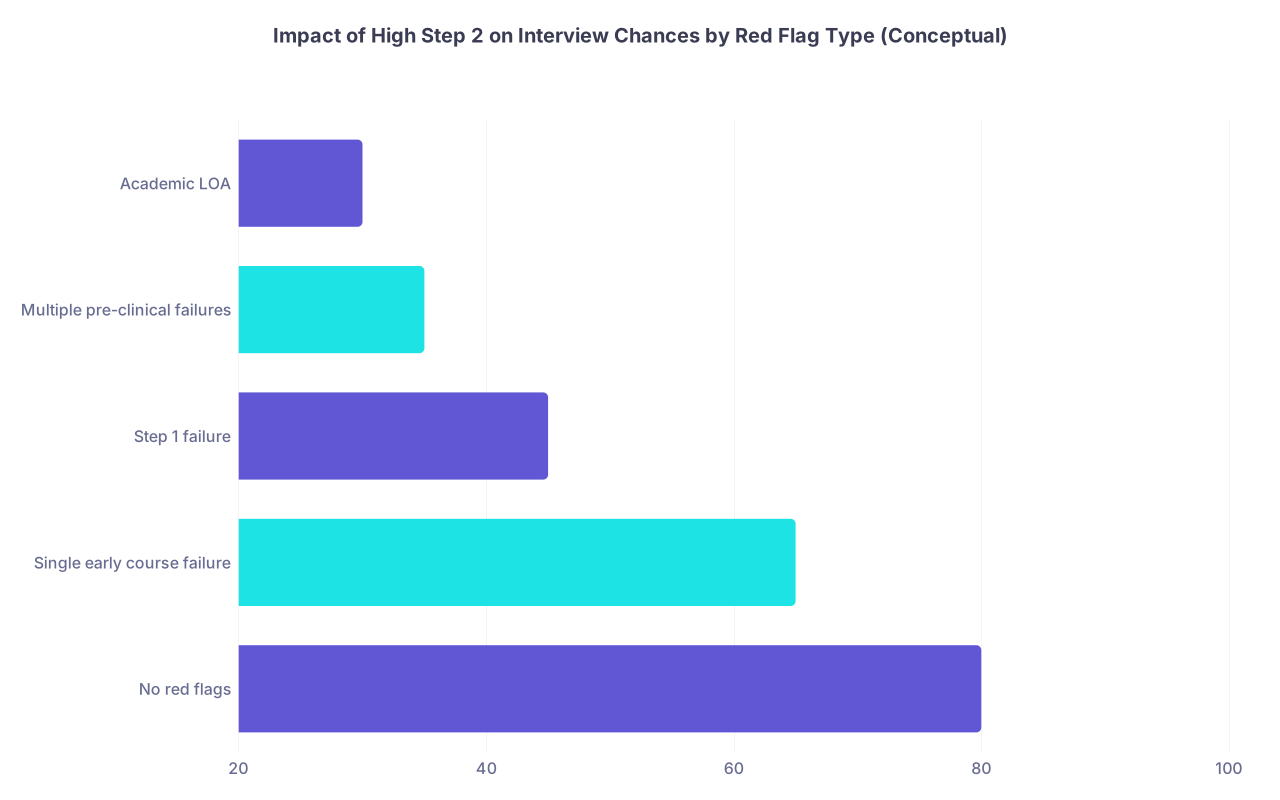
| Category | Value |
|---|---|
| No red flags | 80 |
| Single early course failure | 65 |
| Step 1 failure | 45 |
| Multiple pre-clinical failures | 35 |
| Academic LOA | 30 |
These are illustrative, but you get the trend: the worse the red flag, the less even a top score can “rescue” you.
The Myth of the “Score-Only” Program
A lot of students talk like some PDs are pure number-chasers. “They just sort by score and that’s it.” No, they don’t. They sort by score, then garbage-bin obvious risks.
What I’ve seen repeatedly from selection committees:
- Use Step 2 (and sometimes school rank) to create a “maybe” pile.
- Within that pile, red flags still matter a lot: failures, LOA, professionalism notes, weak letters.
- At the margin, personality in the personal statement and letters plus interview performance decide.
So even in “score-driven” programs, your academic trouble is still part of the discussion. A 265 with a failure isn’t treated like a 265 with a spotless record. That’s fantasy.
What a High Step 2 Can’t Fix (No Matter What Reddit Says)
Here’s where people get burned: they treat Step 2 like bleach and think it will whiten everything.
There are specific problems a big score does not solve:
Serious professionalism problems
Late notes, attitude issues, poor teamwork, repeated feedback about behavior—these doom applications far more reliably than a single academic failure. Step 2 doesn’t touch this.Chronic poor performance in clinical years
If your core clerkships are full of “Pass” with comments like “needs more initiative” or “below level,” you’re fighting a perception problem. A good test-taker who underperforms clinically is a big red flag. Step 2 doesn’t override how you function on the wards.Opaque or concerning MSPE narrative
PDs read between the lines. “Met expectations” for everything with no strong praise is a quiet red flag. Step 2 doesn’t rewrite that narrative.Multiple significant academic events
Example: Two M1 failures, an LOA, then a Pass on Step 1, then finally a 250 on Step 2. That Step 2 is great, but the trajectory is rocky. Some programs will think you’re finally stable. Others will see volatility they do not want.
The Part Nobody Likes: Specialty and Program Tier Matter
“Can my Step 2 erase early issues?” is the wrong question. Better questions:
- In which specialties does my Step 2 mostly neutralize my red flag?
- At which tier of programs does that happen?
A few patterns I’ve seen over and over:
Highly competitive specialties (ortho, derm, plastics, neurosurg, ENT, urology, ophtho, IR):
Red flags are much harder to overcome. A top Step 2 is necessary but nowhere near sufficient. They have enough spotless candidates with great scores. Risk tolerance is low.Moderately competitive specialties (EM, anesthesia, gen surg, radiology):
One early academic blip + strong Step 2 + good clinical performance can be acceptable at many mid-tier and some strong programs. Multiple serious issues? Now you’re relying heavily on geography, connections, or DO-friendly/community programs.Less competitive specialties (FM, psych in many regions, peds):
These are the most forgiving spaces. Here, a high Step 2 can almost function as a reset for minor early trouble—if your behavior and clinical trajectory are clearly solid.
| Specialty Type | How Much a High Step 2 Helps |
|---|---|
| Ultra-competitive | Limited |
| Moderately competitive | Moderate |
| Less competitive | High for minor flags |
So no, there’s no universal answer. Anyone selling you one is simplifying to make you feel better.
How to Leverage a Big Step 2 When You Do Have Red Flags
If you’ve already got the big score, the question becomes: how do you make programs interpret it the way you need?
1. Own the Problem, Then Point to the Trajectory
You do not pretend the failure or LOA never happened. You explain it concisely:
- What happened (specific, not melodramatic)
- What changed (study strategies, time management, mental health treatment, whatever is true)
- How your subsequent record + Step 2 prove the change is durable
The Step 2 score becomes Exhibit A of improvement, not a “surprise” that makes your earlier struggles look random.
2. Align Your Application Story With Your Score
If your Step 2 is 255 and your clerkships are solid, your narrative is straightforward: “Rough start, strong finish.”
If your Step 2 is huge but your clinical feedback is lukewarm, the story is more complicated: “Book-smart but struggling in clinical environments” is a story you do not want them telling. That means you need:
- Tight, specific, enthusiastic letters backing your clinical performance.
- No vague or evasive explanations in your personal statement.
3. Be Strategic About Where You Apply
The brutal reality: some programs will never touch an applicant with a failure or LOA, no matter how good the Step 2 is. Wasting 15 applications on those is just denial with an ERAS fee.
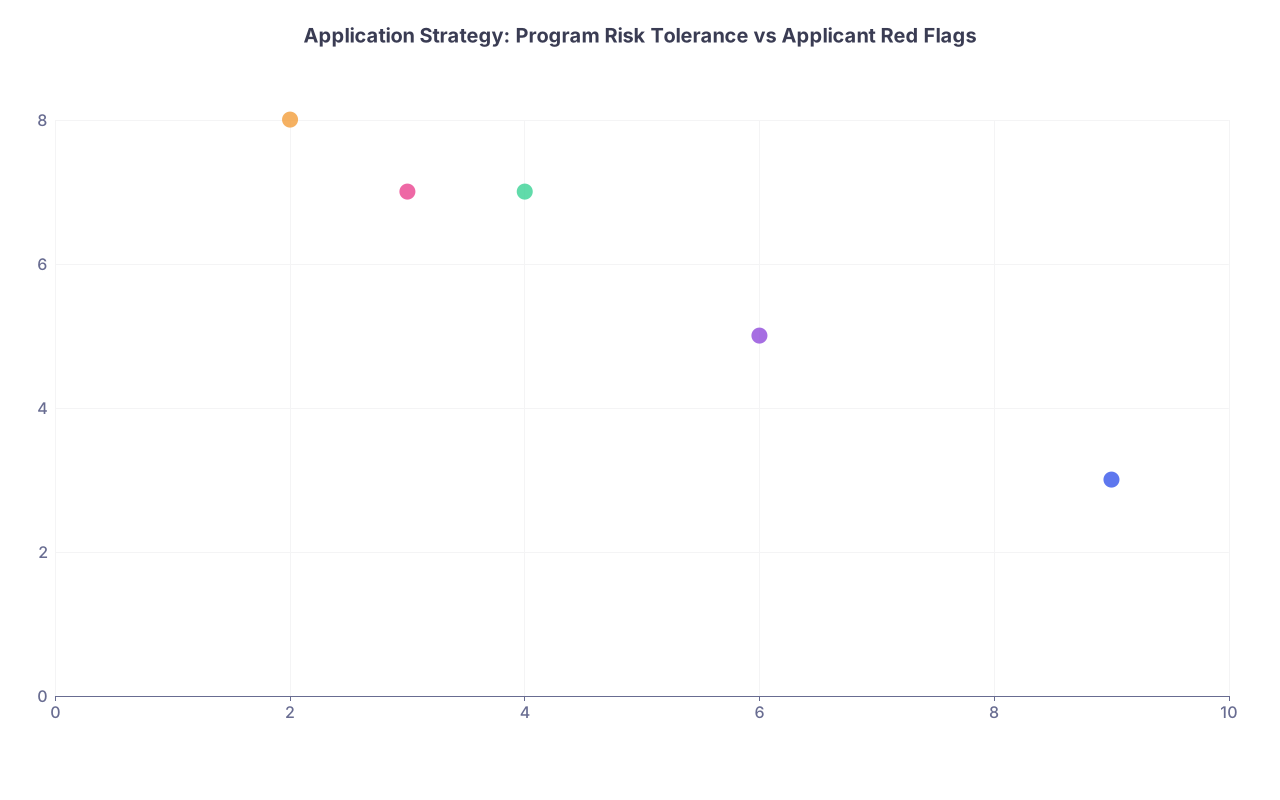
| Category | Value |
|---|---|
| High-tier academic | 9,3 |
| Mid-tier academic | 6,5 |
| Community | 4,7 |
| Rural FM | 2,8 |
| DO-friendly | 3,7 |
(Think of x-axis as “prestige/competitiveness,” y-axis as “willingness to consider red flags.” High prestige frequently means low tolerance.)
You want a portfolio heavy on:
- Programs with a history of taking non-traditional paths
- Community and hybrid programs
- Regions where your school has matched similar profiles before
Ask your dean’s office for specific examples of prior grads like you. Not vibes. Data.
The Harsh Truth — And the Good News
Here is the honest bottom line:
- A stellar Step 2 score does not erase early academic trouble. The red flag still exists. It will still be visible. It will still be discussed.
- What it does is change the narrative from “chronic underperformer” to “early stumble, strong recovery” for many programs and many (not all) specialties.
- The more severe and repeated your academic issues, the less even a sky-high Step 2 can compensate. One hiccup? Very fixable. Multiple significant events? You’re in repair mode, not reset mode.
The good news: programs respect growth. They respect trajectories that slope up. A lot of PDs have their own history of bombing an exam or struggling early. They’re not allergic to imperfection. They’re allergic to risk they cannot predict.
A high Step 2 tells them: “The board risk you were afraid of? Probably manageable.” It does not tell them: “Forget everything else you read.”
If you remember nothing else, keep these three points:
- Step 2 is a powerful counter-signal, not a delete button.
- The type and severity of your red flag matter more than motivational anecdotes you hear from classmates.
- You win not by pretending your record is clean, but by proving—with data and a coherent story—that you are climbing, not sliding.