
The idea that “a leave is a leave, and programs will hate it” is flat‑out wrong.
Residency programs don’t view all leaves of absence the same. Not even close. Some leaves barely register. Others absolutely are red flags. The difference comes down to three things: timing, pattern, and story consistency—not the mere existence of a gap.
Let’s dismantle the myths and get to what actually happens in selection meetings.
Myth #1: “Any leave of absence will kill my chances”
I’ve sat in those committee rooms. Here’s the reality: most faculty don’t care that you had a leave; they care why and what happened after.
A blanket “leaves are bad” narrative is lazy and wrong. Programs are trying to predict one thing: will you show up, function, and finish residency safely and reliably? A leave is just a data point in that prediction.
There are leaves that barely move the needle:
- A single, clearly explained, time-bound LOA for a medical issue that’s now resolved and supported by strong performance afterward.
- A short parental leave during clerkships or research years, with solid evaluations before and after.
- A planned research year that was properly documented as such (sometimes annoyingly labeled as an “LOA” in the MSPE).
And then there are leaves that do light up the radar:
- Repeated, unexplained LOAs with vague language like “personal reasons” and no corresponding narrative.
- LOAs coinciding with Step failures, professionalism issues, or major academic remediation.
- A pattern of withdrawal from responsibilities, especially late in medical school, with no clear stabilization.
The myth comes from people confusing “some LOAs are red flags” with “all LOAs are red flags.” The data and the lived experience of PDs don’t support that.
Myth #2: “Programs don’t have time to care why—you just get screened out”
No. They absolutely care “why.” They just want the answer fast, clear, and consistent.
When applications are screened by filters (Step score, school, etc.), LOA status isn’t usually one of those automatic filters. Where it shows up is later: when your file is actually being read and ranked. That’s where PDs and faculty start asking:
- Was this voluntary or mandatory?
- Did it relate to health, family, academics, or professionalism?
- Did performance stabilize afterwards?
- Are there now clear supports or resolution?
If they can answer those in about 20–30 seconds from your MSPE + personal statement + advisor note, you’re fine. If they can’t answer them, that’s when trouble starts.
To make this concrete, look at how programs informally categorize leaves:
| LOA Type | Typical Committee Reaction |
|---|---|
| Single medical LOA, resolved, strong return | Mild concern → often neutral |
| Short parental leave | Usually neutral |
| Planned research year labeled as LOA | Neutral to positive |
| LOA tied to failed Step/rotation, then stable recovery | Depends on recovery; cautious but often acceptable |
| Multiple vague LOAs with continued problems | Major concern |
Nobody in that room is saying, “LOA = reject.” They’re saying, “Does this look like a risk I don’t have to take when I have 400 other applicants?”
Your job is to make it easy for them to say: “Risk seems low. Story makes sense. Move on.”
Myth #3: “A research year LOA is automatically good”
Let me be blunt: calling something “research” doesn’t magically sanitize it.
There are two very different beasts that both get tagged as “research LOA” in ERAS/MSPE:
- True planned research year: structured, with a mentor, clear outputs (posters, pubs, presentations), and strong faculty letters that mention your work.
- Rebranded academic or personal crash: someone was failing or burning out, got pulled out, and the year got labeled “research” so it would look better.
Committees can usually tell which one you are.
If your “research LOA” didn’t result in:
- clear supervisor,
- tangible output,
- or at least coherent explanation of what you did and learned,
it will raise eyebrows. Especially in competitive specialties.
On the flip side, real research years—particularly for fields like derm, rad onc, neurosurgery—can be a net positive. I’ve watched people with a Step failure and a well-executed research year still match strong because the narrative became: “Stumbled, recalibrated, then crushed it in a structured setting with good supervision and output.”
The research itself isn’t the magic. The trajectory is.
Myth #4: “Medical or mental health leaves are judged more harshly”
This one is both true and false.
Yes, there are still old-school faculty who react badly to anything mental-health related. They exist. But the quiet reality is that plenty of PDs have taken leaves themselves, for health, family, or burnout. Many are more pragmatic than you think.
What they care about isn’t that you had depression, anxiety, surgery, a concussion, whatever. They care about:
- Stability: Has there been a sustained period of functioning since?
- Support: Are you engaged in appropriate treatment or follow-up?
- Insight: Do you understand your limits and triggers?
- Pattern: Is this a single chapter or a recurring motif?
A single medical or mental health LOA where the narrative is: “I was sick, I got treated, I adjusted my coping/medication/support, and I’ve been functioning well since” is often accepted. Especially if followed by strong clinical performance and no further interruptions.
The biggest red flag isn’t “mental health.” It’s recurrence without clear stabilization.
If you took 3 leaves in 3 years—whatever the label—committees will be nervous. Not because of stigma alone, but because residency is objectively harder than med school. They don’t want you to break on their watch.
Myth #5: “If I don’t mention the leave, they might not notice”
They will notice.
The MSPE (Dean’s Letter) is a forensic document. It has dates. It has phrases like “delayed graduation” and “off-cycle clerkships” and “took personal leave between X and Y.” It may have block comments like “The student took time away from medical school for personal reasons.”
When those show up and you’ve said nothing anywhere in your application, people don’t think, “Oh, probably fine.” They think, “Why is this person avoiding talking about it?” And then they imagine outcomes way worse than reality.
Silence is rarely your friend here.
You don’t need a confessional memoir in your personal statement, but you do need:
- A brief, calm, factual explanation in either your personal statement or an “interruption in education” section.
- Tight language. Two to four sentences, not two paragraphs.
- Alignment with what your MSPE and advisor letters say.
Something like:
“During my third year, I took a one-semester leave to address a health issue. I received appropriate treatment, returned to full-time clinical work, and have since completed all rotations on schedule with strong evaluations. This experience reinforced my commitment to maintaining my own health so I can reliably care for patients.”
That’s enough. You’ve given the “why,” the “then what,” and the “now” in one short block. The committee can move on.
How programs actually weigh different kinds of leaves
Let’s stop pretending this is all one bucket. Here’s how I’ve seen committees rank concern informally—from almost non-issue to real problem.
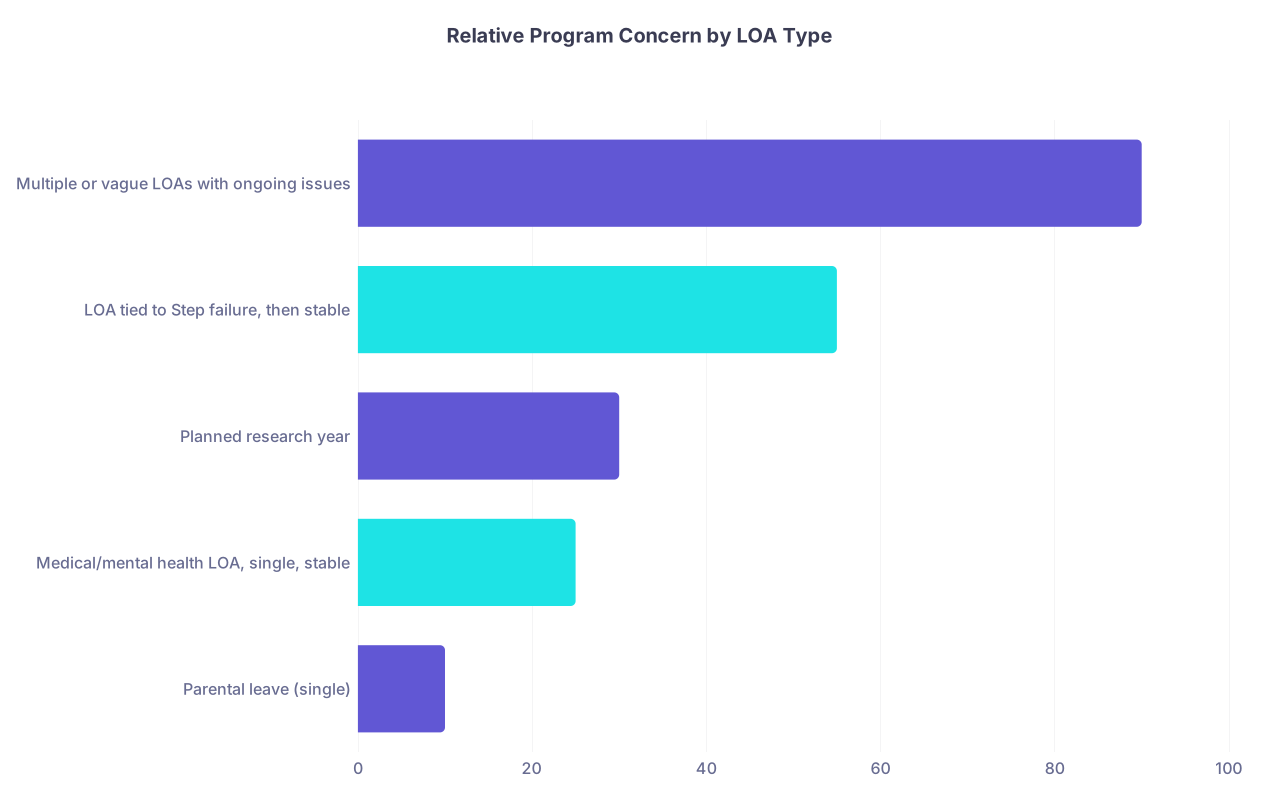
| Category | Value |
|---|---|
| Parental leave (single) | 10 |
| Medical/mental health LOA, single, stable | 25 |
| Planned research year | 30 |
| LOA tied to Step failure, then stable | 55 |
| Multiple or vague LOAs with ongoing issues | 90 |
Parental leaves? Usually near-nonissue, especially as more attendings have their own kids during training or early careers. People get it.
A single medical/mental health leave that’s clearly resolved? Mild concern, often neutralized by a strong upward trajectory.
Planned research year? Often neutral or positive, depending on specialty and execution.
LOA after Step failure or academic difficulty? Moderate concern, but very context-dependent. If the failure was a wakeup call, you remediated, passed early and solidly on the next attempt, and your later clinical remarks are strong, many programs will still bite.
Multiple leaves with vague explanations and inconsistent performance? That’s where doors start quietly closing.
Myth #6: “Explaining the leave in detail will make it worse”
Over-disclosure can be a problem. But under-disclosure is worse.
You do not need to list diagnoses, medications, therapist names, or gory personal details. In fact, do not.
You do need:
- The general category (health, family, academic restructuring, research, parental).
- A short, credible reason.
- A clear statement of resolution or current stability.
- Evidence of functioning afterwards.
What you should avoid:
- Defensive tone (“I had no choice, my school forced me…”).
- Blame-shifting (long tirades about your dean, preceptor, or “toxic admin”).
- Drama or trauma-dumping that turns your application into a therapy session.
Think of it as writing a professional incident report: honest, brief, unemotional, and with a clear “current status” at the end.
Myth #7: “If my leave was for burnout or struggling, I’m doomed”
No, you’re not.
But you cannot pretend it didn’t happen and you can’t spin it as “I just wanted to travel and self-actualize” if the real story is you almost failed out.
Programs know burnout and struggling are baked into medical training. What they’re looking for is whether you:
- Recognized it early enough.
- Got help.
- Developed new habits/systems.
- Demonstrated sustained improvement.
The worst narrative is: “I burned out. I took time. I came back. Then nothing in my file suggests I changed a thing.” That’s when committees worry you’re going to repeat the cycle under higher pressure.
Better narrative: “My performance slipped, I took structured time, worked with faculty/mental health/learning specialists, came back, and my last 18 months look solid.”
If you can point to concrete behavior changes—study strategies, therapy, scheduling, boundaries, physical health habits—keep it brief, but include that flavor. It signals insight and growth, not fragility.
Myth #8: “Every specialty views LOAs the same”
They don’t.
Highly competitive procedural fields (derm, plastics, neurosurgery, ortho) scrutinize everything more, LOAs included. But even there, a well-executed research year plus a single resolved health LOA isn’t a death sentence.
Primary care fields (FM, psych, peds, IM) often show more flexibility around personal and health-related leaves, as long as you’re stable and reliable now. Psych in particular tends to be more understanding about mental health LOAs, provided your story reflects insight and treatment.
Surgical programs care intensely about reliability and stamina. A pattern of repeated, unexplained leaves, especially late in training, will bother them more than a single early LOA with a clean run later.
Bottom line: the more competitive the field, the fewer imperfections they’re willing to tolerate relative to the applicant pool. But no field is blindly anti-LOA.
How to handle an LOA strategically in your application
Let’s be practical. Here’s what you should actually do if you’ve had a leave:
- Make sure your story is consistent across MSPE, personal statement, and any advisor notes. No contradictions.
- Use brief, direct language to explain the category of leave and the resolution.
- Highlight concrete evidence of stability afterward: strong clerkship comments, good Step 2, away rotations completed without issue, leadership, whatever you have.
- Ask a trusted dean or advisor to read your explanation and your MSPE together and tell you where a PD might still have questions.
- Be prepared with a calm, non-defensive one- or two-sentence verbal explanation for interviews. Then shut up. Don’t oversell it.
And if your LOA is genuinely part of why you’re a better, more grounded physician now, you’re allowed to say that. Just don’t turn it into your entire personality.
The actual hierarchy of concern: it’s not just “LOA = red flag”
One last inconvenient truth: there are “worse” things than a clean, explained LOA.
I’ve seen committees far more spooked by:
- Recent unprofessional conduct comments.
- Failure to pass Step 2 by rank list deadline.
- Chaotic interviewer reports (“seems disorganized, couldn’t explain gaps”).
- A weak or backhanded Dean’s letter than by a single leave with a coherent story.
An LOA is often a context, not the crime.
If your overall file says: “This person had a rough chapter, then stabilized, then performed,” most programs will at least keep you in the running. Especially in the current climate of workforce shortages and increasing awareness of wellness.
If your file says: “Chaos, excuses, and no clear resolution,” then yes, the LOA will be part of that red flag picture.
Key Takeaways
- Not all leaves of absence are created equal. Timing, cause, pattern, and post-leave performance matter far more than the mere fact that you stepped away.
- Silence and vagueness hurt you more than a brief, honest, and consistent explanation. Programs care whether you’re stable and reliable now, not whether your path was flawless.
- A single, well-explained LOA—especially for health, parental, or structured research—rarely “kills” an application by itself. It becomes a real red flag only when it’s repeated, unexplained, or paired with ongoing performance or professionalism problems.