
The idea that “no research means no match” for red flag applicants is lazy, defeatist, and mostly wrong.
For some niches and some situations, research can absolutely rescue you. But for the vast majority of applicants with red flags, research is not the magic eraser people pretend it is. It is one tool. Not the tool.
Let’s separate myth from reality.
What People Think Research Does for a Red Flag Applicant
You’ve probably heard some version of this in a group chat or from a panicked classmate:
“I failed Step 1 / repeated a year / had a leave… I have to do a research year or I’m not matching.”
Programs absolutely look at research. But you need to be very clear on how they use it.
In most program director surveys and NRMP data, research is not a “first screen” variable for most core specialties. Step scores, exam failures, class rank, failures/remediations, and professionalism issues are the primary screen. Research usually comes later, once you’re already past the initial filter.
Here’s the rough truth:
- If your red flag is severe (multiple failures, professionalism violation), research alone rarely fixes it.
- If your red flag is moderate (single fail, LOA, lower Step 2), research can help, but only if it’s deep, focused, and comes with strong letters.
- If your application is otherwise fine but a bit “meh,” research might tip you into the interview pile at more competitive places.
But this dogma—“no research means no match” for any red flag—is simply not supported by data or reality. I’ve watched too many people match with red flags and zero publications to let that myth float around unchallenged.
What the Data Actually Shows About Research and Matching
Let’s be precise. The NRMP data is very clear: research volume correlates with match rates, especially for competitive specialties. But correlation is not salvation.
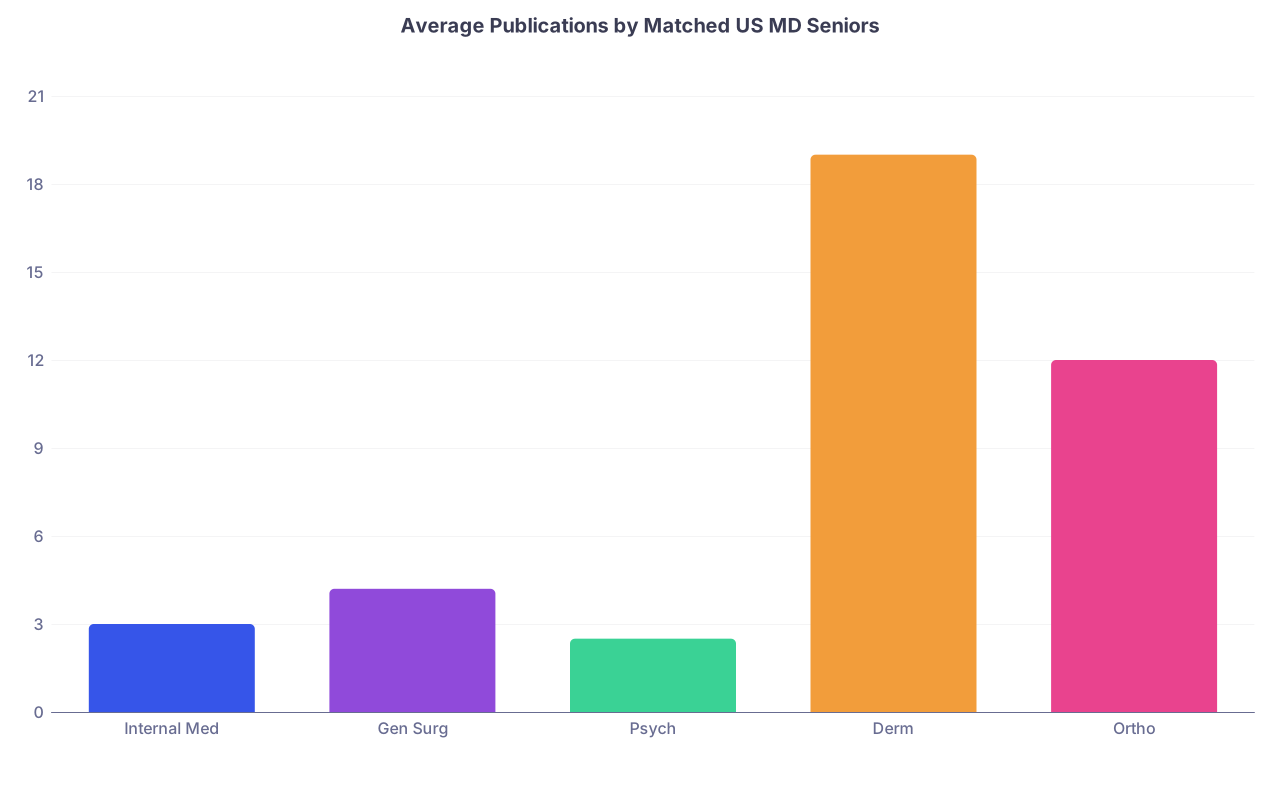
| Category | Value |
|---|---|
| Internal Med | 3 |
| Gen Surg | 4.2 |
| Psych | 2.5 |
| Derm | 19 |
| Ortho | 12 |
Two key problems with how people interpret this:
- Those are averages of people who already matched, not proof that publications caused the match.
- High research output is a marker of being in certain environments (research-heavy schools, AOA, high-resources mentors), not just individual hustle.
For most non-ultra-competitive specialties—internal medicine, family med, psych, peds, even OB in many places—the majority of matched applicants do not have extensive research. Plenty have none.
The bigger determinants of whether a red flag applicant matches are:
- Whether they apply broadly and realistically.
- Whether they have strong, specific letters from people who will pick up the phone for them.
- Whether they improved performance after the red flag (upward trend).
- Whether there were multiple red flags or just one.
I’ve seen this play out over and over:
- Step 1 fail, Step 2 240s, no publications, strong IM letters → matched academic IM.
- Repeat year for health reasons, solid clinical grades, one poster, not even first author → matched psych.
- Failed a clerkship, repeated successfully, zero research, incredible chair letter → matched community surgery.
Were these people perfect? Not even close. Did research (or lack of it) decide their fate? No. Their trajectory and advocacy did.
The One Group Where “No Research Means No Match” Is Closer to True
There is a subset where the myth edges closer to reality: red flag applicants aiming at research-heavy, ultra-competitive specialties.
Think:
- Dermatology
- Plastic surgery
- Neurosurgery
- ENT
- Ortho at top-5 academic powerhouses
In these fields, even “clean” applicants often have double-digit publications, dedicated research time, or well-known mentors who can call PDs directly.
If you bring a red flag into this arena—Step 1 fail, LOA, repeated year—and you also have no research, you’re asking programs to take a risk on you with no counterbalancing academic narrative. That’s tough.
But even here, the real issue isn’t literally “no research.” It’s “nothing compelling to offset a risk.” Research is just the most common currency those fields respect.
Research vs. Red Flag: What Research Can and Cannot Do
Let me be blunt.
Research cannot:
- Erase a professionalism violation documented in your MSPE.
- Make two Step failures disappear from the screening spreadsheet.
- Override a pattern of poor performance with no later recovery.
Research can:
- Signal that you’re capable of focused, sustained academic work.
- Place you in proximity to influential faculty who can write meaningful letters and make calls.
- Give PDs a narrative: “Yes, they had a stumble, but look what they did after.”
Think of research not as “points.” Think of it as a story and a network.
If all you have is your name buried as author #10 on three retrospective chart reviews that you barely remember—congratulations, you just collected some meaningless CV clutter. That does nothing for a red flag.
A single serious project you can talk about in detail, with a mentor who knows your work and your backstory? That’s actually useful.
Clean Applicant vs. Red Flag Applicant: Who Needs Research More?
This is where the myth gets twisted.
A clean applicant shooting for derm with no research? Very tough. Because now you have to compete with your peers, and they’ve got 15–20 abstracts and publications plus connections.
A red flag applicant targeting internal medicine with no research? Very doable. If you play it smart.
| Applicant Type | Target Specialty | No Research Impact |
|---|---|---|
| Clean, average scores | Derm/Plastics | Nearly fatal |
| Red flag, strong rebound | Community IM/FM | Often acceptable |
| Red flag, big ambitions | Academic IM/Neuro | Hurts, but not fatal |
| Clean, low scores | Psych/Peds | Mild disadvantage |
| Red flag + multiple fails | Any competitive | Research rarely enough |
Where people go wrong is assuming “I have a red flag, so I must do research” instead of asking: “For the specialty I’m actually targeting, where is research on the priority list?”
For many bread-and-butter programs, especially community ones, they care a whole lot more about:
- Will you show up?
- Will you pass your boards?
- Are you reasonable to work with?
You don’t need a PubMed trail to prove those things.
The Hidden Variable: Mentors and Advocacy
Here’s the part almost no one talks about when they preach the research gospel: the hidden value is not the paper, it’s the person attached to it.
Serious research usually means:
- Weekly meetings with an attending.
- Deadlines and revisions.
- Presentations at lab meetings or conferences.
- Sitting in the office while they rant about the match and drop names of PDs they can call.
I’ve seen red flag applicants match much higher than their metrics would predict purely because a big-name mentor picked up the phone. Not because they were author #3 on a case series.
So if you’re going to invest time in research as a red flag applicant, you do it for the relationship and the letter, not the line on your CV.
A lukewarm, generic letter from a mid-level researcher you barely know is essentially useless. A detailed, specific letter from a respected clinician-researcher who can say, “They had a rough patch, but here’s what I’ve personally seen since,” is gold.
When a Research Year Is Rational for a Red Flag Applicant
Sometimes a dedicated research year actually makes sense. Not as penance. As strategy.
Very roughly, a research year is rational if:
- Your red flag is moderate (one fail, LOA with a clear explanation, repeated course)
- Your Step 2 is solid or at least rising after the red flag
- You’re aiming for a specialty that does care a lot about research (neuro, academic IM, gas, some surgical fields)
- You can land in a lab with a track record of getting people into residency, not just churning out poster fodder.
And only if you’re honest enough to answer this question:
“Will I use this year to produce serious, defendable work and build strong relationships, or am I just hiding from the match and hoping lines on a CV save me?”
If it’s the latter, you’re wasting a year.

| Step | Description |
|---|---|
| Step 1 | Red flag applicant |
| Step 2 | Focus on clinical strength & broad apps |
| Step 3 | Consider dedicated research year |
| Step 4 | Improve clinical, expand school list |
| Step 5 | Targeting competitive academic field? |
| Step 6 | Can secure strong research mentor? |
When You’re Better Off Skipping Research and Fixing Other Weaknesses
Here’s the uncomfortable truth: a lot of red flag applicants chasing research would be far better off doubling down on other areas.
You probably should not prioritize research if:
- You haven’t taken Step 2 yet and your Step 1 was weak or a fail. Step 2 performance is a higher priority.
- Your clinical evals and narrative comments are mediocre. You need people on the wards saying, “I want this person as a resident.”
- You’re applying to fields where research is a “nice to have,” not a “must have” (FM, peds, psych in many places, community IM).
- You can’t get into a lab with a mentor who actually has time for you.
I’ve watched students sink hundreds of hours into half-baked projects that didn’t yield publications, didn’t generate letters, and didn’t fix the fundamental problem: their clinical performance or exam trajectory was still shaky.
Again: research is a multiplier. It multiplies competence, momentum, and mentorship. It does not create those from nothing.
The Real Red Flag Equation: Risk vs Signal
Here’s the way program directors actually think, stripped of the polite language:
“This person has a ding. Do I see enough signal of reliability, growth, and support to justify ignoring that ding?”
Your job as a red flag applicant is not to “collect research.” It’s to flood the file with counter-evidence:
- Strong Step 2 performance showing you can pass boards.
- Clear upward trend after the red flag.
- Concrete responsibility: chief roles, teaching roles, leadership that didn’t implode.
- Detailed letters that describe you in the trenches, not in abstract adjectives.
Research only matters to the extent it contributes to that counter-signal.
If your PI writes:
“X had a rough academic period earlier in medical school. Over this year I watched them handle complex data sets, meet deadlines, present coherently, and take feedback. I’d trust them with my patients.”
Now your “research” is doing something real. It is reframing your red flag as a rough patch in a larger story of growth.
So, Is “No Research Means No Match” for Red Flag Applicants True or False?
Mostly false. Occasionally partially true. And dangerously oversimplified.
Let me strip it down.
- Research helps red flag applicants only when it is substantial enough to generate strong letters, a coherent narrative of growth, and visible commitment to the field.
- For most core specialties, lack of research is not what sinks red flag applicants; unrealistic school lists, weak Step 2, poor clinical reputation, and multiple unresolved issues are.
- The real asset isn’t the citation count; it’s the mentor who believes in you enough to attach their name to your redemption arc.
If you have a red flag, stop reciting the “no research, no match” mantra like it’s a law of physics. Look at your actual target specialty, your actual weaknesses, and ask a better question:
“What is the highest-yield thing I can do in the next 6–12 months that would change how a PD sees me?”
Sometimes the answer is a research year. Sometimes it’s Step 2 domination. Sometimes it’s an away rotation where you work like your future depends on it.
Because for you, it kind of does.