
What actually happens when you try to “keep it vague” on ERAS about your red flags—do reviewers give you the benefit of the doubt, or do they assume the worst and move on?
You already know the folklore:
“Don’t draw attention to problems.”
“If they don’t ask, don’t tell.”
“Be vague; they’ll fill in the gaps in your favor.”
That’s not how this works. That’s not how any of this works.
Let me walk you through what program directors, APDs, and chief residents actually do when they see a vague, hedged, smoke-and-mirrors application. Because I’ve sat in those rooms, heard the comments, watched borderline applicants get trashed in 30 seconds because of one evasive line in their personal statement.
The Core Myth: “If I Don’t Explain It, It Won’t Hurt Me”
The key misconception is simple: you think information is your enemy. You assume that details about a leave of absence, a failed Step, a professionalism incident, or a sudden med school transfer will automatically sink you. So you try to “strategically under-explain.”
Most applicants doing this are operating on two flawed beliefs:
- Reviewers won’t notice.
- If they notice, vague wording will soften the blow.
Both are wrong.
Program leadership and selection committees are pattern-recognition machines. ERAS is their day job for 2–3 months a year. They notice gaps. They notice euphemisms. They notice when someone clearly had an issue and is tiptoeing around it. And vague usually doesn’t read as “discreet.” It reads as “untrustworthy.”
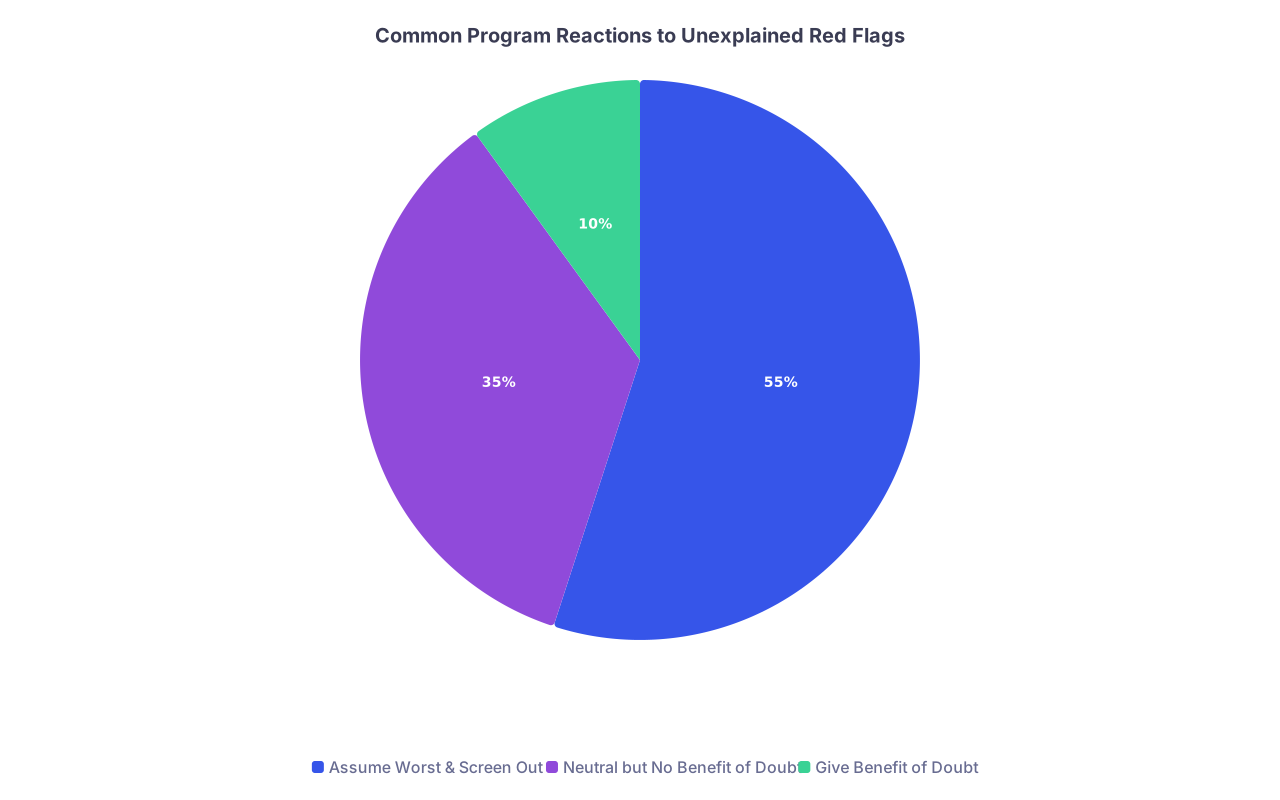
Let’s put numbers to it.
| Category | Value |
|---|---|
| Assume Worst & Screen Out | 55 |
| Neutral but No Benefit of Doubt | 35 |
| Give Benefit of Doubt | 10 |
These proportions come from what PDs and APDs openly say at meetings, panels, and surveys: most do not have the time or incentive to psychoanalyze your silence. If something looks off and you didn’t address it cleanly, more than half will simply move on to the next (cleaner) file.
How ERAS Actually Gets Read (Not How You Imagine It)
You imagine some thoughtful, meditative reading of your life story.
Reality: 30–90 seconds per application on first pass. Faster at high-volume programs. People are skimming.
The rough order many use (with variation by program):
- Filter by USMLE/COMLEX and graduation year.
- Quick scan of school, academics, and any obvious red flag banners (LOAs, extensions).
- Glance at experiences for depth vs fluff.
- Short pass over personal statement for tone and any glaring issues.
- Maybe peek at MSPE and letters if you’re still interesting.
At any point, if something smells off and there’s no clear, credible explanation, that file quietly dies.
Vagueness doesn’t protect you; it just gives them less reason to fight for you.
Here’s the crucial point: the bar isn’t “no red flags.” The bar is “can we trust this person with our patients and our team at 3 a.m.?” A well-explained red flag can pass that bar. An unexplained one usually doesn’t.
The Different Ways People Try to Be Vague (And How They Backfire)
You’ll recognize some of these, maybe in your own drafts.
1. The “Soft Focus” Personal Statement
You had a leave of absence after failing Step 1. Your PS says:
“During my second year of medical school, I encountered personal and academic challenges that helped me grow in resilience and self-awareness. This period of reflection strengthened my commitment to medicine and shaped the physician I’m becoming.”
This sounds smooth to you. It sounds evasive to them.
In committee, it turns into:
“What actually happened?”
“No idea. Could be anything.”
“We have plenty of applicants without mystery issues; pass.”
What works better:
“In my second year, I failed Step 1 on my first attempt. That failure forced me to reassess my study strategies and priorities. I took an approved leave of absence to remediate and returned with a structured plan, faculty mentorship, and dedicated practice. I passed on my second attempt and subsequently performed above the class mean on all remaining clerkships.
The experience was humbling, but it clarified how I handle setbacks: by seeking feedback, changing my approach, and following through. That’s the same mindset I bring to residency training.”
Clear issue. Clear action. Clear outcome. You controlled the narrative instead of letting them imagine whatever they want.
2. The “Strategic Omission”
This one is common:
- You don’t mention the LOA anywhere.
- You hope your transcript dates, extra year, or MSPE wording will “blend in.”
- You think if you say nothing, they might not see it.
They see it.
The MSPE has to mention it. The transcript dates don’t lie. The ERAS “Education” timeline exposes the gap. When they see an unexplained LOA and a PS that pretends everything was continuous and smooth, they don’t think “privacy.” They think “what else aren’t you telling me?”
I’ve heard PDs say it exactly like this:
“If they’re cagey in an application, what happens when there’s a patient error?”
You are signaling future behavior.
3. The Euphemism Wall
You had a professionalism incident. Instead of plain language, you write:
“There was a misunderstanding during my rotation that highlighted the importance of communication and expectations. This feedback, though difficult, ultimately helped me grow in professionalism and teamwork.”
This tells them nothing useful.
A stronger version:
“During my third-year surgery clerkship, I was cited for a professionalism concern related to lateness and incomplete pre-rounding. The feedback was accurate. I was overextended, not asking for help, and assuming I could ‘catch up.’
I met with the clerkship director, developed a clear plan for communication and time management, and was re-assigned later in the year. On the repeat rotation, I received strong evaluations for reliability and preparation.
I no longer treat expectations as negotiable or casual; I treat them as part of patient safety.”
Do some readers still screen you out? Sure. But the ones willing to work with red flags now have evidence you can course-correct.
What PDs Actually Say About Red Flags vs Silence
Let’s put some structure to what you’re really up against.
| Scenario | Typical Reaction |
|---|---|
| Clear red flag, clearly explained | Hesitation, but possible interview if rest is strong |
| Clear red flag, vaguely addressed | Distrust; likely screen-out |
| Clear red flag, no explanation | Assume worst; almost always screen-out |
| Mild concern, honestly described | Often forgiven; may even build trust |
| No apparent issue, but evasive PS tone | “Something’s off” → lower enthusiasm |
And then the unspoken rule: time is limited, risk is high, and there are more applicants than spots. Programs are not obligated to investigate your mysteries. They don’t. They just move on.
So the belief that “less explanation = less damage” collapses under how selection actually works.
When Being Vague Does Make Sense (And When It Really Doesn’t)
You do not need to bare your entire soul on ERAS. Oversharing is also a red flag—especially if it feels uncontained or dramatized.
Here’s the line:
- For routine stress, family issues, minor health fluctuations: you don’t need detail unless it clearly impacted your record.
- For anything that produces a visible record abnormality—LOA, extra year, course failures, exam failures, professionalism flags, transfers—you need a succinct, direct, contained explanation.
Vague works for normal life context.
Vague fails for explainable anomalies.
The sweet spot is:
- Name the issue plainly (no melodrama, no euphemism wall).
- Briefly describe what concretely changed in your behavior or systems.
- Point to objective evidence that things improved and stayed better.
- Stop. Do not turn it into a three-paragraph confessional.
That’s not “being vague.” That’s being concise and responsible.
The Data Problem: Why You Hear So Much Bad Advice
Most of the “be vague, they’ll never notice” advice comes from a biased sample:
- Applicants with minor issues that truly weren’t noticed or didn’t matter.
- People who had a red flag, were vague, but matched anyway at less competitive programs and then attribute their success to the vagueness instead of the rest of their strong file.
- Students repeating hearsay from someone two classes above them who matched dermatology once and is now treated as an oracle.
Program directors, on the other hand, say things like this at national meetings and surveys:
- “Character and professionalism concerns are more problematic than exam failures.”
- “Honest reflection on a past issue can be reassuring if there is evidence of improvement.”
- “Unexplained leaves of absence are very concerning.”
You rarely hear this directly because they’re not coaching you; they’re selecting you.
Concrete Examples: Vague vs Strong Explanations
Let’s walk through a few typical issues you’re tempted to obscure.
Step Failure
Weak, vague:
“Due to unexpected challenges, my initial standardized test performance did not reflect my abilities. After reflection and adjustment, I was able to demonstrate improvement.”
Strong, specific:
“I failed Step 1 on my first attempt. My approach relied too heavily on passive review and not enough on timed questions and spaced repetition. I met with our academic support office, created a daily question-based schedule, and tracked weak areas. On my second attempt, I passed comfortably and later scored [XXX] on Step 2, which better reflects my current preparation style.”
Leave of Absence for Health
Weak, vague:
“I took time away from school to manage personal circumstances, which ultimately helped me grow in resilience and empathy.”
Strong, appropriately limited:
“I took a one-year medical leave of absence for a treatable health condition. I received appropriate care, fully recovered, and have had no further interruptions in training. Since returning, I completed all required clerkships on time with strong evaluations and no additional leaves.”
You do not owe them your full medical record. You do owe them enough clarity that they don’t assume chronic, unstable impairment.
Professionalism Remediation
Weak, vague:
“Feedback during my early clinical training highlighted the importance of communication and professionalism, themes I have worked hard to improve.”
Strong, concrete:
“During my first clerkship, I received a professionalism concern for not promptly returning pages and for sounding dismissive on a phone call. The feedback was difficult but fair. I met with my advisor, sought communication skills coaching, and set a rule for myself: respond within 5 minutes whenever possible, and always confirm follow-up steps.
Since then, my evaluations consistently describe me as responsive and team-oriented. I have not had further professionalism concerns.”
The through-line: vague protects your pride, not your application. Specific, bounded explanations protect your credibility.
The Line Between “Owning It” and Over-Explaining
There’s a different kind of red flag: the applicant who spills everything. Multi-page trauma dump in the PS. Graphic details of mental health crises. Emotionally raw, no clear arc to stability.
This is where the fear of “explaining too much” comes from. Someone sees that, recoils, and overcorrects into vagueness.
The actual problem there isn’t that they explained the red flag—it’s that they never landed the plane. No clear statement of stability, insight, and function. Just chaos.
Your goals when you explain:
- Show you can talk about a hard thing without falling apart.
- Show you turn feedback/failure into concrete behavior change.
- Show the problem is in the past and your current performance supports that.
Two to four sentences often does the job. You’re not writing a memoir. You’re giving a risk assessment.
So, Does Explaining Less Help More?
No. Not when there’s an obvious red flag on your ERAS that anyone can see with two clicks.
Explaining less helps when:
- There is nothing structurally odd in your record.
- The issue is minor and not documented anywhere.
- You’re just tempted to include unnecessary personal drama.
Explaining less hurts when:
- LOA, extra year, course failures, exam failures, professionalism issues, or transfers are evident.
- Your PS tone feels like it’s hiding something.
- You use euphemisms instead of plain language about concrete problems.
The irony: the most “competitive” applicants on paper sometimes tank because they try to curate an immaculate image and end up reading as inauthentic and slippery. Meanwhile, someone with a clearly explained stumble gets a shot because the committee can actually see how they respond to adversity.
The Short Version
- Silence isn’t neutral. When there’s a visible red flag, silence is interpreted against you, not in your favor.
- Vague language doesn’t “soften” concerns; it usually triggers distrust. Clear, concise explanations win more often than they lose.
- You are not judged for having problems; you’re judged for how you handle them—and for whether you’re honest about them when everyone can see them anyway.