
The quickest way to get quietly buried on a rank list is not a low Step score. It is when your interview story does not line up with your MSPE.
Let me be very clear: programs do not need to “catch” you in a dramatic lie to be done with you. All they need is that uneasy feeling of, “Something here isn’t adding up.” Once that seed is planted, your file moves from “possible resident” to “potential problem” in about 10 seconds.
You will not hear about it. You will just slide down the rank list. Or off it.
Let me walk you through what really happens behind the door when your interview narrative clashes with what’s written in your MSPE (Dean’s Letter)—and how to avoid getting flagged.
How Programs Actually Use Your MSPE
First truth: most students wildly underestimate how closely programs read the MSPE once you’ve been invited to interview.
They don’t scrutinize it when you apply to 80 programs. They absolutely scrutinize it when you are on a final shortlist.
On paper, the MSPE is “not an evaluation” but a “performance summary.” In reality, it’s an institutional reference letter that quietly encodes red flags.
Here’s what happens in a typical academic program:
The night before or the morning of your interview, the faculty interviewer opens your file. They skim your ERAS personal statement, glance at your CV, then they pull up the MSPE. They scroll to:
- The “Noteworthy Characteristics”
- Clerkship comments, especially any “lower than expected” performance
- Leaves of absence, course failures, professionalism issues
- Grade distributions (if your school includes them)
Then they walk into the interview with a mental checklist.
They already know where the landmines could be. If the MSPE hints at a “concern for professionalism” and you come in telling a glowing story about your leadership and reliability, their radar turns on instantly.
And here’s the part students don’t see: after interview day, during the rank meeting, someone always has the MSPE open. When your name comes up, someone will say, “Wait, remember that comment in their MSPE about…?” That’s where mismatches get exposed and discussed.
Where Stories and MSPEs Clash Most Often
The disconnect usually shows up in a few predictable places.
1. Professionalism and “Personality” Comments
This is the big one. If your MSPE says:
- “Required close supervision following feedback around communication”
- “Had difficulty adjusting to feedback early in the clerkship but improved”
- “There was a professionalism concern which was addressed with the student”
And in the interview you present yourself as the ultra-mature, universally loved team player with perfect communication skills—no nuance, no admission of growth—that’s a mismatch.
Faculty remember words. I’ve seen an associate PD flip back to the MSPE mid-discussion and read out loud: “Student was late frequently at the beginning of the rotation.” Then ask the room: “And they told me they were always the first one in and last one out. So which is it?”
Once that question is on the table, your whole file is reinterpreted as embellished.
2. Leaves of Absence / Gaps vs. Your Story
If your MSPE documents:
- A leave of absence
- A delay in graduation
- A term of academic probation
And in your interview you give some vague, polished line like, “I just needed time to explore research opportunities,” while the MSPE states, “Student withdrew from clerkship due to personal circumstances”—that discrepancy is a problem.
Programs do not require you to reveal intimate details. But they do expect your version to be directionally consistent with the official record.
When those do not match, what we hear internally is: “They’re managing their image. A lot.” And then the attending who was on the fence flips to no.
3. Clerkship Performance vs. Your Self-Presentation
If your MSPE shows:
- Mostly High Pass with a few Honors, or
- A fail/remediation in one clerkship, or
- Comments about needing extra guidance, slow progress, or “ultimately met expectations” language
But in the interview you talk like you were the workhorse/rock star on every rotation, we notice.
This doesn’t mean you cannot highlight your strengths. It means if you talk like an exceptional outlier, your evaluations better back that up.
Program directors have been reading these letters for years. They recognize when your story implies, “Everyone loved me,” but the MSPE reads, “Solid but unremarkable.” That gap makes them wonder what else you’re inflating.
4. Research, Leadership, and “Impact” Stories
If your MSPE (and CV) show:
- Minimal research
- Limited leadership roles
- Modest involvement in QI or advocacy
But in interviews you deliver huge, dramatic stories of “transforming workflow,” “leading culture change,” or “driving major research projects” without actual outputs (papers, posters, titles), it smells wrong.
Faculty may not call you out to your face, but they will absolutely bring it up later: “That project sounded a lot more impressive than what’s actually documented.” Interpretation: you stretch the truth.
What Actually Happens in the Interview Room
Let me pull back the curtain on the mechanics.
Step 1: The Silent Mental Comparison
You’re answering a question:
“Tell me about a time you faced a challenge during clinical rotations.”
You launch into a story about an attending who “didn’t give you a chance,” how you rose above it, how the team eventually loved you. You emphasize your “strong communication” and “being extremely punctual.”
The interviewer, who read your MSPE note:
“Student was late to pre-rounds on several occasions and needed direct feedback from the chief resident about timeliness.”
…will not necessarily confront you. But their brain clicks:
“Hmm. Interesting.”
They start listening for more discrepancies instead of your actual content.
Step 2: The Follow-up Probe
Smart interviewers do something subtle: they ask a follow-up question pointed just enough to see if your frame cracks.
“Your Dean’s Letter mentioned you had an area of growth in professionalism early on. Can you tell me about that?”
This is the moment many applicants sink themselves.
Bad answers that I’ve heard almost verbatim:
- “I’m not sure what that referred to; I think it was just a misunderstanding.”
- “Honestly I don’t remember anything specific; I’ve always had strong professionalism.”
- “I think that was blown out of proportion.”
Now the mismatch isn’t just between your story and the MSPE. It’s between your willingness to own reality and what’s documented.
Good applicants say something like:
“I did struggle with X at the beginning of third year. I got specific feedback about it, I adjusted by doing Y and Z, and if you look at later clerkship comments, you can see that improvement.”
That answer takes all the poison out of the MSPE line. It aligns your narrative with the written record, and it reassures us you can acknowledge flaws.
Step 3: The Debrief After You Leave
You leave the room. You think it went “pretty good.”
The interviewer goes back to their laptop and drops a quick note:
“Pleasant, but some inconsistencies between MSPE and interview narrative re: professionalism/timeliness. Slightly defensive when asked.”
Later, at the rank meeting, your name comes up.
Someone says, “Any concerns about this one?”
The interviewer reads their note out loud. Someone else opens your MSPE and reads the exact concerning line. Another person says, “We’ve had issues before when we ignored this kind of thing.” That’s all it takes.
You will not be ranked where you think you deserve to be. And you will never know it was that 20-second mismatch that did it.
How Red Flags from Mismatched Stories Get Labeled
Programs rarely say “this person lied.” They use softer language that means the same thing.
Here are the internal phrases you never see but should understand:
| Phrase in Discussion | What It Really Means |
|---|---|
| "Some concern about insight" | Their story didn't match the MSPE; they won't own issues |
| "A bit too polished" | Rehearsed answers that ignore documented problems |
| "Doesn't fully align with file" | Direct discrepancy between narrative and MSPE/CV |
| "Defensive about feedback" | Argued or minimized what was in the MSPE |
| "Questionable reliability" | Timeliness/professionalism issues that they glossed over |
Once any of those labels attach to you, you are almost never a top-tier rank candidate. Programs will choose a slightly “weaker” applicant on paper who feels more honest and coherent over a “stronger” applicant who feels off.
How to Audit Your Application for Mismatches Before Interview Season
You need to do what most students never bother to do: reconcile your narrative with your official record.
1. Sit Down with Your MSPE and Actually Read It Like a PD
Not skimming. Not assuming you know what’s in there. Read it line by line and ask:
- Does any comment contradict the “brand” I’m trying to present?
- Are there any professionalism, timeliness, communication, or teamwork notes?
- Is there a leave, delay, failure, or probation mentioned?
- Do the strengths in my personal statement match the strengths called out in comments?
Then compare it to your personal statement and your usual interview talking points.
If your statement screams “born leader” and the MSPE never once mentions leadership but repeatedly mentions “good team member,” dial it back. Emphasize collaboration, not command.
2. Identify All Potentially Awkward Topics Up Front
Make a list. Not in your head. On paper.
- That one rotation where you barely passed
- The professionalism note in OB that still annoys you
- The leave you took for health/family reasons
- Step failures or repeats (if present elsewhere in your file)
For each one, draft a version of events that is:
- Truthful
- Consistent with the record
- Framed as growth, not victimhood
You’re not writing excuses. You’re writing a coherent narrative that makes sense side by side with your MSPE.
How to Talk About Discrepancies Without Sinking Yourself
The goal is simple: acknowledge, align, and show growth.
1. Acknowledge What’s Written
If a faculty directly references something from your MSPE, do not pretend you’ve never seen it.
Bad: “I’m not sure why they said that.”
Better: “Yes, I remember that feedback.”
You are signaling: I’m not afraid of my own record.
2. Align Your Story to the Same Reality
Do not create a parallel universe where everything was wonderful and the MSPE just “got it wrong.”
You might say:
“The MSPE notes that I struggled with timeliness early in clerkships. That’s accurate. I was transitioning from pre-clinical to clinical life and misjudged how early I needed to arrive to pre-round. My senior resident gave me very direct feedback.”
Now you and the MSPE are describing the same world.
3. Show Specific, Concrete Growth
The part that saves you is not the confession. It’s the change.
Continue:
“After that, I started arriving 30 minutes earlier, pre-charted the night before, and set backup alarms. If you look at my later evaluations in Internal Medicine and Surgery, you’ll see comments about me being very reliable and early to see patients. That shift taught me to over-correct on reliability.”
That’s the magic phrase: “If you look at my later evaluations…” You’re pointing the PD back to written evidence of improvement.
Now your “red flag” becomes a development story instead of a character indictment.
Cases Where Mismatches Get You Completely Burned
Let me be blunt: there are situations you do not come back from.
1. Direct Contradiction Between MSPE and Interview Story
Example I’ve personally seen:
- MSPE: “Student was asked to leave the operating room after unprofessional communication with a nurse. Issue was addressed by clerkship director.”
- Interview: Applicant tells a story about “standing up for a patient” and framing the nurse as unreasonable, never once taking responsibility, and never mentioning the actual incident.
Faculty put two and two together in the rank meeting. Applicant dropped. Hard. Nobody wanted to risk a resident who rewrites an unprofessional episode as heroism.
2. Denying Widely Documented Issues
If your evaluation shows a pattern—multiple comments about communication problems, organization, or not taking feedback—and you deny having any such pattern, the conclusion is simple: lack of insight.
Programs fear lack of insight more than they fear low scores. Because insight predicts whether you will respond to coaching.
3. Discrepancy in Factual Details (Dates, Roles, Responsibilities)
Examples:
- Claiming you “led” a QI project that your MSPE lists as “participated in”
- Saying you “took a year off for research” when MSPE says “leave for personal reasons”
- Describing yourself as “chief of X interest group” when the MSPE lists you as “member”
These seem small. They are not. To faculty who read hundreds of files, they’re clear markers of image inflation.
How Programs Compare Multiple Sources, Not Just MSPE
Your story isn’t just checked against the MSPE. It’s checked against everything.
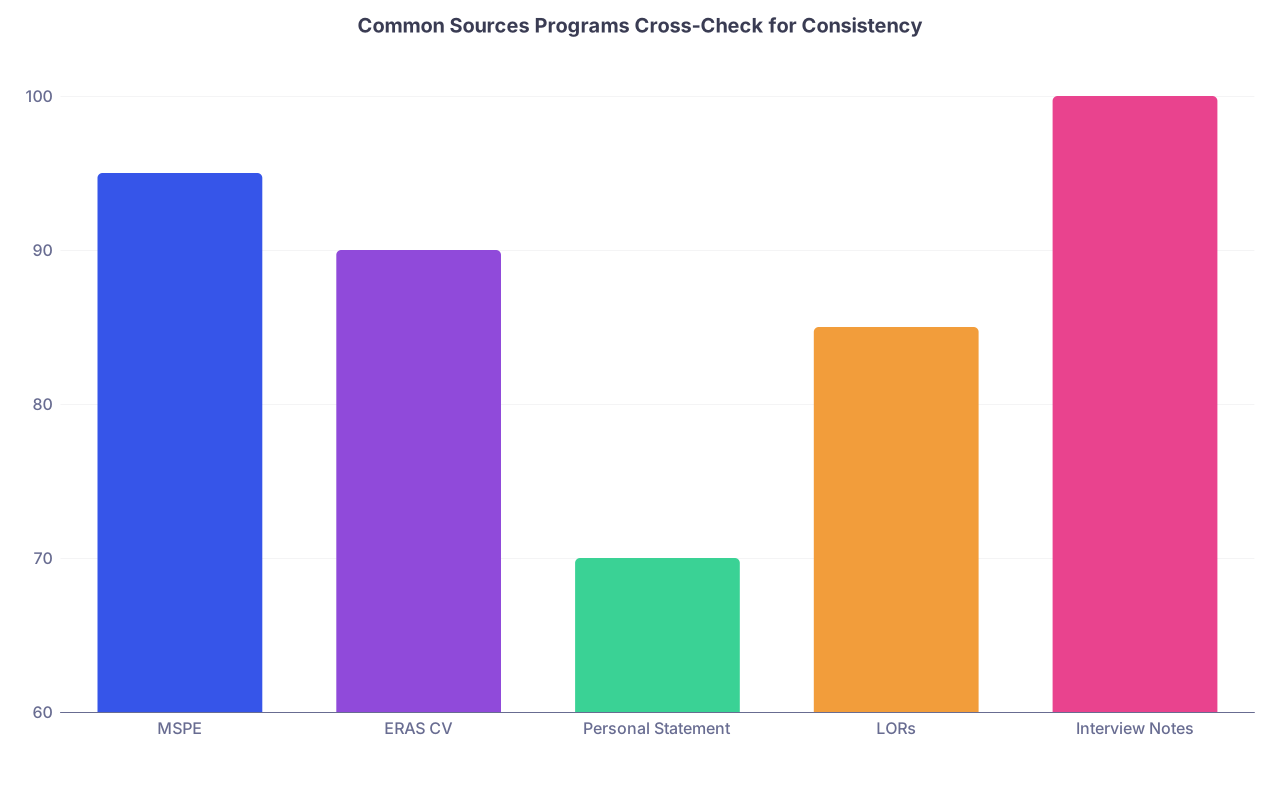
| Category | Value |
|---|---|
| MSPE | 95 |
| ERAS CV | 90 |
| Personal Statement | 70 |
| LORs | 85 |
| Interview Notes | 100 |
Roughly speaking, here’s how “trusted” each piece feels when we’re sniffing out a mismatch:
- MSPE: institutional, somewhat sanitized, but usually accurate on big events
- ERAS CV: where embellishment creeps in; roles and dates get inflated
- Personal statement: where drama and self-mythologizing live
- Letters of recommendation: sometimes coded, but red flags sneak through phrases like “with support, they can…”
- Interview notes: our live read on whether all of the above line up with the actual human
If your mentors over-polished your personal statement into some superhero origin story while your MSPE paints you as a solid but average student, your interview has to bridge that gap with humility and reality.
A Simple Mental Rule to Stay Safe
Here’s the rule I wish more applicants followed:
If a reasonable PD, reading your MSPE and listening to your story, would say, “Yes, that sounds like the same person,” you’re safe.
If they’d say, “Huh, that doesn’t really match what I read,” you’re in danger.
Your job is not to present the best possible version of yourself disconnected from constraints. It’s to present the strongest version of yourself that still fits inside the box drawn by your MSPE and letters.
That’s exactly how PDs talk about it.
Putting It All Together: What You Should Actually Do
Before your next interview, do this:
- Print your MSPE. Mark anything even remotely negative, vague, or weird.
- For each item, write a 2–3 sentence explanation that:
- Admits it exists
- Explains context without blaming
- Tracks improvement over time
- Read your personal statement and main interview stories. Ask honestly:
- Do these sound like the same person described in my MSPE?
- Am I claiming strengths that my evaluations don’t support?
- Tune your narrative. Not to hide. To align and deepen:
- If your MSPE highlights reliability and kindness, lean into that.
- If it never once calls you “outstanding,” don’t talk like you were the star of every room.
- Practice one or two “hard questions” with a mentor who will not coddle you:
- “I see a professionalism note here—tell me about that.”
- “Why did you require remediation in this clerkship?”
If their reaction is, “That feels honest, grounded, and matches your record,” you’re where you need to be.

| Step | Description |
|---|---|
| Step 1 | Interview Day |
| Step 2 | No major concerns noted |
| Step 3 | Ranked according to overall strength |
| Step 4 | Flag for insight check |
| Step 5 | Ranked lower or removed |
| Step 6 | Serious red flag |
| Step 7 | Stories match MSPE? |
| Step 8 | Handles follow-up well? |