
The red flags that scare you less than they scare program directors are the timing ones. Late letters. Late exams. Late graduation. You think they’re small administrative delays; we assume they’re smoke from a fire you’re not telling us about.
Let me be blunt: most PDs will forgive an average score faster than they’ll forgive unexplained lateness. Scores tell us about one day. Timing tells us about how you run your life.
You’re applying into a culture that lives and dies on deadlines. OR start times, ED throughput, 30‑day readmissions, RVU targets, duty hours. So when your application shows a pattern of “I’ll get to it later,” we do not see “busy but fine.” We see the future headache we do not want in our program.
You wanted to know what PDs actually assume? Here it is.
How PDs Really Scan Your Application Timeline
Most applicants imagine PDs reading their personal statement with a cup of coffee, contemplating their “journey.” That’s not what happens.
What actually happens: the coordinator or PD opens ERAS, flips to the Documents and Exam tabs, and silently runs a mental checklist in under 60 seconds:
- Are the exams done?
- Are the scores decent enough for our usual pool?
- Are the letters there? From who?
- Any odd dates? Any gaps? Any “anticipated” nonsense that should not be “anticipated” at this time of year?
Every deviation from the usual timeline throws a little mental flag. One flag is fine if there’s a clear reason. Multiple minor timing flags, with no explanation, quickly become “pass” in a high-volume specialty.
Here’s what “normal” looks like for most core specialties:
| Item | What PDs Expect (Typical) |
|---|---|
| Step 1 (if scored) | Done by end of MS2 |
| Step 2 CK | Taken by Aug–Sep of MS4 |
| All core rotations | Completed by early MS4 fall |
| LORs from home institution | Uploaded by Sep–Oct |
| Graduation | May–June of match year |
When you’re outside those lanes, your file does not auto-die. But it does stop being neutral. Now we’re asking: “Why?” And if you don’t give us a believable answer, we’ll supply one. You won’t like it.
Late Exams: What We Assume When Step 2 Shows Up Slow
Late exams are the first major timing red flag, because they intersect with something PDs care deeply about: risk.
Two patterns worry PDs:
- You took Step 2 CK very late.
- You keep saying “pending” way past when it should be.
Late Step 2 CK: The Silent Story We Tell Ourselves
If your Step 2 CK date is October, November, December of your MS4 year, here’s the cascade of assumptions many PDs run through:
- You were trying to hide a bad Step 1 or mediocre shelf performance.
- You did not feel ready and procrastinated instead of facing it.
- You’re not good at managing high-stakes timelines.
- You might fail. And we really, really do not want a resident who can’t pass boards on time.
Does this apply to everyone? No. Does it apply to too many people for us to ignore? Yes.
I’ve sat in those rank meetings where someone says, “Why did they take CK in November?” and nobody in the room knows, because the personal statement is all “I love teamwork and continuity of care” and never mentions the obvious elephant. That applicant’s name quietly slides down the list.
The difference between:
- “Late exam with a clear, documented, external reason”
vs. - “Late exam + silence”
is massive.
If you had a family crisis, illness, extended leave, or your school structurally pushes CK later, and you spell it out in your MSPE or advisor letter, we’ll accept that. Not always happily, but we understand that life happens. We’re all physicians; we’ve had crises too.
But if your record shows:
- Barely passing shelf exams
- Step 1 close to the cutoff (in the old scoring days)
- CK taken very late with no explanation
the internal PD monologue is: “They waited until the last possible moment and still might barely pass. We’ll be on them for Step 3. Hard pass.”
“Score Pending” Games: What PDs Think
Here’s the thing no one tells you: we know exactly when test dates line up with score release windows. We know the NBME calendar better than you do.
When your ERAS says:
- “Step 2 CK: taken July, result pending” in October or November…
we assume either:
- You failed and are waiting on a retake
or - You’re hiding a mediocre score and hoping we’ll rank you before we see it
Neither is a good look.
Some PDs will not even review your file without a Step 2 score, especially in competitive fields or if Step 1 is pass/fail. There’s too much risk.
So what happens behind the curtain? A few possibilities:
- Your file gets tagged “Hold until CK.” You never escape that pile in time.
- You get an interview but move down the rank list once the late, mediocre score appears.
- Or the coordinator literally writes “No Step 2 – skip” in the spreadsheet, and nobody argues.
The hard truth: if your Step 2 date slips, you need to control the story or the story controls you. That means:
- A concrete reason in your dean’s/MSPE letter if it’s structural or medical.
- Brief explanation in your personal statement or supplemental if it’s life circumstances.
- Your advisor directly emailing PDs for programs you care about if timing was genuinely unavoidable.
Silence = we assume the worst.
Late Letters: What PDs Infer About Your Relationships and Reputation
Letters arriving late are more revealing than you think.
Most students view letters as bureaucratic. PDs view them as social x-rays: how do attendings and chiefs feel about working with you, and were they willing to do you a favor on time?
When letters trickle in after interview season has started, we ask a simple, brutal question: “Why didn’t anyone hustle for this person?”
Three Interpretations of Late LORs
I’ve watched faculty and PDs dissect this over countless application cycles. The usual behind-the-scenes interpretations:
You asked late because you procrastinate.
Translation: “This is what they’ll do with consult notes, discharge summaries, prior-auths.” It sounds petty, but it’s not; we project forward.You did not have strong letter writers willing to commit early.
Translation: “No one was excited enough to write quickly.” That often means you were middle-of-the-pack or forgettable on rotation.Your school or a specific attending was chaotic and delayed everything.
Translation: “System problem, not applicant problem.” This can be forgiven—if the pattern matches what we’ve heard about that school and the rest of your app looks organized.
A single late letter from a notorious slow-writer? Harmless. Three out of four letters all appearing in November? That’s a different story.
The “Strategically Late” Letter Myth
Students love the fantasy that a late letter is “strategic”—like you’re adding a powerful update mid-season.
Here’s what really happens:
- By the time that “amazing” November letter appears, many programs have already:
- Screened their pool
- Sent most interview invites
- Mentally ranked early favorites
Nobody is going back through 1,000 applications just because a letter count went from 3 to 4.
If you’re counting on a “big-name” late letter to rescue a mediocre app, PDs usually don’t bite. We’ve all seen glowing letters for weak students written by famous faculty who barely remember their names.
We look for consistency: strong narrative in MSPE, good comments in evals, solid scores, and then letters that line up with that story. If everything is average and then there’s one flamboyantly glowing letter from an academic celebrity that arrives at the last minute, it smells like a favor, not a reflection of reality.
What Late Letters Suggest About Professionalism
The deeper issue isn’t logistics. It’s professionalism.
Residents live in an ecosystem of other people’s deadlines:
- Consults done before sign-out
- Notes done before post-call
- Follow-up calls before the clinic closes
- Prior-auths before the patient runs out of meds
Late letters—especially when multiple are delayed without any structural explanation—whisper: “This person cuts things close. People don’t bend over backward for them.”
You might be brilliant. But if you give us evidence that you will be chronically “almost on time,” lots of programs will quietly look elsewhere.
Late Graduation: What PDs Really Think When You Don’t Finish on Time
Now we get to the timing red flag with the most weight: delayed or off-cycle graduation.
This is the one that makes PDs stop and really stare at your file. Because late graduation often equals real risk: academic trouble, professionalism issues, health crises, or visa complications.
The Basic Red/Yellow/Green Framework PDs Use
Most PDs won’t say this out loud to students, but internally we bucket delayed graduation into three mental categories:
| Category | PD Interpretation | Interest Level |
|---|---|---|
| Green | Clear, external reason, well-documented | Usually consider |
| Yellow | Vague academic/administrative delay | Case-by-case |
| Red | Professionalism/remediation issues | Usually avoid |
Green (we can live with it)
Examples:
- Major illness (yours or a parent’s) with documented leave of absence.
- Military service or national service obligations.
- Formal research year with publications, clearly planned.
- Dual-degree extension (MD/PhD, MD/MPH) on a normal track.
Assumptions: You can function, you’re likely fine, there was a real external reason. Risk: low.
Yellow (we’re uneasy)
Examples:
- “Extended for academic reasons” with no detail.
- “Required additional time to complete requirements” repeated in formal language.
- “Curricular extension” that doesn’t obviously line up with anything.
Assumptions: Something went wrong, but the school is being polite. Maybe repeated a clerkship. Maybe barely passed something. PDs will split on how much they care depending on specialty competitiveness and how strong the rest of your file is.
Red (we’re done here)
Examples (usually buried in the MSPE if you read carefully):
- “Required professionalism remediation.”
- “Repeated multiple clinical rotations.”
- “Graduation delayed secondary to unprofessional behavior” (yes, I’ve seen that phrasing).
Assumptions: Chronic problems. Headache. Risk to patients, co-residents, brand of the program. In most specialties, that’s an automatic no unless you have an extraordinary advocate making personal calls for you.
Off-Cycle Graduation: The Scheduling Nightmare Factor
There’s another hidden layer students rarely consider: operations.
Residency programs are built around a July 1 start, with:
- Orientation
- Credentialing
- Epic/EMR training
- State licensure paperwork
- Visa arrangements
- Graduation metrics for boards
If you’re off-cycle—say you graduate in December and want to start in March—many programs simply cannot slot you in. Not because they hate you. Because the hospital HR system literally does not support it, or it screws up the coverage model.
So PDs look at off-cycle grads and think:
- “Can our GME office even process this?”
- “Will this leave us short a resident for half a year?”
- “Will we have to do a special orientation just for them?”
Some big academic centers can flex a bit. Most community and mid-size programs cannot. So your late graduation is not just a “story” issue; it’s a logistical problem. Logistics often win.
How PDs Weigh Timing Red Flags Against the Rest of Your File
Nothing is evaluated in isolation. A late exam, late letters, late graduation—those aren’t automatic death sentences. But they get weighed against everything else.
This is more or less how the mental math feels from the PD side:
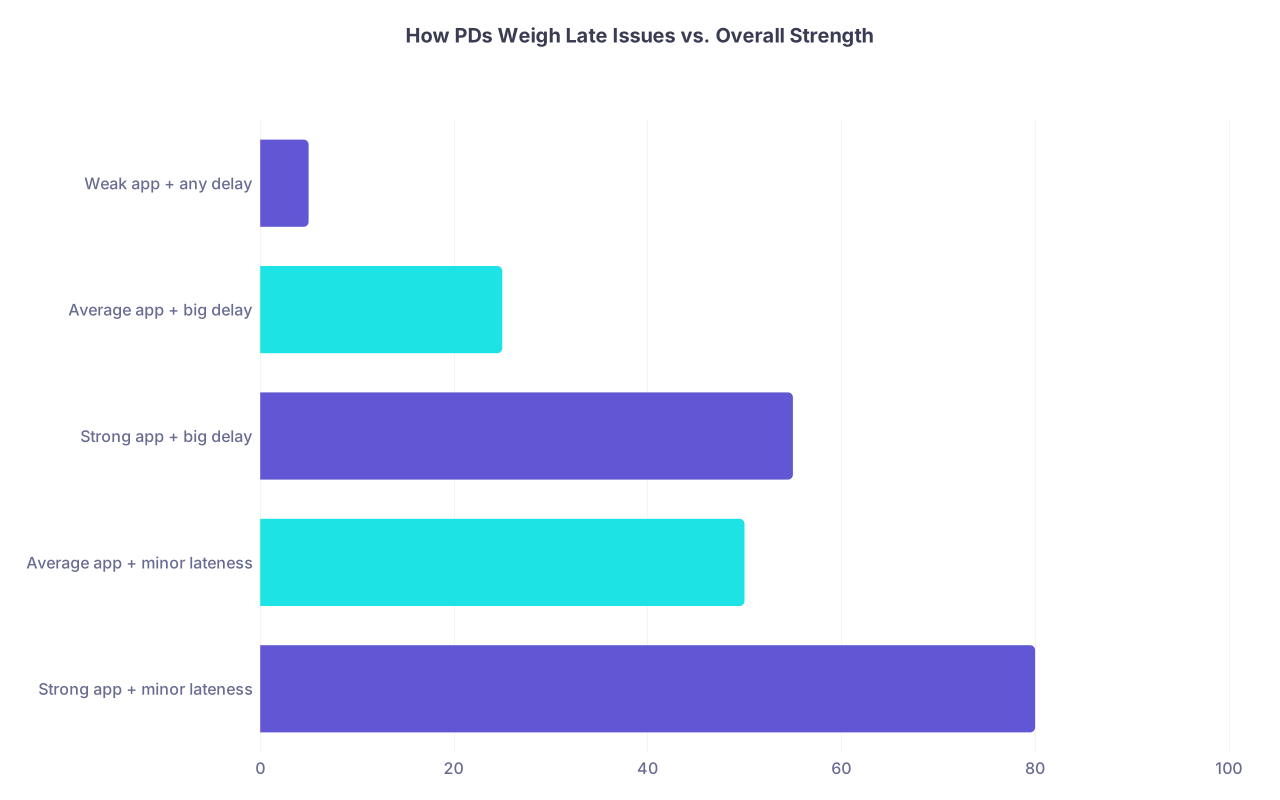
| Category | Value |
|---|---|
| Strong app + minor lateness | 80 |
| Average app + minor lateness | 50 |
| Strong app + big delay | 55 |
| Average app + big delay | 25 |
| Weak app + any delay | 5 |
Those numbers aren’t scientific, but the instincts are real.
If you’re a top-tier applicant with:
- Excellent scores
- Strong narrative in MSPE
- Great letters in core specialties
- Solid research and leadership
a single late exam or slightly delayed letter becomes “annoying but manageable.”
If you’re average on paper and have timing weirdness, that’s where PDs start to ask, “Why should we pick this person over the 100 others with similar metrics and no drama?” That’s the real competition you’re in.
And if you’re already weak on paper—low scores, marginal comments, unimpressive letters—and you also bring major delays or off-cycle graduation? It’s essentially impossible to overcome at competitive programs without an inside champion calling directly.
The One Thing That Actually Helps: Owning the Story
Here’s the part that almost no student handles well: explanation.
Most of you either under-explain (“took time off for personal reasons”) or over-explain (three-paragraph sob story in the personal statement). Both approaches irritate PDs.
What actually works, from what I’ve seen repeatedly in rank meetings, is this:
- A brief, factual, non-dramatic explanation.
- Backed by your school’s documentation.
- Paired with evidence that you bounced back and performed at or above expectations.
For example:
- “Due to a family health crisis in my third year, I required a short leave of absence that delayed one core clerkship and my Step 2 CK exam. After returning, I completed all remaining rotations on schedule and improved my exam performance, scoring above the national mean on CK.”
Then your transcript supports that story. Your MSPE confirms the leave. Your CK score is solid. People move on. PDs don’t want to punish resilience.
What does not work:
- Never mentioning it and hoping no one notices. We notice.
- Emotional oversharing without clear academic recovery.
- Blaming everyone else—school, administration, “unfair policies”—with no ownership.
You don’t need to beg for understanding. You need to show reality, then show that you met or exceeded the standard once the obstacle passed.
To make this practical, here’s how the better applicants I’ve seen handle communication timing:

| Step | Description |
|---|---|
| Step 1 | Identify timing red flag |
| Step 2 | Ask dean/MSPE to mention clearly |
| Step 3 | Add 1-2 sentence explanation in PS or secondary |
| Step 4 | Reflect on cause honestly |
| Step 5 | Discuss with advisor for wording |
| Step 6 | If major issue, advisor emails key PDs |
| Step 7 | External & documented? |
You want PDs to say, “Okay, that makes sense,” and move on. That’s the goal. Not to elicit sympathy. To neutralize suspicion.
The Quiet Reality: PDs Care More About Future Hassle Than Past Sin
If you remember nothing else, remember this: PDs aren’t moral judges; they’re risk managers.
Late exams, late letters, late graduation—those are predictive tools for us.
We’re asking:
- Will this person pass their boards on time?
- Will they get notes done?
- Will they show up on time for rounds, sign-out, OR?
- Will they make our lives easier or harder for three to seven years?
That’s the algorithm, even if no one admits it out loud.
So if your application already has “late” all over it, here’s what you do now:
Stop adding more lateness. Submit ERAS on time. Respond to interview emails quickly. Turn in every form before it’s due. Show a current pattern of reliability, even if your past is messy.
Get a credible adult (advisor, dean, respected attending) to vouch directly for you if your delay was serious—especially for late graduation or academic extensions. A two-sentence email from a trusted name does more than a page of your own explanation.
Accept that some doors are closed and focus on those that remain open. Community programs, prelim years, less competitive regions—these places may look at the whole human in front of them, not just the perfect timeline.
You can recover from late. But only if you stop pretending it doesn’t matter.
Key points:
- PDs read late exams, late letters, and late graduation as signals about reliability, risk, and future hassle, not just “administrative delays.”
- Unexplained lateness is far worse than clearly explained, documented delays with evidence of strong performance afterward.
- You cannot undo the dates, but you can own the story, tighten everything going forward, and choose programs where a non-linear path is actually considered rather than instantly discarded.