
Most applicants have the wrong mental model of how a failed board score is read. It’s not “instant death.” It’s a story prompt. And what story you’ve accidentally written around that failure is what program directors are reacting to.
Let me tell you how it actually plays out in the room.
What Happens The Second We See “Fail”
Program directors don’t read ERAS in order. They scan. Very fast. The USMLE/COMLEX section is one of the first visual anchors our eyes land on.
Here’s the sequence you won’t see written anywhere, but I’ve seen a hundred times in selection meetings:
Eyes hit “USMLE Step 1: Fail” or “COMLEX Level 1: Fail.”
Micro‑pause.
Then three immediate questions in the PD’s head:
- Is this a single contained event or part of a pattern?
- Did they recover strongly or limp across the line?
- Do I trust this person to get licensed and not blow our board pass rate?
Notice what’s missing: “Are they a bad person?” Nobody cares. We care about risk. Time. Headaches.
That’s the frame you need to think in: risk management, not moral judgment.
Now let’s break down exactly how that “Fail” gets interpreted in real life.
The Uncomfortable Truth: Not All Fails Are Equal
I’ve sat in meetings where one applicant with a fail got an interview at a top program and another with “only” low passes got dumped into the reject pile. That surprises students. It shouldn’t.
Let’s organize this the way PDs actually think about it.
| Type of Failure | Typical Reaction | Salvageable? |
|---|---|---|
| Early Step/Level 1 fail, strong later scores | Curious caution | Often yes |
| Step/Level 2 CK/CE fail | High concern | Sometimes |
| Multiple fails on same exam | Massive red flag | Rarely |
| Fail + no later score yet | Black box risk | Usually no |
| Fail with big upward trend and explanation | Case-by-case | Yes, with context |
Step/Level 1 Fail (Now Pass/Fail Era Included)
For those who took it when it was scored: Step 1 fail with a strong Step 2 is the most “forgivable” category of failure. Same for COMLEX Level 1 with a clear rebound on Level 2.
Here’s what PDs are actually asking:
- Was this immaturity and bad prep, or a true knowledge gap?
- Did they crush Step 2/Level 2 (e.g., 245+ / strong Level 2) or just squeak by?
- Did this person repeat the same bad habits or learn from it?
A Step 1 fail with a 252 Step 2? That tells a story of wake‑up call and recovery. A fail with a 221 Step 2? That looks like persistent borderline performance. Different feel entirely.
In the pass/fail Step 1 world, when someone failed before passing, we still see that history in the NBME transcript. The mental translation is: “This person needed more than one swing to clear an exam that most pass.” You’re starting in a hole, but not at the bottom of it.
Step 2 CK / COMLEX Level 2 Fail
This is where people get nervous, and they’re right to be.
Step 2/Level 2 is closer to what we care about: clinical reasoning, day‑to‑day medicine, boards for our specialty. A fail here—especially after a prior Step 1 fail—sets off the “chronic risk” alarm.
Program directors think:
- If you struggled here, what happens on specialty boards?
- Are we going to invest 3–7 years and end up with someone who fails ABIM/ABS/ABEM, etc.?
- Is this someone who underperforms clinically, not just with memorization?
You can still match with a Step 2 fail, but the rescue plan has to be airtight. More on that later.
Multiple Fails
This is the one people soften online and PDs rarely soften in real life.
Two fails on Step 1. Or fail Step 1, then fail Step 2. Or fail COMLEX Level 1 twice.
In PD language: “high maintenance.” They may not say it that directly in public, but behind closed doors, I’ve heard worse.
The key thought: This is no longer “bad day” or “rough semester.” This is a pattern. And residency programs are allergic to patterns of instability because they always come with late‑night emails, remediation plans, and meetings with GME.
Are there exceptions? Yes. But they’re rare, and they almost always come with:
- A phenomenal Step 2/3 or Level 2/3 performance
- Exceptional home support and advocacy
- A compelling, verifiable story (serious illness, family catastrophe, etc.)
- Clear proof that systems and habits have changed
You can’t sell “I just tried harder.” Nobody believes that.
Fail With No Follow‑Up Score Yet
This is the quiet killer.
If you apply with a failed Step 2 and no updated passing score, or a failed Level 2 and nothing else? You’re a complete risk black box. Most PDs will not even consider it.
They’re asking themselves: “Why would I spend an interview slot on someone who might not even be eligible to rank?”
In those days when we download apps and set up filters, this is how it goes:
- Filter 1: Only complete Step 2/Level 2 scores.
- Filter 2: Exclude failed attempts… unless we’re specifically open to red‑flag rescue.
Most of you will never clear Filter 1 if your fail is the current/latest attempt with no pass posted.
What PDs Actually Look For After Seeing a Fail
Once we see that “Fail,” we do not delete your app. We start hunting for context and mitigation.
The order is usually something like this:
- Later scores (Step 2, Level 2, Step/Level 3)
- Transcript for course/clerkship failures or remediation
- MSPE “adverse actions” section
- Personal statement for how you talk about it
- Letters from people who know your academic story
Let’s go through how those pieces change your odds.
1. The Rescue Score: How Strong Is Your Comeback?
The most powerful thing in your file after a fail is not your explanation. It’s your next score.
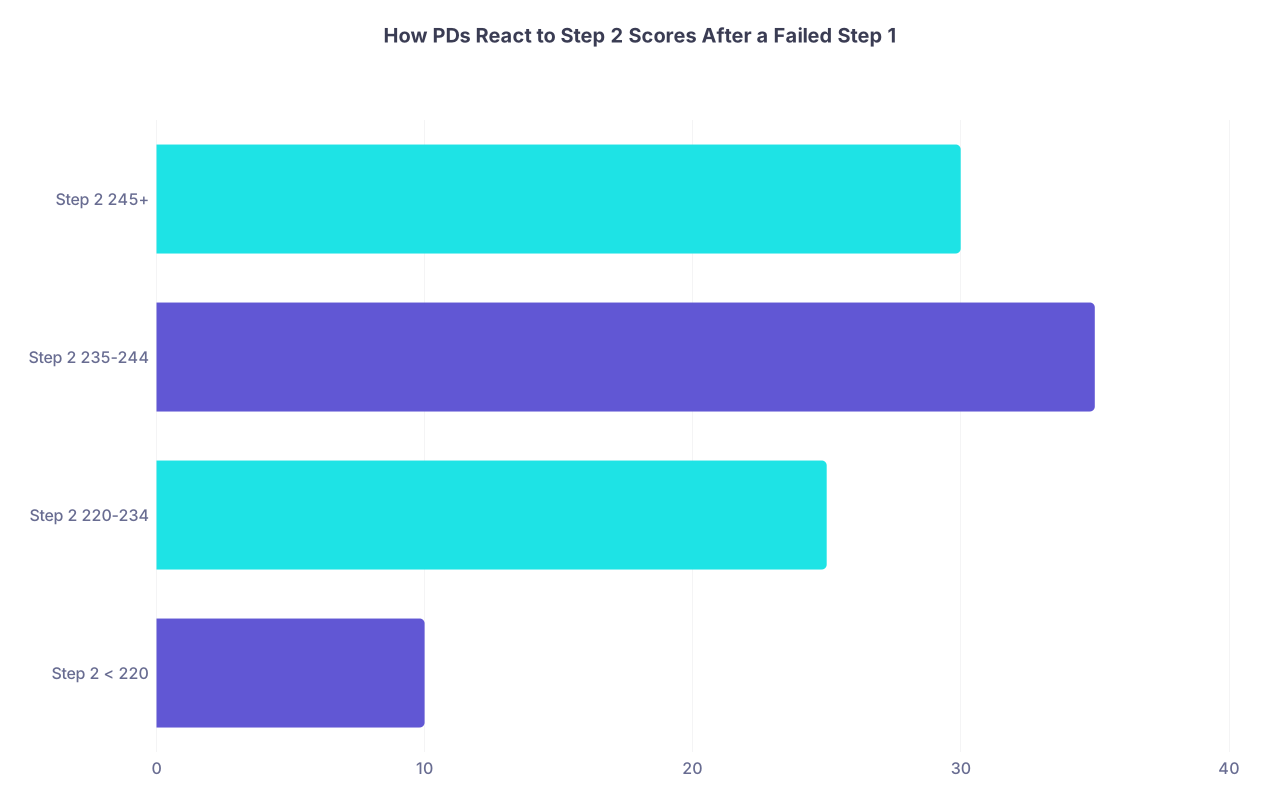
Some PDs literally have mental boxes like this:
| Category | Value |
|---|---|
| Step 2 < 220 | 10 |
| Step 2 220-234 | 25 |
| Step 2 235-244 | 35 |
| Step 2 245+ | 30 |
Interpretation (from countless committee conversations):
- Step 2 < 220 after a fail: “We’re done here.”
- 220–234: “Borderline. Maybe in a less competitive field with strong connections.”
- 235–244: “Okay, maybe they figured it out.”
- 245+: “Hmm. This might be a late bloomer or someone who had one serious disruption.”
The exact numbers vary by specialty, but the shape of the thinking is the same. A big jump makes us lean in. A tiny jump or flat line makes us move on.
2. Does Your Transcript Show You Stabilized?
We look for whether your clinical evaluations, especially in core clerkships, support or contradict the story your boards tell.
Patterns that help you:
- Strong medicine/surgery/peds grades after early failures
- Comments like “reads extensively,” “excellent clinical reasoning,” “top performer”
- Honors in sub‑Is or acting internships in the specialty you’re applying to
Patterns that hurt you badly:
- Multiple remediations (even if not on boards)
- Narrative comments about “needing extra supervision,” “organizational issues,” “struggles to synthesize”
- Fail in a core clerkship plus failed board exam
We’re lazy in a specific way: we want all the arrows pointing in the same direction. If your transcript fights your narrative of “I fixed my study and time management problems,” we’ll believe the transcript.
3. The MSPE Adverse Actions Section
Deans gloss things over. We know that. But if your MSPE has a separate paragraph about academic difficulty, we read that very carefully.
We’re asking:
- Was the school worried enough to put them on formal probation?
- Did they need a reduced schedule or repeat a year?
- Does the language suggest improvement or ongoing concern?
A Step 1 fail with “student underwent remediation and no further concerns” is not the same as “student has continued to struggle but ultimately met minimum graduation requirements.” That second sentence kills more applications than you think.
The Story You Tell: How You Talk About Your Fail
Here’s what applicants get wrong: they think the key is the reason they failed. It’s not. It’s how they process and operationalize that failure.
There are four ways people typically frame it in personal statements or interviews. Only one works well.
1. The Excuse-Heavy Story (Bad)
“I was sick, my family member was ill, I had to work, my school didn’t prepare me, test was unfair…”
I’ve heard all of this. After the second sentence, PDs mentally tune out. Everyone has life stuff. Some of your classmates with the same issues passed.
Excuses signal to us: you’ll blame systems, not adjust yourself. That’s a problem in residency.
2. The Minimizer (Also Bad)
The student who barely mentions it or throws in a line like “I had a setback on Step 1” and moves on.
That approach can sometimes work if every other metric is fantastic. But if you’ve got any other yellow flags, pretending it’s not a big deal makes people suspicious.
Directors think: “If they won’t talk frankly about this now, how are they going to handle difficult feedback?”
3. The Overconfessional Trauma Dump (Bad in a Different Way)
Sharing every detail of your mental health, family trauma, or personal crisis without any boundary.
Harsh truth: some PDs are sympathetic. Some are not. But all of them are thinking: “Am I signing up for a high‑risk situation with unpredictable stability?”
If your story is mostly raw emotion and not structured change, you lose people.
4. The Structured Accountability Narrative (This Works)
The best applicants with fails sound something like this (in their own words, obviously):
Clear acknowledgment without drama:
“Early in medical school, I failed Step 1 on my first attempt.”Brief, specific cause that includes internal responsibility:
“I underestimated the dedicated time needed and relied too much on class notes rather than board‑style questions.”Concrete changes:
“For my second attempt, I switched to a structured qbank‑first approach, joined a small accountability group, and started weekly meetings with our learning specialist to overhaul my schedule.”Evidence the system worked:
“I passed on my next attempt and later scored 244 on Step 2 while on full clinical schedule.”Link to residency‑relevant growth:
“That period forced me to learn how to build sustainable study systems, ask for help early, and be honest about my blind spots—skills I’ve used to become one of the most prepared students on my medicine and ICU rotations.”
Program directors are scanning for: ownership, insight, concrete behavior change, and durable results. Hit those and your fail becomes a “dent,” not a “terminal crack.”
Specialty Differences: Where a Fail Hurts More (and Less)
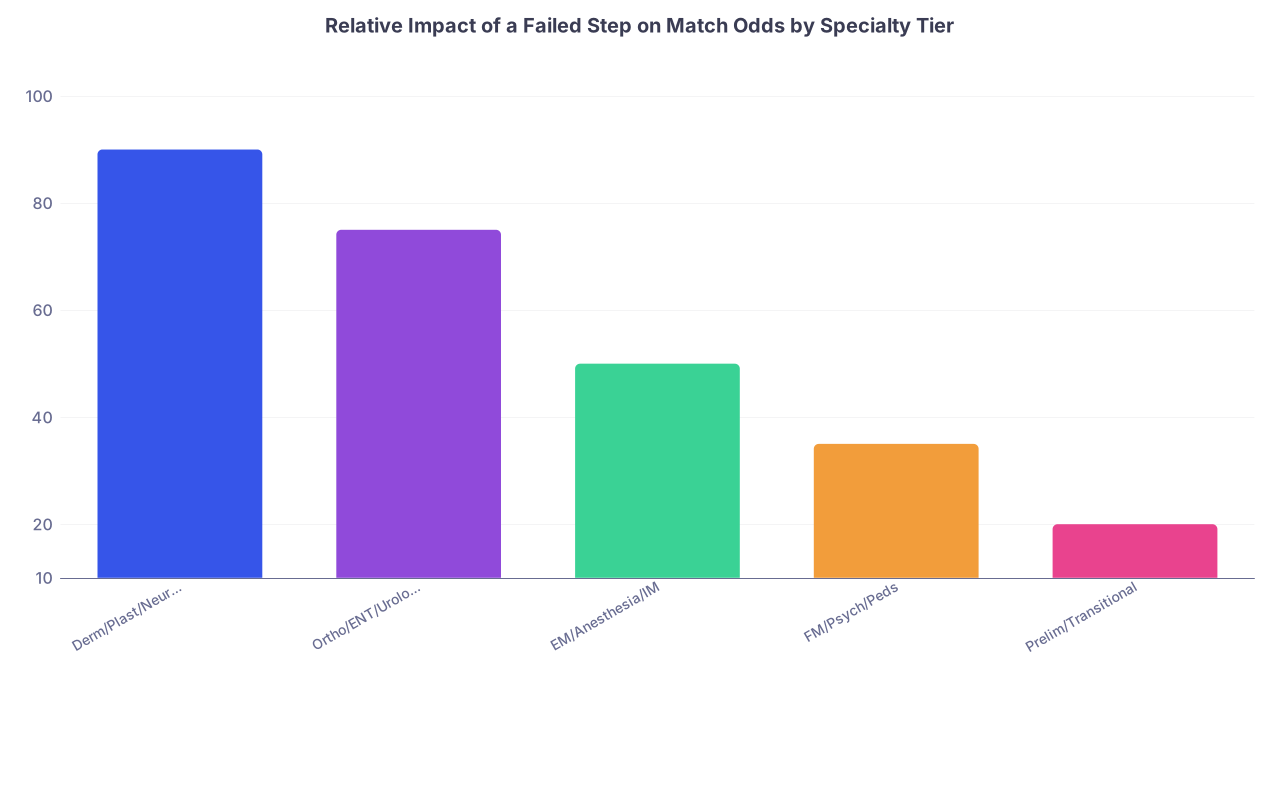
Not every field treats a failed board the same way. The culture matters.
| Category | Value |
|---|---|
| Derm/Plast/Neurosurg | 90 |
| Ortho/ENT/Urology | 75 |
| EM/Anesthesia/IM | 50 |
| FM/Psych/Peds | 35 |
| Prelim/Transitional | 20 |
Think of those numbers as “percent of programs where this will be a huge problem.”
Hyper-Competitive Specialties (Derm, Plastics, Neurosurgery, Ortho, ENT, Urology, Rad Onc)
Reality: a failed Step 1 or Step 2 is almost always disqualifying unless you have:
- A massive Step 2 rebound
- A heavy research portfolio with big‑name mentors
- Strong home program pulling very hard for you
These programs are drowning in people with 260s and first‑author pubs. They just don’t need to take a risk.
Mid-Competitive (EM, Anesthesia, Categorical IM at mid/high tiers, Gen Surg at strong places)
For these, a single fail with a strong rebound and excellent letters can sometimes be absorbed, especially if:
- You’re from their own school or region
- You rotated there and impressed them
- Your later work screams “high performer”
But multiple fails? Or a Step 2 fail? You’re now in the very small “maybe” bucket, fighting for a few mercy interviews.
Less Competitive Categorical (FM, Psych, Peds, some Community IM)
This is where genuine redemption arcs play out.
- FM and Psych in particular will look past an early fail if your story and performance since then are strong.
- Peds and community IM vary by region and PD personality, but they’re more open to “late bloomers.”
Don’t confuse “more forgiving” with “anything goes.” You’re still competing against plenty of clean transcripts.
Prelim and Transitional Years
When PDs are desperate for bodies to cover the wards, they will sometimes scoop up folks with red flags—especially in prelim medicine or surgery spots.
But they’re thinking: “Can this person safely take call and not implode?” If your fail story suggests ongoing instability or poor coping, even prelim programs may pass.
How Programs Filter You Before Even Reading Your File
ERAS is not some slow thoughtful reading journey. It’s mass triage first, nuance later.
Most programs use some variant of this:
- Basic score filters (many still use them even in Step 1 P/F era, especially on Step 2)
- Automatic flags for any fail
- Then human review of the “flagged” pile if they choose to
Some PDs create a separate bin: “Red Flag Review.” That’s where your application with a failed board lands—if it’s not automatically screened out.
What happens next depends heavily on the PD’s culture and bandwidth.
Busy or risk‑averse programs:
“We have 800 clean files. Why are we spending 20 minutes on this one?”PDs who’ve had bad experiences:
“Last time we took someone with multiple fails, it was a disaster. Never again.”PDs who are teachers at heart and have support:
“Let’s see if this is a real growth story or just chronic struggle.”
You can’t control which bucket you land in, but you can control how strong your case looks once a human actually opens it.
Strategic Moves If You Have a Failed Board
Let me be blunt: you can’t “spin” a fail into a positive. But you can contain the damage.
Here’s what serious applicants quietly do behind the scenes.
1. Delay Application Until You Have a Strong Pass
If you just failed Step 2 or Level 2 in June and plan to re‑take in September, you’re better off delaying a cycle than applying incomplete.
An application with “Fail” and no new score will mostly get filtered out. An application next year with “Fail → 247” gives PDs something to work with.
I’ve seen students who rushed it and burned a cycle they couldn’t afford.
2. Stack Your File With Evidence of Clinical Strength
After a fail, “nice” evals aren’t enough. You want language like:
- “Functions at intern level”
- “Top 5% of students I’ve worked with in 10 years”
- “I’d be happy to have them as a resident”
Strong sub‑I and away rotation performance in your chosen specialty can override some board concerns, especially at community and mid‑tier academic programs.
3. Have One Letter That Directly Addresses It (The Right Way)
The best letters for red‑flag applicants usually come from:
- Clerkship or sub‑I directors
- Program directors or APDs at your home institution
- Faculty who actually know your academic struggles and recovery
The magic phrasing PDs like to see sounds like this:
“X had an early board failure that prompted them to completely restructure their study habits. Since then, they’ve consistently performed in the top third of our students on clinical rotations, and I have no concern about their ability to pass specialty boards on first attempt.”
That sentence, from a credible educator, neutralizes a lot of anxiety.
4. Apply Broadly, Not Delusionally
You need both breadth and realism.
- Yes: casting a wide net across geographic regions and program tiers.
- No: anchoring your list to 15 big‑name university programs with one “safety” community place.
I’ve watched students with failed boards apply like they had clean records, because their classmates did. Then they act shocked in February. You are not in the same game. Play the game you’re actually in.
How It Plays Out In the Room: Real Committee Dynamics
Let me pull back the curtain on an actual discussion.
We’re in a mid‑tier IM program meeting. We have 60 interview slots left. This candidate comes up on the screen:
- Step 1: Fail, then Pass
- Step 2: 242
- COMLEX: Pass levels, no fails
- Clinical grades: Mostly High Pass, a couple Honors
- MSPE: Mentions academic difficulty early MS1, no further issues
- Personal statement: Mature, brief explanation
- Home PD letter: “He had a rough start but is now in the top half of our class clinically.”
The room’s conversation goes like this:
- APD #1: “Step 1 fail, but 242 CK. Anyone know this one?”
- Faculty #1: “I had him on wards. Quiet but solid. Never worried about him. Not a star, but reliable.”
- APD #2: “I’m okay with one early fail if the rest is steady. We need some workhorses, not all superstars.”
- PD: “Any behavioral stuff? Anything weird in MSPE?”
- Coordinator: “No, just the early academic note.”
- PD: “Alright, offer interview. Flag as someone to ask about their study habits in person.”
Now compare that to:
- Step 1: Fail, Pass
- Step 2: 218
- Repeated remediation in MS2 neuro
- Mildly concerning MSPE language about “needs close supervision” on medicine
The room:
- APD: “I don’t have the energy for this.”
- PD: “Agreed. We don’t need to sign up for a potential remediation project when we have 400 more applicants.”
Same “Fail.” Completely different downstream story.
FAQ: Failed Boards and the Match
1. Can I still match into a competitive specialty with a failed board exam?
Realistically, usually not. A few people do it each year, almost always with strong institutional support, big research, and a huge rebound score. For most applicants, a fail closes off the top tier of competitive specialties and shifts the strategy toward more realistic fields or backup plans.
2. Should I explain my failed board in my personal statement?
Yes—but briefly and surgically. One short paragraph: state what happened, your role in it, the specific changes you made, and the results. Do not spend half the statement on your failure. Acknowledge it, then pivot quickly to how you’ve grown and what you bring to residency.
3. Is a failed Step 2 worse than a failed Step 1?
In practice, yes. Step 2/Level 2 are closer to clinical work and predictive of specialty boards. A Step 2 fail raises bigger concerns about ongoing performance. A Step 1 fail with a strong Step 2 is more salvageable than the reverse in most programs’ eyes.
4. How many programs should I apply to if I have a failed board?
More than your classmates with clean records. For primary care and less competitive specialties, many applicants with a fail apply 60–100+ programs. For mid‑competitive fields, some go above 100. The exact number depends on your other strengths and support, but “more than average” is the rule.
5. Does doing well on Step 3 or Level 3 help offset earlier failures?
It helps, but it’s not magic. A strong Step 3/Level 3 shows you can clear a high‑stakes exam and may reassure PDs about future board performance. It will not fully erase the concern of multiple earlier fails, but it can move you from “hard no” to “maybe, let’s look closer” in some programs’ minds.
Key takeaway #1: Program directors don’t just see “Fail” and walk away. They see a risk profile and a story. Your job is to make that story one of durable change, not chronic struggle.
Key takeaway #2: A single early fail with a strong upward trajectory, honest explanation, and powerful letters can be contained. Multiple fails or a failed Step 2 without a clear rescue plan are far more damaging than Reddit wants to admit.