
Faculty Whisper Network: How Word of Mouth Magnifies Red Flags
It’s late November. You just hit submit on ERAS, interviews are trickling in, and you’re starting to relax. On paper, you look solid: decent Step scores, strong clerkship comments, a couple of publications. You’re convinced you’ll at least get a fair shot everywhere you applied.
At the same time, in a conference room three floors above the wards, a residency program director is scrolling through an email and says one sentence that changes your entire cycle:
“We got a heads-up about this applicant. Let’s pass.”
No discussion. No committee vote. Your file never gets printed. You never know why the interview invite never came.
That’s the faculty whisper network. And if you think it’s rare or exaggerated, you’re already behind.
Let me walk you through what really happens, and how word of mouth can quietly turn one small “red flag” into a full-blown no-go across multiple programs.
What the Whisper Network Actually Is (Not the Polite Version)
The whisper network is not some formal conspiracy. It’s more boring and more powerful than that: it’s a constant, informal, back-channel conversation among attendings, APDs, and PDs about applicants and residents.
It lives in three main places:
- Behind closed doors in conference rooms
- In text threads, email chains, and shared group chats
- In random hallway conversations and “hey, quick question about this student” phone calls
And here’s the part applicants never quite grasp: faculty actually know each other. Across institutions. Across states. Especially in competitive specialties or small subspecialty circles.
Two examples I’ve seen personally:
An anesthesiology PD in the Midwest calls a surgery PD on the East Coast:
“You trained with Dr. X at Y University, right? One of their students applied with a strong letter from them, but we heard some concerns. You know anything about this person?”
Ten minutes later that applicant is off the rank list.A “minor professionalism issue” during third year (you mouthed off to a senior attending, then tried to charm your way out of it) gets mentioned in a jokey way at a faculty happy hour. Someone there sits on the residency selection committee. Now it’s immortalized.
These aren’t hypotheticals. This is standard operating procedure.
The whisper network matters most for applicants with anything that smells like a red flag. Because the honest truth: red flags are risk multipliers. And programs hate risk more than they like potential.
Why Programs Trust the Whisper Network More Than Your Application
Look at it from the program’s side for a second.
They’re staring at a spreadsheet of 800–1,500 applicants for 8–20 spots. Everyone has similar scores. Everyone’s “passionate” and “hardworking” and “team-oriented.” ERAS is full of fluff and self-promotion.
What actually protects them?
- Not being the program that takes on the unstable resident who flames out and ends up in the dean’s office.
- Not being the PD who missed the professionalism problem and now has a lawsuit, patient complaint, or HR nightmare.
A single difficult resident can destroy:
- Teaching culture
- Faculty morale
- Patient safety metrics
- A program’s reputation with the GME office
So when a trusted colleague says, “I’d avoid this one,” that carries more weight than your glowing personal statement or one amazing letter.
Programs know:
- Deans’ letters are sanitized.
- MSPE language is coded and often watered down.
- Many schools protect students except in the most egregious cases.
But that off-the-record call from a PD they’ve known for a decade? That’s gold. That’s what they trust.
How a Single Red Flag Becomes Network-Currency
Here’s the ugly truth: your red flag is not just a fact; it’s a story. And stories travel.
You might think you have “a small professionalism warning” or “one failed exam” or “a leave of absence” with a good explanation. That’s the version in your head. The version in the whisper network can be much shorter and much harsher.
Let me show you how it actually spreads.
Stage 1: The Incident
Maybe it starts as:
- You no-showed or were late to multiple shifts on a core clerkship.
- You got into a heated argument with a nurse or resident and it got reported.
- You were caught cutting corners on documentation.
- You failed Step 1 or Step 2 once.
- You took a leave of absence that wasn’t cleanly explained.
On paper, it might show up as:
- “Concerns raised regarding professionalism, now resolved.”
- “Required remediation in the XYZ clerkship.”
- “Off-cycle graduation due to personal reasons.”
In a closed-door eval meeting, though, faculty will use very different language:
“Honestly, I would not want this person as a resident.”
“Smart but unreliable.”
“Comes off as entitled. Not great with feedback.”
“Something’s off – I just don’t trust them.”
That last one? Deadliest of all.
Stage 2: Internal Amplification
Inside your own institution, your name can develop a quiet label. I’ve literally heard:
- “Oh, that’s the one who almost failed out of medicine.”
- “That’s the kid who blew up at the NICU nurse.”
- “That’s the one who had that weird leave of absence situation.”
Once that narrative hardens internally, everything you do is filtered through it.
You might show up early and work hard on another rotation. Some residents will give you a fresh slate. Others will say, “They’re trying to rehab their image because apps are coming up.” Both of those reactions are real. Only one helps you.
But the key is this: if someone on the residency selection committee associates your name with “problematic,” they will mention it when your application hits their stack.
Stage 3: External Leakage
This is where the whisper network really kicks in.
Your school sends out your MSPE and letters. Most places read them in good faith. But if there’s any whiff of red flag, programs start looking for more data.
And more data, for them, often means: phone a friend.
Here’s how that actually sounds:
- “Hey, you’re at the same med school as this applicant. Thoughts?”
- “Your faculty wrote this letter. Between us, is there anything else we should know?”
- “We had some concerns on interview day; you guys have seen them on rotations. How are they on the wards?”
If your internal reputation is bad enough, sometimes the warning is unprompted:
- “By the way, you might see an application from [Name] from our institution. Couple of professionalism concerns. I’d be careful.”
That one line, spoken by the right person, crushes half your chances before you ever get to speak.
What Types of Red Flags Spread the Fastest
Not all red flags are equal in the whisper network. Some are seen as fixable. Others are radioactive.
| Red Flag Type | Whisper Risk | How PDs Often React |
|---|---|---|
| Professionalism issues | Very High | Often auto-screen or wary |
| Dishonesty / integrity | Very High | Hard no at many programs |
| Interpersonal conflict | High | Careful ranking if taken |
| Academic failure/remediation | Medium | Case-by-case scrutiny |
| Step failure only | Lower | Depends on specialty/tier |
The ones that really ignite the network:
Professionalism Violations
Chronic lateness. Disrespect to nurses or ancillary staff. Rolling eyes at feedback. Complaining about work in front of patients. Getting written up. That stuff absolutely spreads.Why? Because programs can’t fix personality. They can remediate knowledge. They cannot make you decent to work with at 3 a.m. in a crisis.
Dishonesty / Integrity Concerns
This is the nuclear category. Fabricated notes. Misrepresenting exam answers. Charting you did an exam you didn’t do. Exaggerated or falsified research. Anything that smells like lying.A resident with shaky medical knowledge? You can teach.
A resident who lies? You can’t trust.PDs will blacklist for this. Not officially. But functionally, yes.
“Toxic teammate” Reputation
Being the student who creates drama, splits teams, constantly blames others. The “a lot of people have had issues with them” type. Even without a single documented big event, multiple small stories converge into one conclusion: problem child.Repeated Boundary Issues
Over-familiar with patients. Inappropriate jokes. Social media foolishness. Inappropriate texting or relationships in the workplace. This scares programs because it’s often a prelude to formal complaints later.
Academic stuff—Step fails, repeated tests, even a bad clerkship—gets attention, but it doesn’t travel the same way unless it’s tied to behavior:
“Failed Step once, crushed it on second attempt, no other concerns” is survivable.
“Failed Step and continued to be low-effort, disengaged, and defensive about it” becomes a story. And stories spread.
The Hidden “Signals” Faculty Use When Talking About You
You won’t hear faculty say, “This person is a nightmare” on paper. They use code. And PDs know how to read it.
Phrases that should make your ears ring if you ever see them in a letter or MSPE:
- “Will do well in a structured environment” → They flail when not micromanaged.
- “Improved after feedback” with no positive baseline → They started off bad.
- “Has the potential to be excellent” with weak specifics → Not there yet, and we’re being polite.
- “Would be a solid addition to most programs” → Not ours. We aren’t enthusiastic.
- “I would be comfortable with them caring for my family member” → That’s actually good; absence of this line when it’s standard at that school is a bad sign.
And in the whisper network? The code gets less polite:
- “I’d rank them low.”
- “Not a first-round pick.”
- “We had some issues with professionalism; ask their dean for more details.”
- “There’s more there than what’s in the MSPE.”
That last one is the kiss of death. PDs immediately assume the worst, and almost none of them have the time or motivation to prove that assumption wrong.
How Different Specialties Use the Whisper Network
Some fields are worse than others. You probably already know this intuitively, but let me say it bluntly.
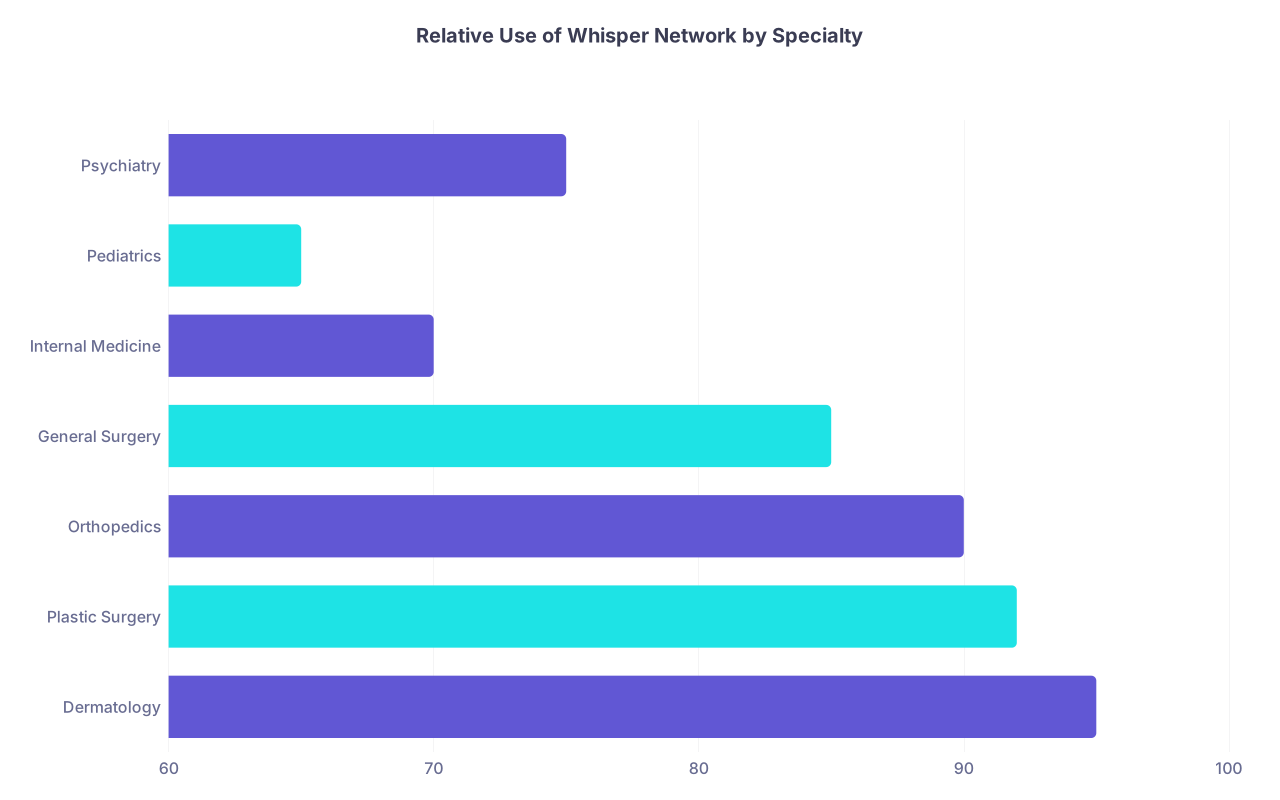
| Category | Value |
|---|---|
| Dermatology | 95 |
| Plastic Surgery | 92 |
| Orthopedics | 90 |
| General Surgery | 85 |
| Internal Medicine | 70 |
| Pediatrics | 65 |
| Psychiatry | 75 |
Derm, plastics, ortho, ENT, neurosurgery: Tiny worlds. Everyone knows everyone. A bad comment from one well-known PD can essentially poison an entire region for you.
General surgery and EM: Very word-of-mouth heavy. They care a lot about work ethic, team dynamics, and how you act at 2 a.m. They absolutely call each other.
Internal medicine: Larger field, more variation. But elite academic IM programs (think MGH, Hopkins, UCSF, Penn) absolutely talk to each other.
Pediatrics, family medicine, psych: Slightly more forgiving in some ways, but don’t delude yourself. A “toxic” or unprofessional student is still kryptonite. These fields also have tight subspecialty communities.
Bottom line: if your specialty has <1,000 spots nationally, assume the whisper network is not just real, it’s dense.
What Actually Triggers a Quiet Blacklist
Let me draw a rough diagram of how it plays out at many programs when your name comes up with a known red flag.

| Step | Description |
|---|---|
| Step 1 | Applicant file reviewed |
| Step 2 | Standard review & scoring |
| Step 3 | Do not interview / rank low |
| Step 4 | Internal discussion |
| Step 5 | Interview with caution |
| Step 6 | Rank with caution |
| Step 7 | Any red flag? |
| Step 8 | Trusted external input? |
| Step 9 | Faculty concerns? |
| Step 10 | Interview confirms concern? |
Most applicants imagine some fair, thorough, courtroom-level evaluation. That’s not how time-limited, busy PDs behave during selection season. Scene from a real selection meeting:
- Committee member: “This one from [Your School]. Any thoughts?”
- Faculty: “Heard they had professionalism issues. I wouldn’t push for them.”
- PD: “Alright, let’s move on.”
That’s it. Ten seconds. Not because they’re evil, but because they have 30 other maybe-problem-free applicants to look at.
Also: there are true blacklists. Not official. Not written. But there are names that get a near-universal “no” whenever they appear, because of one dramatic meltdown, ethics violation, or institutional incident that got talked about at conferences and PD meetings.
You’ll never see that list. But it exists.
How to Keep Your Name Out of the Whisper Network
You can’t fully control what people say about you. But you can control how much ammunition you hand them.
Here’s the unvarnished strategy:
Stop giving people “stories.”
The nurse you snapped at. The resident you rolled your eyes at. The attending you tried to debate aggressively during rounds as an M3. These are the stories people share. You never want to be the anecdote someone uses over drinks at a conference.If you have a real red flag, control the narrative early.
You cannot hide a leave of absence, a failed Step, or documented professionalism remediation. But you can do two things:- Own it clearly and maturely in your application and interviews.
- Get at least one high-credibility faculty member who knows the full story to be willing to vouch for your growth.
PDs are more forgiving if they see true insight + sustained change + a strong advocate.
Identify what your own institution whispers about you.
Hard truth: if you’ve had drama, someone at your school already labeled you. You need to know that label. Talk—carefully—to a trusted advisor or attending who likes you but is honest. Ask them, “Is there anything in my reputation that could hurt me with PDs?”Their hesitation before answering? That’s your answer.
Overperform on away rotations and sub-Is.
For some of you with a local red flag, your only shot is to build a counter-narrative at another institution with clean credibility. That means:- Be early.
- Be humble.
- Be relentlessly helpful.
- Make senior residents want to work with you again.
Then you ask for letters from those people. If an external letter is strong enough, it can partially drown out your home institution’s skepticism. Not erase it. But reduce it.
Do not ever lie or “soft-fabricate” in your application.
PDs talk. Research mentors talk. If you claim first authorship on something you barely touched, or inflate your role in a project, you’re betting your whole career that no one compares notes. That’s a bad bet.
If the Damage Is Already Done
Some of you reading this already know: you have a reputation problem. A real one.
Here’s what faculty actually advise behind closed doors in those cases, though they rarely say it so bluntly to the student’s face:
- “They should apply more broadly and be realistic.”
- “They may need a transitional year / prelim year to prove themselves.”
- “Another cycle after more time and distance might help.”
- “Honestly, they might be better off in a less competitive specialty.”
Not all red flags are compatible with all specialties. A major professionalism issue plus a desire to match plastics at a top 10? Faculty won’t say it out loud, but privately they think: “That’s not happening.”
Your moves if you’re in this category:
- Secure brutally honest mentorship. Not someone who “believes in you.” Someone who will tell you where you actually stand and where you still have a shot.
- Apply strategically, not aspirationally. You can’t outrun the whisper network to every program, but you might out-apply it to enough places willing to take a chance.
- If needed, consider a bridge: prelim year, research year with flawless behavior, or even recalibrating specialty.
Programs do sometimes take on “rehab projects.” But those are rare and usually require one thing: a respected insider promising, “Let me take them. I’ll put my name on them.”
You need to become the kind of person someone is willing to stick their neck out for. That takes time and boring, consistent, non-dramatic excellence.