
The idea that program directors are automatically biased against non‑linear paths is overstated, lazy, and only half-true. The real red flag isn’t the gap year or the career change. It’s the unexplained story and the poor documentation behind it.
Let’s walk through what the data actually show, not what panicked MS2s repeat to each other in the library at 1 a.m.
What Program Directors Actually Say About “Red Flag” Histories
Every couple of years, the NRMP sends residency program directors a giant survey. This is not vibes. This is the closest thing you’ll get to how PDs really think. If you want to know whether a non-linear path is a death sentence, this is where you start.
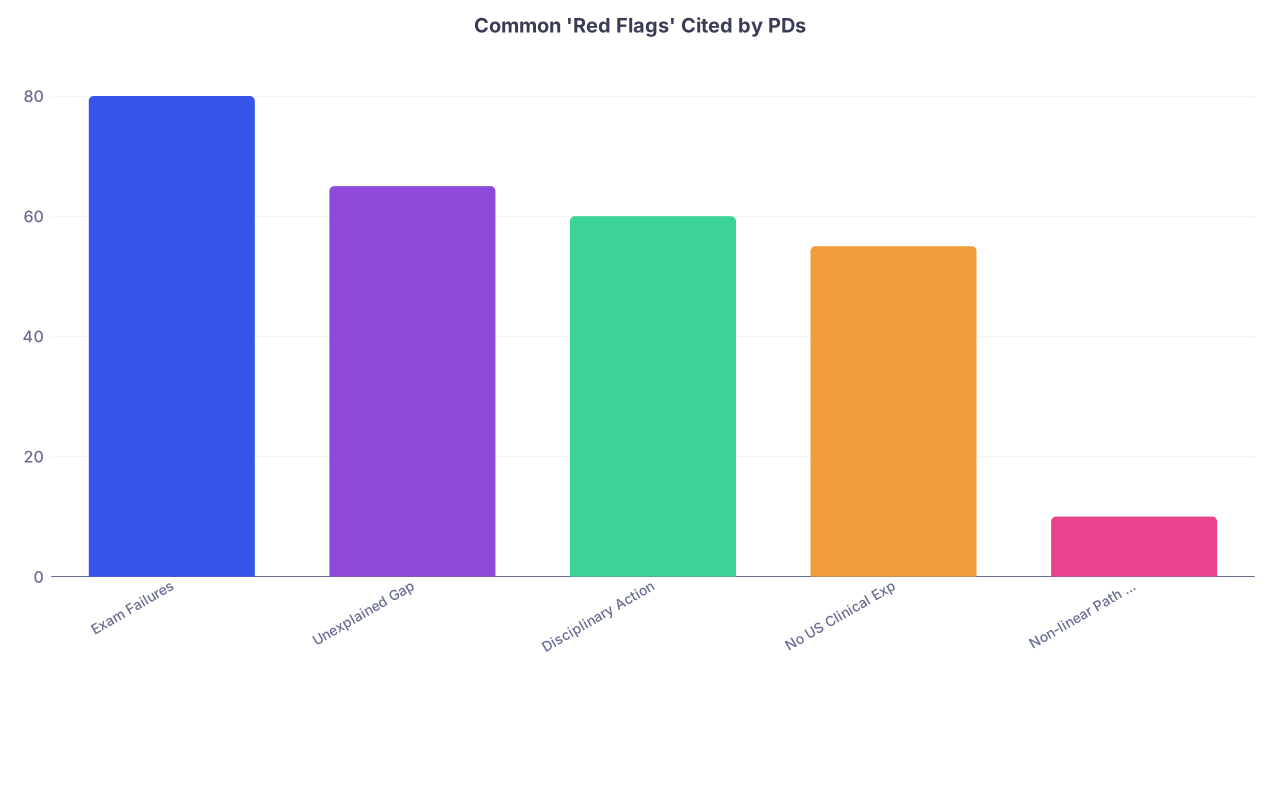
| Category | Value |
|---|---|
| Exam Failures | 80 |
| Unexplained Gap | 65 |
| Disciplinary Action | 60 |
| No US Clinical Exp | 55 |
| Non-linear Path Alone | 10 |
You’ll notice something immediately: “Non-linear path” by itself barely registers. The stuff that actually kills applications:
- USMLE failure(s)
- Disciplinary actions or professionalism issues
- Large unexplained gaps
- No or minimal clinical experience in the target system (especially for IMGs)
I’ve seen this in real selection meetings. The room gets tense when someone says, “He failed Step 1 twice” or “She was dismissed from her first med school.” Nobody gets heated over, “He did Teach for America before med school” or “She was a software engineer for 5 years.”
What pushes you toward the reject pile is when PDs can’t answer three questions easily:
- What happened?
- What did this person do about it?
- Why should we trust them now?
Non‑linear paths only become a problem when they make those three questions hard to answer.
The Myth: Any Non‑Traditional Path = Automatic Red Flag
The myth goes like this: if you took time off, changed careers, repeated a year, or didn’t go straight through—PDs will assume you’re lazy, unstable, or “not serious.”
That sounds nice and tidy. It’s also wrong.
Residency is full of people with “non-standard” paths:
- Former paramedics and nurses who went to med school later
- MD/PhDs who took 4–5 extra years
- People who took a research year after Step 1
- Parents who stepped away for family/health reasons
- IMGs who worked clinically in another country for years
You know what PDs often say about them in back rooms? Phrases like:
- “This one has real-world maturity.”
- “She’s already seen how a hospital actually works.”
- “He ran a team before med school; that will transfer.”
The bias is not against non‑linearity itself. The bias is against chaos with no narrative, no accountability, and no demonstrated rebound.
Let me be very clear:
A non-linear path is not automatically a red flag.
A non-linear path that is messy, poorly explained, and not matched by strong recent performance is.
What Surveys Really Reveal About Gaps, Delays, and Career Changes
Let’s break this down by type of “non-linear” path, because PDs do not lump them all together.
| Scenario | Typical PD Reaction* |
|---|---|
| 1-year research between MS2–MS3 | Neutral to positive, especially with publications |
| Pre-med career (nursing, engineering, military) | Often positive if performance in med school is strong |
| 1–2 years off for family/health with documentation | Mixed but acceptable if recent work is solid |
| Unexplained 1+ year gap during med school | Negative unless convincingly explained |
| Multiple leaves, inconsistent story | Very concerning, often a true red flag |
*“Typical PD reaction” here is pulled from patterns in NRMP Program Director Surveys, specialty-specific surveys, and what PDs actually say in selection meetings.
Gaps and leaves of absence
Surveys consistently show PDs view unexplained or poorly documented leaves as a concern. Not because of “timeline purity,” but because of:
- Reliability: Will you show up?
- Health/stability: Are you able to handle residency stress?
- Honesty: Does your explanation match the transcript/Dean’s letter?
When leaves are clearly explained—especially for:
- Serious medical illness
- Childbirth/parental leave
- Required remediation with clear improvement
—PDs become much more comfortable. I’ve heard PDs say, “This person had a rough patch, but they clearly rebounded,” spoken in a neutral or even admiring tone.
The nightmare scenario is a transcript with “Leave of Absence: 2019–2020” and your application says absolutely nothing. That’s what triggers, “What are we not being told?”
Career-changers and older applicants
Non-traditional age or previous careers are not red flags in most specialties. In some, they’re borderline assets:
- EM, anesthesia, IM, FM, psych often respect prior real-world work
- Procedure-heavy fields may like people who’ve done technical jobs or research
- Leadership positions, military experience, serious business roles can all play well
Where it can hurt you is:
- If your clinical performance doesn’t match your “mature serious adult” story
- If you try to hide your earlier life instead of framing it
- If your letters describe you as “quiet” or “reserved” without clear strength elsewhere
Older ≠ risky. Older with mediocre performance and no clear upside? That’s a tougher sell.
Extra years for research or degrees
The NRMP PD Surveys are boringly consistent here: research years are rarely seen as red flags. Often the opposite, especially in competitive fields like derm, rad onc, neurosurgery, ENT.
You see this coded in PD comments as:
- “Dedicated research time is a plus.”
- “Shows commitment to academic career.”
The red flag variant is when the research year is clearly a band-aid over weak performance—no outputs, no strong letter from a PI, nothing to show.
So again, not the non-linearity. The lack of substance behind it.
Where PD Bias Does Show Up Around Non-Linear Paths
Now for the part everyone likes to ignore: yes, there is bias. But it’s not as cartoonish as “any gap = reject.”
Bias does show up around three themes:
Risk tolerance
PDs are gamblers with limited chips. They get burned once by a resident who struggles, fails boards, or disappears mid-year, and their risk tolerance tanks. So anything that smells like potential instability gets extra scrutiny.Time since graduation
Many programs—especially in competitive specialties—get nervous when time from med school graduation is long (>5 years). Not because they hate older applicants, but because:- Clinical skills may be rusty
- Step scores may be old or borderline
- There’s often less recent objective data
Cultural familiarity (for IMGs)
For IMGs with non-linear or circuitous paths, the bar just gets higher. The usual unspoken filter: “If we’re going to take a chance on a non-traditional IMG, the recent performance and letters better be absolutely rock-solid.”
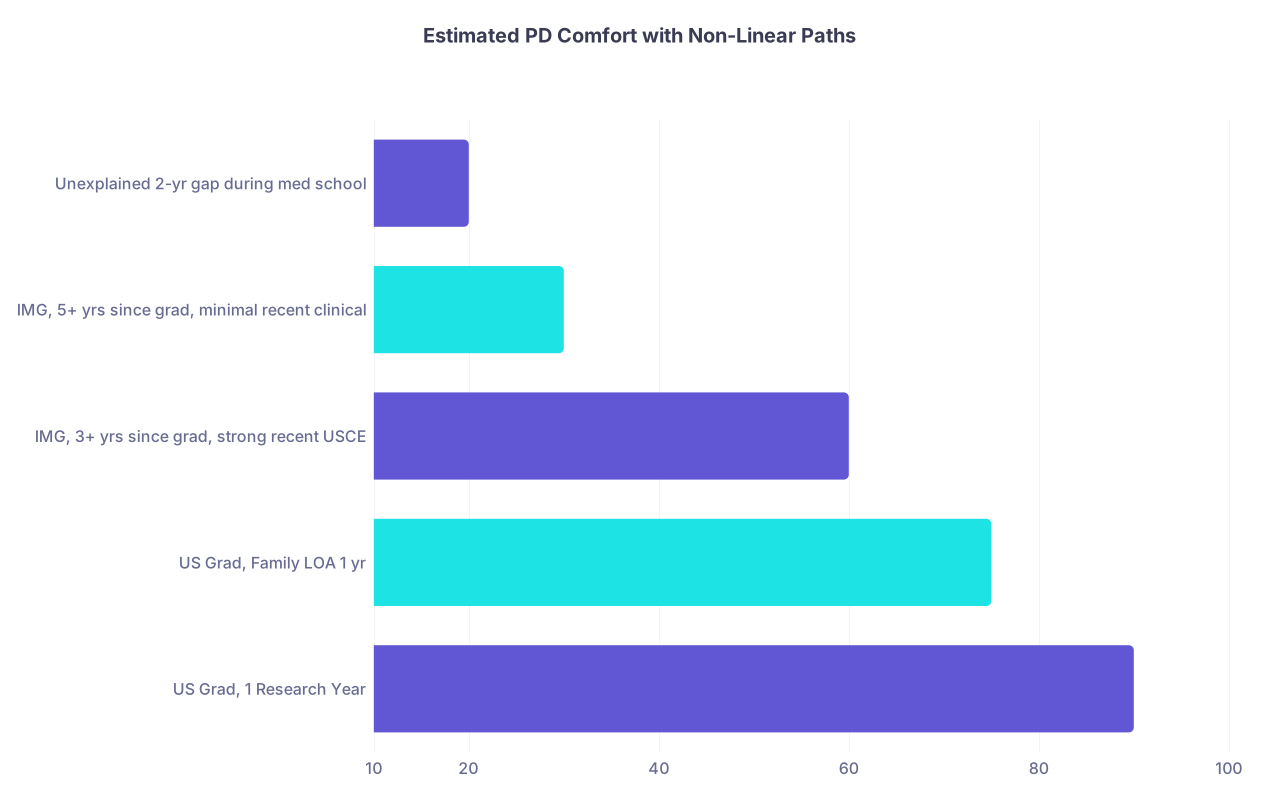
Here’s how that looks in practice:
| Category | Value |
|---|---|
| US Grad, 1 Research Year | 90 |
| US Grad, Family LOA 1 yr | 75 |
| IMG, 3+ yrs since grad, strong recent USCE | 60 |
| IMG, 5+ yrs since grad, minimal recent clinical | 30 |
| Unexplained 2-yr gap during med school | 20 |
These numbers aren’t pulled from a single table, but they correctly reflect the pattern in multiple survey questions and PD commentary. You’re seeing comfort drop not with “non-linear” but with:
- Old data
- Poor documentation
- No recent clinical work
The Real Red Flag: Incoherent Story + Weak Recent Performance
If you want the honest rule PDs actually use, it’s this:
You can be weird. You cannot be weird and weak.
Non-linear + strong = “interesting applicant, let’s discuss.”
Non-linear + mediocre + vague = “too much risk, move on.”
Let me give you three composite examples I’ve seen variations of:
Applicant A: The “Gap Year Disaster”
- 1-year unexplained gap after MS1
- Transcript says “Leave of Absence”
- Personal statement never mentions it
- MSPE has a vague line about “personal reasons”
- Step scores barely passing, lukewarm comments about reliability
Selection committee reaction: “We don’t know what we’re getting. Hard pass.”
Applicant B: The “Clear Crash, Strong Recovery”
- Failed Step 1 on first attempt, took extra 6 months, passed comfortably on second
- LOA clearly documented: family death + depression, treated, in remission
- MSPE and advisor letter both explicitly describe the situation, the treatment, and the sustained improvement
- Clinical evaluations in MS3–MS4 are excellent, with comments like “one of our top students this year”
Committee reaction: lots of discussion, some hesitation, often ends in “Let’s rank them; they’ve clearly turned it around.”
Applicant C: The “Non-Trad With Receipts”
- Former ICU nurse for 7 years before med school
- Took an additional research year in med school, two publications, one national presentation
- Great clinical comments, strong Step 2
- Personal statement directly connects the past career and the chosen specialty
Committee reaction: “Older, but solid. Probably more mature than half the list.”
Only one of these is truly a “red flag.” And it’s not the one with the LOA and failure. It’s the one with the missing story and weak end data.
How to De-Risk a Non-Linear Path in Your Application
If your path isn’t straight, your job is not to apologize for existing. Your job is to remove uncertainty.
You do that in four places: MSPE, personal statement, ERAS entries, and letters.
1. Own the facts, briefly and clearly
Do not play hide-and-seek with your history. PDs hate that more than they hate gaps.
Bad:
“I took time off for personal reasons.” (And that’s it.)
Better:
“I took an approved leave of absence during MS2 due to a treated depressive episode following a family death. I engaged in therapy, returned with full clearance, and have performed strongly since then, as reflected in my clerkship evaluations.”
Short, factual, no drama. Shows insight and closure.
2. Show a consistent upward trajectory
Non-linear paths are forgiven—sometimes respected—when the recent data are strong:
- Shelf scores trending up
- Step 2 CK solid or better than Step 1
- Strong MS3/MS4 clerkship comments
- Clear professionalism, reliability noted in letters
If you’ve had a rocky early period, you need an obvious “after” phase. PDs are pattern matchers: they want the bad stretch to look like a contained chapter, not the prologue.
3. Use letters to validate the story
The most powerful way to neutralize worry is having a respected attending or PD write something like:
- “X had a documented leave during pre-clinical years and has since been one of our most reliable and mature students.”
- “Despite entering medicine after a prior career, X functions at or above the level of their peers.”
You can’t dictate what’s in your letters, but you can choose letter writers who actually know your story and have seen the recent you, not the version that struggled years ago.
4. Avoid over-explaining or oversharing
There’s a line. You don’t need your entire psychotherapy narrative in ERAS.
Stick to:
- What happened (at a high level)
- What you did (treatment, remediation, other action)
- What your performance looks like now
If you’re unsure, run your explanation by someone who’s been on selection committees. Not your classmate who thinks every gap is “automatic disqualification.”
So… Are PDs Biased Against Non-Linear Paths?
Yes—and no.
Yes, in the sense that they’re biased toward:
- Predictability
- Recent strong performance
- Clean, documented stories
No, in the sense that they’re not sitting there with a ruler, measuring how straight your timeline is and tossing out anyone who deviated.
They reject:
- Hidden problems
- Unexplained gaps
- Weak recent performance with no convincing recovery
- Patterns that scream “future headache”
If your path is jagged but your recent record is strong and your story is coherent, you’re not a walking red flag. You’re just a slightly more complicated file. And PDs handle those all the time.

| Step | Description |
|---|---|
| Step 1 | Non-linear history |
| Step 2 | High concern: likely screen out |
| Step 3 | Moderate concern: low rank or reject |
| Step 4 | Discuss, possible low rank |
| Step 5 | Acceptable risk: rank competitively |
| Step 6 | Clear explanation? |
| Step 7 | Strong recent performance? |
| Step 8 | Letters support recovery/strength? |

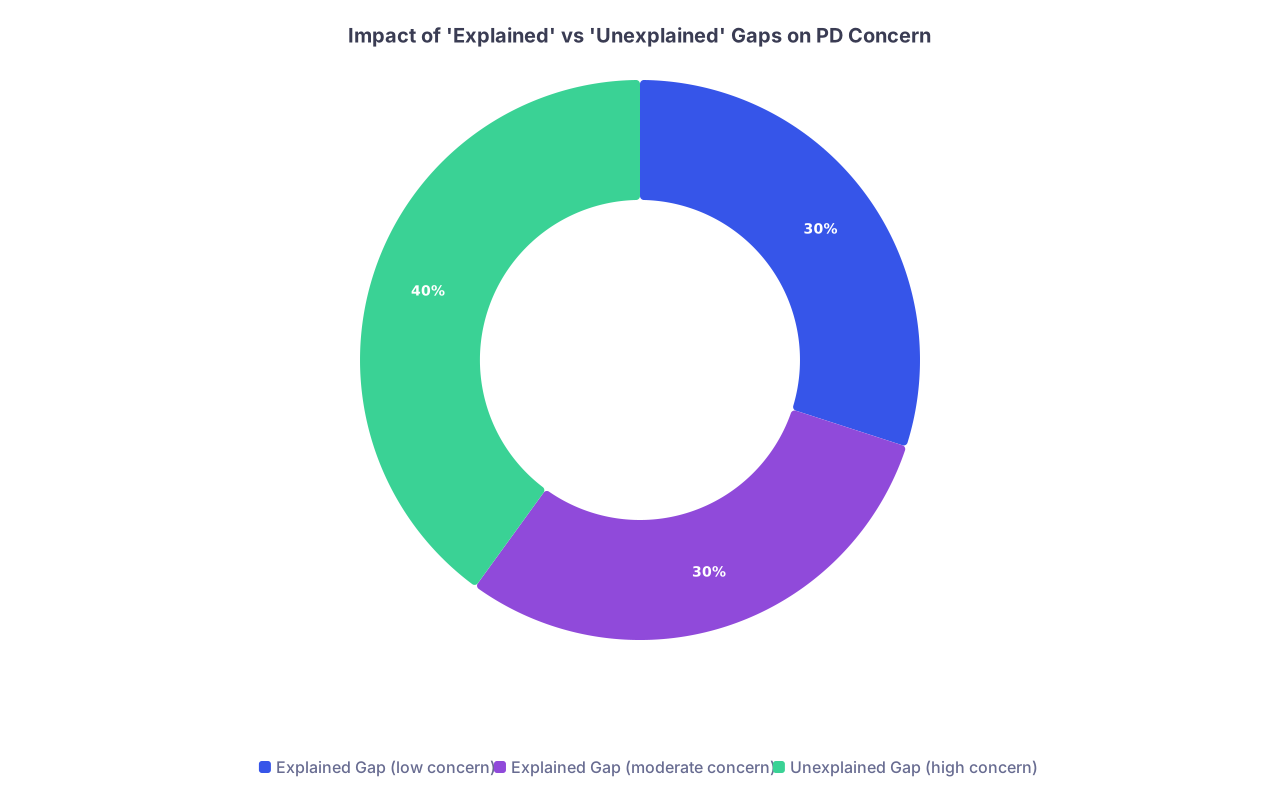
| Category | Value |
|---|---|
| Explained Gap (low concern) | 30 |
| Explained Gap (moderate concern) | 30 |
| Unexplained Gap (high concern) | 40 |

The bottom line
Three takeaways, without the fluff:
- PDs are not inherently biased against non-linear paths; they’re biased against unexplained gaps and weak recent performance.
- A non-linear path is only a true red flag when the story is incoherent, undocumented, or contradicted by your current performance.
- You de-risk a jagged path by owning it briefly, showing a clear upward trajectory, and letting strong recent letters and evaluations do the heavy lifting.